Business representatives and academics from 21 APEC economies gathered in Shenzhen, south China's Guangdong Province, on Saturday to explore new avenues for cooperation at the fourth meeting of the APEC Business Advisory Council (ABAC) in 2026.
More than 60 business representatives and academic guests attended, bringing the total number of participants to over 200.
At the opening plenary, representatives reviewed and approved the report of the council's third meeting this year. The session also discussed the current economic situation, preparations for the APEC CEO Summit, and the findings of the Pacific Economic Cooperation Council's State of the Region survey.
Founded in November 1995, ABAC is the only non-governmental body with an official advisory role in the APEC Economic Leaders' Meeting, engaging in a formal dialogue and submitting annual policy recommendation reports to APEC leaders.
Attendees hold high hopes for smoother trade and greater cooperation under the APEC framework.
Agustin Garcia Rechy, alternate member for Mexico of ABAC, said in an interview with China Media Group that Mexico attaches great importance to business ties with China's Guangdong-Hong Kong-Macao Greater Bay Area, including Shenzhen, and looks forward to further cooperation with China in areas such as innovation and digital connectivity.
"In Mexico, the cooperation that we are looking for and also that we have right now is with some important companies from Shenzhen, for example. all of them are doing a very good job in Mexico and developing very well," he said.
"It is about logistics, it is about sustainability, it is about free trade zone, it is about productivity, efficiency. We want [trade] to be more efficient, more predictive," said Ivan Marambio, president of Frutas de Chile.
"I focus on sustainability, areas like AI and making sure that we have a way of governing AI across the region, and also the importance of making sure that decisions that we make at APEC are also taking into account smaller economies [that aren't] always represented around the table here, but are impacted by the decisions that we make," said Brett O'Riley, a New Zealand member of ABAC.

APEC business leaders seek closer cooperation at Shenzhen meeting
The 2026 World Chinese Language Conference is underway in Beijing from Friday to Sunday, with representatives from more than 160 countries and regions discussing the future of international Chinese language education.
Young people learning Chinese from around the world have also gathered to share their experiences.
Interest in learning Chinese continues to grow worldwide, with 210 million people outside China learning or using the language. For many, curiosity about China is the beginning, and learning Chinese brings them closer to the country.
At this year's World Chinese Language Conference, young people from around the world performed an original musical in Chinese, sharing how the language has shaped their lives.
"I'm very interested in Chinese philosophy. When I first heard about Confucius's ideas, I began to fall in love with this culture," said Mattia Marconi, an Italian student from Beijing Foreign Studies University.
For other learners, the language is a way to deepen their understanding of the country, making the whole process of learning about China easier.
"The reason that I enjoy learning Chinese is because I enjoy learning about China. Learning about China through Chinese makes the whole process easier," said Hernan Perez Mckay, an Irish student from Peking University.
Beyond culture and understanding, Chinese has also become a tool for building a new life and discovering new possibilities.
"Chinese has been not only a language for me, but a tool to start a new life here. Because here I discovered myself totally, you know, a new adult with new hobbies, new interests and new ambitions," said Eliz Stepanyan, an Armenian student from Beijing International Studies University.
That interest can also lead to new opportunities. Today, 92 countries have included Chinese in their national education systems. The language connects people, while also opening access to education, professional skills and new opportunities.
"I saw the opportunities and I saw how China was cooperating with different countries across the world. That's when I thought, 'If I learned Chinese, I could have more opportunities'," said Echoni Moses Sterling, a Ugandan student from Beijing Institute of Technology.
Some learners are already looking ahead, hoping to use their language skills to build bridges between China and their home regions.
"I'm hoping sort of to be a bridge between China and Europe. And I hope to do that through sinology and through all the projects, to be able to connect these two peoples. That would be my goal, my mission," said Benjamin Herman, a Belgian student from Peking University.
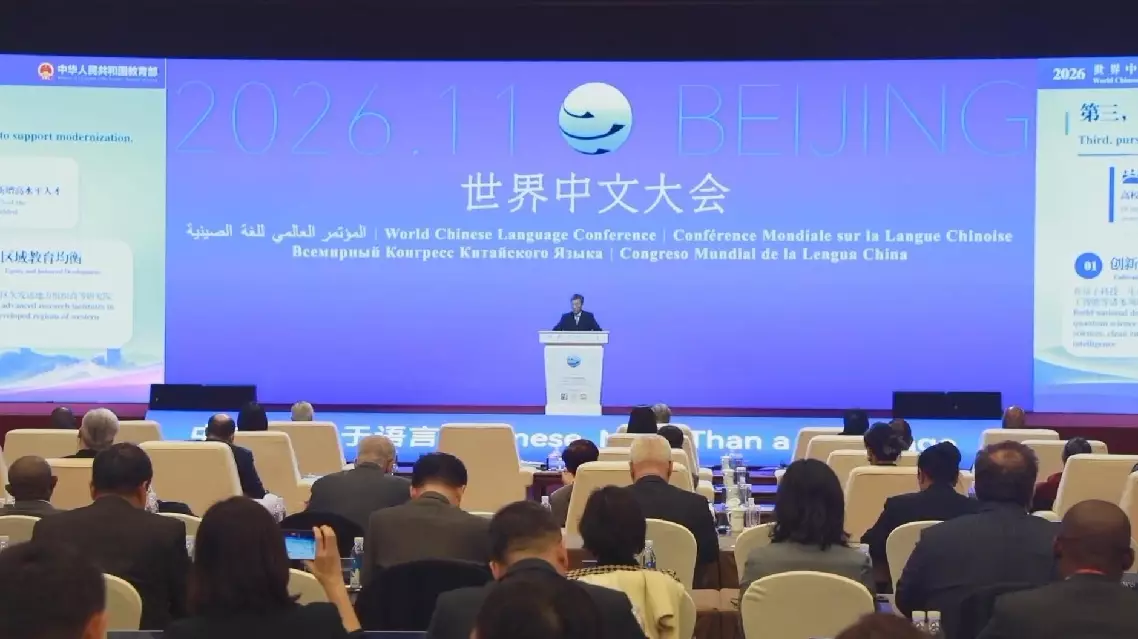
Young foreign learners see Chinese as more than language