Speech by FS at Hong Kong Global Maritime Trade Summit
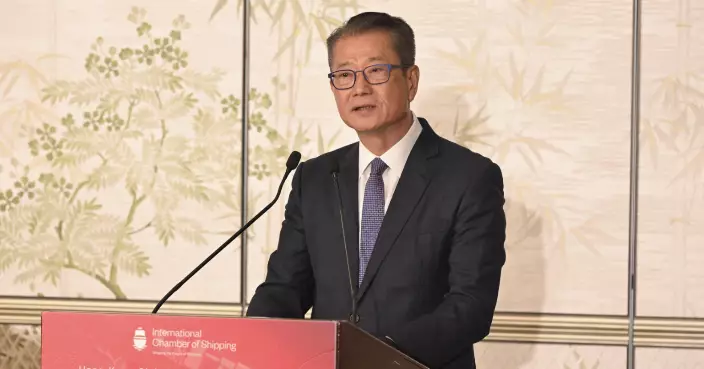
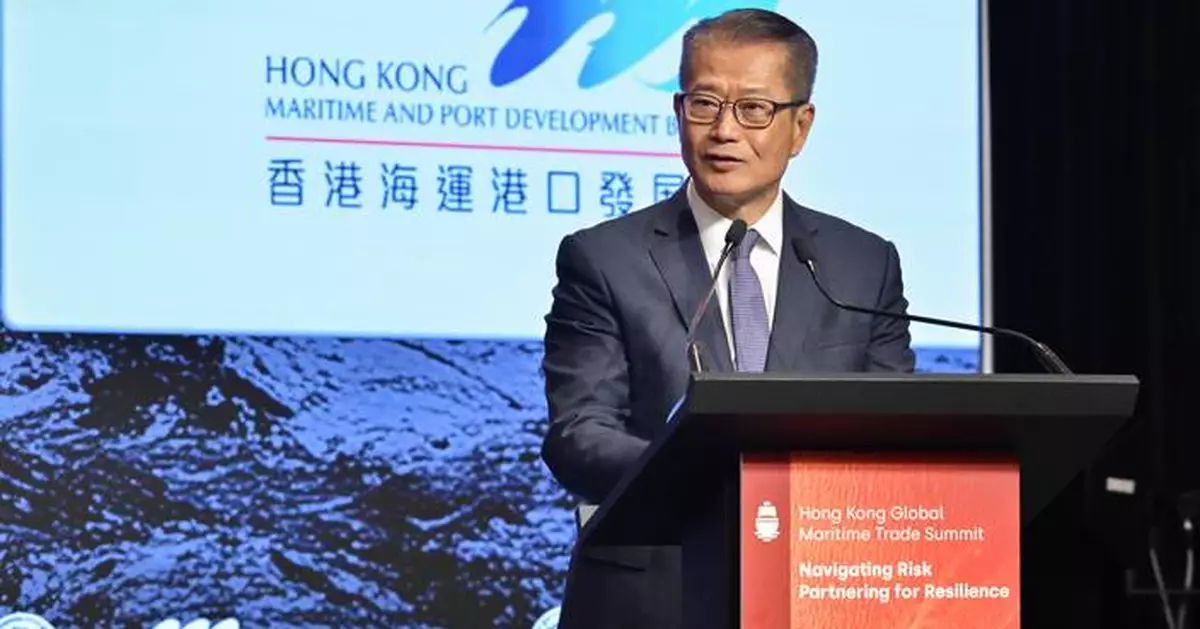
Following is the speech by the Financial Secretary, Mr Paul Chan, at the Hong Kong Global Maritime Trade Summit today (November 16):
Mr John Denholm (Chairman of the International Chamber of Shipping (ICS)), Richard (Chairman of the Hong Kong Shipowners Association, Mr Richard Hext), Excellencies, distinguished guests, ladies and gentlemen,
Good morning, and welcome to the third Hong Kong Global Maritime Trade Summit. I thank the International Chamber of Shipping and the Hong Kong Shipowners Association for bringing the industry together, as Hong Kong Maritime Week reaches its 10th edition.
We meet towards the end of a year in which world trade has proved more resilient than many expected. In March, the World Trade Organization (WTO) forecast that merchandise trade would grow by less than 2 per cent in 2026. It now expects close to 4 per cent.
Yet this is not a return to the past. Three structural trends are changing where cargo moves, what fuels the ships that carry it, and how it is managed. Allow me to take each in turn, and then set out Hong Kong's response.
Three trends
The first is the regionalisation of trade. In the first half of this year, container traffic within Asia grew by nearly 9 per cent, to more than 26 million TEUs (twenty-foot equivalent unit). About two thirds of the trade between the Chinese Mainland and ASEAN (Association of Southeast Asian Nations) now consists of intermediate goods. Hong Kong sees this at first hand: ASEAN's share of our merchandise trade has risen from under 13 per cent in 2020 to almost 16 per cent this year. Supply chains are being extended, across multiple jurisdictions, so cargo calls at more ports and the reliability of each matters more.
The second is the green transition, in which the fleet is moving ahead of the fuel supply. Almost half of the tonnage on order can run on alternative fuels, yet methanol bunkering is available at only 25 ports. Owners are ordering ships that will still be trading in 2050 without knowing where clean fuel will be available, or at what price. Fuel producers, in turn, hesitate to invest until demand is assured. The pace of the transition will therefore be decided at the port, where supply and demand meet.
The third is artificial intelligence, which is changing both the cargo and the way it is handled. AI-related goods such as semiconductors and servers accounted for nearly half of the growth in world merchandise trade in the first half of this year. In port operations, the efficiency gain of AI has progressed more slowly, because the record of a single consignment is divided among shippers, forwarders, carriers, terminals, customs and banks. In shipping, the constraint on AI is less the algorithm than the data.
Together, these trends are changing what a port is for. In 1956, a converted tanker carried 58 containers from Newark to Houston, on the voyage that began the container age. The container did not make ships move faster. It changed what a port had to be, and the ports that adapted became the hubs of a new era. Hong Kong was among them. Now I believe we are at a similar moment. Scale still counts, but a port will increasingly be chosen for the reliability of its rules, the time it saves, and the support behind the ship.
What will not change
Our response begins with what will not change: the singular advantages under the "one country, two systems" framework. Hong Kong continues to be a free port and a separate customs territory, with its own shipping registry and the bilingual common law system. President Xi Jinping has made clear that "one country, two systems" is here for the long run. That continuity matters in shipping, where a vessel trades for decades and the law behind it must be just as durable.
Hong Kong will also remain an open port, and continues to uphold free trade and zero tariffs. As supply chains lengthen, each additional border adds cost and delay, and a port open to cargo from every market on equal terms becomes more valuable.
Nor will there be any compromise on efficiency. Last year, an ocean-going container ship spent on average about one day in Hong Kong, against two days across the world's 20 largest container ports. Hence our reputation as a "catch-up port", where a vessel running late can recover time.
From volume to value
What will change is where Hong Kong looks for growth. A container crossing the quay earns only a handling fee, whereas the voyage around it has to be financed, insured, managed, fuelled and sometimes arbitrated. Our strategy is to move from volume to value by developing these high value-added maritime services.
Commodity trading is a case in point. Commodities make up more than half of the cargo carried by sea, and the traders who charter the vessels, insure the cargoes and arrange the finance are among the principal users of maritime services. The Chinese Mainland receives a quarter of the world's seaborne cargo, and Hong Kong, as the country's international financial centre, is well placed to bring trading, finance and shipping together. A Bill before the Legislative Council proposes a half standard rate profits tax for physical commodity trading to promote maritime services in Hong Kong.
Marine insurance is another. Asia builds nine-tenths of the world's new tonnage and owns more than half of the fleet, yet about half of hull premiums are still written in Europe. More of that risk should be underwritten closer to the owners who bear it. Hong Kong now has its first locally headquartered mutual and a pool for specialty marine risks. For owners, that means more capacity and more choice.
The same logic applies to green fuel. The Mainland has about 60 per cent of the world's operating green methanol capacity. Our model is for fuel to be produced and stored in South China, bunkered and traded in Hong Kong, and supplied to the world's ships. Trading matters as much as bunkering, because a fuel that can be priced and hedged is easier for producers to finance.
The ship registry must also keep pace with the way ships are financed. As ship leasing grows, the company that owns a ship is often not the one that operates it, and the two may wish to use different registries. We will therefore introduce legislation this year to put in place dual registration arrangements, a change the industry has long sought. The owner's registration will be suspended to allow the ship flying under the charterer's flag.
The Port Community System
On technology and AI, Hong Kong is tackling the issue at its core constraint: data. Close to 10 000 enterprises have registered with the Port Community System (PCS) since its rollout in January. Some have begun to secure trade finance on the strength of the PCS's cargo-flow data.
Under Project CargoX, led by the Hong Kong Monetary Authority, 21 banks are testing a faster way to verify trade transactions. Instead of relying on paper documents, they use data shared on a common digital platform, with the data owner's consent.
So far, some 10 trade finance applications have been approved, involving more than $180 million. We are also connecting CargoX with ports in the Yangtze River Delta on the Chinese Mainland, as well as those in Southeast Asia.
Further ahead, the ship itself will change with AI. The IMO (International Maritime Organization)'s first code for autonomous ships took effect in July on a voluntary basis, and Hong Kong is reviewing its maritime law with a view to allowing trials in our waters.
Partnering for resilience
Ladies and gentlemen, none of the changes and challenges we face can be managed by one port or one economy alone, so Hong Kong hopes to work with its partners in three areas.
First, we should keep our rules aligned. WTO economists estimate that a world divided into rival blocs would lose about 5 per cent of its output, and that smaller and poorer economies would lose over three times as much as wealthy ones. In shipping, the case is even more immediate, because a ship trades between jurisdictions for 25 years or more. We hope economies will resist protectionist measures, and will set their standards and settle their differences within global frameworks, above all at the International Maritime Organization, whose members will meet again in London in two weeks. An owner deciding which ship to order needs one answer, not several.
An IMO-backed study found that a container ship that knows in good time when its berth will be ready can save about 14 per cent of its fuel on a voyage, and that begins with ports and ships exchanging a few timestamps in a common format. Partner ports can go further. They can recognise each other's standards for new fuels, so that a ship getting supplied at one end of a route can be supplied to the same standard at the other. They can alert each other early when a route is disrupted, and exchange knowledge as well as data.
The last, and the most important, is to invest in people. The world fleet is already short of some 39 000 officers and will need about 114 000 more by 2030. Technology can be bought, but competence has to be trained. In April, Hong Kong and the ICS trained instructors in alternative fuels. Yesterday, the Hong Kong Maritime and Port Development Board and the ICS Academy signed a Memorandum of Understanding to train a multi-skilled maritime workforce for Hong Kong and beyond with global standards. And we now plan to establish a maritime academy with leading institutions and shipping companies, and will welcome partners from the region and beyond.
Closing
Ladies and gentlemen, this year has shown how much change trade can absorb. To shape the changes ahead is a task for partnership. Hong Kong began as a harbour. What it offers today is what stands behind the harbour: rules that endure, time that is saved, and services and people that add value to every voyage. We look forward to building the next chapter of maritime trade with partners around the world. I wish you all a rewarding Summit and an enjoyable stay in Hong Kong. Thank you very much.
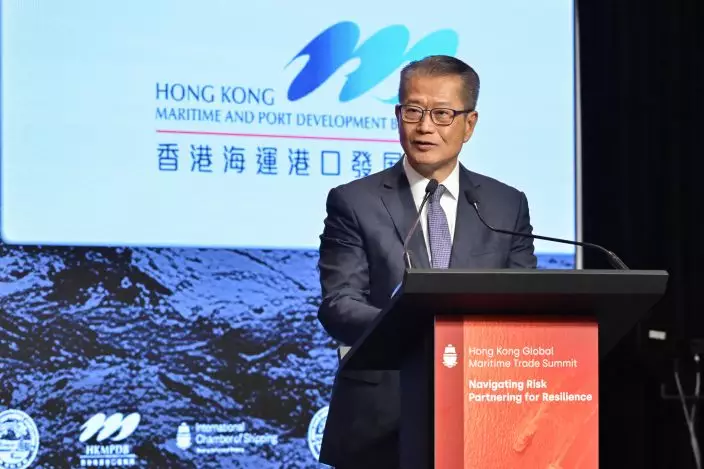
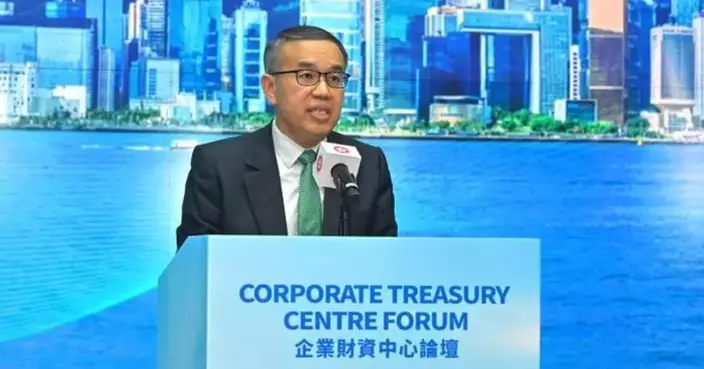
The Financial Secretary, Mr Paul Chan, speaks at the Hong Kong Global Maritime Trade Summit today (November 16). Source: HKSAR Government Press Releases