SAN JOSÉ DEL CABO, Mexico, Nov. 16, 2026 /PRNewswire/ -- Segway Powersports claimed first and second place in Class 2 on its SCORE Baja 1000 debut, with both race-prepared Super Villain UTVs reaching the finish. The result marks a milestone for Segway Powersports, turning its first appearance at the event into a class victory and a double podium.
The No. 2097 Super Villain, with Jacob Zuccone among its drivers, took the Class 2 win, followed by the No. 2095 entry, with Justin He among its drivers, in second. Across desert, mountain and coastal terrain, the race demanded sustained performance from the vehicles and close coordination between drivers, navigators and support crews.
For Segway Factory Racing, bringing both entries home at the front of their class reflects the preparation behind the program. Over an extended race distance, success depended on managing pace, responding to changing conditions and keeping each vehicle running through the demands of endurance competition. Baja put the Super Villain's performance to a sustained test, where durability and consistency mattered as much as speed.
The result follows a season of racing and development for the Super Villain, including appearances at King of the Hammers, the Mint 400, the Silver State 300 and Vegas to Reno. Those events provided opportunities to evaluate the race vehicles in different environments and refine preparations for Baja. The Class 2 one-two finish adds an endurance racing milestone to the sport side-by-side's growing competition record and strengthens Segway Powersports' credentials on the international off-road stage.
The race also provides further data and practical experience for reviewing vehicle durability, system performance and team operations under prolonged demands. For Segway Powersports, entering Baja reflects a willingness to put its engineering to the test, learn through competition and keep improving. That approach gives the brand's FEAR NO PLACE spirit a practical expression on the racecourse.
Segway Powersports will build on the experience through continued engineering, testing and competition. Its first Baja finish gives the team both a result to celebrate and lessons to carry into the continued development of the Super Villain and its racing program.
About Segway Powersports
Segway is a global leader in micro-mobility, powersports, and consumer robotics, known for its innovation and user-focused products. Segway Powersports focuses specifically on the design and manufacturing of next-generation powersports vehicles, including all-terrain vehicles (ATVs) and side-by-side vehicles (SxS) for both utility and sport applications. As a high-tech enterprise, Segway Powersports integrates a superior supply chain with its own manufacturing capabilities, managing the full lifecycle of its products – from R&D and production to sales and after-sales service.
For more information, please visit https://powersports.segway.com
** This press release is distributed by PR Newswire through automated distribution system, for which the client assumes full responsibility. **

Segway Powersports Secures Class 2 One-Two Finish on SCORE Baja 1000 Debut
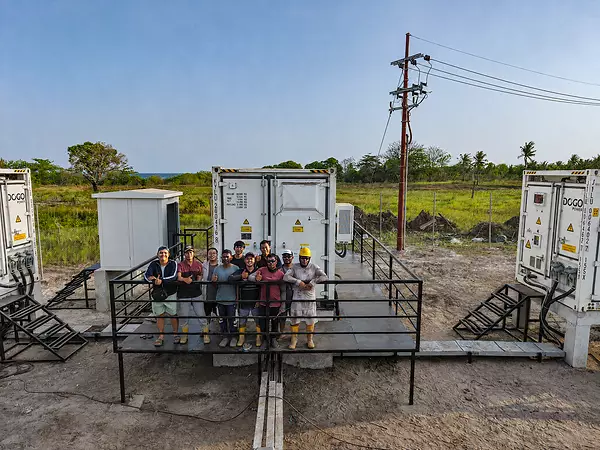
JAKARTA, Indonesia, Nov. 16, 2026 /PRNewswire/ -- DoGo Power's Smart grid-forming energy storage system (ESS) and energy management system (EMS) have officially gone live on Pagerungan Kecil Island (P Island), a remote isle off southern Indonesia. The 1MW PV + 2MW/4MWh ESS project brings stable, reliable power to the off-grid community, creating a replicable blueprint for island microgrid deployment across Southeast Asia.
Years of Diesel Reliance and Rationed Power
Cut off from the mainland grid with no subsea cable connection, P Island has long depended on diesel generators for electricity. Home to more than 2,000 fishing households, the island previously served just a quarter of its residents with power, limited to 3–6 hours a day — mostly during daylight hours — with frequent unplanned outages.
At roughly 35 US cents per kilowatt-hour, diesel power was prohibitively expensive, eating up 25% to 40% of many families' incomes. The chronic power shortage crippled local fishery cold chains and telecom services, and made even basic daily needs — nighttime study, laundry, clinic lighting — a constant struggle.
Grid-Forming Technology Anchors Standalone Microgrid
Engineered for the weak-grid, off-grid conditions of P Island, DoGo's smart grid-forming ESS, built on its proprietary 4S platform, provides active voltage and frequency regulation to the microgrid with no reliance on external grid support. The solar-plus-storage setup delivers over 20 hours of continuous power daily, covering both residential demand and public service loads.
With no dedicated deep-water port on the island, all equipment — energy storage units, lifting gear and trucks — had to be shipped from neighboring islands and unloaded via temporary pontoons at low tide before being hauled to the project site. DoGo's 10-foot storage container, weighing in at under 22 tonnes, was purpose-built to stay within the island's strict hoisting capacity limits. DoGo supplied the full suite of core equipment, including the storage system and EMS, and led end-to-end solution design to ensure robust performance in harsh off-grid conditions.
Tangible Change for 2,000 Island Households
For local families, technical specifications matter far less than the life-altering difference: nights no longer end when the power cuts out.
Stable power is reshaping daily life on the island. "We waited decades for reliable electricity," said village chief Halilurahman. "We used to take turns using power for just one or two hours each night, watching every minute. When we came back from fishing, our biggest fear was losing our catch to spoilage. Now with solar and storage, we have power to spare. We know life will keep getting better."
Residents have shifted from rigid, scheduled power use to flexible, on-demand consumption, with many households now purchasing home appliances such as washing machines. Public services — healthcare clinics, schools, telecom networks and clean water systems — and local industries including fishery processing and cold storage all now have uninterrupted power access.
Project data shows electricity costs for the island's 2,000-plus households have fallen by roughly 81%. The energy storage system achieves 7,300 equivalent utilization hours annually, and is projected to deliver more than 26 million kWh of stable power over its lifecycle, cutting CO₂ emissions by over 22,000 tonnes.
A Benchmark for Remote Island Electrification
The Indonesian government has previously announced a national village-level PV program, which plans to roll out 1MW PV + 4MWh ESS across 80,000 villages nationwide. The P Island project demonstrates the technical and operational viability of grid-forming ESS in remote off-grid island settings, and builds proven delivery expertise for similar deployments.
** This press release is distributed by PR Newswire through automated distribution system, for which the client assumes full responsibility. **
DoGo's Grid-Forming ESS Delivers Round-the-Clock Power to 2,000 Households on Remote Indonesian Island