Advancing scalable, high-performance computing for enterprise AI, cloud, and mission-critical workloads.
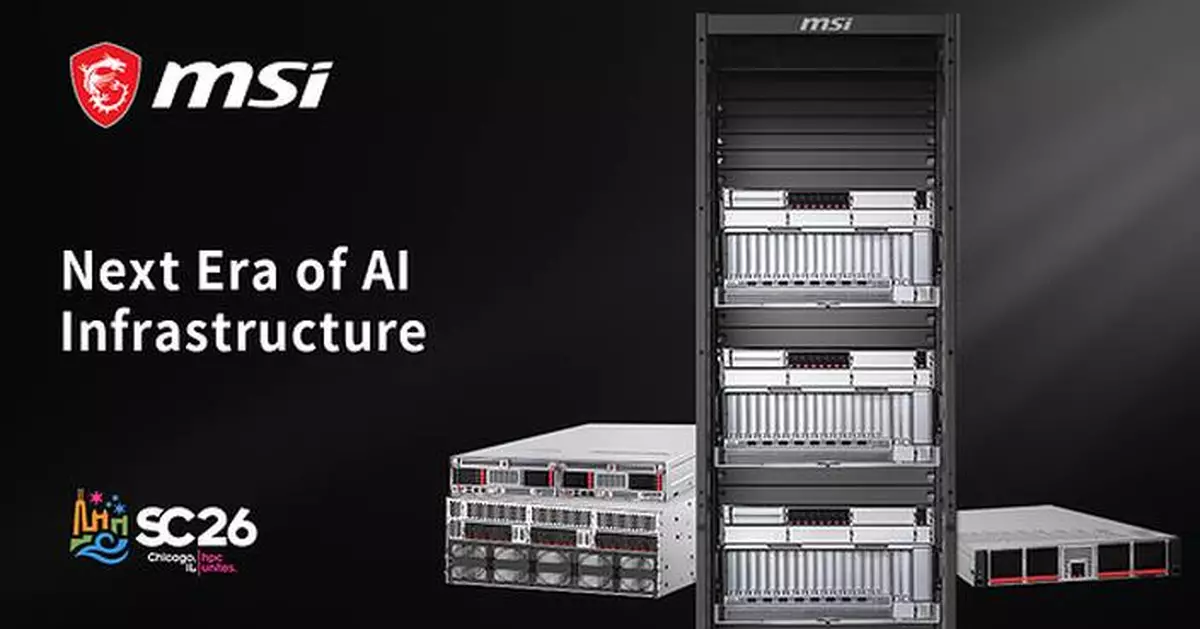
CHICAGO, Nov. 17, 2026 /PRNewswire/ -- MSI, a leading global provider of high-performance server solutions, showcases its latest AI innovations at SuperComputing 2026 (SC26), booth #5429. From liquid-cooled platforms based on NVIDIA MGX and desktop AI supercomputing based on NVIDIA DGX Station architecture to next-generation multi-node compute and enterprise servers, MSI delivers a comprehensive portfolio designed to power agentic AI and AI factory deployments. Spanning the latest AMD and Intel processor architectures, MSI's solutions combine rack-scale compute density with flexible, balanced performance to support enterprise AI workloads, from large-scale infrastructure to local AI development.
"Building a modern data center takes more than computing power. It requires strong technology partnerships and a trusted infrastructure foundation that can turn innovation into real-world value," said Danny Hsu, General Manager of Enterprise Platform Solutions at MSI. "Through our collaborations with AMD, Intel, and NVIDIA, we combine leading-edge technologies with MSI's system integration expertise to deliver reliable, flexible, and efficient infrastructure that helps customers maximize their investments, scale with confidence, and prepare for the next era of AI."
Build AI-Ready Infrastructure with Liquid-Cooled Architecture Solutions
Built on the NVIDIA MGX architecture, MSI showcases its 6U liquid-cooled CG681-S6093 systems alongside a 48RU rack configuration featuring four CG681-S6093 systems. Leveraging an open, modular reference architecture, MSI delivers liquid-cooled building blocks that scale from single-node servers to rack-scale AI Factory deployments, helping system builders design future-compatible systems faster, reducing costs, accelerating time to market, and improving ROI.
- NVIDIA MGX Rack: A 48RU rack configuration featuring four MSI CG681-S6093 liquid-cooled NVIDIA MGX systems, NVIDIA Spectrum-4 SN5600 data switches, and SN2201 out-of-band networking switches. This integrated solution provides a foundation for rack-scale accelerated computing deployments.
- CG681-S6093: A 6U liquid-cooled NVIDIA MGX platform supporting up to eight liquid cooled NVIDIA RTX PRO 6000 Blackwell Server Edition GPUs, dual AMD EPYC™ 9006 Series Server processors, eight NVIDIA ConnectX-8 SuperNICs with 400Gbps Ethernet connectivity per port, PCIe 6.0 expansion, and up to 32 DDR5 DIMM slots. It is designed for high-density AI and accelerated computing workloads.
Accelerate Enterprise AI at Scale with NVIDIA MGX Servers and NVIDIA DGX Station
To address diverse enterprise AI deployment needs, from cloud computing and edge inference to desktop AI development, MSI offers 4U and 2U NVIDIA MGX servers supporting NVIDIA RTX PRO 6000 and RTX PRO 4500 Blackwell Server Edition GPUs. These platforms are designed for demanding workloads, including large language models (LLMs), deep learning training, and NVIDIA Omniverse applications.
- CG480-S6053: A 4U dual-socket AMD EPYC™ 9005 platform supporting up to eight double-wide GPUs, 24 DDR5 DIMM slots, eight U.2 NVMe drives, and five additional PCIe 5.0 expansion slots for scalable AI infrastructure.
- CG290-S3063: A 2U single-socket Intel® Xeon® 6 platform supporting up to four double-wide GPUs, 16 DDR5 DIMM slots, and four rear U.2 NVMe drives. It is ideal for edge computing and small-scale AI inference deployments.
For enterprise AI teams seeking powerful local computing for AI development, the MSI XpertStation WS300, built on the NVIDIA DGX Station platform, brings desktop AI supercomputing to the workplace. Designed for AI development, fine-tuning, inference, and data-intensive workflows, it will support Windows for local AI application and agent development.
Powered by the NVIDIA GB300 Grace Blackwell Ultra Desktop Superchip, the WS300 delivers up to 748GB of coherent memory with ECC and 7.1TB/s of HBM3e GPU memory bandwidth to accelerate CPU-GPU communication and large-model processing. Dual 400GbE networking via NVIDIA ConnectX-8 SuperNICs, combined with a liquid-cooled thermal design, brings data-center-class AI computing to a compact deskside form factor.
DC-MHS Open Compute and Core Compute Servers — Maximum Rack Density for AI and Cloud Infrastructure
Designed for hyperscale data centers and cloud service providers, MSI's Open Compute and Core Compute platforms deliver high-density, multi-node server architectures optimized for rack-scale deployments. MSI's 21-inch Open Compute platforms support ORv3 infrastructure in air-cooled 2OU 2-node and direct-to-chip (DLC) liquid-cooled 1OU 2-node configurations, with CPU TDPs of up to 600W. Complementing these solutions, MSI's 19-inch DC-MHS Core Compute platforms offer 2U 2-node and 2U 4-node configurations to maximize compute density and infrastructure efficiency. Powered by AMD EPYC™ 9006 Series SP7 Server processors or Intel Xeon 6 processors, these platforms provide a scalable foundation for large-scale AI, cloud, and HPC deployments.
AMD EPYC 9006 Series SP7-Based Servers
- CD281-S4091-X2: An ORv3 2OU 2-node, single-socket server featuring 16 DDR5-8000 RDIMM slots and eight front E3.S 1T PCIe 6.0 x4 NVMe drive bays per node.
- CD182-S6091-X2: An ORv3 1OU 2-node, direct liquid-cooled, dual-socket server featuring 32 DDR5-8000 RDIMM slots and four front E1.S PCIe 6.0 x4 NVMe drive bays per node.
- CD270-S4091-X2: A 2U 2-node, single-socket server featuring 16 DDR5-8000 RDIMM slots and eight front E1.S PCIe 6.0 x4 NVMe drive bays per node.
Intel Xeon 6 Servers
- CD270-S3061-X4: A 2U 4-node, single-socket server featuring 16 DDR5 DIMM slots and three PCIe 5.0 x4 U.2 NVMe drive bays per node.
DC-MHS Enterprise Servers — Optimized Enterprise IT Performance, Storage, and Flexibility
Designed for mainstream enterprise IT environments, MSI's DC-MHS Enterprise Servers deliver a balanced combination of compute performance, memory capacity, and storage flexibility for virtualization, databases, business-critical applications, and AI-assisted workloads. Available in 1U and 2U configurations powered by AMD EPYC™ 9006 Series SP8 Server processors or Intel Xeon 6 processors, these platforms offer flexible memory configurations, high-density NVMe storage, and scalable expansion options. With configurations supporting up to 32 DIMM slots and 32 E3.S 1T PCIe 6.0 NVMe drives, MSI's Enterprise Servers help businesses optimize infrastructure utilization, maximize return on investment, and adapt to evolving IT demands.
AMD EPYC 9006 Series SP8-Based Servers
- CX272-S6082: A 2U dual-socket server featuring 32 DDR5-8000 RDIMM slots, 32 front E3.S 1T PCIe 6.0 x4 NVMe, and two front PCIe 4.0 x4 E1.S NVMe drive bays.
- CX172-S4081: A 1U single-socket server featuring 16 DDR5-8000 RDIMM slots, 16 front E3.S 1T PCIe 6.0 x4 NVMe, and two front PCIe 4.0 x2 E1.S NVMe drive bays.
In addition, MSI offers AMD Instinct™ MI350P-based solutions, enabling enterprises to extend their existing infrastructure with advanced AI computing capabilities and scale generative and agentic AI workloads.
Intel Xeon 6 Servers
- CX270-S5062: A 2U dual-socket server featuring 32 DDR5 DIMM slots and configurable storage options with eight or 24 PCIe 5.0 x4 U.2 NVMe drive bays.
- CX170-S5062: A 1U single-socket server featuring 32 DDR5 DIMM slots, 12 PCIe 5.0 x4 U.2 NVMe and two rear E1.S PCIe 5.0 x4 NVMe drive bays.
** This press release is distributed by PR Newswire through automated distribution system, for which the client assumes full responsibility. **
MSI Powers the Next Era of AI Infrastructure at SC26