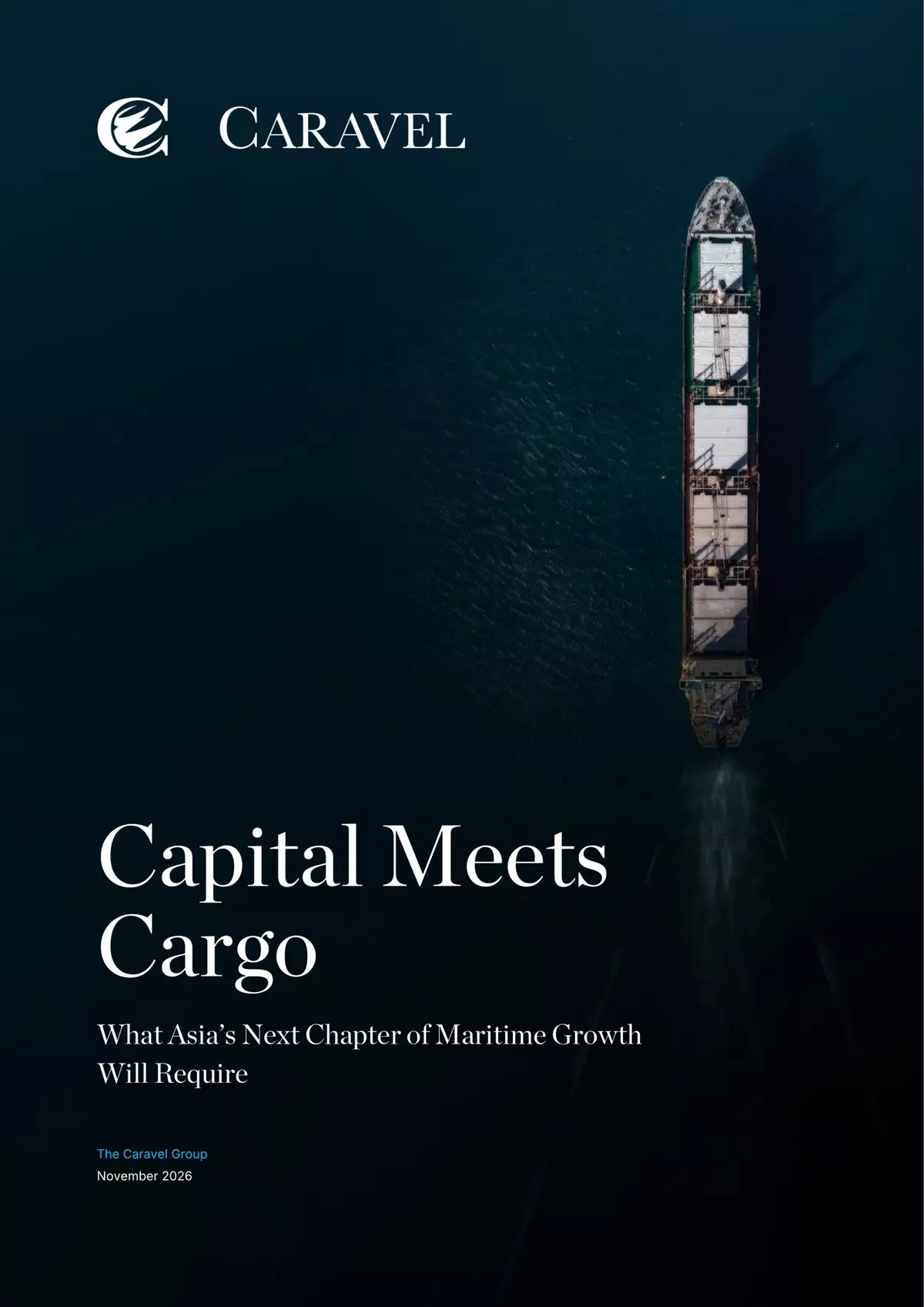
The Caravel Group's new paper Capital Meets Cargo brings together policymakers, shipowners, financiers and operators to examine what Asia's next chapter of maritime growth will require
HONG KONG SAR – Media OutReach Newswire – 17 November 2026 – Asia's next phase of maritime growth will be shaped by the decisions made long before a ship sails. Cargo demand drives trade flows, trade flows attract capital, and capital supports fleet renewal, infrastructure, technology and people. Hong Kong's opportunity is not just to serve maritime deals, but to attract the commercial decisions that create them. That is the central conclusion of Capital Meets Cargo: What Asia's Next Chapter of Maritime Growth Will Require, a new white paper by The Caravel Group, drawing on perspectives from leaders across government, shipping, finance and operations.
Hong Kong's maritime opportunity lies in attracting the decisions behind the deals, says Caravel Group's new paper
Finance, modern ships and new technology all matter, but none is enough on its own. Lasting maritime growth rests on committed customer demand, steady earnings and the ability to deliver reliable operations. The paper looks at how well a maritime economy brings those elements together. It distinguishes between a maritime center, where shipping business is transacted, and a maritime capital, where that business is decided: where cargo decisions are made, capital is allocated, risk is managed and commercial authority sits. One decision to move 180,000 tonnes of iron ore from Port Hedland to Caofeidian creates a Capesize fixture, a letter of credit, a cargo insurance policy, a bunker stem, a charter party and a price hedge. Every contract follows from the trader's decision.
The paper is a business perspective, not a policy paper. It examines where business can partner and lead to build growth and competitiveness, building on the efforts already in progress. The benefits are shared: when more commercial decisions are made in Hong Kong, the whole ecosystem gains, and so do the regional and global industries that are international by nature. Working in partnership with industry and with the region, Hong Kong can reach new heights in support of that wider industry.
Hong Kong has distinctive advantages: access to the Chinese Mainland, an international, common-law business environment trusted by investors, deep capital markets and professional services. The challenge is to make these strengths work together, giving businesses a compelling commercial reason to create and direct maritime activity from the city. The aim is for the principals to sit in Hong Kong, the cargo decisions to be taken here, and the depth of talent to make the choice obvious.
"The ship was the consequence and the trade was the decision. A maritime capital is where maritime business is decided, which means it is where the person who controls the cargo sits. Hong Kong's common-law system, capital markets, position as a leading offshore renminbi (RMB) hub and professional-services capabilities give it strong foundations for supporting increasingly complex cross-border maritime business."
Angad Banga, JP, Chief Executive Officer, The Caravel Group
In her foreword to the paper, Ms Mable Chan, JP, Secretary for Transport and Logistics, writes:
"The global centre of gravity for the maritime industry is shifting decisively to Asia, propelled by expanding regional supply chains and long-term economic momentum. Yet, realising this immense potential requires far more than expanding vessel capacity. The future will be decided upstream, where customer demand, long-term capital, and practical operating capability align."
Ms Mable Chan, JP, Secretary for Transport and Logistics, Hong Kong SAR Government
The paper is published as the industry gathers for the 10th Hong Kong Maritime Week to take stock of where growth will come from. It reflects a conviction that runs through the paper: the business sector has a central part to play in contributing solutions. As a company headquartered in Hong Kong, with a long-standing place in the city's maritime community and the convening power to bring shipowners, financiers, operators and policymakers into one conversation, Caravel is well placed to bring that perspective together at this moment.
The Caravel Group thanks the contributors who shared their perspectives for the paper: The Hon Mrs Regina Ip, GBM, GBS, JP, Convenor, Executive Council of the HKSAR; Ms Mable Chan, JP, Secretary for Transport and Logistics, Hong Kong SAR Government; Bjørn Højgaard, Chief Executive Officer, Anglo-Eastern; Kenneth Lam, JP, Founder and Chief Executive Officer, SeaKapital Limited; Martin Fruergaard, Chief Executive Officer and Executive Director, Pacific Basin; Richard Hext, Chairman, Hong Kong Shipowners Association; Vineet Puri, Managing Director and Head of Global Shipping, Logistics and Offshore (Japan, Asia North and Australia, Asia South), Corporate Banking, Citi; and Wellington Koo, JP, Executive Director, Valles Steamship Co., Ltd.
Government has set the direction through the 2026 Policy Address and Hong Kong's first Five-Year Plan. The paper looks at how business can help turn that direction into growth, and concludes that no single party can deliver it alone.
Looking beyond 2026, the paper sets out five developments likely to reshape the relationship between cargo, capital and operating capability. Because ships, infrastructure and people take years to build, the decisions taken now will determine how well the industry responds:
- Decision density. Maritime competitiveness will increasingly depend on whether businesses use a location to make major cargo, capital, chartering and fleet-strategy decisions, not on port capacity alone.
- A more regional picture. Asia's maritime growth will spread across ASEAN, Belt and Road markets and the Gulf, with room for several centers to grow. Hong Kong will complement Singapore, London and others by connecting China and the wider region with international capital and expertise.
- Operating resilience. Capital will place greater weight on customer commitments, credit quality and alternative employment alongside ship values, and financing will move closer to the trade itself.
- Flexibility and execution. The energy transition will reward those who move from what is technically possible to what works commercially, with lower-emission shipping and digital technology advancing where they meet defined customer and operating needs.
- A shortage of skilled people. The onshore roles that anchor a maritime capital are where the next talent gap will be felt, making early links between industry and universities, and clearer routes between onboard and onshore careers, a priority.
The real measure of success is not how many maritime companies are registered in Hong Kong, but how much commercial authority sits here. That means attracting traders, charterers and owners with genuine decision-making responsibility, building lasting trade relationships, and creating the skilled maritime roles that support them. A maritime capital is not declared. It is earned, one decision-maker at a time.
The full paper is available at www.caravel-group.com.
Hashtag: #TheCaravelGroup #CapitalMeetsCargo #HongKongMaritime
The issuer is solely responsible for the content of this announcement.
About The Caravel Group
The Caravel Group builds, owns and operates businesses that support global trade and essential supply chains. Headquartered in Hong Kong with 30 strategically positioned offices, the Group operates through Caravel Maritime, Caravel Resources and Caravel Asset Management. Through its maritime services, shipping investments and training institutions, the Group supports maritime talent development and the long-term competitiveness of global shipping.
In addition to his role as Chief Executive Officer of The Caravel Group, Angad Banga, JP, is Executive Director of Fleet Management Limited, a Member of the Hong Kong Maritime and Port Development Board and Chairman of its Promotion and External Relations Committee.
** This press release is distributed by Media OutReach Newswire through automated distribution system, for which the client assumes full responsibility. **