A startup in the southern Chinese tech hub of Shenzhen in Guangdong Province is dedicated to making humanoid robots more accessible and as affordable as a household appliance, as the firm strives to bring its high-tech products into people's daily lives in the years ahead.
Leng Xiaokun is the founder of Leju Robotics, a high-tech enterprise based in Shenzhen that is focused on developing highly-versatile and flexible humanoids for multi-purpose use.
Ten years ago, Leng and eight fellow schoolmates embarked on a 3,000-kilometer journey all the way from northeast China's Harbin, establishing their tech company with the ambitious goal of one-day bringing humanoid robots into every household.
After setting up in Shenzhen, the firm started to make its own full-size humanoid robots in 2018. Leng said that back then they relied heavily on imports for many core components, noting it often could take over half a year just to get a single sample in those days.
However, leveraging Shenzhen's complete industrial chain, Leng said Leju Robotics has worked alongside domestic suppliers to tackle these challenges one by one.
"Ten years ago, we hoped to have a product like this. Since it didn't exist at the time, we kept making adjustments toward that goal, refining it bit by bit until it became the product you see today," he said.
Tapping into the well-connected supply chain of Shenzhen and the surrounding area, the company's "Kuafu" line of humanoid robots has notably achieved a domestic sourcing rate of 95 percent for its core components, significantly reducing costs and enabling rapid market launch.
A milestone moment came last year, when Leju's "Kuafu" robot served as a torchbearer during the torch relay for China's 15th National Games, which were co-hosted by Guangdong, Hong Kong and Macao.
And the flame has continued to burn as the company pushes ahead with the development of its robotics innovations. Leng said many related firms in Shenzhen are willing to open their doors for robot testing, allowing his startup to learn about the robot's performance in real-world conditions.
"You encounter all sorts of unexpected situations in outdoor environment, such as changes in weather and other factors. So the tests can only be conducted in real-world environments. While the robot's motion control capabilities have advanced rapidly, its 'brain' still needs to learn how to interpret tasks and make judgments. We want it to be as smart as a PhD holder, and as affordable as a household appliance, making it accessible enough for an average family to own and be truly helpful in their daily lives," he said.
Amid this rapid period of development, Leng boldly predicts humanoid robots are likely to begin providing services and becoming commonplace within the next three to five years.
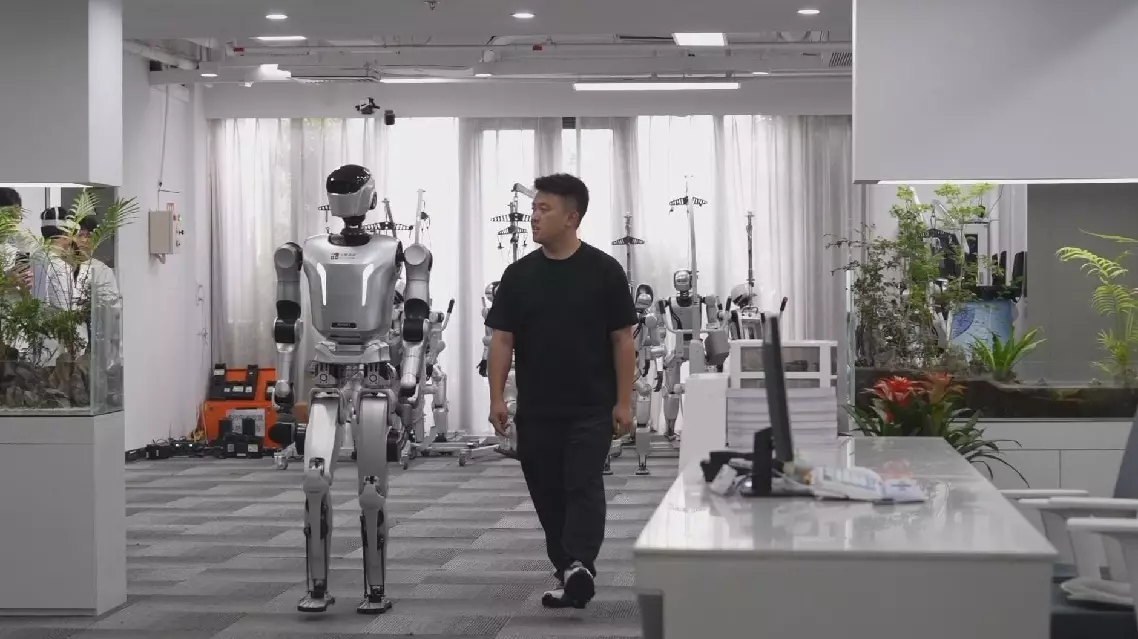
Shenzhen startup strives to make humanoid robots as affordable as household appliance