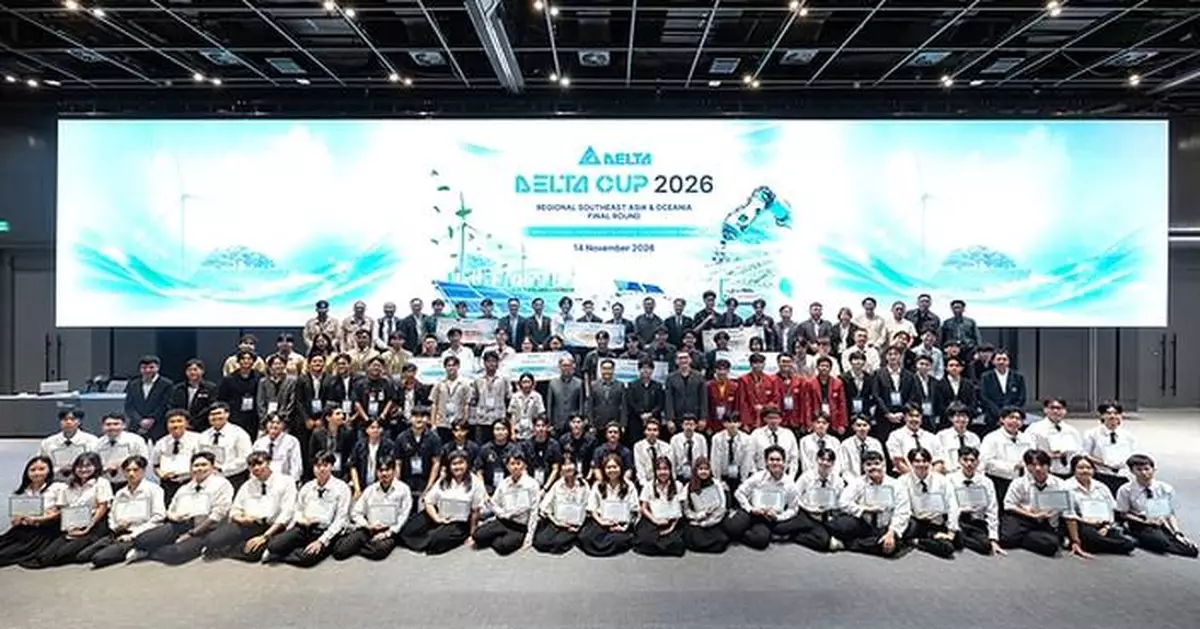
BANGKOK, Nov. 17, 2026 /PRNewswire/ -- Delta Electronics (Thailand) Public Company Limited, a global leader in power management and smart green solutions, hosted its first Regional Final Round of "Delta Cup 2026: Regional Engineering Innovation Challenge" on November 14, 2026. Held under the theme "Smart Power, Intelligent Systems, Sustainable Future," the event brought together 20 finalist teams from Southeast Asia and Oceania, including 10 teams from Thailand, five from Indonesia, two from Singapore, and one each from Vietnam, Malaysia and Australia, to compete and showcase their engineering innovations in energy and automation.
Mr. Victor Cheng, Chief Executive Officer, Delta Electronics (Thailand) PCL, said at the competition's opening ceremony, "Delta Cup 2026 marks an important milestone for Delta Thailand as we bring together young engineering talents from Southeast Asia and Oceania. With the world advancing toward AI, electrification and smart automation, we need a new generation of engineers who can turn these technologies into practical solutions for a sustainable future. Through Delta Cup, we connect education, industry and innovation, inspiring new ideas and empower university students to achieve breakthroughs beyond the classroom."
Prof. Dr. Supachai Pathumnakul, Permanent Secretary for Higher Education, Science, Research and Innovation, said, "I would like to extend my sincere appreciation to Delta for its commitment to developing engineering talent and for organizing Delta Cup 2026. The competition gives students from Thailand and other participating countries the opportunity to showcase their capabilities and learn from one another. Collaboration between universities and the private sector helps students apply classroom knowledge to real industry challenges while developing critical thinking, problem-solving and innovation skills. These skills are essential to preparing the next generation of engineers for future industries and building stronger, more sustainable engineering ecosystems in Thailand and the wider region."
Delta Cup 2026 received 106 team submissions from nine countries, involving 382 students and 67 academic advisors. The 20 finalist teams competed for a total prize pool of US$20,000, presenting projects designed to address practical challenges in energy efficiency, resource use and industrial automation.
Among the projects competing in the final round were three-dimensional solar power designs, sodium-ion battery concepts using agricultural and food waste, and solar-powered wireless charging for drones. Other teams explored automation applications such as acoustic monitoring to detect abnormalities in rice milling machinery and AI-based analysis of machine performance and energy consumption.
Through project demonstrations and presentations to industry experts, Delta Cup gave students opportunities to explain their design choices, connect technical ideas with user needs and explore potential applications in energy and automation. Students also exchanged perspectives on how energy and automation challenges vary across countries.
In addition, toward the end of the event, Mr. Victor Cheng, Chief Executive Officer, and Mr. Chih Hao Huang, Chief Human Resources Officer of SEA and Oceania Region presented certificates to graduates of this year's Delta Automation Academy program with Thai universities, which provides automation training for university students, as well as to the winning teams of Delta Cup 2026.
The official results of the Regional Final Round were as follows:
- Grand Prize, US$5,000: Awarded to Dash from the National University of Singapore in Singapore for Dash, an electric vending cart with a motor that helps vendors push it and a solar panel that helps power its refrigerator.
- Second Prize, US$2,000: Awarded to Mekkharm from King Mongkut's Institute of Technology Ladkrabang in Thailand for PRISM (Predictive Resource and Intelligent Systems Manager), an AI system designed to reduce energy use by adjusting how factory equipment operates based on its condition and production demand.
- Third Prize, US$1,000: Awarded to AETHER.WING from King Mongkut's University of Technology Thonburi in Thailand for Solar-Powered Resonant Wireless Charging System for Drones, which uses solar energy to charge drones wirelessly in areas without access to the power grid.
Four special awards, each worth US$500, were also presented.
- Best Innovation: Awarded to Socrates from the University of Brawijaya in Indonesia for BUMI NA: Gel Electrolyte Sodium Battery, a sodium-ion battery that uses materials derived from palm and shrimp waste.
- Best Sustainability Impact: Awarded to SecondSpark from King Mongkut's University of Technology Thonburi in Thailand for Smart Second-Life BESS for Industrial, an energy storage system that reuses EV batteries to help factories reduce peak electricity costs.
- Best Technical Excellence: Awarded to PGRE Lab from Hanoi University of Science and Technology in Vietnam for BitNet ViT: Ternary-Quantized Vision Transformer for Photovoltaic Fault Detection on Microcontrollers, a compact AI model that runs on a drone to detect faults in solar panels.
- Best Presentation: Awarded to EETU from Thammasat University in Thailand for Intelligent DC Fault Discrimination for 800 VDC AI Data Center Power Distribution, a system that distinguishes electrical faults from brief power fluctuations in AI data centers.
Each of the 20 finalist teams also received US$500 for qualifying for the Regional Final Round through the Online Pitching Round.
Delta Cup 2026 forms part of Delta's ESG commitment to developing engineering talent by aligning education and technology with industry needs. Through this initiative, Delta aims to strengthen the region's engineering ecosystem and support innovation that contributes to more efficient and sustainable industries.
About Delta Electronics (Thailand) Public Company Limited
Founded in 1988, Delta Electronics (Thailand) PCL. is a leading provider of power and thermal management products and smart green solutions. The company is a subsidiary of Delta Electronics, Inc. and is guided by its mission: "To provide innovative, clean and energy-efficient solutions for a better tomorrow."
With core competencies in power electronics and innovative research and development, Delta's business categories include Power Electronics, Mobility, Automation and Infrastructure. The company supports customers through sales offices in key regions around the world; manufacturing facilities in Thailand, India and Slovakia; and R&D centers located in Thailand, India, Germany and other countries.
Delta continues to receive regional and domestic recognition for its achievements, including the ASEAN Business Award and the Prime Minister's Best Industry Award. Delta has also earned significant recognition for its ESG performance. The company has been included in the Dow Jones Best-in-Class Indices since 2021 in recognition of its strong performance across environmental, social and governance dimensions.
For more information about Delta Thailand, please visit: www.DeltaThailand.com
** This press release is distributed by PR Newswire through automated distribution system, for which the client assumes full responsibility. **
Delta Thailand Hosts First Regional Delta Cup 2026 for Top Clean Energy and Automation Engineering Students from Southeast Asia and Oceania