ROME (AP) — Scammers are using U.S. technology to sexually blackmail teens, with sometimes fatal results. Yet recent changes by tech companies have not stopped the surge in sextortion, and some are making young people even more vulnerable online, an Associated Press and FRONTLINE investigation has found.
Financially motivated sextortion — threatening to expose people’s private images unless they send money — surged nearly 40% last year and now impacts more than 160 children every day, according to the National Center for Missing & Exploited Children, a nonprofit based in Virginia. The stakes are high: Since 2021, NCMEC has documented the deaths of at least three dozen teenage boys in the U.S. who took their own lives after being sextorted.
At least seven countries, including Australia, have adopted nationwide restrictions on social media use for kids, from minimum age bans to parental supervision requirements. Another 15 jurisdictions, including the United Kingdom, the European Union and Canada, have committed to or are considering similar rules.
But Washington has been concerned about hindering growth, free speech and falling behind global competitors. So the U.S. has largely left tech companies to police themselves — or face litigation after damage has already been done.
“The ecosystem as a whole is completely broken,” said Lauren Coffren, an executive director at NCMEC. “There is not enough being done. And it should have happened 35 suicides ago.”
End-to-end encryption allows only the sender and receiver of a message to see its contents, which bolsters privacy online. But that also makes it harder for platforms to spot and report potentially abusive material.
Meta knew that its controversial decision to roll out end-to-end encryption by default on Facebook Messenger by 2024 would impact child safety but decided the risks could be mitigated, according to a former Meta employee who worked in trust and safety.
EDITOR’S NOTE: This story includes discussion of suicide. If you or someone you know needs help, the national suicide and crisis lifeline in the U.S. is available by calling or texting 988.
Meta said its decision came as the industry as a whole was moving toward end-to-end encryption. The company acknowledged child safety issues were a concern and said it only put in the changes after developing new safety features for encrypted spaces. These include improved user reporting tools, monitoring for patterns of suspicious behavior and blocking suspect accounts from finding and interacting with teens, it said.
The expansion of end-to-end encryption contributed to a 19% drop in overall reporting of child sexual abuse material in 2024, according to NCMEC. Predators have started to move children to encrypted spaces more quickly, which is making it harder for law enforcement to build cases, NCMEC’s Coffren said.
Social media companies in the U.S. are legally required to report apparent child sexual abuse material, including sextortion, to NCMEC when they become aware of it. But there are no legal requirements for what they must do to detect it.
Meta, which owns Instagram, WhatsApp and Facebook, is the world’s largest social media company. In 2025, Meta platforms filed nearly 11 million reports to NCMEC, far more than any other social media company.
Along with Meta's platforms, Australian regulators name Telegram and iMessage — which both offer end-to-end encrypted messaging — as platforms with the highest numbers of sexual extortion reports. Yet Apple filed just 296 reports to NCMEC last year.
Telegram, which is based in Dubai and not subject to U.S. reporting laws, only started reporting in 2026, according to NCMEC.
Both Apple and Telegram said they were committed to child safety, but neither responded directly to questions about their reporting to NCMEC. Telegram said it has been investing in content moderation, removes harmful content at NCMEC’s request and may disclose information about users in response to valid court orders.
“The right to private conversations cannot be surrendered simply because a minuscule number of people may misuse it,” Telegram said in an email.
After TikTok expanded direct messaging and allowed users to exchange images last year, reports of financial sextortion on the platform skyrocketed, according to data from Canada’s government-backed Cybertip.ca reporting hotline.
In 2023, TikTok was cited in just 2% of sextortion reports. By 2025 that had risen to 27%, and this year so far TikTok is the most cited platform, in 33% of reports, according to the nonprofit Canadian Centre for Child Protection (C3P), which runs the hotline and shared the data with the AP.
TikTok U.S. said it has safeguards in place and reminds users to share images only with people they trust, warning them that content can be downloaded or forwarded.
Around 60% of online safety features meant to protect young people failed in tests this year by The Cybersafety Research Center, a nonpartisan, independent research group at New York University and Northeastern University.
“They are designed for public relations and theater. They are not designed to effectively reduce the harms we care about,” said Arturo Bejar, a former safety executive at Meta who contributed to the analysis. “Until we have independent measures of harm to regulate and control the outcomes of these companies, it’s going to be slow progress.”
Meta called the report, which included Instagram, “fundamentally flawed” and said it “demonstrates a basic misunderstanding of how our tools work.”
A number of platforms, including Meta, TikTok and Apple, have introduced teen accounts with higher safety standards, but teens generally don’t have to verify their age when they open an account. Meta and TikTok U.S. said they use other tools, like AI and community reporting, to identify underage users. Apple said it asks for age confirmation when required by law, which currently applies in Australia, Brazil, Singapore, South Korea, the U.K. and the state of Texas.
Meta and Apple have also created nudity protection filters that are active by default on accounts registered to teens, which detect potentially explicit images and encourage users to think twice before opening or sending them. But critics argue that they could just as easily block nude images of minors before they are sent.
Apple said its nudity detection feature is based on user devices, and the company does not receive indications that sensitive content was detected and cannot access the images.
Meta said it doesn’t block the images because the filters are designed to err on the side of caution and may mistakenly catch images that aren’t actually explicit. The company said that in June 2025, over 40% of blurred images received in direct messages stayed blurred. The company did not provide data on how many potentially explicit images the filters blocked teens from sending.
Another step Meta took to cut down on sextortion was to hide follower and following lists — which blackmailers use to pressure victims — from potential scammers on Instagram.
This summer, cybercrime analyst Paul Raffile set up a decoy account on Instagram — a teenage boy in the U.S. who was targeted by four sextortionists in just two weeks. All sent threatening screenshots of the account’s followers.
“The moment a teen accepts a scammer’s friend request on Instagram, their entire social network is compromised,” Raffile said. “The new safety feature was not effective in any of our tests.”
He said the four accounts were deleted after he reported them to Meta, but that accounts with similar usernames, profile pics and bios, soon popped up.
Meta said it restricts teens from being messaged by accounts they don’t follow, blocks suspicious accounts from seeing teens’ followers, and notifies them if they’re chatting with someone in another country.
The company said that in 2025 it prevented more than 265 million suspicious accounts on Facebook and more than 135 million on Instagram from finding and interacting with teens. It said it disabled 1.9 million of them on Facebook and 2.5 million of them on Instagram.
TikTok has also periodically taken down content that facilitates scams in response to public reporting. But that hasn’t stopped the proliferation.
The AP easily identified a dozen accounts on TikTok that promote tips, tools and scripts for sextortionists and other scammers.
In one case, a scammer bragged, using shorthand for “blackmail”: “If it’s your mother I BM yesterday may her soul rest in peace. I didn’t mean to kill them.”
Another scammer posted a video showing himself calling a woman while using AI to look like a U.S. soldier. The woman, whose name is visible on screen, is delighted.
“At least I know you are real,” she said.
Some of these profiles had hundreds of thousands of likes, with posts that got millions of views.
TikTok said it took down all the accounts AP identified for violating its guidelines, which prohibit facilitating or instructing people how to carry out scams. The company said it uses automation as well as people to find and remove harmful content.
But videos promoting tools for scamming continued to pop up on TikTok's “For You” feed. The company said it again took down the additional suspicious accounts its algorithm had delivered — after AP flagged them.
Wisdom Howell contributed to this report from Washington, D.C.

FILE - A car passes Facebook's new Meta logo on a sign at the company headquarters on Oct. 28, 2021, in Menlo Park, Calif. (AP Photo/Tony Avelar, File)

Junior, who is part of a thriving subculture in Nigeria of online scammers known locally as Yahoo Boys and who agreed to be photographed on condition that his full name not be published because of his illegal work, poses for a portrait in Lagos, Nigeria, Aug. 1, 2025. (AP Photo/Grace Ekpu)
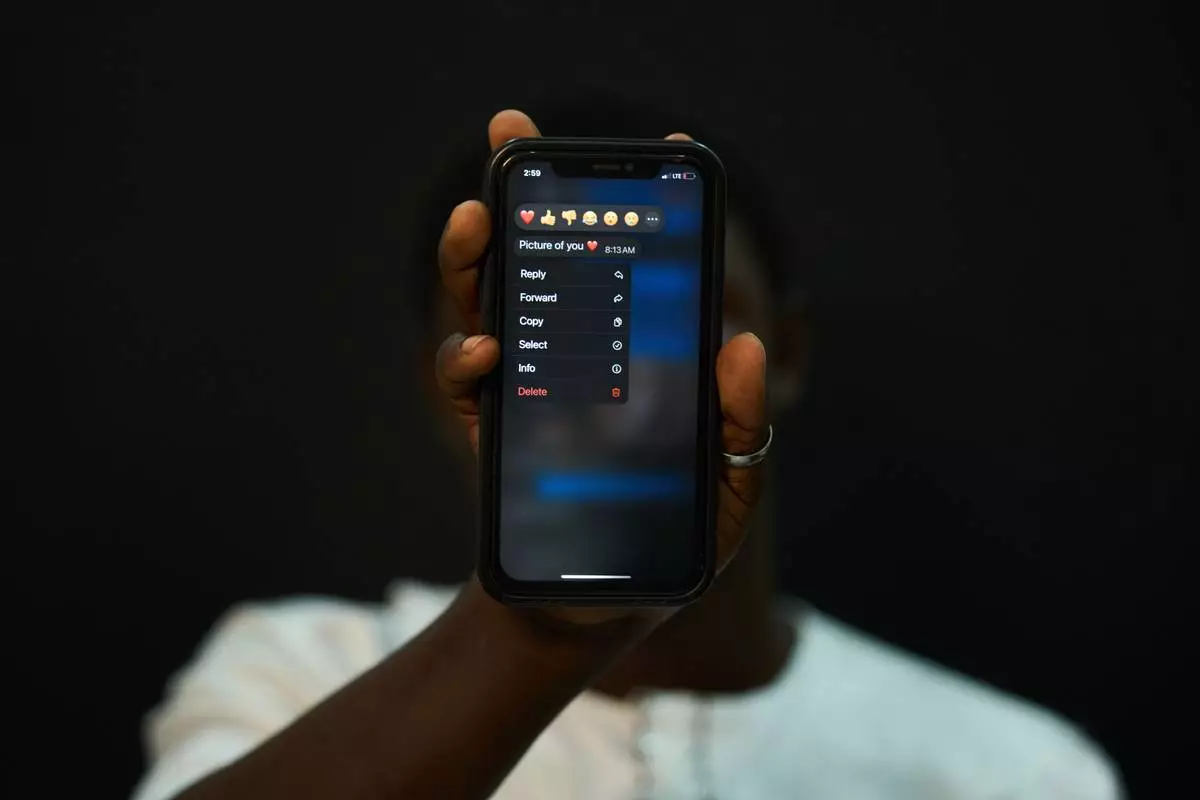
Junior, who is part of a thriving subculture in Nigeria of online scammers known locally as Yahoo Boys and who agreed to be photographed on condition that his full name not be published because of his illegal work, shows a message on his phone he sent a victim as he poses for a photo in Lagos, Nigeria, Aug. 1, 2025. (AP Photo/Grace Ekpu)
LAGOS, Nigeria (AP) — The teenage boy felt his heart drop. His mind went blank.
He’d sent the nude photo the girl wanted, and now she was demanding money. She threatened to post the picture to his family, friends and boss and effectively destroy his life.
“My mind couldn’t think anymore,” he told The Associated Press. “It couldn’t even comprehend the situation I was in.”
He no longer believed there was a buxom brunette with a sweet smile on the other side of his phone. But he never imagined that one day he’d find out who was.
The teen was trapped in a scam that increasingly targets young men: Sextortion. The FBI has warned of a surge in financially motivated sextortion of minors – threatening to expose people’s private images unless they send money. This year is on track to be the worst ever.
By August, the National Center for Missing & Exploited Children (NCMEC) had received more than 40,000 reports of financial sextortion, against a total of 50,000 for all of last year. The impact can be lethal: Dozens of young people have taken their own lives after being sextorted.
Most sextortion crimes are never solved. But the AP and FRONTLINE met the teen’s scammer in Lagos: A soft-spoken Nigerian student named Ayomide.
“Scamming is not good,” said Ayomide, who in his early 20s is not much older than his victim. “I do feel bad. But as a man, you have to make money.”
Ayomide shared chat histories of some of his successful scams, including with his victim in Canada. The AP does not publish the names of underage victims, and reached out to the teen after he turned 18. He spoke on condition of anonymity to discuss traumatic events he had not even discussed with his family.
Ayomide told him that if he didn’t want his photo posted, he’d have to pay. Panicked, the teen said he sent $500.
“Are we done now?” he remembers asking. “Let’s go our separate ways.”
The response is seared on his brain: “Not just yet. This isn’t that simple.”
Ayomide is part of a thriving subculture in Nigeria, in which scamming has been normalized — fueled, some say, by the legacy of colonialism. Yahoo Boys — as online scammers are known locally — are helping drive a global surge in sextortion by exploiting Western social media and payment infrastructure to blackmail their victims, the AP and FRONTLINE found. Even as sextortion rates reach record highs, steps some major social media platforms have taken to increase privacy have only made teens more vulnerable, data shows.
“These perpetrators are becoming more and more aggressive,” said Charles Smith, the FBI’s law enforcement attaché in Abuja. “It can happen to any of our children, any child with access to a computer or online.”
The share of U.S. middle and high school students who say they have been victims of sextortion has tripled in the last decade, to nearly 15%, according to researchers at the University of Wisconsin-Eau Claire and Florida Atlantic University. They also found that sextorted teens are nine times more likely to attempt suicide. More than 60 teens under 18 years old from around the world have killed themselves after being financially sextorted since the end of 2021, according to Paul Raffile, a cybersecurity analyst.
EDITOR’S NOTE: This story includes discussion of suicide. If you or someone you know needs help, the national suicide and crisis lifeline in the U.S. is available by calling or texting 988.
Like other Yahoo Boys the AP and FRONTLINE met, Ayomide said he learned how to use his phone to blackmail foreigners from his friends. All the scammers spoke on condition that their full names not be published because of their illegal work.
Some aspiring scammers in Nigeria join so-called Hustle Kingdoms — groups of young men who live and work together under the guidance of an experienced scammer who takes a cut of earnings. Universities have also become training grounds for scammers.
Sextortion has proven so profitable it is drawing the attention of organized criminal groups in West Africa and Southeast Asia, according to Interpol and the nonprofit International Justice Mission, which traced reports of child sextortion to scam compounds in Cambodia, Laos and Myanmar.
“There’s no shame in being a Yahoo Boy,” said Adedeji Oyenuga, a professor of criminology at Lagos State University. “There is pride.”
For many in Nigeria, scamming is just another hustle in a country where more than 90% of workers don’t have stable, formal jobs. Hit songs celebrate Yahoo Boys and videos on social media show scamming rich Westerners as a way to quick, flashy wealth.
But Ayomide seems out of place in the nightclubs that rise from dark, dirt streets on the outskirts of Lagos, where young men spray crisp paper money at the throbbing, beautiful crowd to prove how much they have to waste.
He described himself as a “soft boy” and said he was apprenticing at a barbershop while pursuing a degree in computer science. He said he’d rather cut hair than scam, but the math was not working in his favor.
His parents sell clothes in a local market, he said. It was up to him to squeeze 110,000 naira ($82) for school fees and 250,000 naira ($186) for his annual rent from an economy where 70% of people lived on less than $4.20 a day last year, according to the World Bank.
Some Nigerian parents see cybercrime as an appealing career opportunity for their kids, according to Oyenuga and others. Parents have pushed their sons into Hustle Kingdoms and arranged for their daughters to marry Yahoo Boys, he said.
Oyenuga got a call late one night from a student’s father, who asked the professor to help his son become a Yahoo Boy, he said. Oyenuga tried — and failed -- to steer the engineering student toward foreign exchange trading instead.
“For the parents it’s poverty,” he said. “They just want their children to be successful.”
For Yahoo Boys themselves, scamming is often a temporary stage, a way to earn enough to get a foothold in the legitimate economy.
Ayomide said he hadn’t told his mother about his work because he knows she’d disapprove. He vowed to stop scamming within a year and figured he’d eventually earn enough as a barber to stay afloat. His dream, he said, is to be an engineer and work on planes out at the airport.
“Everything in Nigeria is all about money,” Ayomide said. “But I pray everything works out.”
Ayomide’s method was simple: impersonate a beautiful woman, follow hundreds of foreign men and boys on TikTok and chat up the ones who followed him back: What’s your name? Are you alone today? Do you want to have fun? Then he’d move the conversation to a private messaging app.
For every 50 people Ayomide follows on TikTok, he said, around 10 follow him back, and five of those are willing to chat.
Once he hooks someone, Ayomide said, he has them buy Apple or Steam gift cards, which he cashes out in local currency using CardBrother, a gift card resale app that markets to Nigerian users.
Steam said that it was phasing out physical gift cards this year, in part as a response to abuse by scammers.
Apple said it educates users about risks of gift card scams, including a warning on its gift card landing page. Apple said it removed CardBrother from its app store this year after finding it was connected to another account engaged in fraudulent activity.
The app was still available on Google Play, where it had gotten more than 1 million downloads. CardBrother’s developer did not respond to emailed requests for comment.
Google said it runs 10,000 safety checks on every app and scans 350 billion apps a day. Google removed the CardBrother app after AP flagged its fictitious US address and a dead phone number.
Ayomide also exploited PayPal, paying money mules he found on WhatsApp to use their accounts.
The AP provided PayPal with three accounts Ayomide used to extort his victims. PayPal said the accounts had been restricted shortly after they were created. The company said it is committed to providing a safe platform and invests in systems to disrupt suspicious activity. Meta said it has systems in place to detect malicious behavior on WhatsApp and bans millions of accounts each year.
One of Ayomide’s most successful characters was Ava, an attentive young woman with an extraordinary body.
The Canadian teen said he was 15 when Ava followed him on TikTok.
Just exchanging messages seemed harmless. And it was easy to avoid TikTok’s ban on direct messaging for under-16 accounts by inventing a birthday when he signed up.
Ava asked the teen to move their conversation to an encrypted messaging app called Zangi.
He said he called Ava but never managed to get through for one reason or another. Sometimes she tried him back, but when he picked up, all he heard was a woman saying “hello … hello … hello.”
Later, he would realize that he shouldn’t have followed Ava to Zangi and that the voice was likely a recording.
Ava told him it was hard for a girl to trust people online. Could he send a copy of his driver’s license?
Yes, he could.
Ayomide now had a weapon in his hands: A copy of the teen’s learner’s permit, with his address and date of birth.
Ayomide copied a naked photo he'd found online and sent it to the teen, telling him it was Ava.
“Of course, in my 15-year-old mind, I wanted more,” he told AP.
Then Ava asked for one in return. One evening, he sent it.
“Wow, that was nice,” Ayomide replied.
Ayomide was following a highly scripted – and ruthlessly efficient – playbook. Child safety advocates say apps with direct messaging are where children are most often targeted by sextortionists, who quickly move them to encrypted platforms.
Design changes some social media platforms have made to increase privacy are making teens more vulnerable, data shows. After TikTok expanded direct messaging and allowed users to exchange images last year, user reports of financial sextortion on the platform skyrocketed, data from Canada’s Cybertip.ca hotline shared with the AP shows.
TikTok U.S. said it reminds users to share images only with people they trust, and in keeping with U.S. industry norms it doesn’t require proof of age to create an account. The company added that because messaging is not end-to-end encrypted, the platform is less attractive to bad actors.
The spread of end-to-end encryption, which allows only the sender and receiver to access messages, has raised alarm among child advocates. Under U.S. law, when companies become aware of child sexual abuse, including sextortion, they must report those incidents to NCMEC.
But platforms cannot report what they don’t see.
NCMEC said the expansion of end-to-end encryption made it more difficult to detect potential abuse and contributed to a 19% drop in overall reports in 2024.
“It creates a Wild, Wild West,” said Lauren Coffren, executive director of NCMEC’s Exploited Children Division. “I can imagine what we don’t know and it’s terrifying.”
Meta, the world's largest social media company, completed its rollout of end-to-end encryption by default on Facebook Messenger in 2024. The company, which files more reports to NCMEC than any other, said it was aware of child safety concerns and only put in the default encryption after it had developed new safety features.
“We work aggressively to fight sextortion, disrupting networks of scammers and supporting law enforcement in prosecuting them,” Meta said in an email. “These determined criminals do everything they can to avoid detection.”
The demands started a week after they’d exchanged explicit photos, the Canadian teen recalled. After the first payment, Ayomide kept pressing for more.
“That’s all they need is one photo,” he told AP.
Alone and afraid, he found himself crying at night. He couldn’t see a way out.
“If I told somebody about it, I’d have to suffer the consequences of the embarrassment and my whole identity being ruined for life,” he said. “But at the same time, it felt like if I didn’t comply with this person’s orders, that was going to happen anyway.”
As Ayomide pummeled him for more money, the teen sank deeper into isolation. He said he was afraid to report the crime because he didn’t want his family to find out.
“I had no hope in my existence,” he said. “This guy was telling me no one is here for you, you got nobody. He would call me his slave.”
The legacy of slavery is part of the reason scammers thrive in Nigeria today, according to the Rev. Lateef OgoOluwa Bakre, a pastor who has spent two decades ministering to Yahoo Boys.
“A lot of us believe that the colonial masters cheated on us,” he said. “They molested our parents, our forefathers were treated very badly and they were extorted. So these guys feel it is our turn.”
Yahoo Boys sometimes turn to local spiritual leaders for rituals they believe will help them make more money – a practice known as Yahoo Plus.
Scammers seeking occult power have brought money to places like Owode Egba, a village northeast of Lagos. Among those who have prospered is Akeem Olajide, an Ifa diviner, or babalawo.
Two shrines sit in front of his low concrete home, heaped with the bones, feathers and grease of past sacrifices. When Yahoo Boys come to him seeking wealth, he does his best to help.
“I also want to make money,” he explained. “Whatever I have, I would use it to help the person succeed, and when the person becomes successful, they will come back and reward me.”
The day before, a Yahoo Boy who’d come for help with an uncooperative “client” gave him 20,000 naira ($15) as thanks, he said. He gestured to his motorbike — a gift from another Yahoo Boy who prospered from his services, he said.
Olajide lifted the lid off a chipped white enamel pot in the dim room where he works. Inside, pieces of a dove floated in thick black liquid -- an offering to curry favor with the forces of wealth and prosperity for a client, Olajide said.
The liquid in the pot was alive with maggots. A good sign: The more maggots, the more money.
Nigerian authorities have decried the spread of Yahoo Plus. And Nigerian law enforcement has cooperated with the FBI to crack down on transnational scams, including a high-profile operation launched in 2023 that led to the arrest of 22 suspected sextortionists – around half allegedly involved in cases that led to a suicide.
“Rest assured, Nigeria is no longer going to be a safe haven for fraudsters or criminal activities,” Olanipekun Olukoyede, the Chairman of Nigeria’s Economic and Financial Crimes Commission (EFCC), said in a rare interview with AP/FRONTLINE. He has called Yahoo Boys a “national shame.”
Despite stepped-up law enforcement, many Yahoo Boys continue to work with impunity.
Godspower and Junior, two other scammers, told AP and FRONTLINE they’d had run-ins with police. Both said they paid a bribe and were released.
EFCC officials acknowledged that corruption is a problem in Nigeria, as elsewhere, but said perpetrators are punished.
“Look, even among my staff, I won’t sit down here and tell you everybody’s a saint,” Olukoyede said. “But as much as we get them, we expose them and we sanction them. We do what we need to do.”
Bakre, the pastor, has taken a different approach to fighting scams. With his Zion of Love ministry, he started a free school down the road from the babalawo to divert kids from a life of crime.
The school sits near a house with two luxury cars parked outside – wealth that came from scams, the pastor said.
“People are celebrated for what they have,” he said. “It’s no more about the source of what they’ve gotten.”
The solution, he believes, is education.
One August night, three dozen children gathered, amid muffled giggles and shuffling feet, in the plain room where they learn math, reading, writing and English – building blocks, the pastor believes, for self-esteem and faith in an honest future.
The kids said Yahoo Boys were bad because they smoked and did evil rituals, and whatever money they had now wouldn’t last long. A gifted, nail-thin 9-year-old named Warisat Ayodele put it succinctly: “They are thieves.”
Ayomide mocked up a fake news video using the teen’s photo.
“I made it like fake breaking news for him just to be scared,” Ayomide said.
The teen kept blocking Ayomide online, but Ayomide would pop right back up.
“Not even a minute later a random email or number will message you saying, ’Why did you block me? Don’t block this number. You’re only making this situation a whole lot worse,’” he explained.
He cut Ayomide off on Zangi. Ayomide found him on WhatsApp.
“Hello (wave emoji) How are you doing today?”Ayomide wrote on WhatsApp on Sept. 13, 2024.
“Hello,” the teen responded.
“LOL,” Ayomide shot back with a crying laughing emoji.
“Oyyy,” the teen wrote.
Meta and Zangi said their end-to-end encrypted messaging apps are designed to protect people from unwanted contact. WhatsApp users must have someone’s phone number, and Zangi users need a 10-digit private number assigned by the platform to connect.
Both platforms said they encourage users to block and report unwanted contacts.
Meta said it collaborates with industry peers, including through the Lantern network, a voluntary, industry-funded initiative to share intelligence about online child exploitation. Real-time interventions, however, are rare.
Ayomide had groomed the teen, who thought he was sharing his personal details with someone he could trust. The AP reviewed more than 200 WhatsApp messages Ayomide sent the victim in Canada. In mid-January 2025, Ayomide started bombing him with volleys of more than a dozen messages at a time on WhatsApp:
“Ohhh you think you are smart right don’t forget I have all your information with me. If you block me again this will get you in trouble okay,” he wrote.
Each time the boy paid to delete his photo, Ayomide asked for more. “Just because I want more money, I did not,” Ayomide told AP and FRONTLINE.
“Your mom okay she will be really disappointed (crying emoji) of giving birth to you when she see your naked pictures online,” he wrote.
He sent threatening screenshots to the teen of his followers on TikTok and his ID.
“I ain’t got no money so don’t ask for any,” the teen replied.
“Hey are you fool. Am trying to help you,” Ayomide said. “If you give me good reason I will not post it again and I will leave you.”
Those words made him wonder if there might be one sliver of decency in the person on the other side of the phone. He typed out his reply: “Okay I’ll tell you and please listen.”
“Okay,” Ayomide said.
“If you yourself was 16 years old would you like some random guy threatening you every day and making you feel anxious every day of your life?” he wrote. “Probably not because you have better things to experience in your young life than some random guy threatening your whole career for your hard earned money.”
Ayomide’s reply was swift and merciless: “You did this to yourself.”
It was just another trap.
The teen knew he needed to take a different approach. He decided to send one last payment and then, no matter what happened, that would be the end.
He sent screenshots as proof of the PayPal transfer.
“Delete everything you have of me now. Goodbye,” he wrote.
“Wait,” replied Ayomide. “You never hear me out.”
But he was done listening. He had a plan: He wouldn’t say anything that came from a place of fear. In fact, he wouldn’t say anything at all.
“These guys they feed off of fear. They feed off of your own fear and they love the feeling of power,” he told AP.
Now it was Ayomide’s turn for desperation. PayPal had blocked the account he was using and he couldn’t cash out.
Ayomide’s goal had never been to post the photo. Posting the photo would mean defeat. He pummeled the teen with more than 100 WhatsApp messages over the course of 11 days.
“No matter how many thoughts go through your head and how much fear you are feeling, every time he tries to message or talk to you, just ignore it completely,” the teen told himself.
He strained to hold tight to his silence.
One ultimatum after the next pinged into silence. Ayomide had lost his power.
The teenage boy had won.
Ayomide said he never posted the Canadian’s picture. He said he had taken a few hundred dollars, but the teen told AP it was closer to $2,000. Neither had comprehensive records of the payments, and AP had no way to verify the amounts.
Ayomide and other scammers told AP and FRONTLINE that if victims don’t pay, they leave them alone.
The FBI and child safety advocates say this is sound advice: The best way to defeat sextortionists is to ignore them. They urge kids and teens at risk to talk with someone who can help — a parent, teacher, friend or child safety hotline — and report the crime.
“If kids pay, the threats inevitably continue,” said Lindsay Lobb, director of support services at the nonprofit Canadian Centre for Child Protection (C3P). “These people are only looking for money. They are not interested in sharing your image.”
Fewer than 1 in 10 young people who were financially sextorted reported to C3P that their images had been shared. When a photo is posted, Lobb added, it’s now possible to get those images taken down.
Ayomide said he felt bad about what he’d done to the Canadian teen and if he had the chance would apologize.
“Maybe we should just be friends,” he told AP and FRONTLINE. “I was sorry for the hurt.”
The teen told AP that he could not take an apology from a master manipulator seriously.
“I doubt he felt bad,” he said. “You can’t show these guys any pity because that’s all they feed off.”
Nearly two years after he escaped the scam, the teen is haunted by what happened. He said his heart still skips a beat when he gets random requests to talk.
He was recently targeted by another scammer, he said - someone pretending to be a Japanese woman asking if he lived nearby. This time round he knew exactly what to do.
“I just said no, never have, said I had no business with them and blocked the number," he told AP.
A year after Ayomide vowed to stop, he had fallen in with a group of other Yahoo Boys at his university.
He declined to comment on why he is still scamming.
—
Bukola Omoseni and Grace Ekpu in Lagos, Nigeria; Simon Reef in Abuja, Nigeria; and Jesse Bedayn in Denver contributed to this report.
—
This story is part of an ongoing collaboration between The Associated Press and FRONTLINE (PBS) that includes the documentary “Scammed.” Watch the documentary at pbs.org/frontline, in the PBS App and on FRONTLINE’s YouTube channel.

Junior, an aspiring tailor who is part of a thriving subculture in Nigeria of online scammers known locally as Yahoo Boys and who agreed to be photographed on condition that his full name not be published because of his illegal work, sits with his sewing machine at his home in Ogun state, Nigeria, Dec. 1, 2025. (AP Photo/Grace Ekpu)

Student Joseph Adewunm looks at a workbook at a free school set up by Rev. Lateef OgoOluwa Bakre and his Zion of Love ministry to divert kids from a life of crime, in Owode Egba, Southwest Nigeria, Monday, Nov. 9, 2026. (AP Photo/Sunday Alamba)

Students Joshua Owolabi, from left, Roqueebat Saheed and Joseph Adewunmi, attend a free school set up by Rev. Lateef OgoOluwa Bakre and his Zion of Love ministry to divert kids from a life of crime, in Owode Egba, Southwest Nigeria, Monday, Nov. 9, 2026. (AP Photo/Sunday Alamba)

Akeem Olajide, an Ifa diviner, or babalawo, who helps when Yahoo Boys, or scammers, come to him seeking wealth, sits outside his home next to bones, feathers and grease of past sacrifices in Owode Egba, Nigeria, Aug. 3, 2025. (AP Photo/Grace Ekpu)

Ayomide, a student who is part of a thriving subculture in Nigeria of online scammers known locally as Yahoo Boys and who agreed to be photographed on condition that his full name not be published because of his illegal work, shows a text message he sent a teenage boy in Canada demanding payment as part of his sextortion scam, in Lagos, Nigeria, Aug. 2, 2025. (AP Photo/Grace Ekpu)

Ayomide, a student who is part of a thriving subculture in Nigeria of online scammers known locally as Yahoo Boys and who agreed to be photographed on condition that his full name not be published because of his illegal work, poses for a portrait in Lagos, Nigeria, Aug. 2, 2025. (AP Photo/Grace Ekpu)