Skip to Content Facebook Feature Image

Man gets more than 27 years in US prison for assassination plot that he said was steered from Iran

News

Man gets more than 27 years in US prison for assassination plot that he said was steered from Iran
News

News

Man gets more than 27 years in US prison for assassination plot that he said was steered from Iran

2026-11-18 06:50 Last Updated At:07:10

NEW YORK (AP) — A man who admitted trying to get a U.S. politician killed — and said Iran's paramilitary Revolutionary Guard drove him to it — was sentenced Tuesday to nearly three decades in prison.

Asif Merchant, a Pakistani businessman, had faced the possibility of life in prison for what the judge called an exceptionally serious crime. Possible targets of the thwarted plot included then-candidate and now-President Donald Trump, then-President Joe Biden or then-candidate and former U.N. Ambassador Nikki Haley, according to trial testimony.

“Not many charges … are more serious than the contemplated, targeted killing of a U.S. president or other senior government official,” said U.S. District Judge Eric Komitee, a Trump appointee.

Merchant, 48, shifted in his chair but otherwise showed no visible reaction when he was sentenced to a little more than 27 years. One of his lawyers, Avraham Moskowitz, said after court that Merchant plans to appeal but was grateful that the judge turned down prosecutors' bid for a life term.

“I think what it shows is that our judiciary remains independent, thankfully,” Moskowitz said.

Attorney General Todd Blanche said in a statement that Merchant was “justly sentenced.”

The sentencing capped a remarkable trial about an alleged Iran-driven plan to kill a prominent U.S. political figure in the thick of the 2024 campaign season. The Iranian government has denied trying to kill U.S. officials.

Merchant, who was convicted earlier this year of murder for hire and attempted terrorism, declined to speak at his sentencing. But at his trial, he bluntly told jurors that he researched Trump rally locations and spoke of carrying out an assassination at a political rally, using objects on a hotel napkin to illustrate the scenario for an acquaintance. Merchant then lined up people he thought were hit men and paid them $5,000 in cash that he'd borrowed from a relative.

He testified that he was just playing along with instructions from a Revolutionary Guard intelligence operative in order to protect relatives in Iran. Merchant said he figured that U.S. authorities would foil the plan, that he would cooperate and that he might get immigration help as a reward.

U.S. law enforcement was, indeed, onto him: The supposed killers-for-hire actually were undercover FBI agents, tipped by the acquaintance who saw Merchant's napkin demonstration. Merchant was arrested in Texas while packing for a flight back to Pakistan on July 12, 2024, a day before an unrelated attempt on Trump’s life in Butler, Pennsylvania.

“This plot was incompetent from the very beginning,” defense lawyer Christopher Neff said in court on Tuesday. “Mr. Merchant's participation was half-hearted.”

Merchant worked for Pakistani banks for decades and then got into businesses ranging from car sales to banana exports, and he traveled periodically to the U.S. for work and to see relatives. He also traveled to Iran for Shiite Muslim religious pilgrimages and visits with kin.

After meeting a Revolutionary Guard operative several years ago, Merchant imagined intelligence work would be exciting and profitable, and he feared for his relatives' safety if he defied the powerful paramilitary, according to his defense.

“My family was under threat, and I had to do this,” Merchant testified in March. He said his handler named Biden, Haley and Trump as potential targets.

Prosecutors challenged Merchant's claim that he acted under duress. They noted that he had shared anti-American and anti-Trump social media posts after the U.S. killing of top Iranian military leader Qassem Soleimani in 2020, during Trump's first administration.

Merchant's defense portrayed the posts as venting, and Neff insisted that his client wasn't an extremist or inclined to turn his beliefs into violence.

But Assistant U.S. Attorney Sarah Winik countered that Merchant did “the most extreme thing you can do: Plot the assassination of a government official.”

The judge said he believed Merchant had some concern for his family but also was “highly motivated to do harm to this country.”

FILE - This image provided by the Justice Department, contained in the complaint supporting the arrest warrant, shows Asif Merchant. (Justice Department via AP, File)

FILE - This image provided by the Justice Department, contained in the complaint supporting the arrest warrant, shows Asif Merchant. (Justice Department via AP, File)
JACKSON, Miss. (AP) — The murder case against a man charged after a Black woman was found hanged in a Jackson, Mississippi, tree has been sent back to police detectives for additional investigation.

A judge agreed Tuesday during Earnest Lloyd Jr.’s preliminary hearing that there was not enough evidence against him to proceed.

WAPT-TV reports that prosecutors said the case was not ready to go before a grand jury.

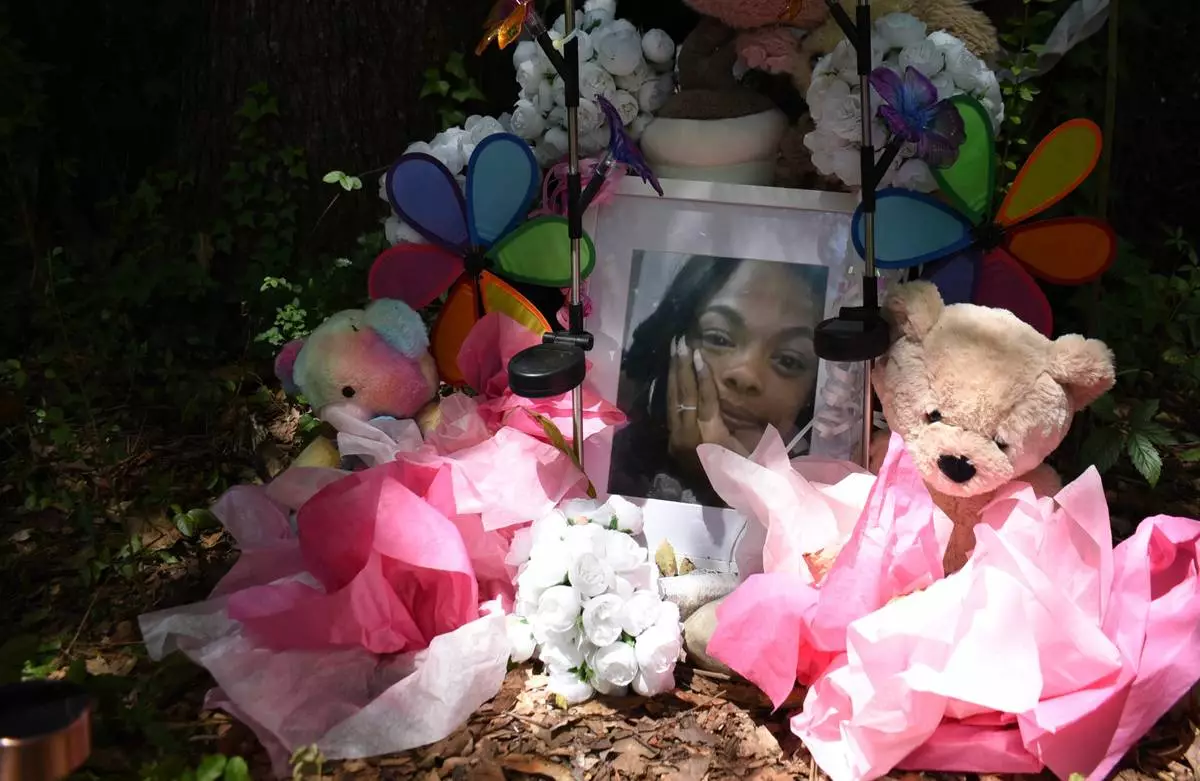
Lloyd, 25, is one of three men charged in the death of 29-year-old Tasia Fortune. Fortune’s body was found Aug. 3 in a tree behind a vacant house.

Her death stoked fears that Fortune was targeted because of her race and conjured memories of the state’s long and painful history of lynching. However, all three suspects in Fortune’s death are Black. Authorities say that the three staged the scene after a drug dispute.

The Associated Press sent emails Tuesday seeking comment from the Hinds County District Attorney’s office and the attorney listed as representing Lloyd.

State Public Defender Andre de Gruy said his office is not representing Lloyd, but that he believes if the evidence at a preliminary hearing is insufficient, then the case should be dismissed "without prejudice.”

He added that Lloyd should be released from custody, that an investigation could continue and charges could be refiled at a later date.

Lloyd did not appear in court today. He was in transit from a jail in northern Mississippi, and the hearing took place without him.

Tommie Brown, public information officer for the Jackson Police Department, had no comment Tuesday afternoon on the decision to send the case back for further investigation.

Lloyd had been held at the Tallahatchie Correctional Facility but was to be moved to the Hinds County Detention Center, according to WAPT-TV.

Some officials had called for a federal civil rights investigation into Fortune's killing, but Police Chief RaShall Brackney said that props were left at the scene “as part of the staging” of Fortune’s death.

Over the past two years, about a half-dozen Black women and men have been found hanged across the South. None of the deaths has been found to be criminal, though in some cases critics said that law enforcement appeared to move quickly to label them suicides before having sufficient evidence to rule out foul play.

Like Lloyd, 45-year-old Eric Clark and 51-year-old Jarques Ratliff are being held on murder charges. Police have said that Ratliff had an “association” with Fortune.

Judge Jeffery Reynolds, who set bond at $5 million for Clark following his arrest in late September, called Fortune's killing “heinous.”

“People justifiably didn’t know if we had a killer on the loose who might hang people for racial reasons,” Reynolds said.

Brackney said that the fear that the image of Fortune's hanging body evoked has damaged the community.

“We know we have a very sordid history around lynchings and racial terror across this nation and particularly around the South. That is still a very current narrative. It is still a very raw narrative,” she said.

Prior to any of the arrests, Fortune’s mother, Christy Spivey, told The Associated Press that she didn’t believe race had anything to do with her daughter’s death. Spivey is white. She said that Fortune’s father is Black.

“I think this is something very personal, very personal,” Spivey said, insisting that someone who was acquainted with Fortune was involved.

Spivey said that following a hearing for Ratliff earlier in September, Clark hugged her at the courthouse.

“He never said he did it, but he said he was there to turn himself in for murder,” Spivey told reporters following Clark’s own hearing later that month.

FILE - A makeshift memorial honouring Tasia Fortune stands in the backyard of the property where her body was found, Aug. 10, 2026, in Jackson, Miss. (AP Photo/Sophie Bates, File)

FILE - A makeshift memorial honouring Tasia Fortune stands in the backyard of the property where her body was found, Aug. 10, 2026, in Jackson, Miss. (AP Photo/Sophie Bates, File)

Recommended Articles