Skip to Content Facebook Feature Image

Business leaders at APEC CEO Summit share insights on innovation, AI adoption

China

China

China

Business leaders at APEC CEO Summit share insights on innovation, AI adoption

2026-11-18 17:34 Last Updated At:17:48

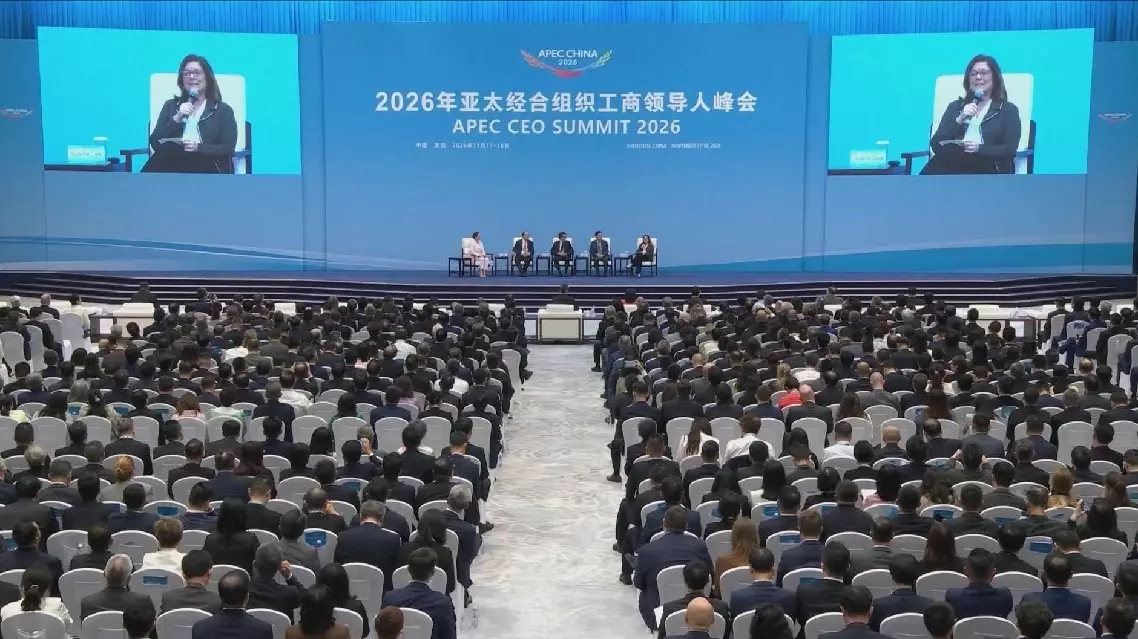
Top business leaders from across the Asia-Pacific have weighed in on innovation development, artificial intelligence adoption and supply chain resilience at a dialogue session in Shenzhen, as the southern Chinese city plays host to this week's Asia-Pacific Economic Cooperation (APEC) meetings.

The two-day 2026 APEC CEO Summit opened in the city on Tuesday, drawing more than 2,000 political and business representatives from 21 member economies and 13 non-APEC economies. Discussions are set to focus on emerging areas of cooperation, including the digital economy, artificial intelligence and green, low-carbon development.

Among the speakers was Zeng Yuqun, chairman and CEO of Contemporary Amperex Technology Company Limited (CATL), China's leading battery manufacturer, who said the company has always put innovation first as the main force behind its development.

"I think the important things are technology innovation and the business model innovation, and we [work] together to make a solution to a sustainable green future. For example, everyone now is focused on the EV. We are more focused on the infrastructure of EV. So, battery swapping is one of the innovations which can help all the EV cars to swap the battery in 99 seconds, so it's very fast. This one really can [be applied] to this region," said Zeng.

The discussion then moved to AI adoption, where Suzanne P. Clark, president and CEO of the U.S. Chamber of Commerce, voiced the optimism running through the U.S. business community and pointed to the healthcare industry as proof of the technology's potential.

"I think the American business community is largely digital and AI optimistic. If we think about solving big challenges at scale, this is the technology that we will need. In the United States, it's estimated, for example, that the healthcare savings due to AI could be 360 billion U.S. dollars. That's 10 percent of household spending. That's a really big deal. Not to mention the cures that we're starting to see around the world for what was once thought of as just intractable diseases," said Clark.

Baidu chairman and CEO Li Yanhong highlighted that AI's value lies in real-world applications, adding that the company's on applying AI to specific scenarios in different countries and organizations.

"I care more about how to apply these AI technologies to all kinds of scenarios, in all countries, in all companies. If you look at the application layer, I think robotaxi is probably a perfect example. Every year, more than a million people get killed on the road. But when robotaxi is operated, the city record is like 10 times better than a human driver. We're saying over the past few years, the US and China gradually opened up the road to robotaxi operations," said Li.

Representing the traditional mining industry, Rio Tinto's CEO Simon Trott called for innovation on supply chains in order to strengthen its resilience.

"The innovations we need to make in our own business, particularly for in how we search for and develop mines. But I think in some ways the greater innovation is going to be how we innovate around our supply chains. Because if you think about it, trust is probably the cheapest input that we have. Because without that, you'll see supply chains fracture," said Trott.

The 2026 APEC CEO Summit, part of the 2026 APEC Economic Leaders' Week, runs Tuesday and Wednesday at the Qianhai International Convention Center under the theme 'To Prosper and Win the Future Together.'
Business leaders at APEC CEO Summit share insights on innovation, AI adoption


Business leaders at APEC CEO Summit share insights on innovation, AI adoption
The southern Chinese city of Shenzhen is best known for its skyscrapers and technological innovation. But the city, home to more than 17 million people, has also made room for nature, with mangrove forests thriving alongside its bustling urban center.

For decades, Shenzhen, the 2026 APEC host city, has pursued hands-on wetland conservation, demonstrating a sustained commitment to protecting its natural environment.

Millions of mangrove seedlings blanket the city's coastline, forming a natural barrier against climate-related disasters and helping shield the urban area from extreme weather.

Mangroves are among the planet's most valuable ecosystems. Their dense root systems help prevent coastal erosion and reduce the impact of waves and storm surges. They also provide vital nursery habitats for fish, crabs and other marine life.

But researcher Julio Salas Raza says their greatest asset may be their extraordinary ability to store carbon in the soil for up to a century.

"They can store more carbon like even almost five times more carbon than terrestrial forests. So that's why mangroves are really our best allies against climate change,” said the postdoctoral researcher at Shenzhen University.

Yet mangroves are under threat worldwide.

According to the Yale Center Beijing, up to 50 percent of the world's original mangrove forests have been lost to urban expansion, land reclamation, water pollution and rising sea levels.

Shenzhen, however, has been at the forefront of mangrove restoration.

Through strategic urban planning, strict biodiversity protection laws and market-based initiatives, the city has expanded its mangrove coverage to nearly 300 hectares.

These protected wetlands have also become an important stopover and wintering habitat for migratory birds, with nearly 100,000 arriving each year.

China is also sharing its conservation experience with the rest of the world.

Tahiry Rakotomamonjy works at the International Mangrove Center, an intergovernmental organization initiated by China to promote global mangrove conservation.

The center now has more than 20 signatory countries across Asia, Africa and the Americas. It shares restoration expertise and techniques, including the use of high-resolution satellite imagery, to help member countries identify priority areas and make better use of their resources.

"I think China is at the forefront of new technology, new methodology of carbon accounting, they use a very new technology for counting mangrove so they can transfer this technology to other member states," said Rakotomamonjy, program officer at the International Mangrove Center.

But conservation efforts don't always rely on high technology.

In Shenzhen, public parks have been integrated into the mangrove wetlands, creating spaces where people can experience nature and observe wildlife up close.

"As people walk around the park, take in the scenery and even photograph the birds, they begin to appreciate how wonderful nature is and how relaxing it can be. At the same time, these experiences help people realize that we need to protect this mangrove forest and preserve this wintering habitat for migratory birds,” said Yang Qiong, head of the scientific research office at the Guangdong Neilingding-Futian National Nature Reserve.

Shenzhen offers a compelling example of how urban development and nature conservation can go hand in hand, safeguarding coastal ecosystems and preserving their benefits for generations to come.

Shenzhen strikes balance between urban growth and mangrove conservation

Shenzhen strikes balance between urban growth and mangrove conservation

Recommended Articles