Record turkey prices and higher fuel costs could make Thanksgiving dinner more expensive this year, according to a survey released Wednesday.
The American Farm Bureau Federation said the cost of an average Thanksgiving feast for 10 will rise 6% from last year to $58.63. The group tracks grocery prices using hundreds of volunteers in all 50 states and Puerto Rico.
The Farm Bureau, which has been tracking Thanksgiving costs for 40 years, said it's the first time since 2022 that Americans will see the price of the meal increase. The price hit a record of $64.05 in 2022.
High diesel prices have made it more expensive for farmers to process and transport Thanksgiving staples like milk, dinner rolls, potatoes and cranberries, the Farm Bureau said. Diesel prices have surged since the start of the Iran war and hit a record average of $6.53 per gallon in the U.S. in September, according to AAA.
On Wednesday diesel averaged $5.96 per gallon, up 58% from a year ago, AAA said.
Turkey prices have also risen sharply over the past year. The Farm Bureau said the 16-pound turkey in its survey cost an average of $23.68 this year, up from $21.50 last year.
Bird flu has been decimating U.S. turkey flocks since an outbreak began in 2022. But cases have been waning, and turkey production increased substantially this year, said Mark Jordan, the executive director of Leap Market Analytics.
At the same time, turkey demand has been rising, as more Americans seek out lean protein and U.S. turkey exports rise. That strong demand has limited U.S. turkey inventories and raised prices. The U.S. Department of Agriculture expects the wholesale price of a whole frozen turkey hen will average a record $1.76 per pound this year, up 29% from last year.
“Over the last few years there's been a lot of doom and gloom for the turkey industry,” Jordan said. “This is one of those years that turkey producers are feeling a little bit better about their lot in life.”
Jordan said diesel costs likely didn't impact turkey prices this year, since so much of the decision-making and timing related to the turkeys that will be consumed this Thanksgiving happened before diesel prices spiraled. But diesel costs could have a notable impact on turkey prices next year, he said.
A few of the items on the Thanksgiving menu are cheaper than last year, the Farm Bureau said. A 1-pound vegetable tray featuring carrots and celery is 5 cents cheaper, while a 16-ounce bag of frozen peas is 4 cents cheaper. Frozen pie crusts are also slightly cheaper, although a can of pumpkin pie filling is more expensive.
And in some cases, stores will price turkey and other Thanksgiving staples lower in order to draw shoppers. Aldi said its feast for 10, which mirrors the Farm Bureau's menu, costs $39 this year. Walmart, which adds items like corn muffin mix and marshmallows but doesn't include carrots and celery, said its feast for 10 is $35.
Persistently high grocery prices have been frustrating Americans since the pandemic and played a role in Republicans' recent losses in the midterm elections. Prices for food eaten at home jumped 22% between October 2021 and October 2026, according to U.S. government data. That's almost double the usual pace of food price inflation.
This year, the USDA predicts prices for food eaten at home to rise 2.3%. That would be lower than the recent annual average of 2.6%.
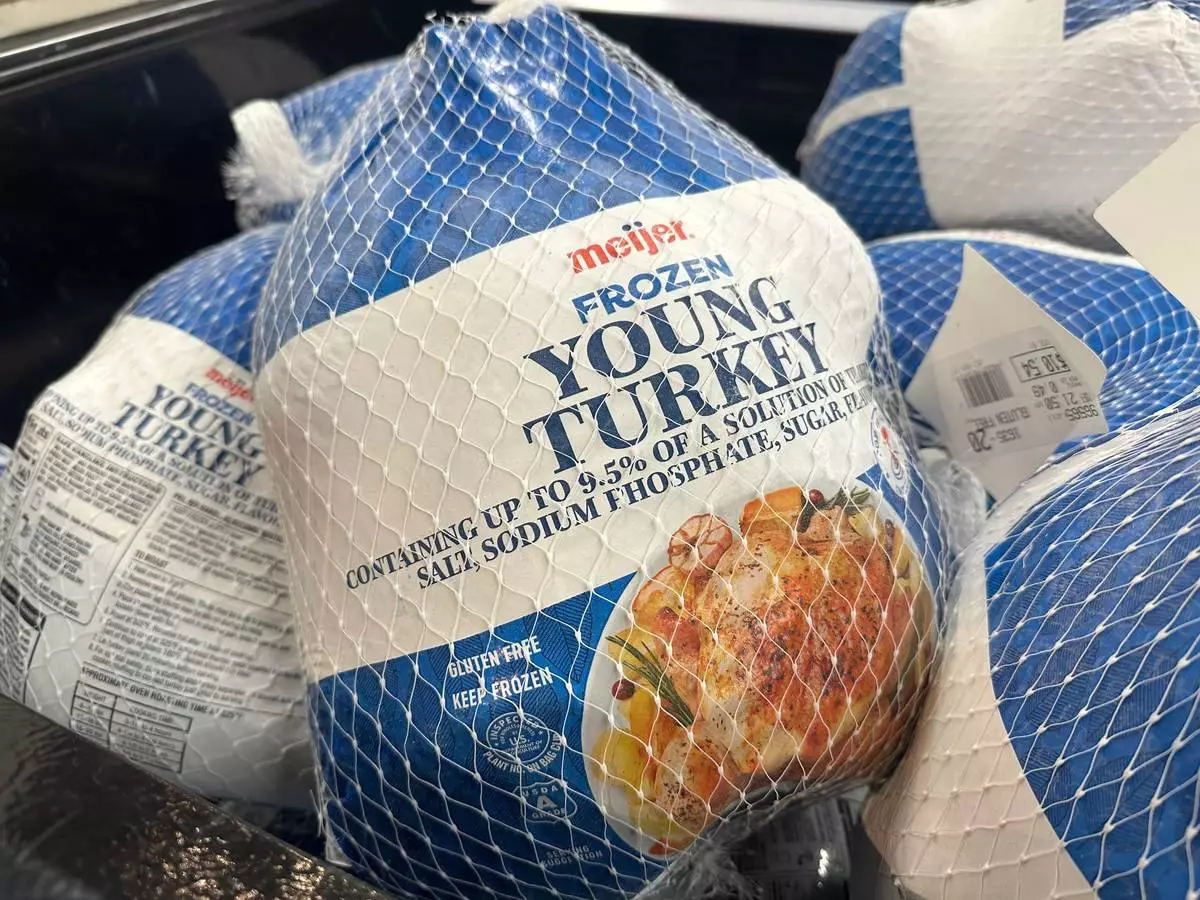
FILE - Frozen turkeys are on display at a Meijer store Friday, Nov. 21, 2025, in Canton Township, Mich. (AP Photo/Mike Householder, File)
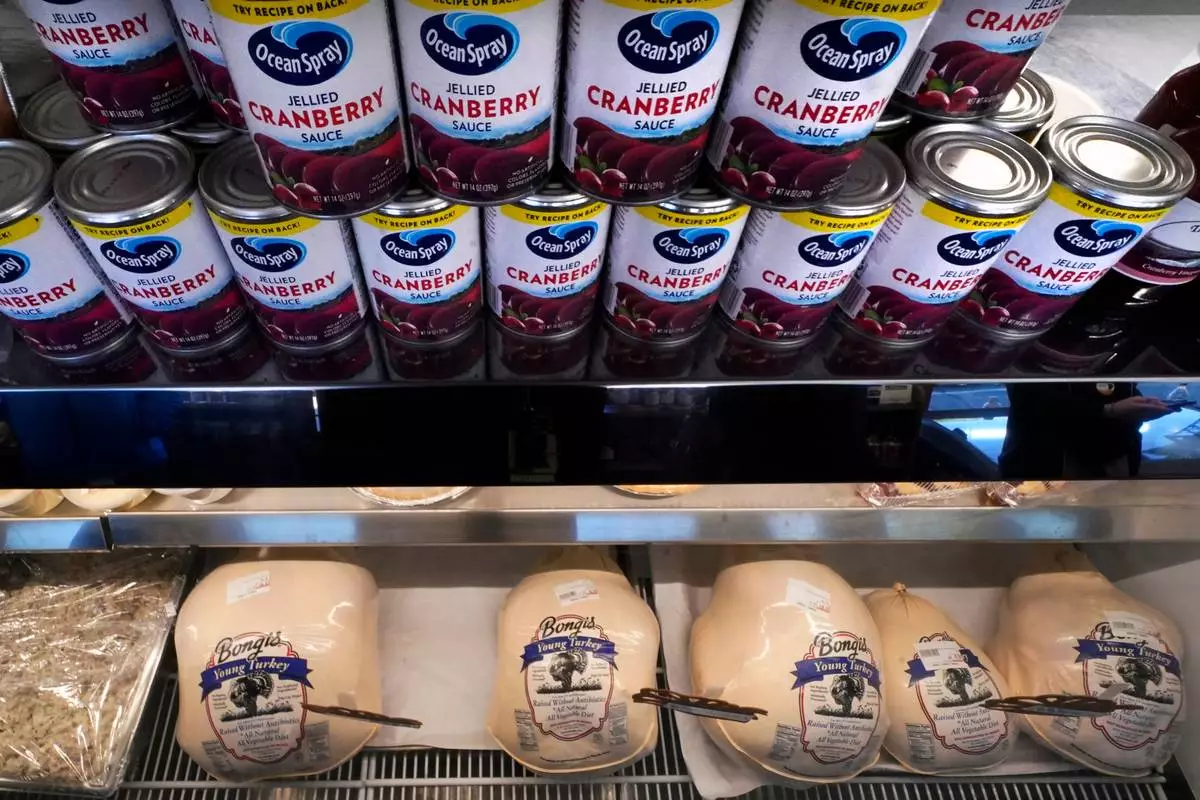
FILE - Cans of cranberry sauce line a turkey display case at Bongi's Turkey Roost in advance of the Thanksgiving holiday, Nov. 22, 2022, in Duxbury, Mass. (AP Photo/Charles Krupa, File)
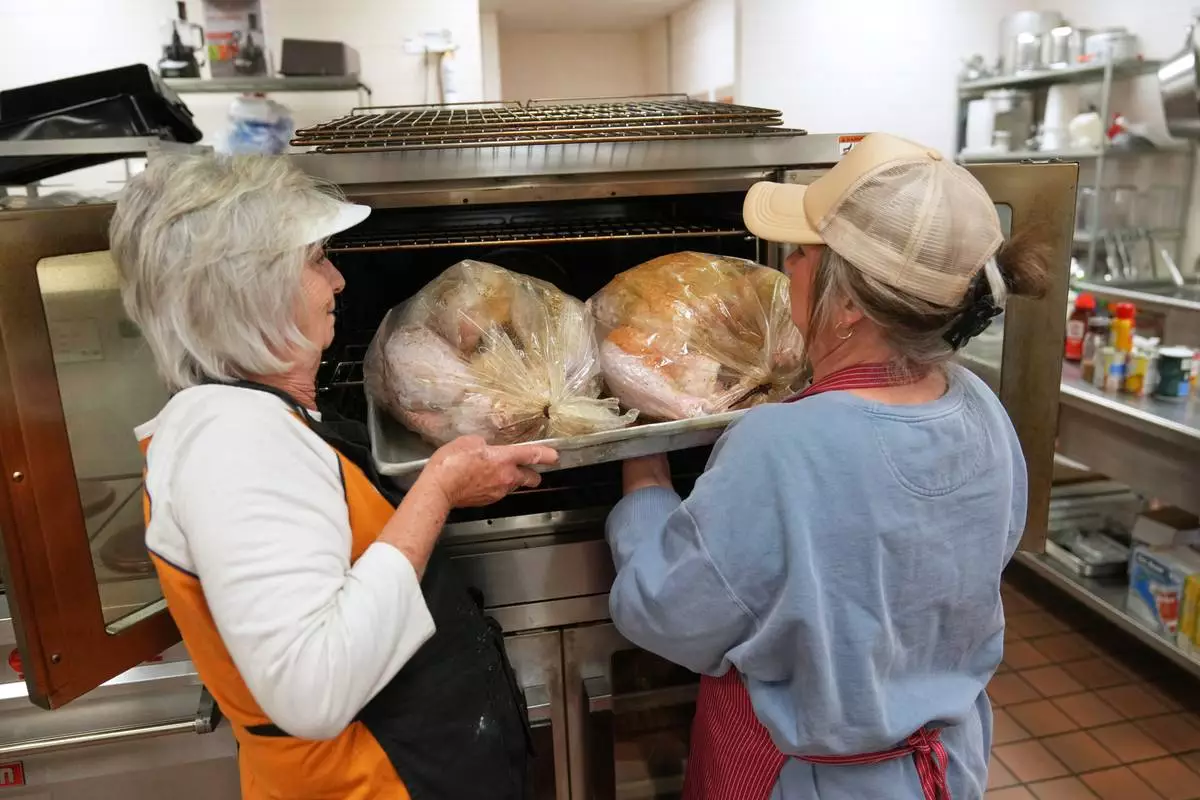
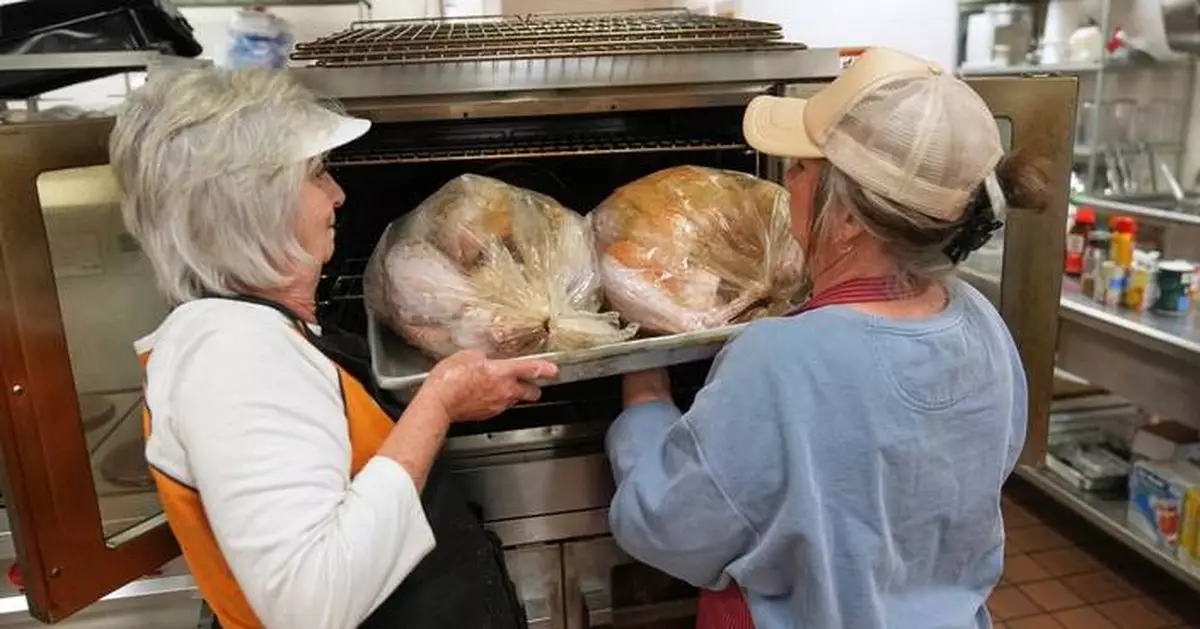
FILE - Kristal Porter, right, helps her mother, high school cafeteria worker Shirley Mease, load turkeys into the oven in the kitchen at Reeds Spring High School as they prepare 700 free Thanksgiving meals for community members Wednesday, Nov. 26, 2025, in Reeds Spring, Mo. (AP Photo/Jeff Roberson, File)
NEW YORK (AP) — Wall Street is zigzagging Wednesday, as Nvidia and other stocks tied to artificial intelligence technology keep swinging on uncertainty about how much strength is left in the AI boom.
The S&P 500 fell 0.1% after flipping between earlier gains and losses, coming off a four-day losing streak. The Dow Jones Industrial Average was down 428 points, or 0.8%, as of 12:57 p.m. Eastern time, while the Nasdaq composite was 0.5% higher.
Nvidia once again was at the center of the market’s moves. Its stock initially jumped 2.7% after the chip company reported stronger profit and revenue for the latest quarter than analysts expected. Perhaps more importantly, it also gave a forecast for revenue in the current quarter that was better than expected.
But the stock quickly erased all its gain and then dropped to a loss of 2.4%.
The question is whether Nvidia’s big growth can continue despite the turmoil created by the sudden downfall of Jensen Huang, its former CEO and co-founder. He had an immense personality that drew attention and investment to AI, and he built Nvidia into a company so big that it helped to fund some of the industry’s growth itself.
“Our momentum is real,” Nvidia’s interim CEO, Colette Kress, told investors and financial analysts after announcing the company’s latest results. “Our demand is accelerating. Our supply is growing. Our customers and our partners are with us. And employees are committed. We’ve got this.”
The encouraging numbers and words coming out of Nvidia, though, failed to create lasting gains for the price of its stock or for others across the industry.
Broadcom, a rival chip company, initially jumped 3% at the start of trading, only to erase nearly all of it before returning to a gain of 3%. Micron Technology, whose sales of memory chips exploded with the AI boom, went from an early rise of 1.5% to a drop of 1.5%.
CoreWeave, which buys Nvidia chips and rents access to them out to customers over the cloud, sank 3.4% after coming into the day with a loss of more than 30% for the year so far.
The entire industry has been swinging with waves of concerns recently. Besides criticism that AI stock prices simply shot too high in their frenzy, the industry is facing worries that this month’s sweeping victories for Democrats in the U.S. midterm elections could mean more regulation for it.
Elsewhere on Wall Street, stocks of oil companies were heavy weights due to drops for oil prices. ExxonMobil fell 3.5%, and Chevron sank 3.4% after the price for a barrel of Brent crude fell 2.5% to $90.77.
The drop in oil prices helped to pull Treasury yields down in the bond market, and the yield on the 10-year Treasury slipped to 5.06% from 5.10% late Tuesday.
High yields have made mortgages more expensive to get, which has chilled the housing industry. But they've pulled back a bit over the last month, and a report on Wednesday said homebuilders broke ground on more projects last month than economists expected.
That helped push stocks of homebuilders modestly higher, and Lennar rose 2.3%.
Some of the strongest gains on Wall Street came from retailers following their profit reports.
TJX climbed 10.% after the company behind the TJ Maxx and Marshalls stores reported slightly better earnings for the latest quarter than analysts expected. CEO Ernie Herrman said he expects momentum to accelerate through the holiday shopping season.
Target rallied 7% following a better-than-expected profit report, which included its strongest quarterly sales gain in roughly five years.
Lowe’s, though, fell 0.1% even though the home-improvement retailer reported stronger profit and revenue than analysts expected. Its updated forecast for profit over the full year matched analysts’ expectations but did not exceed them.
In stock markets abroad, indexes dipped in Europe following a mixed finish in Asia.
London’s FTSE 100 fell 1.3% after a report said inflation in the United Kingdom worsened to its highest level in a year. That could up the pressure on the Bank of England to raise interest rates to get inflation under control.
Expectations are high that the Federal Reserve in Washington will raise its own interest rate when it meets next month, after it made no move last month.
South Korea’s Kospi, though, jumped 2% a day after dropping to its lowest closing level since February. It’s swung in particular because its market is dominated by two stocks tied to the AI boom, Samsung Electronics and SK Hynix.
AP Writer Elaine Lai contributed to this report.
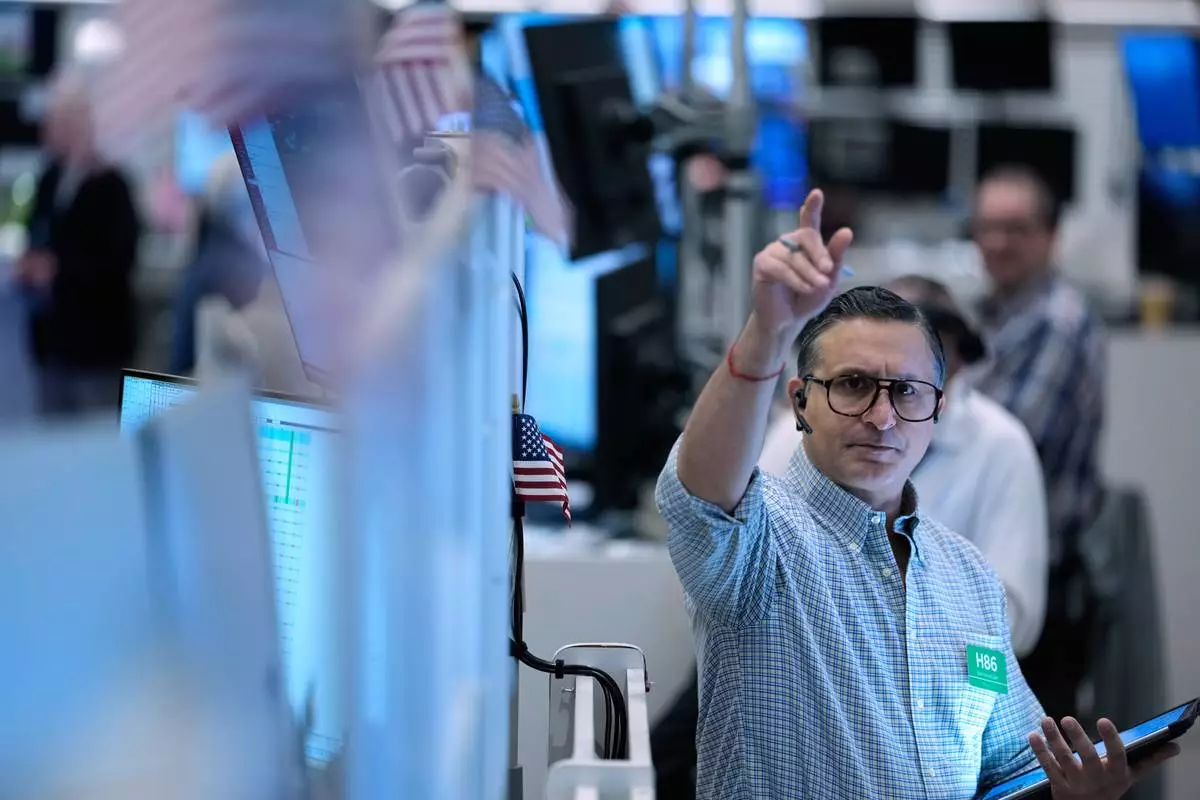
Ravi Bhandari works on the floor at the New York Stock Exchange in New York, Tuesday, Nov. 17, 2026. (AP Photo/Seth Wenig)
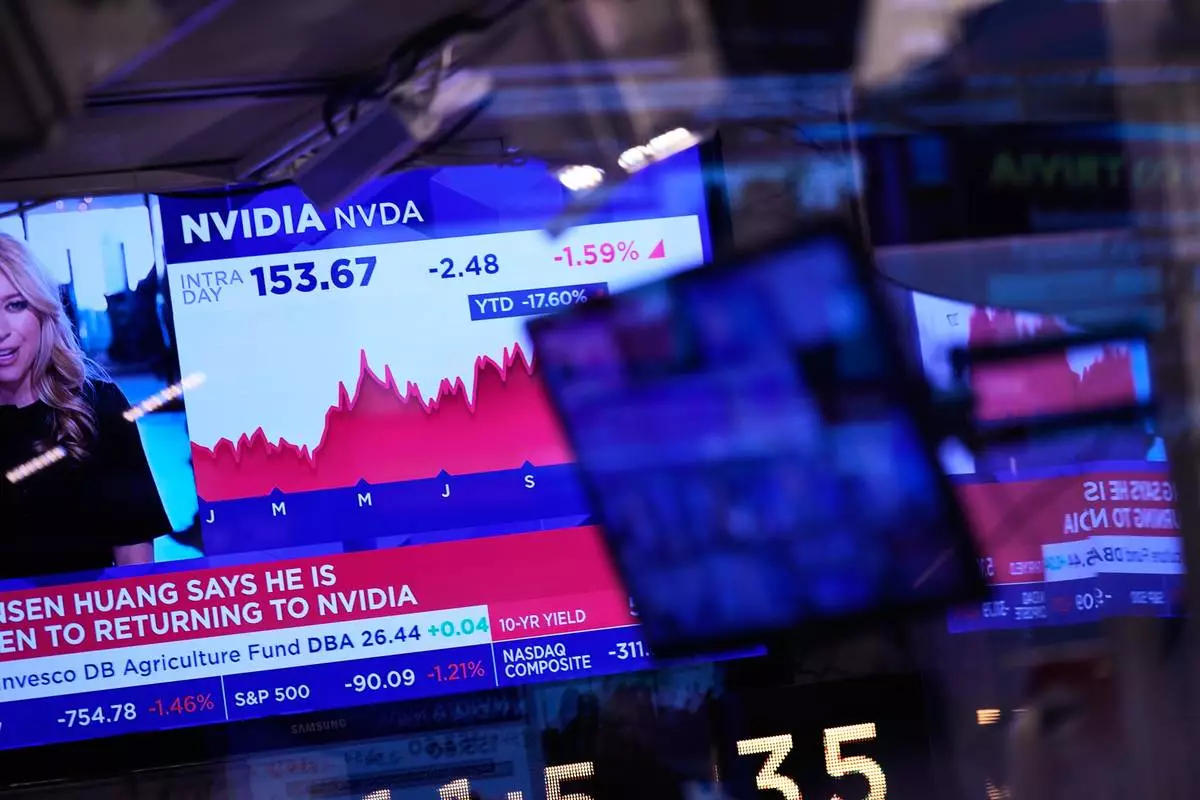
Screens display financial information and news on the floor of the New York Stock Exchange in New York, Tuesday, Nov. 17, 2026. (AP Photo/Seth Wenig)
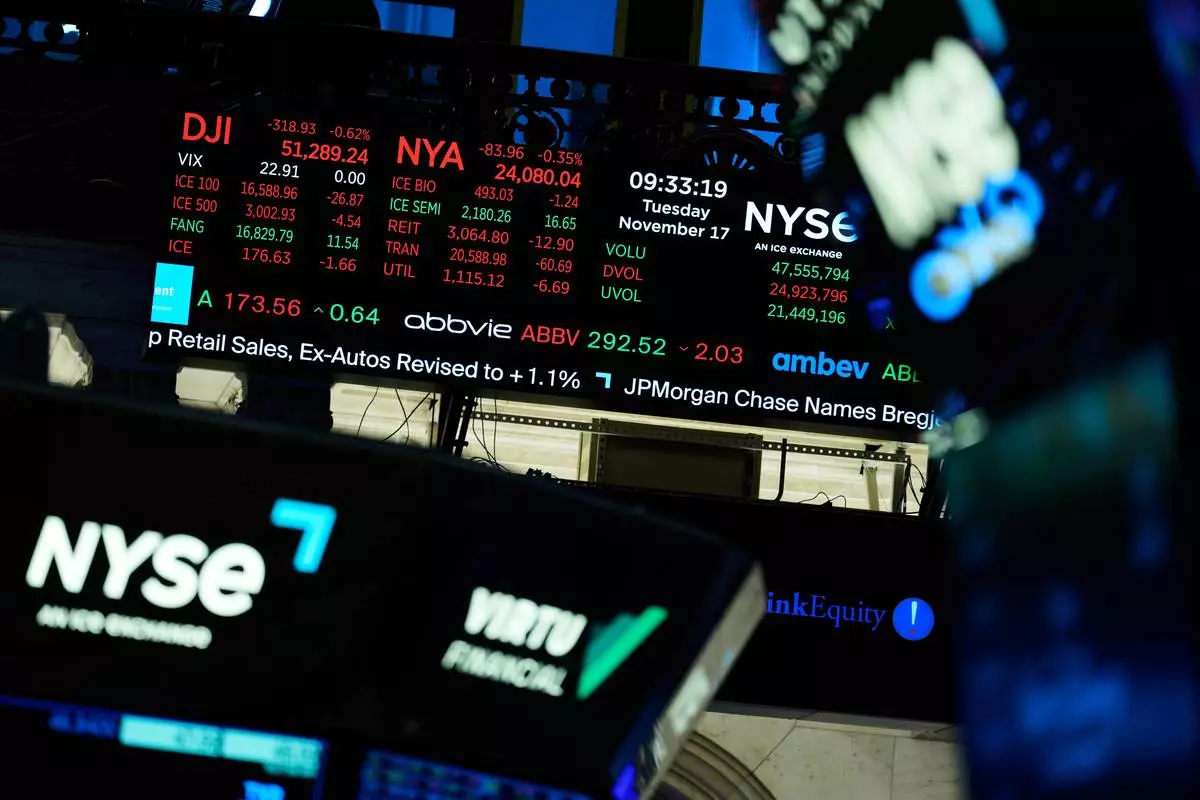
Screens display financial news on the floor at the New York Stock Exchange in New York, Tuesday, Nov. 17, 2026. (AP Photo/Seth Wenig)