NEW YORK (AP) — For a filmmaker who very nearly died and who’s living in exile from his home country, Russia, Andrey Zvyagintsev can be quite funny.
Asked whether it was difficult for him, after resolving not to return to Russia following the invasion of Ukraine, to move his family to France, he doesn't hesitate.
“No, it was easy to pick the country because France has final cut for the directors,” Zvyagintsev says with a laugh before adding: “Only half joke.”
Few filmmakers have been through more over the last few years than Zvyagintsev, the leading Russian filmmaker of the Oscar-nominated films “Leviathan” and “Loveless.” Even while his films subtly but unmistakably critiqued insidious corruption within Vladimir Putin’s Russia — Russia’s Culture Minister claimed “Leviathan” “openly spit” on the government — Zvyagintsev continued living and working in Russia.
But in 2021, his life changed. After receiving the Sputnik V COVID-19 vaccine in 2021, Zvyagintsev became seriously ill and was put into a medically induced coma.
“I woke up in September ’21 after 40 days of coma. When I was conscious, I realized that I can’t do this,” said Zvyagintsev, snapping his fingers, in a recent interview. “My arms were not listening to me.”
“When I realized I couldn’t move my hands or feet, I thought: What am I going to do?” he says, speaking through an interpreter. “I had suicidal thoughts. What do I live for if I can’t make a movie?”
Now healthy and energetic, Zvyagintsev smiles as he looks out the second-floor windows of Lincoln Center. “Now it’s a different picture, eh?”
“Minotaur,” Zvyagintsev’s latest film and first in nine years, opens in theaters Friday. It’s been celebrated as a rare, unvarnished dramatization of Russian society during the war with Ukraine. In Cannes, “Minotaur” was awarded the Grand Prix. For the Oscars, it’s France’s — not Russia’s — submission for best international film.
Zvyagintsev, 62, ultimately spent 11 months in the hospital. It took five procedures to heal him of Guillain-Barré syndrome. In the midst of his illness, he was transferred to Germany. There, his wife informed him of the Russian invasion of Ukraine.
“I was horizontal. I couldn’t even speak. In this state of being, I discovered the war started,” he says. “That day or the next day, we decided we cannot be associated with what the country was doing. We needed to figure out where we’d live.”
Since Russia launched its war with Ukraine, Russia has heavily censored films released there theatrically, programming only state-approved movies. Hollywood has largely ceased playing its films there.
“Minotaur,” filmed in Latvia, is a domestic crime drama, but it’s set against a backdrop of the war's beginning. Russian men are being conscripted and sent south. Few expect them to return.
Loosely adapted from Claude Chabrol’s 1969 film, “The Unfaithful Wife,” “Minotaur” follows a provincial executive Gleb (Dmitriy Mazurov), who learns that his wife, Galina (Iris Lebedeva), is having an affair. The murderous fallout dovetails with Gleb’s need to meet a conscription quota, and hand in a list of employees to be swept into the military.
“In Russia, for many, many years, there will be no movies like this,” says Zvyagintsev. “It’s impossible even to imagine. Outside of Russia, maybe. So we understood we had certain responsibilities to those who are anti-war and have to be silent. It’s impossible to speak up there.”
Zvyagintsev and his family now live in France, which last year also adopted the cause of Iranian filmmaker Jafar Panahi's Palme d’Or-winning film, “It Was Just an Accident,” as an Oscar submission. Final cut wasn't the only allure; Zvyagintsev’s son previously studied in France. Still, he calls France “the Mecca of cinema.”
“I speak Russian and not French. I made a movie about my Russian problems,” Zvyagintsev says. “So for me, this gesture means the French have the kind heart and soul of acceptance.”
Accepting his prize in Cannes, Zvyagintsev pleaded from the stage for Putin to end the war in Ukraine, saying that “millions of people on both sides of the front line have only one dream — that the countless killings will finally stop.”
In September, Russia’s Justice Ministry added Zvyagintsev to the country’s list of “foreign agents,” claiming that he “disseminated inaccurate information about decisions made by Russian public authorities.”
Lebedeva, a Russian actor living in Dubai, was astounded by Zvyagintsev’s zeal for moviemaking so soon after his near-death experience.
“He feels alive when he’s working. He was so happy each day. I felt so much energy from him. I can’t imagine one year before he was in a wheelchair,” says Lebedeva. “He’s like a phoenix, born out of the fire.”
The centerpiece scene of “Minotaur” involves a murder and the disposal of a body in broad daylight. In a large courtyard flanked by apartment windows, a body wrapped in a rug is dropped several stories. At the suggestion that the scene reflects that the world is a witness to Russia’s war in Ukraine, Zvyagintsev lights up.
“This is very, very good metaphor,” he says. “With your permission, I will use it.”
“For a very long time, in Russia, people would use blinders,” Zvyagintsev says. “They could not believe it. They’d keep saying: It’s fake. It’s a provocation. Nothing is happening. They would believe and trust the TV and not believe the objective realities that independent sources would tell them.”
But while “Minotaur” ends with the ominous drumbeat of war, it’s not merely a political screed. As in Zvyagintsev’s previous films, its attention is deftly trained on the lives of individuals, and the choices they make, amid much larger forces.
“There was nothing to emphasize, there was nothing to shout out loud,” he says. “You just put a mirror up and show what’s really going on there.”
Zvyagintsev is now more fixated than ever on making movies. His close encounter with death has bred a new urgency.
“Returning to life taught me: I want to be faster now. Postponing is no longer for me. One after another,” Zvyagintsev says, snapping the fingers he couldn’t move three years ago.
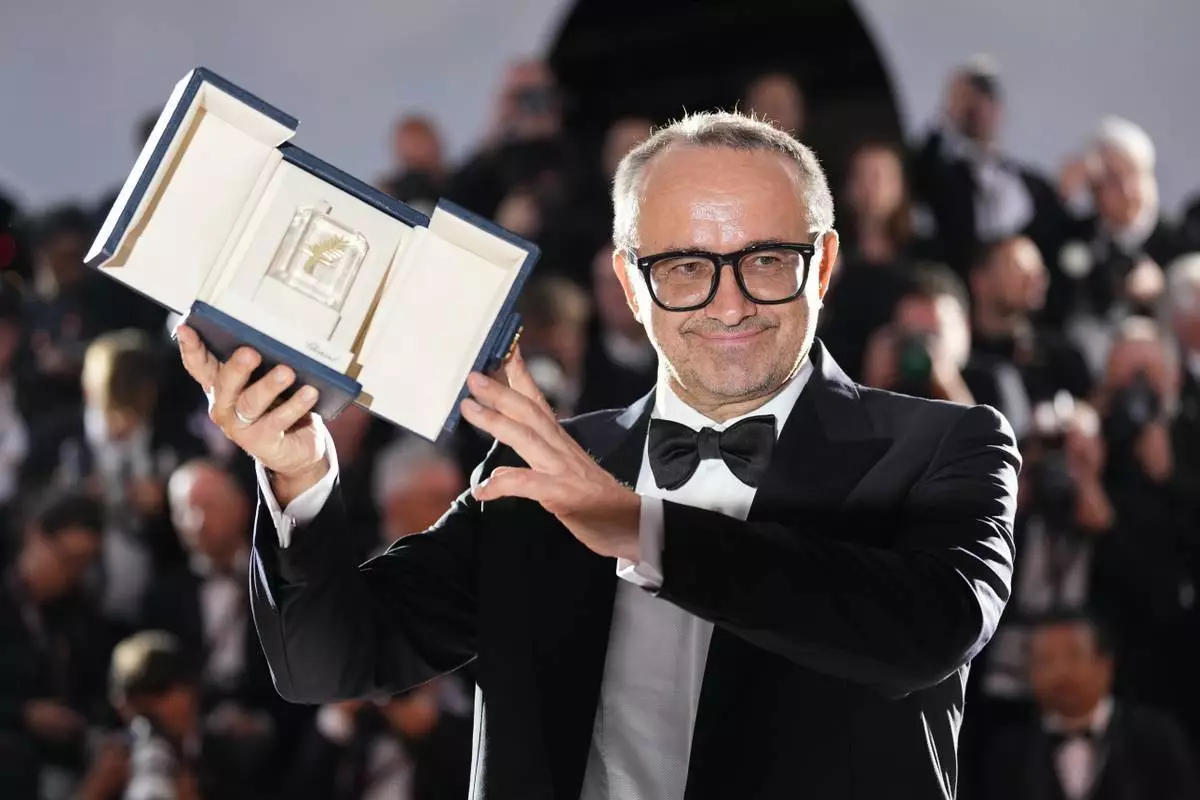
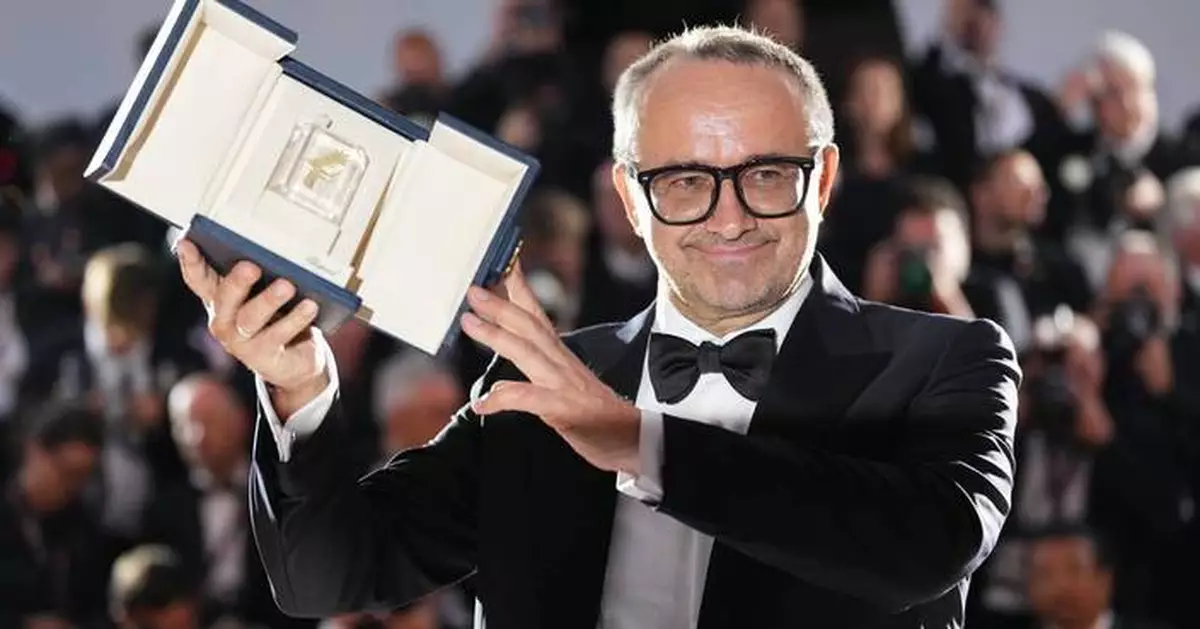
FILE - Andrey Zvyagintsev, winner of the grand prize for "Minotaur," poses at the awards ceremony photocall during the 79th international film festival, Cannes, southern France, on May 23, 2026. (Photo by Scott A Garfitt/Invision/AP, File)