Remarks by CE at media session in Shenzhen
The Chief Executive, Mr John Lee, met the media in Shenzhen this afternoon (November 19) during his attendance at the Asia-Pacific Economic Cooperation (APEC) Economic Leaders' Meeting and other related activities. Following are Mr Lee's remarks:
Reporter: My first question is, what do you see, or expect to be, Hong Kong's biggest achievement and takeaway at this year's event? Hong Kong is serving its dual role as a "super connector" and a "super value-adder". How would you explain this important concept to our global audience, especially in terms of the SAR's integration into the overall national development of China and the Greater Bay Area?
Chief Executive: We have been actively participating. I think we have achieved five results.
First, contributing Hong Kong's strength by actively participating in and supporting our country's successful hosting of the APEC meetings. The Hong Kong SAR (Special Administrative Region) has a dual role on this occasion. Hong Kong, China is an APEC member, and I am, at the same time, an official of China, our country. Therefore, we should take an active role in assisting our country's successful hosting of this year's APEC meetings. Therefore, Hong Kong, China actively attended and organised meetings and workshops, and launched a series of capacity-building projects. For this week's APEC Economic Leaders' Week, Hong Kong has sent its largest-ever delegation of over 50 members.
Second, deepening exchanges with APEC member economies. APEC member economies are Hong Kong's important trading partners, accounting for 87 per cent of Hong Kong's external trade. Through APEC meetings and events, I exchanged views with leaders of various economies. Through bilateral meetings and engagements, I met with the leaders of seven economies: Malaysia, Vietnam, Brunei, Thailand, Chile, Peru and Singapore to strengthen ties and discuss issues of mutual concern.
Third, consolidating relations with ASEAN (Association of Southeast Asian Nations) member states. Seven ASEAN member states are APEC members. ASEAN is Hong Kong's second-largest trading partner. The APEC meetings provided me with the opportunity to meet with five ASEAN leaders at bilateral meetings and engagements to further consolidate our relations.
Fourth, further exploring emerging markets. The Hong Kong SAR Government is actively expanding Hong Kong's economic and trade network, and expanding and exploring different markets, especially on strengthening ties with emerging markets and economies with growth potential. Yesterday, the President of Chile and I jointly witnessed the signing of the Working Holiday Scheme agreement between Hong Kong and Chile.
Fifth, telling good stories of the Greater Bay Area (GBA) and Hong Kong. The successful hosting of APEC meetings in Shenzhen, a core city of the Greater Bay Area, fully demonstrated the GBA's strength and charm as a window for the country's high-standard opening up. At the APEC CEO Summit on Tuesday, I seized the opportunity to promote the development opportunities of the GBA and Hong Kong's unique advantages, and I also discussed GBA opportunities with participating leaders.
My takeaway is that Hong Kong's development resonates with our country's development. As an international city and international financial centre, we can serve the country's needs with our unique advantages and what Hong Kong does best. We are pressing ahead with four centres development and one hub development, contributing to our country's high-quality development. Therefore, we shall actively integrate with and serve our national development, and at the same time, we will strengthen our connectivity with the international world.
On connectivity, Hong Kong can continue to leverage our unique advantages under the "one country, two systems" principle to play an active role as a "super connector" and "super value-adder". We can make full use of APEC and other international platforms to showcase the HKSAR as an international hub. The 2026 APEC Finance Ministers' Meeting in the HKSAR actually demonstrated our unique advantage in this regard. We can also expand the global trade and investment network. Through our 15 overseas ETOs (Economic and Trade Offices), together with Hong Kong Trade Development Council and Invest Hong Kong offices, our network covers 68 cities and 129 countries. We will deepen engagement with emerging economies in ASEAN (Association of Southeast Asian Nations), the Middle East, Central Asia and South America, pursue early RCEP (Regional Comprehensive Economic Partnership) accession, and aim at reaching more free trade agreements and investment promotion and protection agreements. I think we can also leverage Hong Kong's status as an international centre to contribute to the country's high-quality development. We will press ahead with the development of the "four centres and one hub" to serve the country's high-level opening up.
As regards deepening our integration into national development, first of all, I think we can deepen Greater Bay Area development through hard and soft connectivity and connectivity of hearts, and take forward the Northern Metropolis development for integrating into national development. Second, we can contribute to Belt and Road co-operation. Third, we can, through the GoGlobal Task Force (Task Force on Supporting Mainland Enterprises in Going Global), support Mainland enterprises in leveraging Hong Kong's world-class professional services and extensive global network, and using Hong Kong as a springboard to expand into global markets. Thank you.
(Please also refer to the Chinese portion of the remarks.)
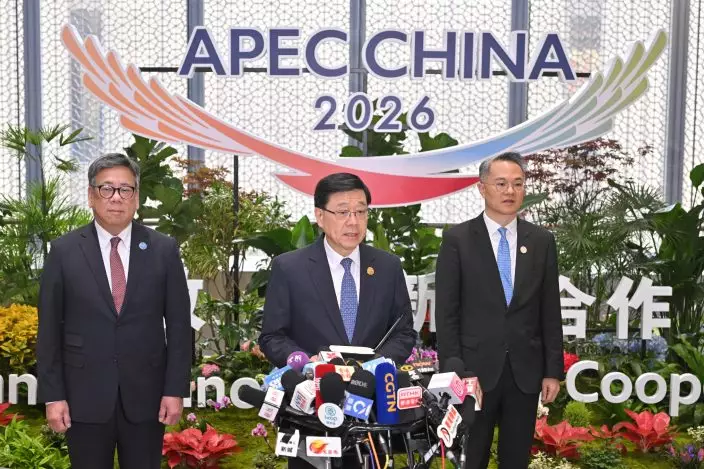
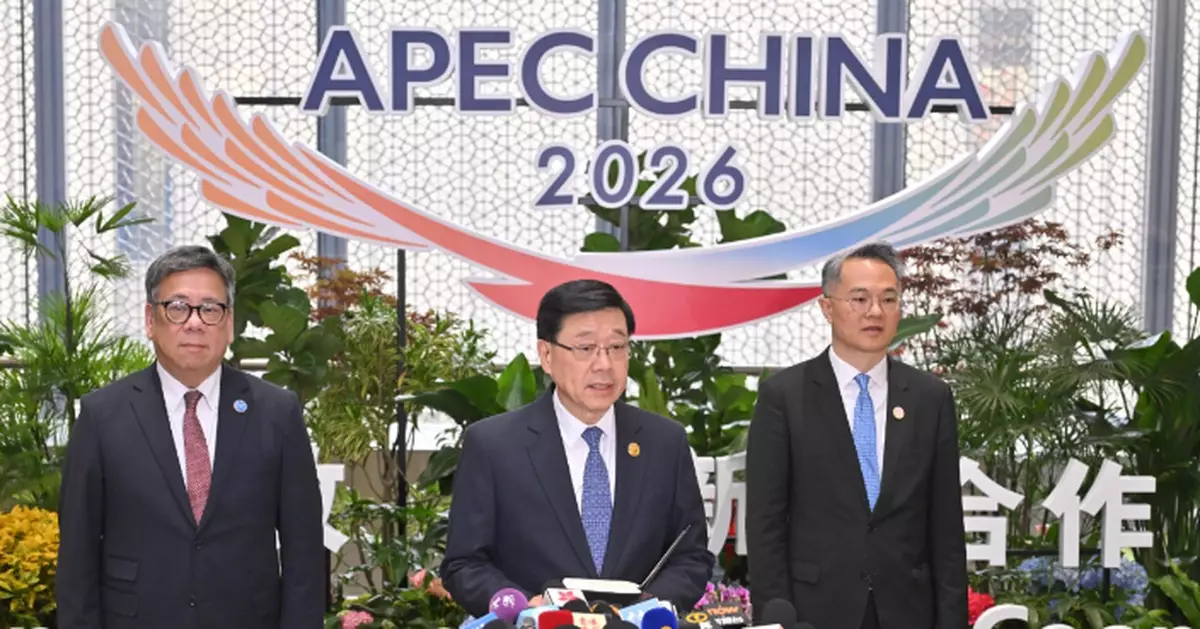
The Chief Executive, Mr John Lee (centre), accompanied by the Secretary for Commerce and Economic Development, Mr Algernon Yau (left), and the Director-General of Trade and Industry, Mr Aaron Liu (right), meets the media in Shenzhen today (November 19). Source: HKSAR Government Press Releases
Voters to follow voting procedures in 2026 Election Committee Subsector Ordinary Elections to be held this Sunday (with video)
The 2026 Election Committee Subsector Ordinary Elections will be held this Sunday (November 22) with polling hours from 9am to 6pm. The Registration and Electoral Office (REO) reminds voters/authorised representatives (ARs) concerned to follow the instructions on their poll card and bring the original of their valid Hong Kong identity (HKID) card to vote at their designated polling station.
A spokesman for the REO said today (November 19), "In accordance with the law, only registered voters/ARs in the 2026 final register of voters for Election Committee subsectors who belong to the 31 contested subsectors are eligible to vote on the polling day. The voters/ARs of these subsectors may use 'iAM Smart' or the voter registration website (vr.gov.hk) to log in to the Online Voter Information Enquiry System to check polling information such as the name and address of their designated polling station and its location on the map, the polling hours, as well as the Introduction to Candidates. They can also call the election hotline (2891 1001) for enquiries. A video introducing the voting procedures has been uploaded to the election website (www.elections.gov.hk)."
On the polling day, a total of 856 candidates will contest 723 seats in 31 subsectors.Five ordinary polling stations (OPSs) located at Harbour Road Sports Centre, Kowloon Park Sports Centre, Tsuen Wan Sports Centre, Tiu Keng Leng Sports Centre and Che Kung Temple Sports Centre, and two dedicated polling stations located at Happy Valley Police Station and Shek Pik Prison will be set up for voters/ARs of the contested subsectors to cast their votes.
Polling arrangements
The OPSs will make use of the Electronic Poll Register (EPR) System to issue ballot papers for the elections. Voters/ARs must produce the original of their valid HKID card at the ballot paper issuing desk in the polling station. The polling staff will scan the HKID card of the voters/ARs using a tablet of the EPR System to verify their identity and issue the ballot paper(s) upon verification.
When marking the ballot paper, voters/ARs must use the pen provided at the polling station to shade the ovals to the left of their chosen candidates' names. The number of chosen candidates should be no more than the prescribed number of seats to be elected by the relevant subsector, or the ballot paper will be regarded as invalid.
The spokesman said, "Ballot paper checking machines will be available at the polling stations for voters/ARs to check whether they have marked their ballot paper(s) properly in accordance with electoral laws. The ballot paper checking machines will not record or count choices marked on the ballot papers. After checking, the voters/ARs should turn the ballot paper so the marked side faces down and put the unfolded ballot paper directly into the ballot box. It is in principle alright for voters/ARs to bring along a piece of paper listing the names or numbers of the candidates of their choice for easy reference when marking the ballot papers. Nevertheless, voters/ARs should bear in mind that they should not show the paper to other people inside the polling station and they should take the paper with them when leaving the polling station. Otherwise, the voters/ARs concerned may violate the electoral laws," the spokesman said.
Based on the principles of the autonomy of voting and secrecy of votes, it is prohibited under the law to have anyone (even the voter/AR's relative or friend) accompany or assist voters to cast their vote(s). If necessary, voters/ARs may, in accordance with the law, ask the Presiding Officer or his/her deputy to mark the ballot paper on the voters/ARs' behalf in the presence of a member of the polling staff as witness. It is an offence for any voter/AR to disturb others, use electronic devices for communication, take photographs, or make video or audio recordings at a polling station.
The spokesman said that the introduction booklets on candidates printed by the REO will be displayed at all polling stations for reference by voters/ARs.
Special arrangements at polling stations
Two queues will be set up at the polling stations. One queue is for people aged 70 or above, pregnant women and persons who are unable to queue for a long time due to physical conditions, while another queue is for other voters/ARs. The Presiding Officers will flexibly deploy ballot paper issuing desks depending on the queuing situation.
A certain area outside each polling station will be designated as a no canvassing zone to ensure that voters/ARs can gain access to the polling stations without interference. No one is allowed to canvass for votes or conduct "de-facto canvassing" such as making hand gestures and greetings in the no canvassing zone.A no staying zone will also be designated in the vicinity of the entrance and exit of a polling station. No one is allowed to stay in the no staying zone.
Enquiries about the elections on the polling day can be made to the election hotline at 2891 1001, which will operate from 8.30am to 6.30pm that day. A complaint hotline (2827 7251/3707 0188) will be in service from 8.30am to 7pm that day to handle complaints about breaches of electoral rules or guidelines.
Counting arrangements
Central counting will be adopted for the elections. Once the poll is closed, the ballot boxes will be delivered to the Central Counting Station (CCS) at the Hong Kong Convention and Exhibition Centre for counting. Candidates, election agents and counting agents may enter the CCS to observe the count at designated areas of the counting zone. Members of the public and media may also enter the CCS to observe the count but they are not allowed to enter the counting zone. A notice setting out the maximum capacity of members of the public in the public area will be displayed outside the CCS.
Once the counting of votes of a subsector is completed and verified by the REO, the Returning Officer will make known the counting and election results to the candidates and their agents present at the tables for determination of questionable ballot papers at the CCS. Also, the elected candidates will be invited to receive applause on the stage of the Media Centre (MC). The election results will be displayed outside the MC and published via press releases and the election website.
For enquiries, please call the election hotline on 2891 1001 or visit the election website for more information on the elections.
Source: AI-found images