China on Thursday launched the second batch of pilot projects for the innovative development of trusted data spaces, according to the National Data Administration (NDA).
A trusted data space serves as a channel for large-scale data circulation, providing a secure, trustworthy environment that is controllable, manageable and measurable for data flows and industrial applications.
China's 15th Five-Year Plan (2026–2030) explicitly calls for implementing an action plan for the development of trusted data spaces.
Compared with the first batch, the new round of pilots sharpens its focus on two-way empowerment between data and artificial intelligence (AI). Under strict security and access controls, data from more enterprises and sectors will be unlocked to expand the pool of high-quality training and inference data for AI models.
The pilots also break new ground in market mechanism design. They will test usage-based billing and revenue-sharing models tied to token consumption or real application outcomes, aiming to build self-sustaining commercial loops and drive coordinated innovation across data resources, AI models and real-world scenarios.

China launches new batch of pilot projects for trusted data spaces
A train loaded with about 200 Chinese-made new energy vehicles rolled out of the Zhengzhou International Land Port in central China's Henan Province on Thursday, marking the 10,000th trip by specialized freight trains carrying vehicles for export.
The vehicles will be transported by rail to Minhang Railway Station in Shanghai, where they will be loaded onto a roll-on/roll-off vessel at the city's port. They are expected to reach Australia in roughly 14 days, covering a journey of over 10,000 kilometers.
"Since 2021, freight trains for exporting domestically made vehicles have been in regular operation. In about four years, 5,000 trips were made, while it took only a little over a year to go from 5,000 to the current 10,000, with growth in export volumes clearly accelerating," said Wang Xiaolu, said Wang Xiaolu, project leader of the Market Department of China Railway Special Cargo Logistics.
To keep pace with rising demand, the company has accelerated both its cross-border rail services and rail-sea routes, with regular export lines now running through land ports including Horgos and the Alataw Pass on the Kazakh border and Manzhouli on the Russian border.
Farther south, cross-border trains on the China-Laos Railway provide stable, direct access to Southeast Asian markets.
"In our hub alone, three to four special trains dedicated to vehicle exports run regularly every day, and 700 to 1,000 vehicles bound for export are transported daily," said Zhao Ruijie, deputy Party secretary of Henan International Logistics Hub Construction and Operation.
More than 2 million vehicles destined for overseas markets have been transported by rail so far this year, up 79 percent from a year earlier, as an increasing number of specialized trains carry Chinese-made vehicles to global markets with faster delivery times and lower costs.
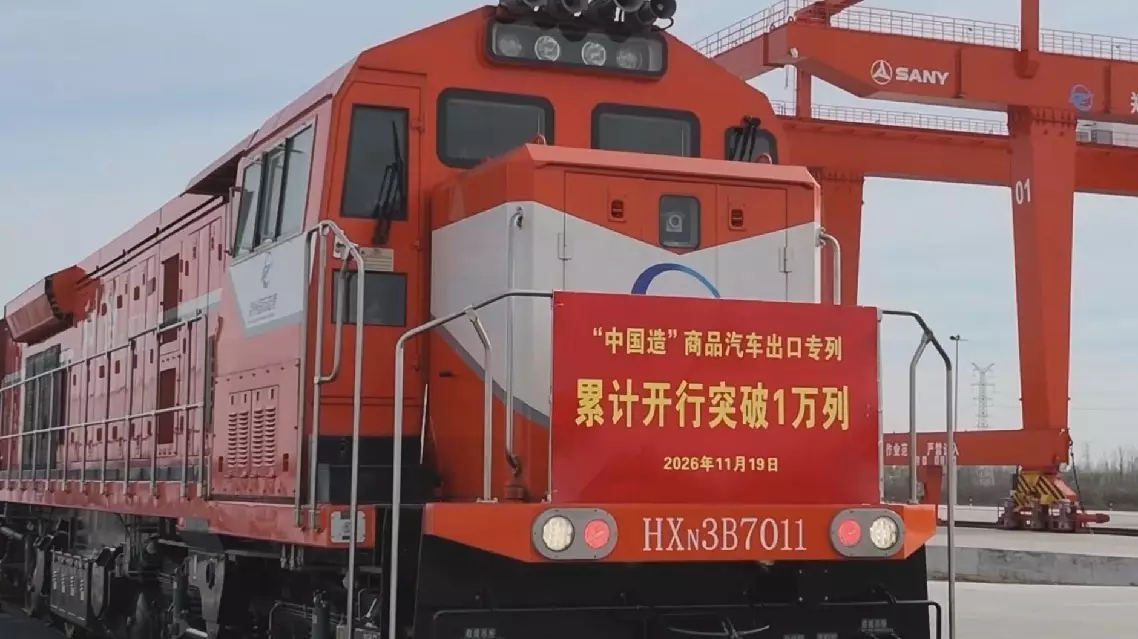
China's specialized freight trains for vehicle exports reach 10,000 trips