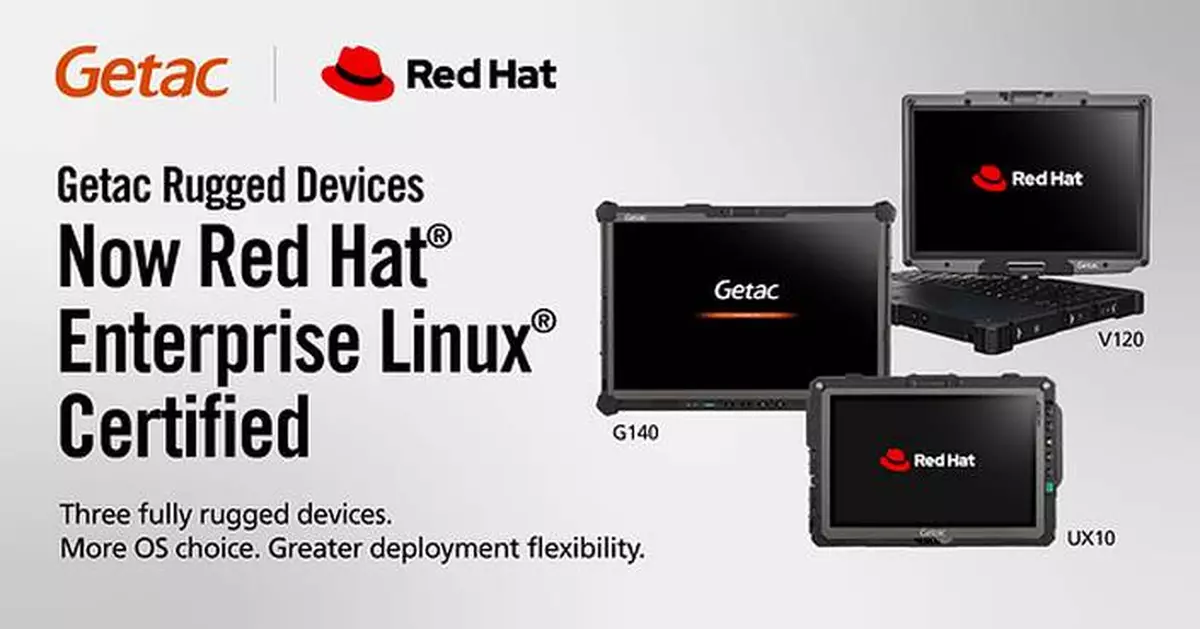
Customers can now run Red Hat Enterprise Linux on Getac's UX10, G140, and V120 models, depending on their operational and IT requirements
News in brief:
- Getac's UX10, G140, and V120 models are now certified on Red Hat Enterprise Linux and listed in the Red Hat Ecosystem Catalog.
- Customers can install and deploy Red Hat Enterprise Linux on these devices after delivery, with confidence that the hardware has been tested and certified for compatibility.
- This announcement helps organisations in highly regulated industries such as defence, public safety and utilities extend their security and compliance standards to the edge, with greater flexibility in choosing the rugged solutions that support them.
TAIPEI, Nov. 20, 2026 /PRNewswire/ -- Getac Technology Corporation (Getac), a leading provider of rugged computing and mobile video solutions and a manufacturer with advanced in-house capabilities, today announced that three of its flagship fully rugged devices – UX10, G140, and V120 – have achieved Red Hat® Enterprise Linux® hardware certification.
With Red Hat Enterprise Linux and Windows both supported on the same hardware, IT teams can match each deployment to its operational and compliance requirements while maintaining a consistent fleet of rugged devices. Red Hat Enterprise Linux is installed by the customer, allowing IT teams to deploy it in line with their own configuration and security policies.
The three devices are certified for Red Hat Enterprise Linux 10.2 and later 10.x versions:
- The UX10 10.1-inch fully rugged tablet
- The G140 14-inch fully rugged tablet
- The V120 12.2-inch fully rugged laptop
Security-focused, fully rugged IT foundation
Organisations in defence, public safety and utilities must protect sensitive data and meet strict security standards, right out to the field. The combination of Red Hat Enterprise Linux and Getac technology gives these security-conscious organisations an enterprise-grade, highly customisable operating system on devices engineered for demanding field operations. Red Hat Enterprise Linux incorporates multiple layers of protection, including secure-by-default configurations, least-privilege access controls and security profiles that IT teams can apply at build time, helping deployments align with compliance and corporate policy requirements.
The extended support lifecycle of Red Hat Enterprise Linux also complements Getac's commitment to long-term device reliability, aligning with the procurement and deployment timelines common across defence and critical infrastructure. This helps organisations extend device service life and better manage total cost of ownership.
"Mission-critical operations don't stop at the network edge, and neither should the security standards that protect them. Our customers in defence, public safety and utilities shouldn't have to treat their field devices as an exception to the IT policies they enforce in the data centre," says James Hwang, President of Getac Technology Corporation. "With Red Hat Enterprise Linux certification, they can extend the same trusted platform from the server room to the frontline, on fully rugged hardware built for the conditions they work in."
For more information, please visit www.getac.com
About Getac
Getac Technology Corporation is a global leader in AI-capable rugged mobile technology and intelligent video solutions, including laptops, tablets, software, body-worn cameras, in-car video systems, digital evidence management and enterprise video analytics solutions. Getac's solutions and services are designed to enable extraordinary experiences for frontline workers in challenging environments. Today, Getac serves customers in over 100 countries spanning defence, public safety, ambulance, fire & rescue, utilities, automotive, natural resources, manufacturing, transport, and logistics. Getac was recognized as one of Newsweek's "World's Most Trustworthy Companies" for 2024. For more information, visit: https://www.getac.com. Participate in the Getac Industry blog or follow the company on LinkedIn and YouTube.
Getac and Getac logo are trademarks of Getac Holdings Corporation or its affiliates. Red Hat, Red Hat Enterprise Linux and the Red Hat logo are trademarks or registered trademarks of Red Hat, LLC or its subsidiaries in the U.S. and other countries. Linux® is the registered trademark of Linus Torvalds in the U.S. and other countries. Other brands or trademarks are the property of their respective owners. ©2026 Getac Technology Corporation.
** This press release is distributed by PR Newswire through automated distribution system, for which the client assumes full responsibility. **
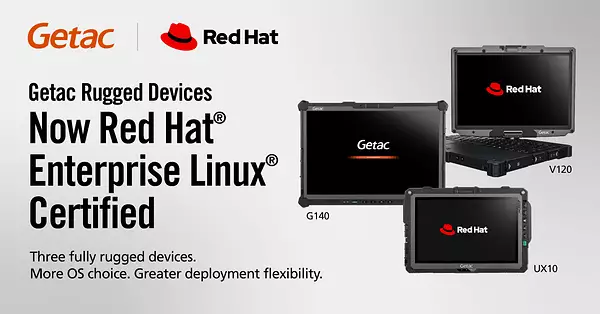
Getac Expands OS Choice for Highly Regulated Industries with Red Hat® Enterprise Linux® Certification Across Three Fully Rugged Devices
Powered by Open Hybrid AI Infrastructure and Three Intelligent Factories, Huawei Helps Global Financial Institutions Build Differentiated Competitive Advantages
SINGAPORE, Nov. 20, 2026 /PRNewswire/ -- At SFF 2026, Huawei shared insights on "Accelerating Financial AI at Scale, Advancing Agentic Finance" with global financial institutions and industry partners, showcasing its technologies and solutions.
Jason Cao, CEO of Huawei Digital Finance, and Alvin Feng, President of Huawei International Financial BU, delivered keynotes on the Festival Stage and Frontier Stage. Huawei showcased solutions for resilient infrastructure, application modernization, insurance, securities, and central banks, plus joint solutions under the RONGHAI Financial Partner Program and achievements from its 4-Win ecosystem collaboration.
To Move from AI Adoption to AI at Scale, Financial Institutions Must Build Their Own AI Capabilities
The competitive focus in financial AI is shifting from model performance to enterprise-grade system capabilities. Financial institutions must be able to independently select, securely operate, replicate at scale, and continuously evolve their AI capabilities.
Jason Cao shared lessons from China's AI journey: an open ecosystem makes AI affordable; extreme engineering makes it effective; and commercialization at scale makes AI deeply integrated and reliable in business. He identified four characteristics among China's financial institutions: ongoing application modernization (Zero Legacy); hybrid infrastructure combining on-premises deployment and public cloud; enterprise-grade AI architecture for centralized development and management; and AI in core business workflows such as mobile banking, credit, and risk control, reshaping business processes to enhance competitiveness.
As AI evolves to understand intent, plan, and act proactively, customers and employees will rely on their own AI agents. Banks must ensure their financial services can be understood, connected, and invoked by these agents, while building an AI flywheel linking data, execution, learning, and feedback toward Customer-AI-Friendly Finance.
Huawei is exploring a "Two Super Agents, Multiple Specialized Agents" architecture. The Customer Super Agent and Employee Super Agent understand user intent, deliver personalized services, and flexibly invoke specialized banking capabilities. Multiple Specialized Agents support domains such as credit, marketing, risk management, and wealth management through human-AI and multi-agent collaboration. Banks can turn expertise in compliance rules, credit judgment, marketing strategies, and risk management into invokable, reusable, continuously evolving AI capabilities. Through the Two Super Agents and Multiple Specialized Agents, Huawei helps banks connect customers and employees, coordinate business tasks, and continuously capture and refine expert intelligence to build self-evolving, enterprise-grade systems.
Cao said scaling AI for business growth requires hybrid infrastructure combining on-premises deployment and public cloud for flexible options, open architecture for technical agility, standardized engineering to build and replicate AI efficiently, and proven knowledge, skills, and agent capabilities as shared assets for reuse across teams and scenarios. He stressed that financial institutions must own their data, knowledge, and business logic—the core assets underpinning differentiated competitiveness—and integrate them deeply with business processes to create financial-grade AI capabilities.
Three Intelligent Factories on Open Hybrid AI Infrastructure Accelerate Production-Grade Deployment of Financial Agents
On the Frontier Stage, Alvin Feng delivered a keynote titled "Owning Your AI, Advancing Agentic Finance" and unveiled Huawei's Fintelligent AI Solution. He outlined an enterprise-grade framework to address security, sustainability, and scalability: open architecture for flexibility and continuous technological evolution; standardized engineering for mass production of AI agents; and shared assets for reuse across teams and scenarios.
Built on open hybrid AI infrastructure, the solution brings these capabilities together through three intelligent factories: the Agent Factory for agent development and governance; the Token Factory for full-lifecycle token operations; and the Data&Knowledge Factory for continuous, high-quality data and knowledge supply.
At the Huawei Finance Exhibition Area, Huawei showcased its capabilities and partner practices for scaling AI worldwide. With 16 years in finance, Huawei has served more than 7,100 financial customers, including 54 of the world's top 100 banks.
** This press release is distributed by PR Newswire through automated distribution system, for which the client assumes full responsibility. **
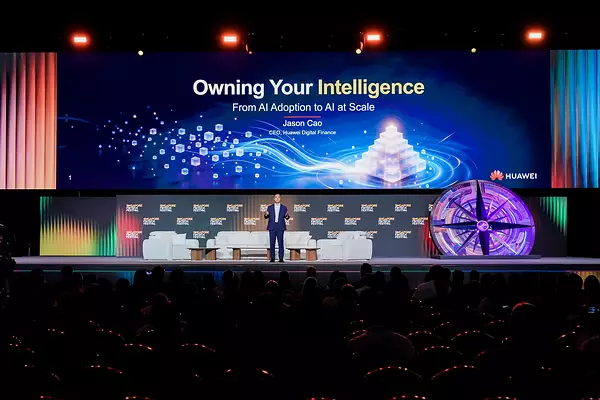
Huawei Unveils Financial AI Scaling Capabilities at Singapore FinTech Festival 2026