Speech by FS at Canadian Indo Pacific Business Summit
Following is the speech by the Financial Secretary, Mr Paul Chan, at the Canadian Indo Pacific Business Summit today (November 20):
Assistant Deputy Minister Epp (Assistant Deputy Minister for the Indo Pacific, Government of Canada, Mr Weldon Epp), Consul General Charles Reeve (Consul General of Canada to Hong Kong and Macao), Goldy (President and Chief Executive Officer of the Business Council of Canada, Mr Goldy Hyder), Brett (Executive Co-Convenor of the Canadian Chambers of the Indo Pacific, Mr Brett Stephenson), Adam (Executive Co-Convenor of the Canadian Chambers of the Indo Pacific, Dr Adam Janikowski), Rosemary (Chair of the Canadian Chamber of Commerce in Hong Kong, Ms Rosemary Goater), Chairs of the Canadian chambers of commerce across the region, distinguished guests, ladies and gentlemen,
Good morning, and welcome to Hong Kong. It is a great pleasure to join you at the first Canadian Indo Pacific Business Summit. We are honoured that the 21 Canadian chambers across the region, with their partners in Canada, have chosen Hong Kong as their host. You have timed it well too, in the same week that APEC (Asia-Pacific Economic Cooperation) leaders met just across the boundary in Shenzhen.
A long partnership
The ties between Canada and Hong Kong are long-standing and close. About 300 000 Canadians live here, one of the largest Canadian communities outside Canada. More than 200 000 people in Hong Kong are graduates of Canadian universities. Canadian companies have been in Hong Kong for well over a century, and two of them, Sun Life and Manulife, now account for nearly 40 per cent of the assets in our Mandatory Provident Fund system.
Canada looks to Asia
These ties matter more now, because Canada is widening its trade and investment across Asia. It has set the goal of doubling its exports to markets beyond the United States within a decade. In January, China and Canada established a new strategic partnership, and Canada aims to increase its exports to the Chinese Mainland by 50 per cent by 2030. Last week, Canada announced that it had substantially concluded free trade negotiations with ASEAN (Association of Southeast Asian Nations).
And in Shenzhen this week, on the sidelines of APEC, China and Canada agreed to expand mutual tariff relief and to extend their trade arrangement to the end of 2028. As Prime Minister Carney (Prime Minister of Canada, Mr Mark Carney) said the next day, the relationship is "growing on every front".
I had the pleasure of meeting Prime Minister Carney in Davos earlier this year. There, he said that Canada has what the world wants: energy, resources, talent and capital. A fast-growing Asia needs all four. And Hong Kong, as a "super connector" and "super value-adder", is where Canadian supply and Asian demand can meet.
So today, I would like to share with you where Hong Kong is heading, and where we can do more together.
Where Hong Kong is heading
Our economy is growing strongly. It expanded by 5.1 per cent over the first nine months, the fastest pace for that period in five years. Exports are leading the way: goods exports rose by 30 per cent in the third quarter, lifted by strong global demand for AI-related electronics.
Domestic demand remains solid, with private consumption up by 2.9 per cent and investment up by 7.5 per cent in the third quarter. We forecast growth of 4.8 per cent for the year as a whole.
Underlying inflation is low, at 1.7 per cent in the first nine months, and unemployment has edged down to 3.8 per cent. Home prices have risen by around 7 per cent this year, and the office market is stabilising. Capital keeps flowing in: bank deposits grew by nearly 8 per cent in the first nine months, to HK$21 trillion. Earlier this month, when global financial leaders met in Hong Kong, all expressed optimism about our prospects, and a number of them told us they intend to increase their investment and headcount here.
Business sentiment is positive, and we are cautiously optimistic about the outlook for 2027.
Behind these numbers are our enduring institutional strengths under the "one country, two systems" framework: bilingual common law system, a freely convertible currency with no exchange control, a simple and low tax regime, and a free port. Last month, the Fraser Institute in Vancouver again rated Hong Kong the freest economy in the world.
Our rule of law is recognised internationally. In the latest World Justice Project Rule of Law Index, Hong Kong ranks 24th among 143 jurisdictions, and in the global top 10 both for absence of corruption and for order and security.
Our development direction for the coming five years is set out in Hong Kong's First Five-Year Plan, published in September. It aligns with the National 15th Five-Year Plan, which supports Hong Kong's development as "four centres and one hub": international centres for finance, shipping, trade, and innovation and technology, plus an international hub for top talent.
In the interest of time, I would just highlight two major themes in the Plan: finance, and technology and innovation.
On finance, we are building a more complete range of funding options for businesses, from private equity, venture capital, patient capital to the equities market. In the first 10 months of this year, 121 companies listed on our stock exchange, raising over HK$400 billion. We are also going beyond equities into fixed income, gold and commodities, and will further strengthen our leading position in offshore Renminbi business.
On technology, AI is leading the way. It is not simply another sector; it is transforming existing industries.
Hong Kong's edge also rests on our synergy with the Greater Bay Area (GBA), which is one of the most competitive global innovation and technology hubs, supported by advanced manufacturing and commercialisation capabilities. For a new technology, the GBA is a testing ground, a production base and a market of 88 million people.
Our main platform for this collaboration is the Northern Metropolis on the border with Shenzhen. There, we are settling down the technology companies attracted to Hong Kong and building three university towns so that cutting-edge research, start-ups and industries can flourish side by side. A company can take an idea from the laboratory to the factory, and on to the market, without leaving the GBA.
A hotspot of this collaboration is Hetao, where a science park in Hong Kong and its sister park in Shenzhen work together across the Shenzhen River. There, we are piloting special policies to ease the flow of people, materials, capital and data between the two parks.
Consider biotechnology and medicine, where these flows matter most. A clinical trial depends on patients, samples and data. At Hetao, we have established a joint clinical trial platform with Shenzhen, so that biological samples and medical data from the Mainland can be used in the Hong Kong park. The aim is to shorten the time of research breakthrough to outcome commercialisation, and to allow a technology company based there to serve both the Mainland and international markets.
So what more can Hong Kong and Canada do together? I see three areas: capital, resources and innovation.
Capital, in both directions
The first is capital. Canadian investors have long used Hong Kong as their base for Asia. As opportunities in Mainland technology expand, Hong Kong will remain the channel of choice through which Canadian capital can take part in that growth.
Capital can flow the other way as well. Canada aims to catalyse CDN$1 trillion of investment at home over the next five years, in fields such as energy, critical minerals and artificial intelligence.
Hong Kong is a natural place to help realise that ambition. We are Asia's leading asset and wealth management centre, with about HK$42 trillion under management at the end of last year. We are also home to more than 3 300 wealthy family offices. I encourage Canadian project sponsors to come here and make their case.
Our capital markets offer another solution. Several Canadian companies are already listed in Hong Kong, and the Toronto Stock Exchange is among the exchanges that we recognise for secondary listings.
Hong Kong also brings companies and innovation to Canada. In September, under our GoGlobal Task Force (Task Force on Supporting Mainland Enterprises in Going Global), Invest Hong Kong took a delegation of Mainland green technology and life sciences companies to Vancouver, Calgary and Edmonton. We encourage Canadian companies to work with Mainland enterprises as they go global, and to use Hong Kong as the meeting place.
Resources, and the services they need
The second area is resources. Canada is one of the world's major producers of energy and metals, and about 40 per cent of the world's public mining companies are listed on Canadian exchanges. More of what Canada produces is being sold in this region. Canada now ships about 1 million tonnes of liquefied natural gas to Asia every month.
Trade on that scale needs financing, hedging and settlement, and Hong Kong is building the capacity to provide all of them. In fixed income and currencies, we are developing the whole chain, from issuance, trading, clearing and settlement to the derivatives used to manage interest rate and currency risk.
We are doing the same in commodities, starting with gold. Canada was the world's fourth largest gold producer last year, and Hong Kong is developing an international gold trading market, with services that run from storage and clearing to financing and risk management.
For other metals, we have more than 20 warehouses approved by the London Metal Exchange. A bill before the Legislative Council would halve the profits tax rate for qualified traders of physical commodities, from energy and metals to canola. I hope Canadian producers, traders and their bankers will use these services to reach their customers in Asia.
Innovation and talent
The third area is innovation and talent.
Canada is one of the birthplaces of modern AI, and much of the pioneering research was done in its universities. Hong Kong's strength is in turning that science into applications. We offer an international environment for testing and applying these technologies, and what succeeds here can go on to succeed elsewhere.
We are keen to attract the best tech enterprises to Hong Kong. To this end, we have set up the Office for Attracting Strategic Enterprises, and are willing and ready to put together dedicated packages comprising land grant, financial support and tax concessions for the right enterprises.
None of this is possible without talent, and our doors are wide open. Since the end of 2022, more than 320 000 people have arrived in Hong Kong through our talent schemes, and we would welcome many more from Canada.
Closing
Ladies and gentlemen, a business that commits to a market for the long term needs to know that the policies and rules will hold.
In a world of growing uncertainty, Hong Kong remains a place of predictability and consistency. It is also a city of abundant opportunity.
In 2027, the Hong Kong Special Administrative Region turns 30, and the Canadian Chamber of Commerce in Hong Kong turns 50. Canadian companies, schools and families have contributed a great deal to Hong Kong through those years. For that, we are truly grateful.
As Brett described in his invitation to me on this conference: Hong Kong is a champion for Canadian business in the region. We will remain exactly that: always open, always welcoming, and always ready to work with you, here and across Asia.
I wish you a most successful Summit. Thank you.
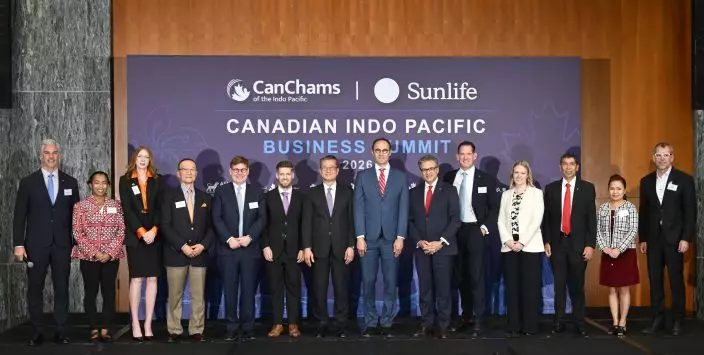
The Financial Secretary, Mr Paul Chan, attended the Canadian Indo Pacific Business Summit today (November 20). Photo shows Mr Chan (seventh left); Assistant Deputy Minister for the Indo Pacific, Government of Canada, Mr Weldon Epp (eighth left); Executive Co-Convenor of the Canadian Chambers of the Indo-Pacific, Mr Brett Stephenson (sixth left), and other guests at the event. Source: HKSAR Government Press Releases
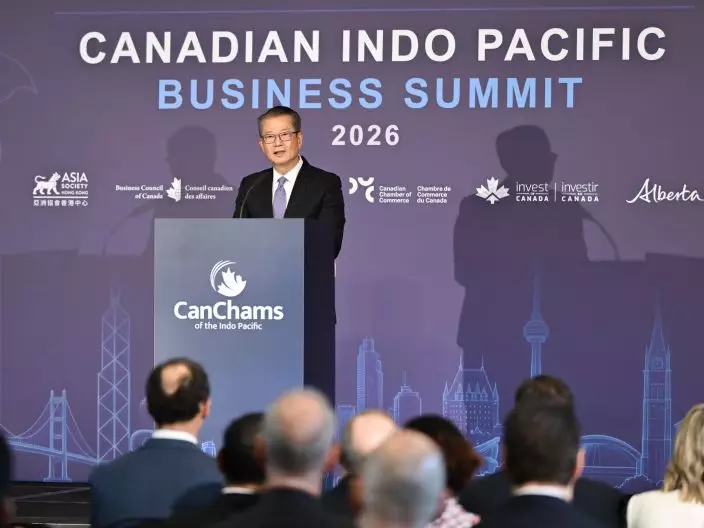
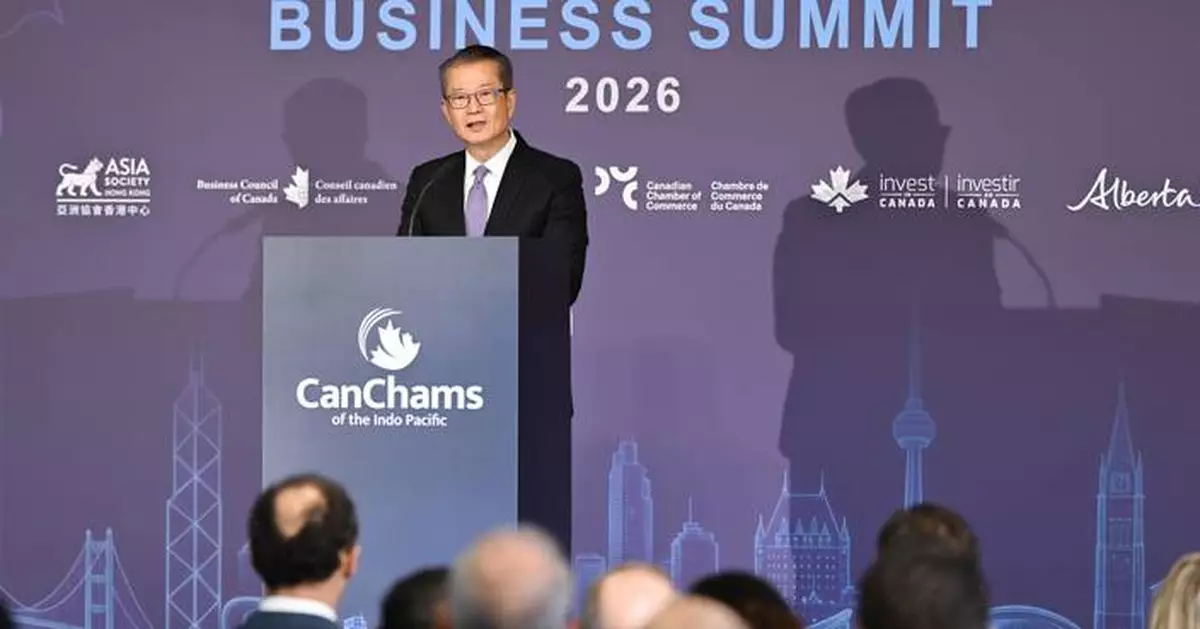
The Financial Secretary, Mr Paul Chan, speaks at the Canadian Indo Pacific Business Summit today (November 20). Source: HKSAR Government Press Releases