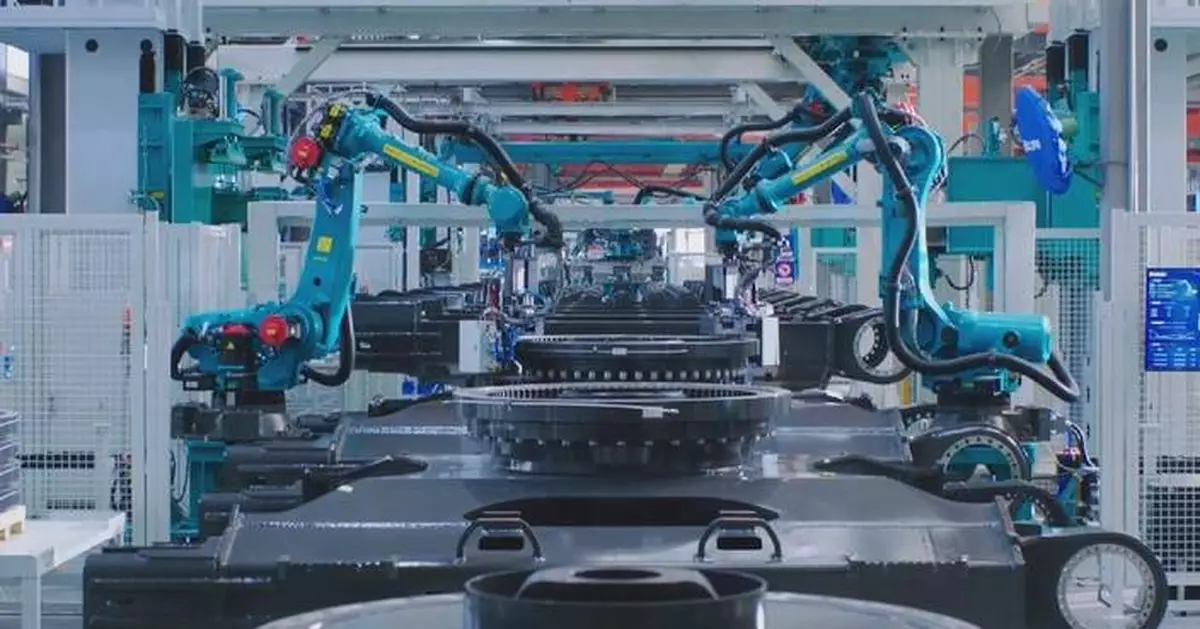
China's flagship smart factories demonstrate not only extremely high levels of intelligence, but also a strong role in driving the wider industry forward, highlighting a new path for next-generation intelligent manufacturing that deeply integrates artificial intelligence (AI) with advanced manufacturing.
China has added 34 factories to its cultivation list of flagship smart factories, the highest tier under the country's four-tier smart factory cultivation system, bringing the total number of flagship smart factories to 49, the Ministry of Industry and Information Technology (MIIT) and five other government departments announced on Thursday.
The selected factories span a range of industries and feature advanced technologies and innovative manufacturing models.
The manufacture of national strategic equipment is an important testing ground for flagship smart factories.
In Deyang City, southwest China's Sichuan Province, Dongfang Turbine Co., Ltd. has equipped its smart factory with a modular collaborative manufacturing system to address the industry-wide challenge of coordinating the discrete manufacturing of large-scale power generation equipment.
"In leveraging our modular manufacturing model, we have enhanced the efficiency of energy equipment manufacturing and the consistency of product quality, ensuring the stable and reliable operation of national strategic equipment," said Hou Mingjun, deputy general manager of Dongfang Turbine Co., Ltd.
Beyond major equipment, tiny precision components also demonstrate China's advanced manufacturing strength.
In Weifang, east China's Shandong Province, a smart factory producing precision electroacoustic components has independently developed core production equipment across the entire chain to meet micron-level processing requirements for miniature acoustic devices, achieving agile and flexible production of multiple categories of precision electroacoustic products.
While leading in manufacturing, these smart factories also lead the industries in artificial intelligence.
A Chongqing-based automobile factory in southwest China uses an industrial brain as its intelligent hub, engaging hundreds of upstream and downstream suppliers, and integrating multiple artificial intelligence technologies such as AI visual inspection and digital twins across the entire vehicle manufacturing process.
A Nanjing-based factory in Jiangsu Province has a self-developed intelligent agent platform. Its dozens of industrial AI agents have enabled autonomous decision-making in production scheduling, equipment maintenance and other areas, achieving autonomous workflow management in the production of communications equipment.
"Intelligent agents can perceive production line status in real time, drive production autonomously through information flow, and receive real-time feedback on material flow status. They can automatically issue production instructions, schedule resources, and perform quality inspections, enabling seamless production line changeovers for more than 300 product models," said Zhou Jianfeng, general manager of ZTE Corporation (Nanjing) Co., Ltd.
Experts said that the new batch of flagship smart factories no longer simply use AI for auxiliary office work, but have deeply embedded it into core business operations such as process optimization, equipment control, research and development, and innovation.
"Among the second batch of flagship smart factories, AI applications make up more than 70 percent of total usage; over 1,000 industrial AI agents have been developed; and the average daily token calls exceed 300 million. AI is evolving from isolated applications toward a systemic architectural transformation. Most of the flagship smart factories have entered the era of data governance 2.0, leading the innovation in future manufacturing models," said Ao Li, deputy director of the China Academy of Information and Communications Technology.
China's flagship smart factories highlight deep integration of AI, advanced manufacturing