Welcome remarks by SJ at 16th Business of IP Asia Forum Concurrent Breakout Session
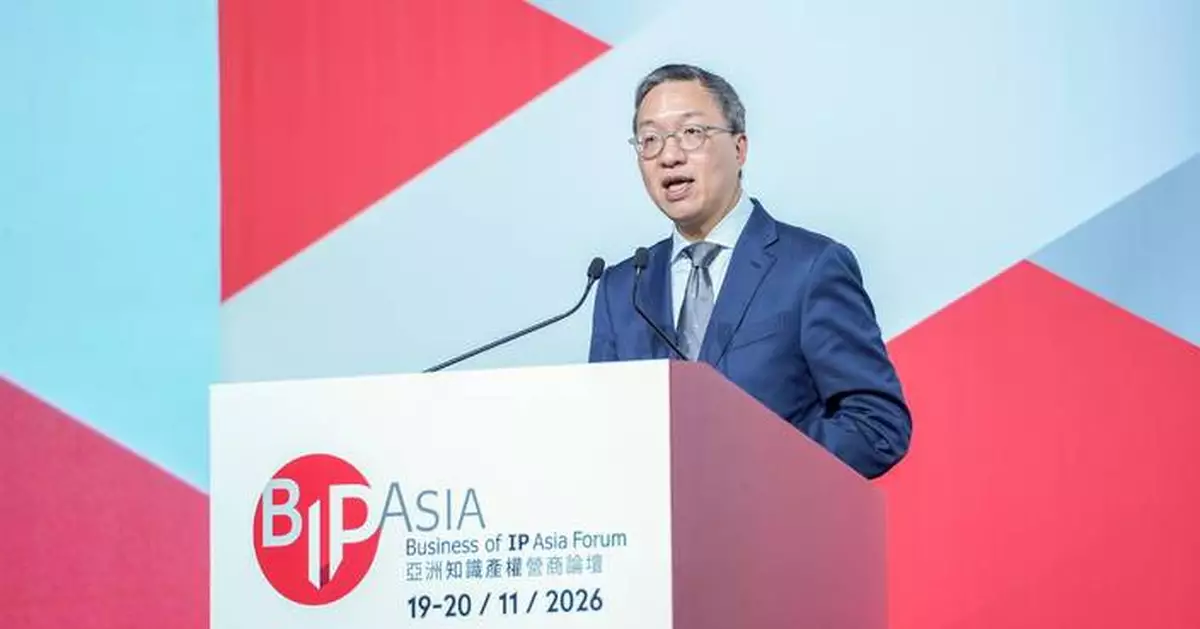
Following are the welcome remarks by the Secretary for Justice, Mr Paul Lam, SC, at the 16th Business of IP Asia Forum Concurrent Breakout Session "Turning Creativity into Economic Value: Clearing Legal Roadblocks in IP Commercialization" today (November 20):
Distinguished guests, ladies and gentlemen,
A very good afternoon. A warm welcome to the 2026 Business of IP (BIP) Asia Forum. I am delighted to open this thematic breakout session co-organised by the Department of Justice and the Hong Kong Trade Development Council.
To set the stage, we must first look at the broader vision guiding our development. The National 15th Five-Year Plan prioritises accelerating innovation, strengthening intellectual property (IP) protection and utilisation, and supporting Hong Kong in deepening its status as an international legal and dispute resolution services centre, as well as a regional IP trading centre. Echoing this national strategy, the Chief Executive's 2026 Policy Address highlights the Government's all-front commitment to developing Hong Kong as a premier regional IP trading hub. Today's session timely explores how innovators and enterprises could capitalise on these macro policy objectives via IP commercialisation.
The engine: IP commercialisation in action
To see this vision in action, let's start from home - our local cultural and creative industries. As a cultural melting pot of East and West, Hong Kong has been accelerating the commercial development of these sectors through cross-sectoral and cross-genre collaborations of local IPs, enabling innovators and enterprises to confidently capitalise on our macro policy objectives.
For instance, movie IPs are deployed to promote tourism. Building on the resounding success of a Hong Kong movie, "Twilight of the Warriors: Walled In", , the Hong Kong Tourism Board collaborated with the movie producer to launch an exhibition titled "Live out the Cinematic Charm of Hong Kong" in the name of that movie, where merchandise vendors offered classic dishes, nostalgic toys and movie merchandise on-site. This demonstrates how cultural buzz can be converted into tangible economic value.
Another example is the Hong Kong Palace Museum's recently concluded special exhibition, "Ancient Egypt Unveiled: Treasures from Egyptian Museums", which attracted over 670 000 visitors. The Museum launched around 170 original merchandise items inspired by ancient Egyptian civilisation, such as the black cat plush and blind box. These products have generated more than $33 million in revenue for the Museum. The Museum's original IP, Pharaoh Cat, became a sold-out hit. You may recall having seen this cat at MTR stations and on KMB buses.
To further lower the costs of IP transactions and facilitate IP trading, the Government introduced the Inland Revenue (Amendment) (Tax Deductions for Intellectual Property Expenditure) Bill 2026 into the Legislative Council last month. This Bill would implement tax-deduction arrangements for capital expenditure incurred by enterprises for purchasing eligible IP rights, or for the licence to use eligible IP rights. By reducing the tax associated with IP acquisition, we aim to encourage more enterprises to actively invest in IP development and commercialisation, thereby injecting stronger momentum into Hong Kong's development as a premier regional IP trading hub.
The shield: a robust IP protection regime
We must recognise that the fruits of IP can truly flourish only when backed by solid legal safeguards. Safeguarding IP rights acts as a vital shield for innovation; it is the cornerstone for fostering technological development and allowing creators to safely monetise their work.
Hong Kong possesses a robust legislative framework protecting all forms of IP, including patents, trademarks, registered designs and copyright. As a World Trade Organization (WTO) member, our IP protection regime fully aligns with the international standards set forth in the WTO Agreement on Trade-Related Aspects of IP Rights.
Guided by the strategic blueprints I mentioned earlier, we will advance the extension of suitable international IP treaties to Hong Kong in an orderly manner. Currently, we are proactively forging ahead with the preparatory work for implementing the Protocol Relating to the Madrid Agreement Concerning the International Registration of Marks in Hong Kong.
To ensure that the local registered designs regime follows the mainstream international practices and meets future local industrial development needs, particularly those driven by the new industrialisation and growth of the digital economy, we are proactively planning to update the relevant regime. The Government is formulating a code of practice addressing copyright issues and the application of legal principles relating to the development of generative artificial intelligence technology, serving as a vital reference for the industry.
The safety net: excellence in dispute resolution
As global innovation rapidly develops and IP commercialisation expands across borders, commercial disputes inevitably arise. Hong Kong is well-positioned to provide pre-eminent IP dispute resolution services. Both our IP protection regime and dispute resolution services are well recognised and widely acclaimed by the international community.
According to the World Competitiveness Yearbook 2026, Hong Kong ranks seventh globally in IP rights. Building on this, and with the Central People's Government's support, Hong Kong signed a Memorandum of Understanding (MOU) with the World Intellectual Property Organization (WIPO) in September 2025 regarding co-operation on the WIPO Lex-Judgments database. Under the MOU, Hong Kong contributes leading IP judgments from the Judiciary to the database, facilitating the international IP community's access to such judgments, while showcasing the quality of Hong Kong's IP-related jurisprudence. By enhancing the global transparency of our IP legal regime, we instill greater confidence to international businesses and IP rights holders to invest, innovate and commercialise their assets in Hong Kong.
Of equal significance is the pioneering Arrangement on Reciprocal Recognition and Enforcement of Judgments in Civil and Commercial Matters by the Courts of the Mainland and of the Hong Kong Special Administrative Region, which has been given effect by our local legislation. Hong Kong judgments on IP disputes are now generally recognised and enforceable in the Chinese Mainland. This marks an unprecedented breakthrough as it goes beyond the conventional international norms in the Hague Convention (Hague Convention on the Recognition and Enforcement of Foreign Judgments in Civil or Commercial Matters) which explicitly excludes IP matters.
Moving onto arbitration, our arbitration regime and services are also globally recognised by the international legal community. According to the 2025 Queen Mary University of London International Arbitration Survey, Hong Kong ranks as the second most preferred seat for arbitration globally and the most preferred seat in the Asia-Pacific region.
Our Arbitration Ordinance (Cap. 609) was amended in 2017 to expressly provide that disputes over IP rights, whether arising within or outside Hong Kong, are arbitrable, and that enforcig an arbitral award is not contrary to public policy solely because it involves an IP dispute. This enhancement gives Hong Kong a competitive edge over other jurisdictions in the region.
To maintain our edge, the Government is resolutely pressing ahead with initiatives to strengthen Hong Kong's status as a leading international arbitral seat, including enhancing our arbitration legislative framework. To ensure that such a framework remains competitive and stays at the forefront of international development, the Working Group on Arbitration Law Reform was established in October last year to review and make recommendations on amendments to the Arbitration Ordinance. Drawing on its recommendations, we have put forward proposed amendments to the Arbitration Ordinance and launched a one-month stakeholder consultation, and target to complete the relevant legislative amendments within next year.
Earlier today, you may have attended sessions at the BIP Asia Forum on diverse topics covering IP financing, valuation and management. I trust that our session today will complete the picture, with our panel speakers discussing the benefits of resolving IP disputes through arbitration and sharing case studies. They will also discuss how IP commercialisation drives innovation and fuels the local cultural and creative industries in Hong Kong.
Looking ahead, the Government will continue its multipronged strategy to support and strengthen the capability of different industries, including cultural and creative sectors, in utilising IP. Supported by our solid legal infrastructure, Hong Kong has every opportunity to cement its role as a leading international legal and dispute resolution services centre and a regional IP trading centre in the years ahead.
On this note, I wish this Forum and today's session every success. Thank you very much.
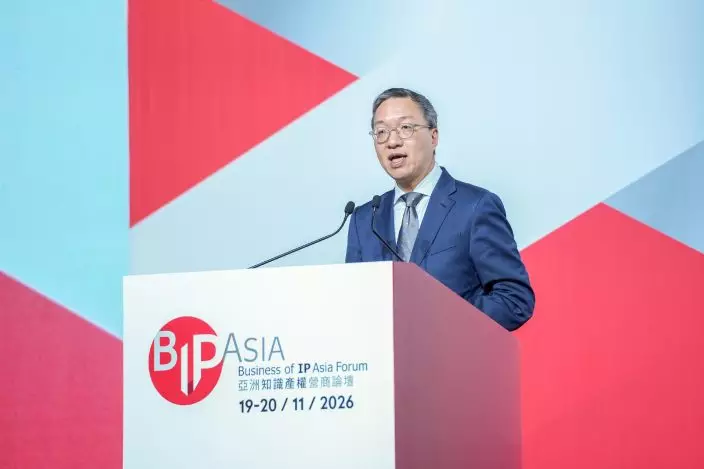
The Secretary for Justice, Mr Paul Lam, SC, delivers his welcome remarks at the 16th Business of IP Asia Forum Concurrent Breakout Session "Turning Creativity into Economic Value: Clearing Legal Roadblocks in IP Commercialization" today (November 20). Source: HKSAR Government Press Releases