Opening Gateway to Middle East's Emerging IR Market
MACAU and HONG KONG, Nov. 20, 2026 /PRNewswire/ -- Asia Pioneer Entertainment Holdings Limited ("APE" or the "Company", with its subsidiaries collectively referred to as the "Group"; Stock Code: 8400.HK), a HKEX-listed Macau supplier of electronic gaming equipment and integrated casino solutions, today announced a major international expansion milestone after securing a federal Gaming-Related Vendor License from the United Arab Emirates' General Commercial Gaming Regulatory Authority (GCGRA), an independent entity of the UAE Federal Government with exclusive jurisdiction to regulate, license, and supervise all commercial gaming activities.
With this regulatory approval, APE is officially authorized to serve the UAE's newly established commercial gaming sector. The license unlocks immediate commercial access to a market projected to become one of the world's premier integrated resort destinations.
Capitalizing on UAE IR Expansion
Under the federal license, APE is authorized to distribute its full portfolio of Electronic Gaming Machines (EGMs), Electronic Table Games (ETGs), and other APE-distributed products directly to licensed commercial operators throughout the UAE.
"Securing our Gaming-Related Vendor License from the GCGRA is a commercial breakthrough in APE's overseas expansion," said Ms. Maria Garcia, Executive Director and Sales Director of Asia Pioneer Entertainment. "The UAE is rapidly emerging as a global benchmark for luxury integrated resorts, and we are excited to bring our proven expertise from Macau and Asia to this dynamic new market."
Executing the International Growth Strategy
The federal UAE license strengthens APE's footprint across high-growth international gaming jurisdictions, supplementing active vendor licenses in the Philippines, Malaysia, and Cyprus, alongside an ongoing license application in Japan.
"The international licensing is a strong validation of APE's technical compliance, high operational integrity, and world-class product portfolio. APE is now firmly a pan-Asia pioneer in Electronic Gaming Equipment supplier with roots in Macau and a global distribution capability." stated Mr. Herman Ng, Chief Executive Officer and Executive Director of Asia Pioneer Entertainment.
About Asia Pioneer Entertainment Holdings Limited (Stock Code: 8400.HK)
Established in 2006, Asia Pioneer Entertainment Holdings Limited (APE) is a prominent Macau-based Electronic Gaming Equipment (EGE) supplier listed on the GEM market of the Stock Exchange of Hong Kong. Serving as an exclusive distributor for major international equipment manufacturers, APE delivers technical solutions, equipment, and localized services to integrated resorts across Macau and the broader Asia-Pacific region.
Official Website: www.apemacau.com
About the General Commercial Gaming Regulatory Authority (GCGRA)
The General Commercial Gaming Regulatory Authority (GCGRA) is an independent executive federal agency of the UAE Government tasked with establishing, regulating, and supervising commercial gaming activities and national lottery operations in the United Arab Emirates, ensuring the highest standards of integrity, transparency, and consumer protection.
Official Website: https://www.gcgra.gov.ae/
Safe Harbor Statement
This press release contains forward-looking statements that are based on current expectations, forecasts, and assumptions of APE management. Actual results and performance may differ materially due to regulatory developments, market conditions, and operational variables across jurisdictions.
** This press release is distributed by PR Newswire through automated distribution system, for which the client assumes full responsibility. **

Asia Pioneer Entertainment (8400.HK) Secures UAE Gaming Vendor License
As AI adoption becomes mainstream, LongbridgeAI explores how reducing repetitive tasks and making information more accessible can help bridge Hong Kong's productivity gap.
HONG KONG and SINGAPORE, Nov. 20, 2026 /PRNewswire/ -- Artificial intelligence (AI) has become an increasingly familiar part of everyday work in Hong Kong. Yet despite widespread adoption, translating its capabilities into meaningful improvements in how people work remains a challenge.
According to a 2026 McKinsey study, 70% of Hong Kong's white-collar workers have adopted AI tools, with 88% of users reporting productivity improvements. However, fewer than a quarter use AI to execute complete workflows from beginning to end.
The findings highlight a gap between AI adoption and deeper integration into everyday activities. While AI has made it easier to access information and complete individual tasks, many users continue to incorporate it into existing routines rather than fundamentally changing how work is organised.
The next challenge for Hong Kong is therefore not simply getting more people to use AI, but making it work more effectively for those already using it.
The Hidden Cost of Repetitive Information Gathering
Consider how much time people spend keeping themselves informed. Whether following industry developments, checking the latest news or preparing regular reports, many activities involve gathering similar information from multiple sources. AI has made these tasks easier, but the experience often remains reactive. Users ask a question, receive a response and repeat the process whenever they need an update.
Microsoft's 2026 Work Trend Index reinforces this challenge. In Hong Kong, 57% of surveyed AI users said it felt safer to focus on existing goals rather than redesign how they work with AI. The opportunity lies in moving beyond answering individual questions towards reducing the repetitive steps involved in accessing information.
From Reactive AI to More Proactive Assistance
One emerging approach is using AI to automate recurring information requests. Rather than manually asking the same questions every day, users can define what information they need and when they want it delivered. For instance, someone following developments across multiple industries could schedule a daily summary of relevant news. Similarly, regular information updates could be organised around weekly or monthly routines. This reflects a broader shift in conversational AI: moving beyond individual questions towards supporting more structured, user-defined workflows. The broader evolution of task-oriented AI is also gaining attention in Hong Kong.
At Hong Kong FinTech Week 2026, the Hong Kong Monetary Authority announced Project SAGE, an initiative supporting the responsible development of agentic AI in financial services, with a focus on practical applications, interoperability and governance. While agentic AI encompasses capabilities beyond scheduled automation, both developments reflect growing interest in AI systems that can perform defined tasks rather than simply respond to individual prompts.
Why Smarter AI Still Needs Human Judgement
Greater automation does not necessarily translate into better information or decisions. An AI-generated summary may be delivered automatically, but its contents could still be inaccurate, incomplete or outdated. McKinsey's Hong Kong findings illustrate this distinction. While more than 90% of surveyed AI users were comfortable using AI for supporting tasks, only 40% expressed comfort with full workflow automation. The contrast highlights an important principle: automating information gathering should not mean delegating judgement. As AI becomes more integrated into everyday routines, users must retain control over how tasks are defined, how outputs are reviewed and how information is ultimately used.
Turning AI's Potential into Everyday Utility
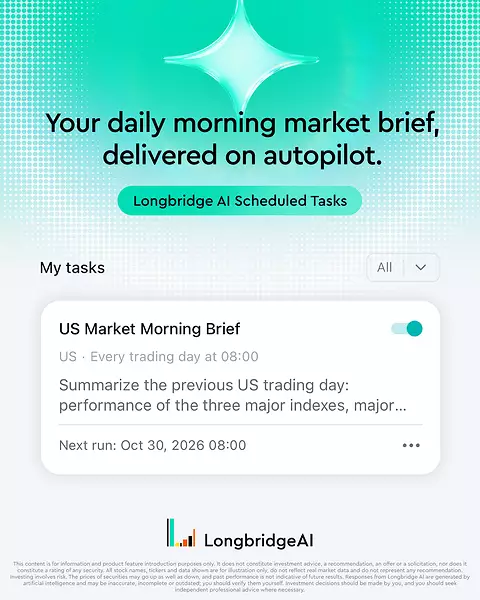
As the conversation around AI shifts from adoption to practical application, the focus is increasingly on making technology more useful in everyday routines. This is an area that LongbridgeAI, an AI-powered conversational platform, is exploring through its Scheduled Tasks feature, introduced in October 2026.
Instead of repeatedly entering the same requests, users can configure AI tasks to run at daily, weekly or monthly intervals. Whether preparing a recurring information briefing, following developments on a topic of interest or organising regular summaries, the feature enables users to establish their information needs in advance and receive AI-generated results through the platform's Message Center. The significance lies not simply in automating individual requests, but in making AI more adaptable to how people access and manage information.
Importantly, automation does not replace the need for human oversight. Users remain responsible for reviewing AI-generated content, verifying its accuracy and determining how the information should be used. For Hong Kong, where AI adoption is already widespread, the opportunity lies in making these technologies more relevant to everyday routines while maintaining appropriate safeguards. Ultimately, the next chapter of AI will not be defined simply by how many people use it, but by how effectively it helps people access information, reduce repetitive work and remain in control.
About LongbridgeAI
Longbridge AI Technologies Limited ("Longbridge AI") is the artificial intelligence arm of AI-native financial technology company, Longbridge Group, dedicated to advancing the development and responsible adoption of AI technology.
Combining deep financial market expertise with cutting-edge AI capabilities, Longbridge AI develops intelligent solutions that transform how individuals and institutions access information, analyse markets, and make informed decisions. Through its AI-powered tools and strategic industry collaborations, Longbridge AI aims to make institutional-grade intelligence more actionable, intuitive, and accessible.
With a vision to pioneer the next era of AI-native solutions, Longbridge AI is committed to building a holistic ecosystem where technology empowers human judgement.
** This press release is distributed by PR Newswire through automated distribution system, for which the client assumes full responsibility. **
Beyond AI Adoption: Hong Kong's Next Challenge Is Making AI Work Smarter