Iron ore futures finished higher Friday in daytime trading on the Dalian Commodity Exchange (DCE).
The most active iron ore contract for January 2027 delivery rose 0.62 percent to close at 652.50 yuan (about 97.88 U.S. dollars) per tonne.
Iron ore futures were launched on the Dalian Commodity Exchange in October 2013 and have since become the world's most actively traded iron ore derivatives contract.
As the world's largest importer of iron ore, China opened the contract to international investors in May 2018, further enhancing its role as a key price benchmark for the global seaborne iron ore market.
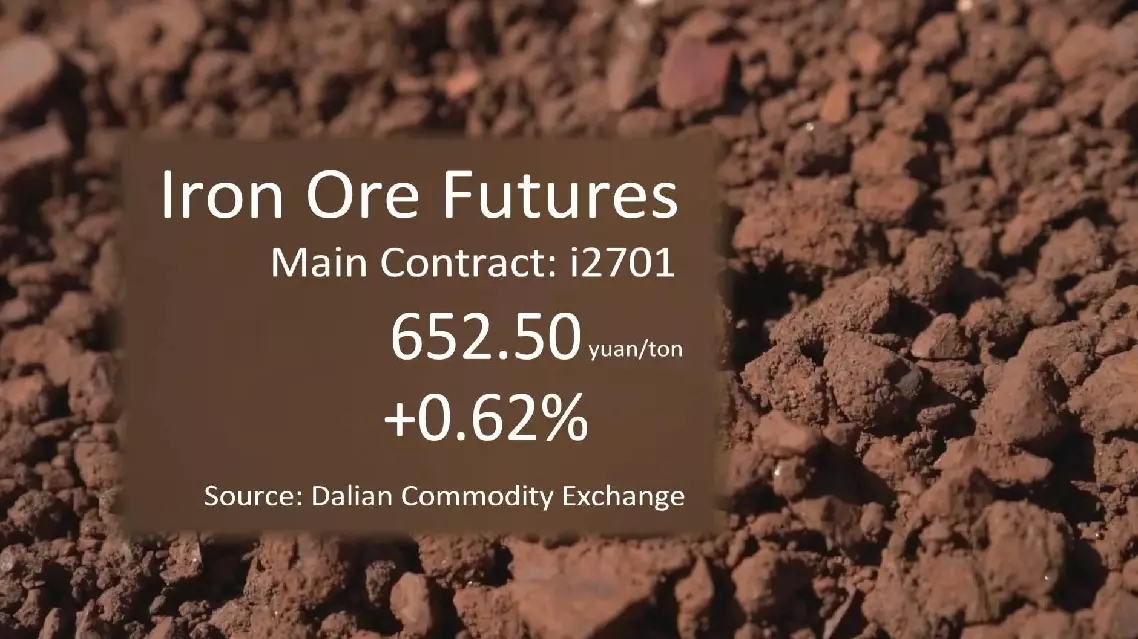
China’s iron ore futures finish higher Friday
From January through October of this year, China's e-commerce sector experienced steady growth, with digital technology empowering industrial upgrading and helping steer China's economy toward high-quality development, according to the Ministry of Commerce.
According to data from the National Bureau of Statistics (NBS), in the first 10 months, the country's online retail sales of goods and services grew by 3.7 percent, with online retail sales of goods increasing by 2.9 percent and online retail sales of services rising by 5 percent.
According to the Ministry of Commerce's big data system, online retail sales of smart wearables and laptops in October surged by 42.5 percent and 32.4 percent, respectively.
On-demand retail has unlocked the potential for offline goods consumption, with transaction volumes on key monitored platforms growing at double-digit rates from January through October.
E-commerce platforms have continuously improved the convenience of service consumption.
According to the ministry's big data monitoring, online retail sales of tourism, food and beverage, and lifestyle services went up 24.3 percent, 12 percent and 11.5 percent, respectively, in the first ten months.
E-commerce has leveraged its advantages in technology, data and application scenarios to inject new momentum into the digital and intelligent transformation and upgrading of agriculture, manufacturing and the service sector.
According to the ministry's big data, online retail sales of farm produce in China grew by 12 percent from January through October.
The "e-commerce plus industrial clusters" model drove online retail sales of wigs from Xuchang City of central China's Henan Province and purple clay teapots from Yixing City in east China's Jiangsu Province to shoot up by 33.6 percent and 16.8 percent, respectively, in the same period.
According to NBS data, in October, the production indexes for the information transmission, software and information technology services sector as well as the transportation, warehousing and postal services sector, rose by 9.2 percent and 5.1 percent, respectively.
The third Silk Road E-commerce Selection Month was launched during the 9th China International Import Expo, releasing a collection of typical practices and a storybook on Silk Road E-commerce, as well as country-specific e-commerce investment guidelines.
The Silk Road E-commerce Promotion Conference on Cooperation, Innovation and Development facilitated 12 letters of intent between Chinese e-commerce platforms and enterprises from partner countries.
Regions across the country simultaneously held distinctive events such as the ASEAN online shopping festival, the China-Arab good products fair, the Lancang-Mekong online shopping festival, the Silk Road E-commerce selection Beijing promotion and the Shanghai Cooperation Organization (SCO) e-commerce festival to help bring quality products from along the Silk Road into China.
On key monitored cross-border e-commerce import platforms, retail sales of goods from Armenia, the Republic of Korea and Uzbekistan soared by 87.8 percent, 32.6 percent and 22.6 percent, respectively, in October.

China's e-commerce logs stable growth in Jan-Oct period