LIMA, Peru (AP) — When Latin Grammy-winning singer Susana Baca was asked to sing for Pope Leo XIV during his visit home to Peru, she vowed to let the music speak for itself and declined all interview requests.
Baca, the world’s best-known Afro-Peruvian musician, feared the moment could be trivialized when in fact it marked a watershed for her and Peru’s African-descended community. As Peru’s first Black culture minister, the 82-year-old Baca remains a leader in the campaign to end discrimination that has long made second-class citizens of Indigenous and Black Peruvians.
Breaking her silence in an exclusive written interview with The Associated Press, Baca reflected on Leo’s message, its meaning for Peruvians and the music she chose to sing him. She also reflected on the significance of Leo’s historic apology for the Catholic Church’s role in facilitating slavery and his visit to a UNESCO-recognized memorial for slavery in Peru, given Leo’s own family tree includes enslaved people and slave owners.
Answers have been edited for brevity and clarity.
BACA: For me, the pope himself was a revelation. In his gaze of a good man, I was able to find a deeper meaning in his ecclesiastical commitment. He draws closer to his religious foundation where he grows, which is the people.
He conveys in his words the vision of a church renewed in its social dimension, to highlight Catholicism in its core principles: the struggle for, and the commitment to, the men and women who are most vulnerable.
BACA: The pope, through his humility, is the one who opens the door to music and to communicating with young people. In every culture, the return of the prodigal son is celebrated. In this visit, the pope is that son visiting, and we celebrate him with music, dance, and flavors for the palate. This can only happen when the bond between the people and the pope is that of a family.
BACA: The poem and the song I performed before the pope are rooted in my heart. I believe and feel that singing for the pope is a way to accompany him in his message, in the preaching of faith that he expresses.
“Canción de Fe” is a song of hope at a difficult moment for Peru with politicians of low caliber and little moral quality.
As for “Si me quitaran totalmente todo” (“If they took absolutely everything from me”) — it’s a very intense poem and I sang it as an act of solidarity with those who suffer in a violent world. I sang it on my album “Espíritu Vivo” (“Living Spirit”), which I recorded in New York City on Sept. 11, 2001. ... I've managed to move people who were living through moments of great desperation and war, because this is a poem that brings life and death together. I feel that this is Gaza today … .It’s that same pain, which persists today in the Middle East and that can’t be silenced.
BACA: I felt very good and happy. For me, the pope’s act of asking forgiveness and reflecting on the history of St. Turibius of Mogrovejo, so long afterward but in such a meaningful way, was very important. It’s a gesture that the Afro-Peruvian community not only is grateful for, but also feels that this dark chapter of history is finally addressed with a clear vision – that’s the light, the forgiveness and the recognition that we can fail, but we can also heal our mistakes.
BACA: I believe that one of the most important things in the history of Afro-Peruvians is that we did not remain submerged despite our history of suffering. We’re an Afro-Peruvian people who have learned to forgive; the injustice of many moments in history is less painful if we have the capacity to forgive.
And perhaps, this is what connects me in my conscience, to the pope. I feel that in all his homilies and teachings, the pope emphasizes the importance of asking for forgiveness and forgiving — that the injustice of many moments in history is less painful if we have the capacity to forgive and to be forgiven. Finally, it’s forgiveness. And that’s faith.
I feel that this identifies my singing, which seeks to be a reflective singing — the same notion of faith that the pope has, and a historical process that belongs to the Afro community. Peru’s people have a beautiful diversity, and that’s also something that the pope said in his speech, and this condenses his own rich human nature in the presence of the Afro-Peruvians, and in the presence of the Indigenous and Amazonian peoples.
BACA: The message is very clear. First, for the young people in the sense who understand the pope’s words as part of their own language of rebellion today, of speaking a truth that was covered under the pope before last.
Before Francis, the Church was distant from young people; the Church didn’t represent a sense of a future, and what this pope has done is put everything he says into a context that speaks to young people.
The pope moves beyond the conservative rhetoric of the old church and speaks in a context that is youthful, vital and grounded in day-to-day life. I feel that the pope’s words are an embrace for the young people.
Associated Press religion coverage receives support through the AP’s collaboration with The Conversation US, with funding from Lilly Endowment Inc. The AP is solely responsible for this content.
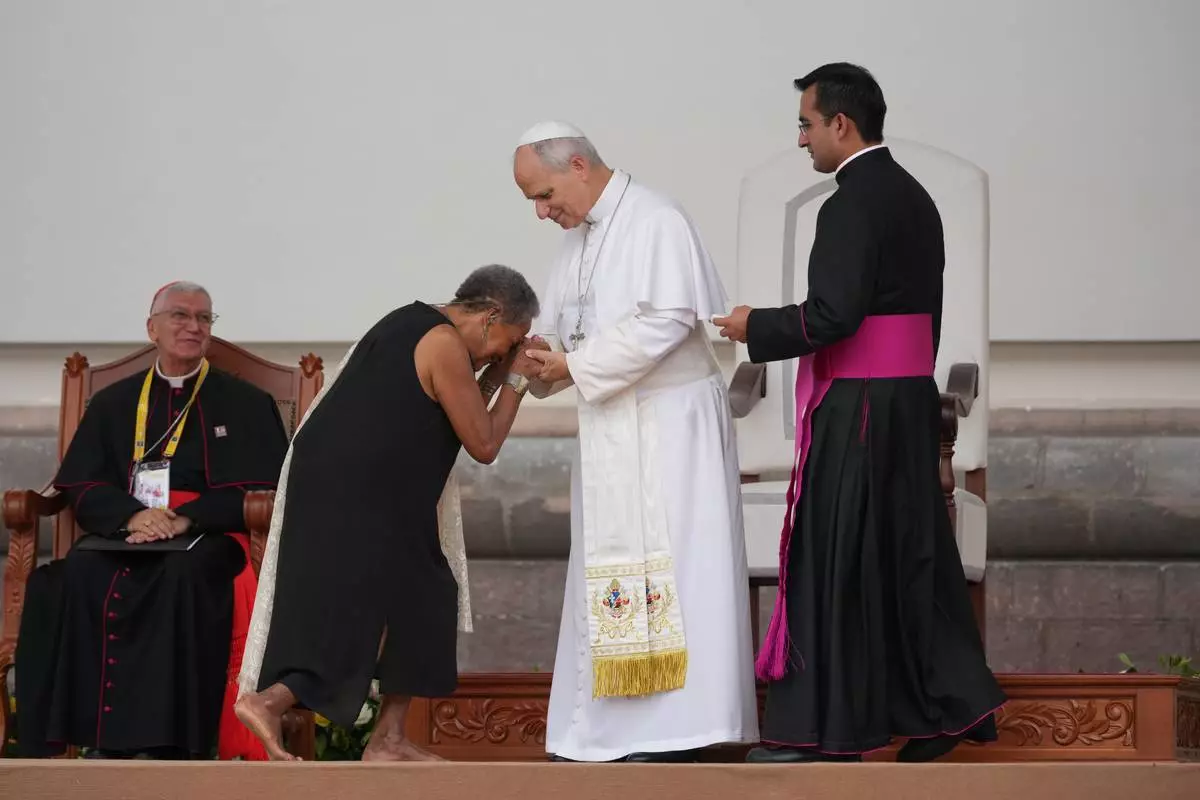
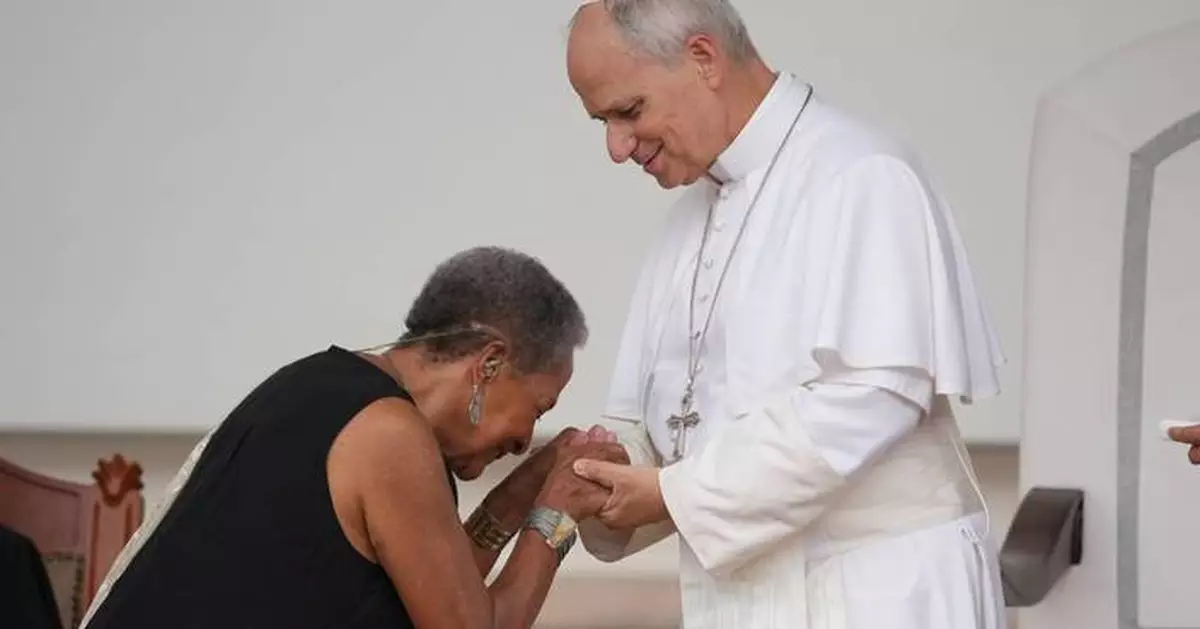
Pope Leo XIV is greeted by Peruvian singer Susana Baca during a meeting on the challenges and hopes for the future of the Peruvian people in the square outside Lima's cathedral, on the seventh day of his twelve-day apostolic journey to South America, Thursday, Nov. 12, 2026. (AP Photo/Andrew Medichini)
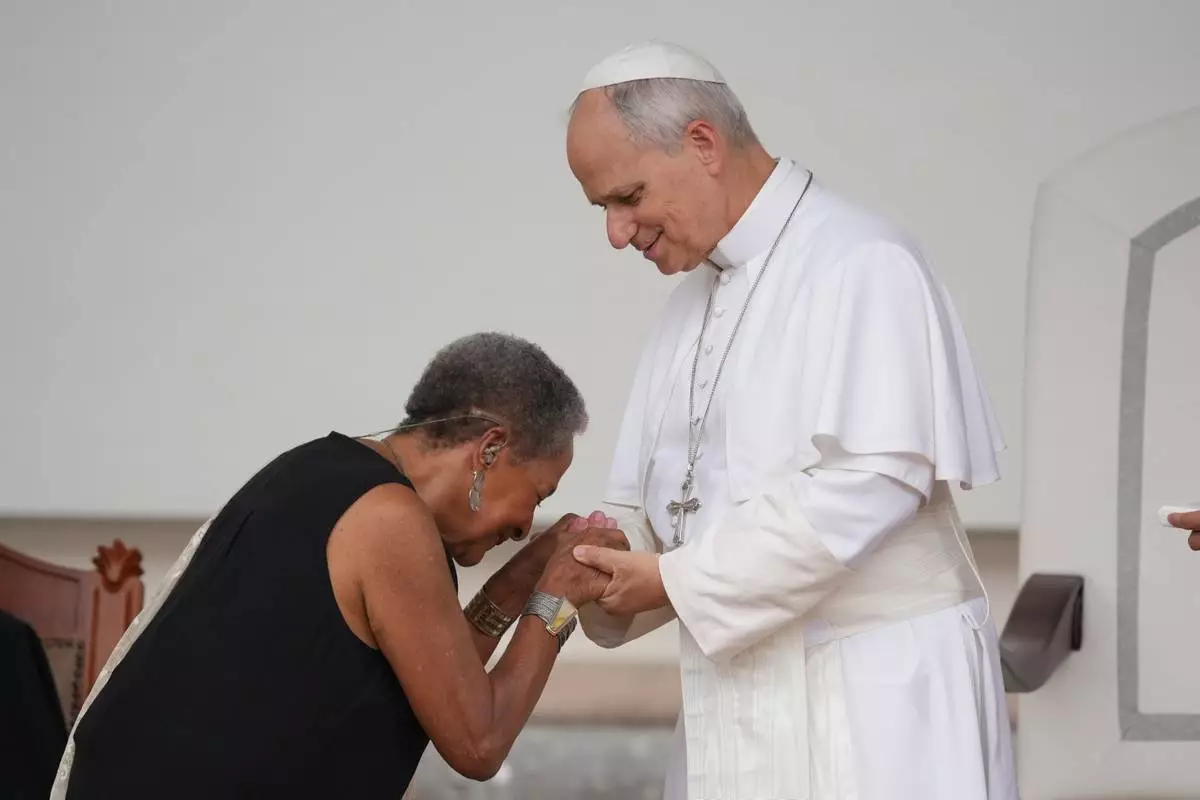
Pope Leo XIV is greeted by Peruvian singer Susana Baca during a meeting on the challenges and hopes for the future of the Peruvian people in the square outside Lima's cathedral, on the seventh day of his twelve-day apostolic journey to South America, Thursday, Nov. 12, 2026. (AP Photo/Andrew Medichini)
The Trump administration has moved to effectively drop its lawsuit that sought to block the certification of Democrat Mary Peltola’s victory in Alaska’s U.S. Senate race, ending a much-criticized gambit by the president to prevent one of his political rivals from taking office.
Also, the White House named a new national cyber director Thursday after a series of widespread service outages disrupted life and unnerved many Americans. Kirsten Davies, chief information officer at the Defense Department, will fill the role, according to social media posts by several members of President Donald Trump’s cabinet. She'll replace Sean Cairncross as the administration’s top cybersecurity official.
Here's the latest:
The bipartisan legislation approved Thursday aims to speed up permitting reviews to build power plants, transmission lines and other energy infrastructure as lawmakers seek to increase the nation’s energy supplies to meet surging demand and lower electricity prices.
The legislation’s sweeping changes would shorten the timeline to start big energy projects and make sure data centers pay for the energy they use and upgrades to the larger transmission network.
The 62-33 vote sends the bill to the House.
Industry groups representing utilities, clean energy developers and the oil and gas sector support the bill, but environmentalists and many Democrats say it would weaken environmental safeguards and make it harder for communities to challenge project approvals.
President Trump has urged approval of the bill, calling it a big win for U.S. energy independence.
▶ Read more
A top House Democrat is demanding that multiple government agencies preserve communications created on nongovernment messaging apps and investigate whether any records related to official business have been deleted.
Rep. Jamie Raskin, the top Democrat on the House Judiciary Committee and the panel’s incoming chairman, said in a series of nearly identical letters made public Friday that he was concerned that President Trump’s administration was circumventing record-keeping requirements by using apps like Signal that can be configured to automatically delete messages after a certain time period.
Raskin noted in the letters, which were sent to top officials at the FBI, the Justice Department, the Department of Homeland Security, the Bureau of Prisons and Immigration and Customs Enforcement, that the agencies were legally required to preserve all records related to their official business, policies and decisions.
▶ Read more
Melania Trump is back on screens Friday with another behind-the-scenes look at her life before and after she became first lady, discussing her marriage to President Trump, her relationship with son Barron Trump and the healing power of a day at the spa.
“Melania: The Series” is a two-part follow-up to a documentary released in January covering her life in the two weeks before Donald Trump returned to the presidency in 2025.
The first lady is known for being private. In this series, set for release on Prime Video, she spends a lot of onscreen time answering probing questions from director Brett Ratner.
She talks at length about Barron, her only child with the president. Her father, Viktor Knavs, who’s rarely seen in public, makes a cameo and explains why she’s a good daughter. Melania Trump also talks about her relationship with the president — and he answers a few questions about his wife, too.
“She’s very strong. She’s not easy to get to the peace table,” the president says in the series.
▶ Read more
After she lost the Georgia governor’s race in 2018, Abrams used her national profile and fundraising prowess to start an organization to confront problems with ballot access and voter disenfranchisement around the country.
Eight years later, the Atlanta Democrat says the organization, Fair Fight, is winding down its voting-focused operations. Abrams plans to reveal a new structure and mission in the new year focused on shoring up democratic processes and confronting what she describes as authoritarian maneuvers in state and local governments.
Abrams, who shared her plans with The Associated Press, said it’s a necessary evolution as President Trump’s second term enters its final two years and Democrats take control of Capitol Hill in January.
“I don’t think it’s getting out of the game. I think it’s changing the approach,” she said.
▶ Read more
Cpl. Spencer Collart’s headstone faces the rising sun and the Lincoln Memorial to the east. The Marine Corps War Memorial is nearby. Soon, President Trump’s gilded, towering arch could be, too.
Trump’s proposed 250-foot-tall (76-meter-tall) arch could cast a long shadow on Arlington National Cemetery, with the potential to literally shade gravesites, disrupt solemn visits with the noise of construction and alter the carefully designed historic landscape of the nation’s capital.
For many veterans and their families, and the loved ones of others buried at the cemetery, the arch has no place so close to the Arlington, Virginia, burial grounds. That opposition has sparked lawsuits by veterans groups and others, including nine family members of the Kennedy political dynasty, who argue the arch, which would be built on a traffic circle about half a mile (0.8 kilometers) from Arlington’s main entrance, will fundamentally change the experience of visiting the cemetery.
▶ Read more
The White House named a new national cyber director Thursday after a series of widespread service outages disrupted life and unnerved many Americans.
Kirsten Davies, chief information officer at the Defense Department, will fill the role, according to social media posts by several members of Trump’s cabinet. She'll replace Sean Cairncross as the administration’s top cybersecurity official.
“Our nation stands in the crossroad of analog, digital, and quantum technologies, our American way of living increasingly interconnected,” Davies wrote in a post on X. “Our opportunity is to dominate the cyber landscape for generations to come … but only if we modernize and drive resilience into the foundations our great nation runs on, as well as build cyber talent for our future.”
President Donald Trump faced a groundswell of criticism as Americans grappled with a cascade of service outages that snarled travel, cut off work, limited bank access and disrupted classified communications.
▶ Read more
The Trump administration on Thursday moved to effectively drop its lawsuit that sought to block the certification of Democrat Mary Peltola’s victory in Alaska’s U.S. Senate race, ending a much-criticized gambit by the president to prevent one of his political rivals from taking office.
The legal challenge centered around the presence on the ballot of a second candidate with the same name as the incumbent, Republican Sen. Dan Sullivan. The Alaska Supreme Court already ruled that the second Sullivan’s candidacy is legal and that he could be on the ballot.
Attorneys for the state, which is currently controlled by Republicans, also objected to the administration’s move, calling it legally “meritless” and filing papers to help get the initial case dismissed. The administration moved Thursday to have an appeals court declare its case moot, two days after the race was decided.
▶ Read more
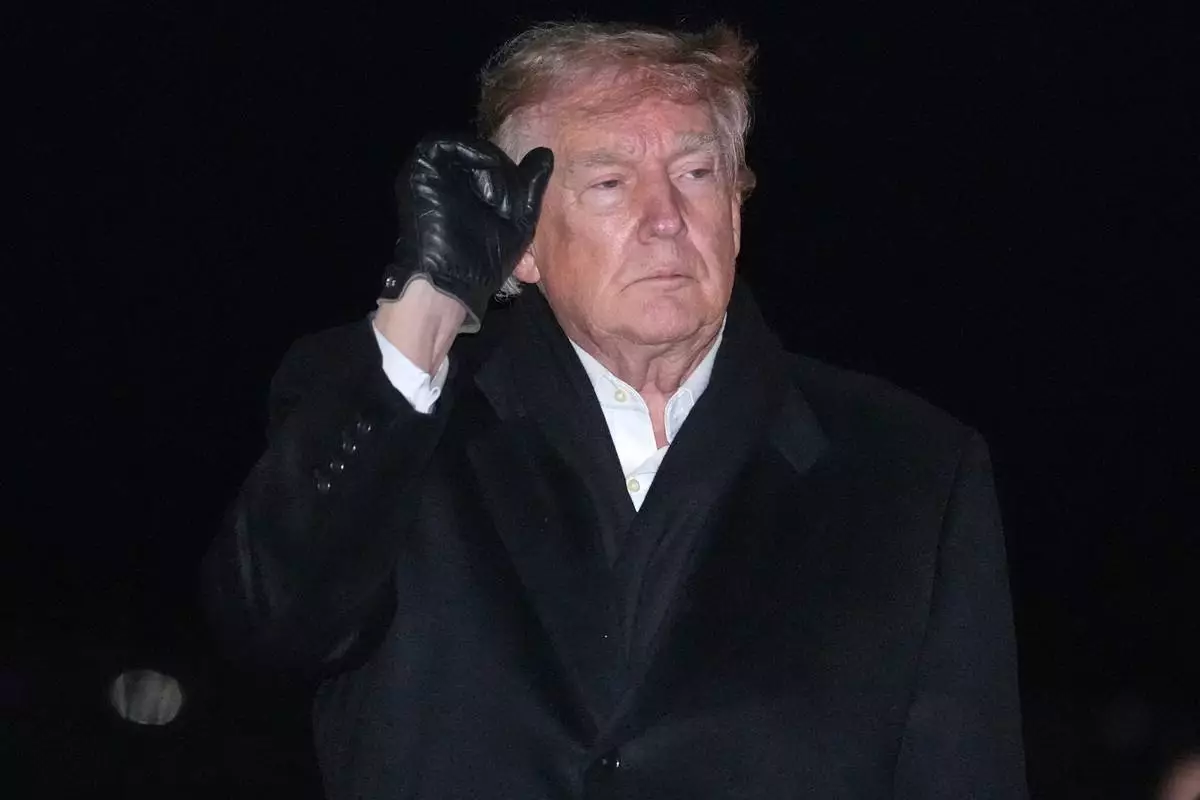
President Donald Trump arrives on Air Force One, Thursday, Nov. 19, 2026, at Joint Base Andrews, Md. (AP Photo/Mark Schiefelbein)
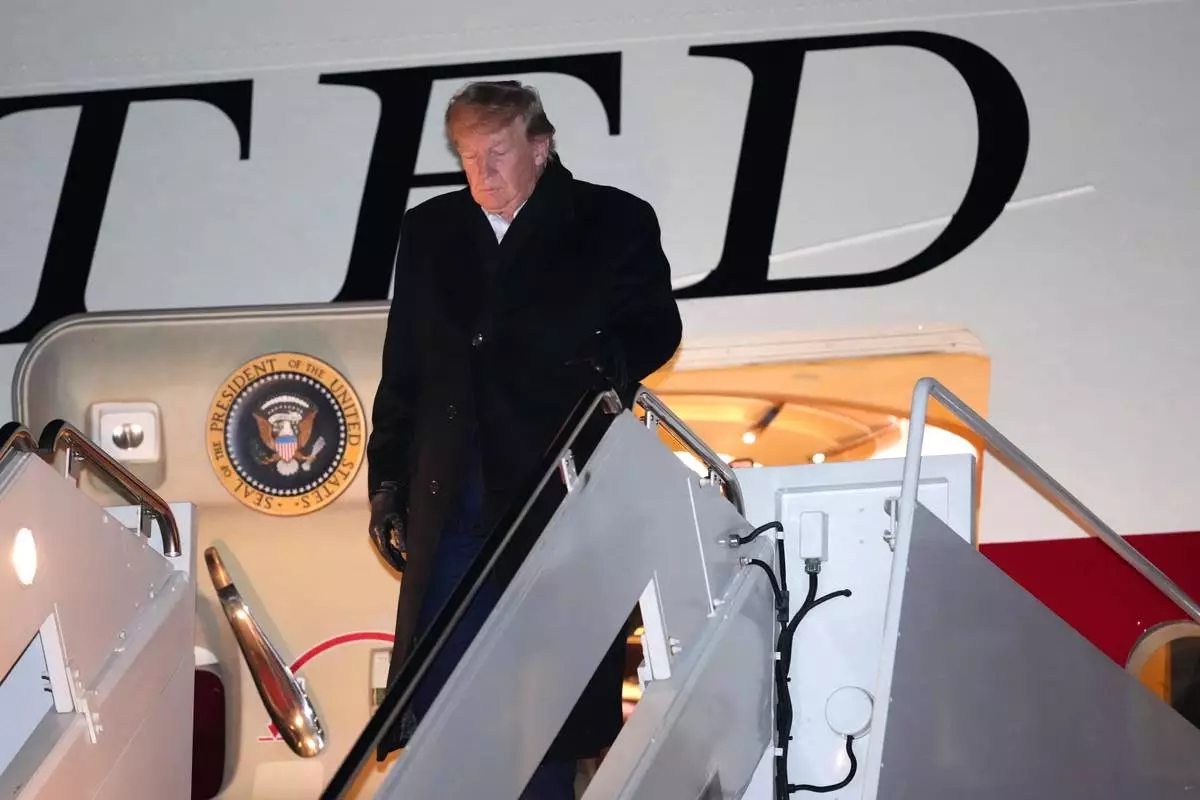
President Donald Trump arrives on Air Force One, Thursday, Nov. 19, 2026, at Joint Base Andrews, Md. (AP Photo/Mark Schiefelbein)