Skip to Content Facebook Feature Image

Beyond Electrification: Inside VinFast’s Technology Strategy for the Next Generation of Intelligent Vehicles

Asia Pacific

Beyond Electrification: Inside VinFast’s Technology Strategy for the Next Generation of Intelligent Vehicles
Asia Pacific

Asia Pacific

Beyond Electrification: Inside VinFast’s Technology Strategy for the Next Generation of Intelligent Vehicles

2026-11-20 23:12 Last Updated At:23:12

With investments in proprietary software, advanced driver-assistance systems and AI-powered automated driving, the Vietnamese automaker is building the engineering capabilities to compete in an increasingly software-defined automotive industry.

NHA TRANG, VIETNAM – Media OutReach Newswire – 20 November 2026 – The automotive industry's next technological race extends well beyond batteries, electric motors and driving range. Increasingly, comp1.270etitive advantage is being defined by computing power, software architecture and artificial intelligence — technologies that determine how vehicles perceive their surroundings, anticipate hazards and evolve throughout their lifecycles.
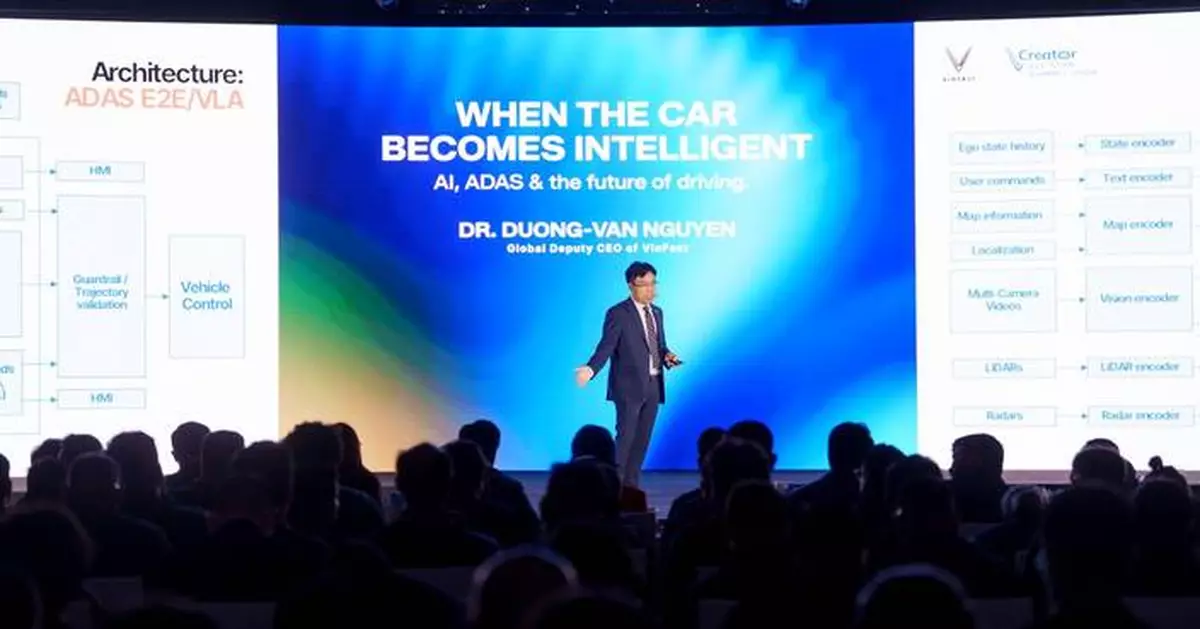
Mr. Nguyen Van Duong, VinFast Deputy CEO of ADAS Development, shares insights on ADAS and the future of intelligent driving.

Mr. Nguyen Van Duong, VinFast Deputy CEO of ADAS Development, shares insights on ADAS and the future of intelligent driving.

As established automakers and technology companies invest heavily in software-defined vehicles (SDVs) and automated driving, Vietnam's VinFast is accelerating its own technological transformation.

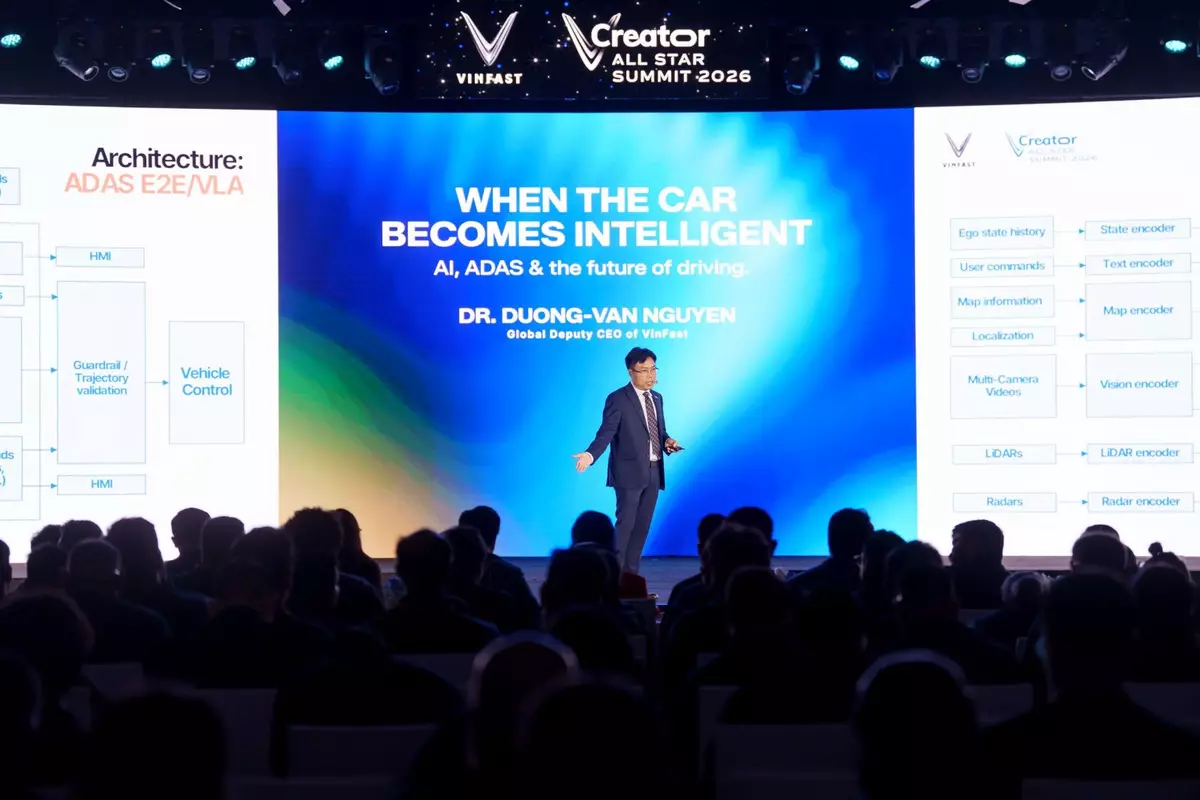
At the V-Creator All Star Summit 2026, held in Nha Trang, Vietnam, from November 15 to 19, VinFast offered international media a closer look at its engineering strategy, combining in-house technology development, global partnerships and the resources of parent company Vingroup.

While electrification established VinFast's presence on the global automotive stage, vehicle intelligence is increasingly shaping its next chapter.

From electric vehicles to software-defined vehicles

The transition toward software-defined vehicles represents a fundamental shift in automotive engineering. Rather than relying on numerous distributed electronic control units, automakers are moving toward centralized computing architectures that enable greater software integration, more efficient development and scalable vehicle functionality.

For VinFast, this transition is already taking shape in production vehicles. Launched in Vietnam in May 2026, the all-new VF 8 marks a significant milestone in the company's engineering evolution. Beyond improvements to its chassis, suspension and driving dynamics, the electric SUV introduces a next-generation electrical/electronic (E/E) architecture developed in-house.

At its core is a Central Vehicle Computer (CVC), designed to coordinate vehicle functions and support more integrated software development.

The new VF 8 also marks the first commercial deployment of VinFast's internally developed advanced driver-assistance systems (ADAS), encompassing highway driving assistance, adaptive cruise control, lane-keeping assistance, automatic emergency braking, blind-spot warnings and surround-view monitoring.

The significance extends beyond individual features. Developing the underlying architecture and software gives VinFast greater control over system integration, engineering costs and the evolution of future vehicle platforms.

According to its 2025 annual report, VinFast had nearly 2,500 in-house research and development professionals at year-end, including more than 600 software engineers.

For an automaker founded less than a decade ago, that engineering investment underscores the growing importance of proprietary technology in its long-term competitive strategy.

Two technology paths, one long-term ambition

At the summit, Prof. Dr. Duong-Van Nguyen, VinFast's Deputy CEO overseeing ADAS and autonomous driving, outlined a dual-track development strategy: advancing Level 2 and enhanced Level 2 driver-assistance systems for passenger vehicles, while developing Level 4 automated driving technology for future mobility applications.

For near-term ADAS development, VinFast is pursuing a hybrid architecture that combines AI-powered perception, sensor fusion and conventional rule-based algorithms for motion planning and vehicle control.

This approach seeks to balance computational efficiency, predictable system behavior, safety validation and affordability — considerations that are particularly important when deploying advanced technologies across mass-market vehicle segments.

Nguyen also presented advanced automated parking and vehicle-summoning capabilities, illustrating how software could address everyday challenges such as maneuvering in confined parking spaces.

These technologies form part of a broader effort to advance driver assistance. Level 2 systems, however, still require continuous driver supervision and do not constitute autonomous driving.

For higher levels of automation, VinFast is exploring more sophisticated AI architectures, including end-to-end learning and Vision-Language-Action (VLA) models.

An emerging area of automotive AI research, VLA technology connects visual perception with contextual reasoning and action generation. The objective is to enable vehicles to interpret complex traffic scenarios, anticipate potential hazards and make increasingly context-aware driving decisions.

Although these technologies remain under development and validation, their inclusion in VinFast's roadmap reflects the company's efforts to keep pace with advances in intelligent vehicle engineering worldwide.

Southeast Asia as a proving ground for automotive AI

One of the more distinctive aspects of VinFast's technology strategy is the environment in which its systems are being developed.

Vietnam's urban roads present formidable challenges for automated driving systems. Dense motorcycle traffic, complex interactions among road users and constantly changing traffic conditions create a demanding environment for perception, prediction and motion planning.

For automotive AI engineers, these conditions represent both a technical challenge and a potentially valuable source of real-world driving data.

VinFast is seeking to leverage this opportunity through the broader Vingroup ecosystem, particularly Green SM, its affiliated electric mobility services operator.

Access to commercial fleet operations could provide diverse driving datasets, supporting the training, testing and continuous refinement of AI-powered driving systems.

VinFast's development framework encompasses data collection, scenario identification, AI training, simulation, benchmarking and vehicle-level validation. Complex driving scenarios can be reconstructed in virtual environments to evaluate system performance and refine subsequent software iterations.

The approach reflects the automotive industry's growing emphasis on data-driven engineering, in which software development and real-world validation become increasingly interconnected.

Successfully addressing Southeast Asia's complex traffic environments could help VinFast build engineering expertise with applications well beyond its home market.

VinFast's V-Creators All-Star Summit 2026 in Nha Trang, Vietnam.

VinFast's V-Creators All-Star Summit 2026 in Nha Trang, Vietnam.

Global expertise, proprietary engineering

"Partner to move fast. Build in-house capabilities to go far.". Presented by Nguyen at V-Creator, that principle encapsulates VinFast's approach to technology development.

In January 2026, VinFast announced a strategic partnership with automotive AI specialist Autobrains to develop enhanced Level 2 driver-assistance systems and explore more cost-efficient automated driving architectures. Initial pilot testing had begun on VF 8 and VF 9 vehicles.

In June, the collaboration expanded to include a next-generation Level 4 automated driving program built on the NVIDIA DRIVE Hyperion platform.

By combining international expertise in automotive computing and AI with its own engineering resources, vehicle platforms and mobility ecosystem, VinFast is seeking to accelerate technological development while strengthening its proprietary engineering capabilities.

The roadmap presented at V-Creator identifies 2026 as a period of technology validation and platform selection, followed by industrialization and planned initial service deployment in 2027, including applications at Vinhomes Green Paradise in Can Gio, Vietnam.

These milestones remain subject to further engineering development, safety validation and applicable regulatory requirements.

Bringing automotive intelligence to the mass market

For VinFast, the ultimate measure of automotive intelligence is not the sophistication of its underlying algorithms, but the tangible value delivered to customers.

As Tapan Ghosh, CEO of VinFast Asia, explained at the summit: "A smart car should give drivers fewer things to worry about and more time to enjoy life."

VinFast envisions increasingly connected vehicles capable of learning from usage patterns, anticipating maintenance needs, recommending charging locations and delivering more personalized assistance.

This philosophy is particularly relevant in fast-growing automotive markets such as India, Indonesia and the Philippines, where affordability, practicality and ease of ownership remain central to purchasing decisions.

The challenge is not simply to develop advanced technology, but to make it reliable, intuitive and accessible across a broad range of vehicle segments.

As the global automotive industry moves toward increasingly intelligent, connected and software-defined vehicles, the ability to develop, integrate and continuously refine core technologies is becoming a critical differentiator.

VinFast's investments in proprietary software, AI, advanced driver assistance and automated driving reflect an ambition that extends beyond electrification: to build the technological depth required to compete in the next era of automotive innovation.

For a young automaker that entered the global industry during one of its most disruptive transitions, the next defining milestone may lie not in how its vehicles are powered, but in how intelligently they operate — and how effectively VinFast can bring that intelligence to the mass market.

Hashtag: #VinFast

The issuer is solely responsible for the content of this announcement.

** This press release is distributed by Media OutReach Newswire through automated distribution system, for which the client assumes full responsibility. **


Revenue Growth Accelerates; Operating Profit Increases Substantially

HONG KONG SAR – Media OutReach Newswire – 20 November 2026 – Phancy Group Co., Ltd. ("Phancy" or "the Group", stock code: 6682.HK), a leading full-stack enterprise-AI cloud services platform, today announced its business performance for the nine months ended September 30, 2026 ("the period").

During the period, the Group recorded an acceleration in revenue growth across its businesses and a substantial increase in operating profit. The Group achieved revenue of RMB6,747 million, up 53.3% year on year. Gross profit amounted to approximately RMB2,260 million, up 39.4% year on year, representing a notable acceleration from the same period last year. Overall gross profit margin stood at approximately 33.5%, a steady improvement from the first half of the year. The Group's revenue growth was accelerated by rising enterprise demand for more efficient AI resource management and the deployment of large model inference across a wider range of business scenarios.

The Group further optimized its cost structure. In the first nine months of 2026, its operating expense ratio declined by more than two percentage points compared with the first half of the year. Operating cash flow improved significantly, and the cash collection cycle shortened significantly. The Group's overall financial leverage remained low, and the cost of its RMB-denominated borrowings in the third quarter decreased to 2.25% to 2.80%, reflecting a sound financial position.

Dr. Dai Wenyuan, Founder, Chairman and Chief Executive Officer of Phancy, said, "In the first nine months of the year, revenue growth accelerated across the Group's businesses, operating profit increased substantially and profitability improved further. For Phancy, high-quality growth is not only about expanding scale, but also about building sustainable profitability. Enterprise demand for AI is eevolving. Clients need not only more capable models, but also better management of computing power and models, so that AI can operate efficiently and reliably in real business settings. As AI reaches more industries, the next priority is to strengthen the infrastructure that supports its development and operation. . Over the past 12 years, we have worked to bring AI to more people. Looking ahead, we want to enable more people to contribute to making AI better, so that better AI can truly improve people's lives. This is the thinking behind the new vision we introduced on our 12th anniversary: 'Everyone for AI'."

AI Platform Delivers Strong Growth and Steadily Improving Profitability

In the first nine months of 2026, the AI Platform business recorded revenue of RMB5,392 million, up 32.0% year on year. Its gross profit margin improved steadily in the third quarter compared with the first half of the year. As of September 30, 2026, the business' orders on hand amounted to approximately RMB9 billion, representing significant growth both year on year and quarter on quarter.

AI Platform is the Group's main revenue contributor and operates under an asset-light model. The business accelerated growth while further improving profitability and continuing to expand its market share. As clients place greater emphasis on AI sovereignty, data security, and internal control and governance, the Group remains confident in the business's long-term growth prospects.

During the period, Phancy continued to enhance the capabilities of its AI Platform products. In computing resource management, the Group uses technologies including HAMi vGPU to schedule heterogeneous computing resources. Launched in October, subsequent to the period, ModelSphere further covers model adaptation, inference performance optimization, and Token management and scheduling, helping clients use their existing resources more efficiently and reduce the cost of deploying and operating AI applications. Customer stickiness continues to increase alongside improvements in product capabilities.

API Business Sustains Rapid Growth with Further Gross Margin Improvement

In the first nine months of 2026, the API business recorded revenue of RMB1,014 million, up 1,556% year on year. Building on the year-on-year improvement in its gross profit margin in the first half of 2026, the API business's gross profit margin continued to achieve significant improvement in the third quarter compared with the first half.

As client demand for Tokens continued to grow, the Group also focused on the operational efficiency and resource utilization of the API business. As of September 30, 2026, the available computing power resources for the API business increased to 40,000 PFLOPS, an increase of 42.9% from the end of the first half of the year.

With client demand for Tokens remaining strong and the API business's financing costs remaining at a low level, the API business is expected to sustain its growth, and its profit margin is expected to improve further.

From a business portfolio perspective, the AI Platform business continues to deliver high-quality growth on an asset-light model, while the API business serves fast-growing demand for model inference. The two businesses complement each other operationally and financially, laying a solid foundation for the Group's long-term, steady growth and continued improvement in profitability.

Enhancing Enterprise AI Resource Management and Expanding the Model Portfolio

The Group continued to advance core product iteration and technology capabilities around the key needs of enterprise AI adoption.

In September 2026, Phancy was included in the first batch of enterprises publicly announced by the Ministry of Industry and Information Technology (MIIT) for development as demonstration enterprises of the National Emerging Industry Development Demonstration Bases, one of 18 enterprises nationwide selected in the first batch. In addition, Phancy ranked first overall in the China AI Computing Power Management Platform Technical Capability Assessment, 2026, published by International Data Corporation (IDC) in September. It was also the only vendor to receive full marks across all four dimensions: compute resource management, compute operations, technical architecture and delivery services.

In model development, subsequent to the period, Phancy launched its Phai series of models in November, comprising Phai-A1, a general-purpose language model, and Phai-M1, a video generation model. Phancy plans to make the weights for both models available to developers worldwide in the near future. Phai-A1 is designed for applications such as software development and AI assistants, with a focus on efficient inference and long-context processing. It supports a one-million-token context window and can be deployed locally on a personal computer. Phai-M1 is designed for live-action film and television content and AI-generated short-form dramas, with a focus on improving visual detail and synchronizing visuals with audio.

Phancy also completed end-to-end post-training of Phai-A1 on a leading domestic compute platform, including reinforcement learning, enabling close integration between model training and the platform. This makes Phancy one of the few enterprises in China to have completed the full post-training process, including reinforcement learning, on that platform. The achievement further demonstrates the Group's capabilities in developing in-house models, integrating them with domestic compute platforms and deploying enterprise AI technologies.

Outlook: From "AI for Everyone" to "Everyone for AI"

In November 2026, Phancy introduced its new vision "Everyone for AI" on its 12th anniversary. Over the past 12 years, Phancy has brought AI to various industries and more people. As the adoption of large models and AI agents accelerates and AI applications become more widespread, the infrastructure that supports the development and operation of AI has become increasingly important.

Looking ahead, Phancy will continue to deepen its commitment to AI infrastructure, addressing critical bottlenecks in AI development and operation and enabling broader deployment of AI applications through continued infrastructure improvements. Moving from helping more people use AI to making AI better, Phancy aims to work with partners and the wider AI community to build a stronger foundation for AI development—so that more efficient, more trustworthy AI can better serve people and improve their lives.

Hashtag: #Phancy

The issuer is solely responsible for the content of this announcement.

About Phancy Group

Phancy Group (6682.HK) is a leading full-stack AI cloud services platform, providing comprehensive solutions for the AI 2.0 era. Our offerings include SageAIOS, HAMi vGPU and ModelHub XC, delivering efficient and scalable AI infrastructure with end-to-end capabilities. We provide a complete solution from heterogeneous compute resource management and optimization to the deployment of intelligent agent models. These solutions empower digital transformation across a wide range of industries, supporting our vision of building a large-scale and efficient "Token Factory."

Guided by the vision of "Everyone for AI," Phancy Group is committed to bringing together more technologies, enterprises and developers to advance AI together.

** This press release is distributed by Media OutReach Newswire through automated distribution system, for which the client assumes full responsibility. **
Recommended Articles