GUANGZHOU, China, Nov. 21, 2026 /PRNewswire/ -- This is a news report from South.
The 33rd Asia-Pacific Economic Cooperation (APEC) Economic Leaders' Meeting in Shenzhen is expected to bring new opportunities for the Guangdong-Hong Kong-Macao Greater Bay Area (GBA) to deepen cooperation with Asia-Pacific economies. As the GBA's strategic pivot, Nansha District in Guangzhou is using the occasion to show how high-standard opening-up and regional connectivity translate into concrete trade gains.
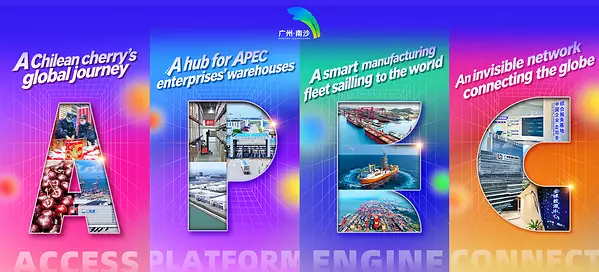
Access: A Chilean cherry's global journey
Nansha Port operates 220 container liner routes, including more than 100 directly serving APEC economies, and connects over 300 ports in more than 100 countries and regions. Chilean cherries can now reach Nansha in 22 days, while Thai durians arrive in four days via a direct "durian express" service. In the first nine months of 2026, Nansha's trade with APEC economies rose 16.8 percent year on year to 151.68 billion yuan, with exports up 21.2 percent.
Platform: A hub for APEC enterprises' warehouses
Nansha has become the first stop for Asia-Pacific brands entering the Chinese market. Brands such as Mead Johnson and Danone have set up Asia-Pacific distribution centers in Nansha, while platforms including Shein, Temu, TikTok Shop and AliExpress have gone global from the district. Nansha is also building the Global Cross-border Trade Industrial Cluster, which has attracted companies in cross-border services, digital technology and international trade.
Engine: A smart manufacturing fleet sailing to the world
Shipbuilding is a rising export engine for Nansha. The district is home to 221 ship and marine enterprises, which together form an industry worth 50 billion yuan. In April, what is billed as the world's first 10,800-vehicle LNG dual-fuel car carrier was delivered in Nansha, setting a global capacity record.
Connect: An invisible network connecting the globe
Data is becoming a new trade artery. Nansha's "International Digital Port" has opened a data processing plant that enables "foreign data, Chinese computing" and "token exports," with localized AI models deployed in physical isolation. The "Going Global" Comprehensive Service Center for Chinese enterprises in Nansha offers support at every stage, from pre-investment analysis and help with approvals to post-investment services. These initiatives position Nansha as a rules-based hub connecting cross-border data flows and outbound investment.
** This press release is distributed by PR Newswire through automated distribution system, for which the client assumes full responsibility. **
Guangzhou Nansha: GBA's strategic pivot for Asia-Pacific trade
About 10% of the money is set aside for the next shock, and most of the funding goes to local organisations who know these communities
GENEVA, Nov. 21, 2026 /PRNewswire/ -- More than 300,000 children whose lives have been upended by war, floods and displacement in Lebanon, Myanmar and South Sudan will get back to learning, catch up on lost lessons and receive psychosocial support, thanks to US$52 million announced today by Education Cannot Wait (ECW), the global fund for education in crises within the United Nations.
The funding commitment comes on World Children's Day, as 258 million children worldwide have their education disrupted by crises.
"Every child has the right to learn, and for children living through war, floods and displacement, school is often what keeps hope alive," said Maysa Jalbout, Director of Education Cannot Wait. "Too often, help arrives only after the classrooms have emptied. These programmes keep children learning today and set aside emergency funds to keep them in school when the next crisis strikes."
In Lebanon, more than 1.1 million people, including over 390,000 children, have been displaced since the conflict escalated in March 2026. The US$13 million programme, led by Ana Aqra Association and the International Rescue Committee, will help about 59,000 children back into school with catch-up classes, early childhood education, safer classrooms and psychosocial support. Local organisations will manage 74% of the funding.
In Myanmar, the US$16 million programme will reach nearly 150,000 children and adolescents across the country. Half of them are out of school today, and more than a third have been forced from their homes. The programme is delivered by international and national humanitarian partners, and local organisations will manage or receive 74% of the funding.
South Sudan is the country most at risk of humanitarian crisis in the world, and around 2.8 million of its children are out of school. There, the US$23 million programme will reach more than 100,000 children in some of the hardest-hit areas, where floods, conflict and new arrivals from Sudan keep disrupting learning. It is led by Save the Children International, the national organisation Universal Network for Knowledge and Empowerment Agency (UNKEA), and local organisations will receive 59% of the funding.
In all three countries, at least half of the children reached are girls, and about one in ten is a child with a disability.
The three programmes are among the first under ECW's new Crisis-Oriented Resilience and Emergency (CORE) approach, which brings together emergency response and longer-term support in a single investment. The response and a portion of the funding is planned in advance so classes can continue when a new crisis hits. Together, the programmes set aside more than US$5 million in crisis modifiers; funding that can be released quickly, without a new proposal, when agreed warning signs appear. Across the three countries, national and local organisations, including women-led organisations and organisations of persons with disabilities, will manage or receive most of the funding.
Help close the gap
Earlier this month, donors at ECW's High-Level Replenishment Conference in Geneva, hosted by Switzerland, helped ECW reach 90% of its US$600 million goal for 2027–2030. ECW is calling on public and private partners to close the remaining US$58.4 million gap, so that more children in crises can keep learning.
Notes to Editors
Download fact sheets for:
About Education Cannot Wait:
Education Cannot Wait (ECW) is the global fund for education in crises. The Fund provides rapid, flexible funding to locally-led education responses that protect learning for refugee, internally displaced and other children, while strengthening systems to sustain learning and resilience in fragile and conflict-affected contexts. ECW works with governments, public and private funders, UN agencies, civil society organisations, and other humanitarian and development aid actors so that no child is left behind.
As global crises intensify and the education financing gap widens, ECW calls on public and private sector partners to scale up investments so millions more crisis-affected girls and boys can learn and rebuild their futures.
Additional information available at: www.educationcannotwait.org
** This press release is distributed by PR Newswire through automated distribution system, for which the client assumes full responsibility. **
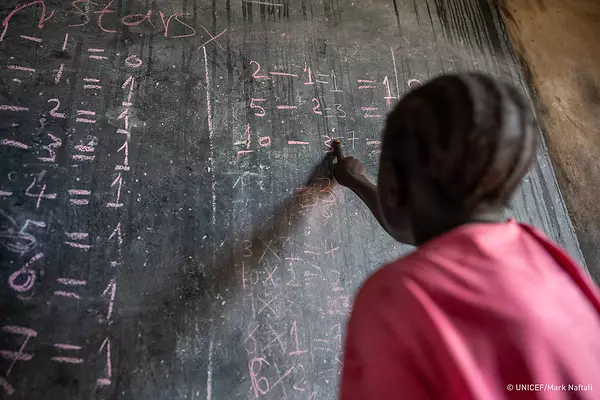
Education Cannot Wait announces US$52 million to keep 300,000 children learning in Lebanon, Myanmar and South Sudan