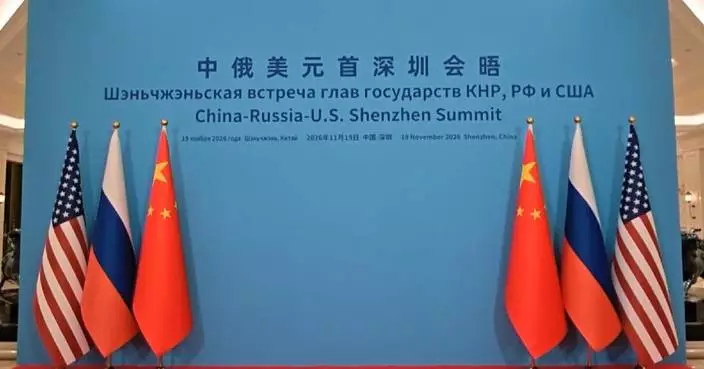
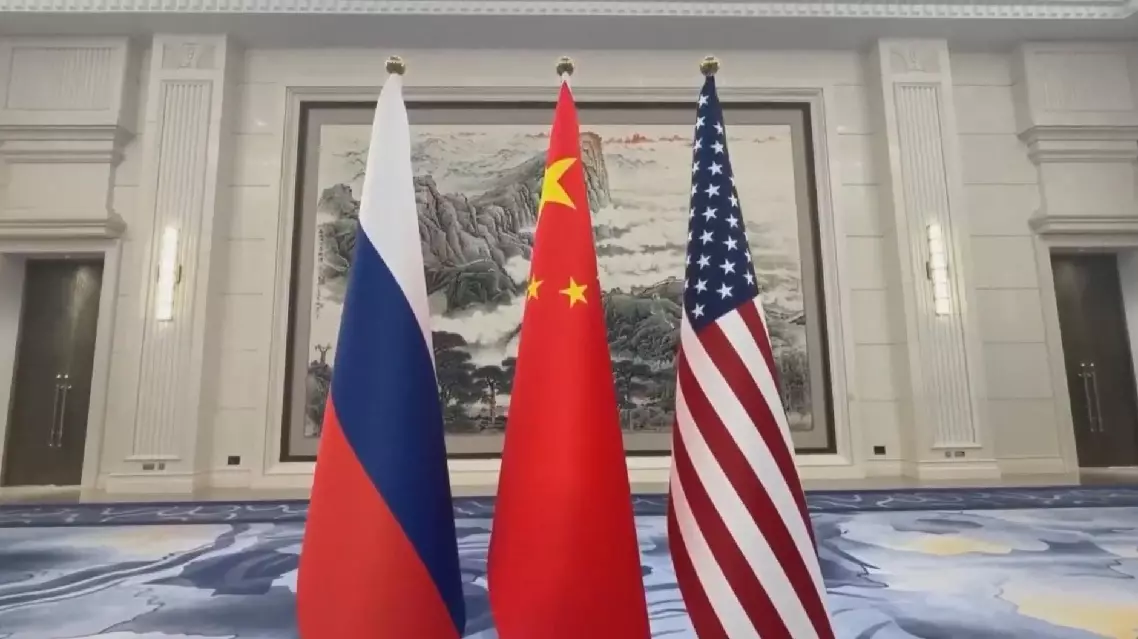
International observers say the historic meeting of Chinese, Russian and U.S. leaders in Shenzhen, south China's Guangdong Province, has sent a clear message of commitment to dialogue, managing differences and building consensus, while strengthening confidence in joint efforts toward a better world.
Chaired by President Xi Jinping in Shenzhen on Thursday, the historic sit-down was the first in-person trilateral summit of the Chinese, Russian and U.S. heads of state.
The gathering took place after all three leaders attended the 33rd Asia-Pacific Economic Cooperation (APEC) Economic Leaders' Meeting, which concluded in Shenzhen the same day.
Konstantin Kosachev, chairman of the Foreign Affairs Committee of Russia's Federation Council, said the summit had helped strengthen political stability in relations among the three major powers and injected fresh momentum into global economic development.
"This meeting, unprecedented in history, was made possible through President Xi Jinping's effective leadership. The three leaders delivered concise yet sharply focused remarks on a wide range of critical global issues. APEC centers on trade, economy, transport, logistics, and investment cooperation, all of which rest on a peaceful and balanced international political landscape. Creating such an enabling environment may well be the core value of this Shenzhen gathering," he said.
Anna Ashton, a former senior fellow at the Asia Society Policy Institute, noted that the face-to-face meeting helped foster mutual understanding and lay the foundation for trilateral cooperation.
"I think the fact of the meeting is a deliverable. It's that kind of sit-down, that kind of being in the room together, that is necessary for the three countries to be able to fully understand each other and look for ways to work together and find their common ground," she said.
Marcela Vera, director of Asian Affairs at the School of Management and Economics of the University of Santiago of Chile, argued that the summit's value extends beyond economic and industrial progress to global security.
"The meeting between President Xi, President Putin, and President Trump marks the first time these three major powers have come together in this format. Should the three leaders agree on a framework for their relations and reach medium- and long-term agreements, the world economy will stand to gain deeper integration. Deals of this sort can connect industries across borders, bringing not only firmer economic outlooks but, more importantly, enhanced global security," she said.
Khaled El-Shamy, chief editor of International Affairs at Egypt's Al-Masry Al-Youm, highlighted President Xi Jinping's four-point proposition on how major countries could find the right way to get along and jointly underpin world peace, namely uphold mutual respect, peaceful coexistence, win-win cooperation, and dialogue and consultation, as an important Chinese contribution to global governance.
"This is a historic and highly consequential meeting. President Xi has provided a remedy for our turbulent world. If nations take this to heart and translate it into real action, we can build a more peaceful, stable, prosperous and win-win world," he said.
Historic China-Russia-U.S. meeting builds confidence in cooperation for better world: experts