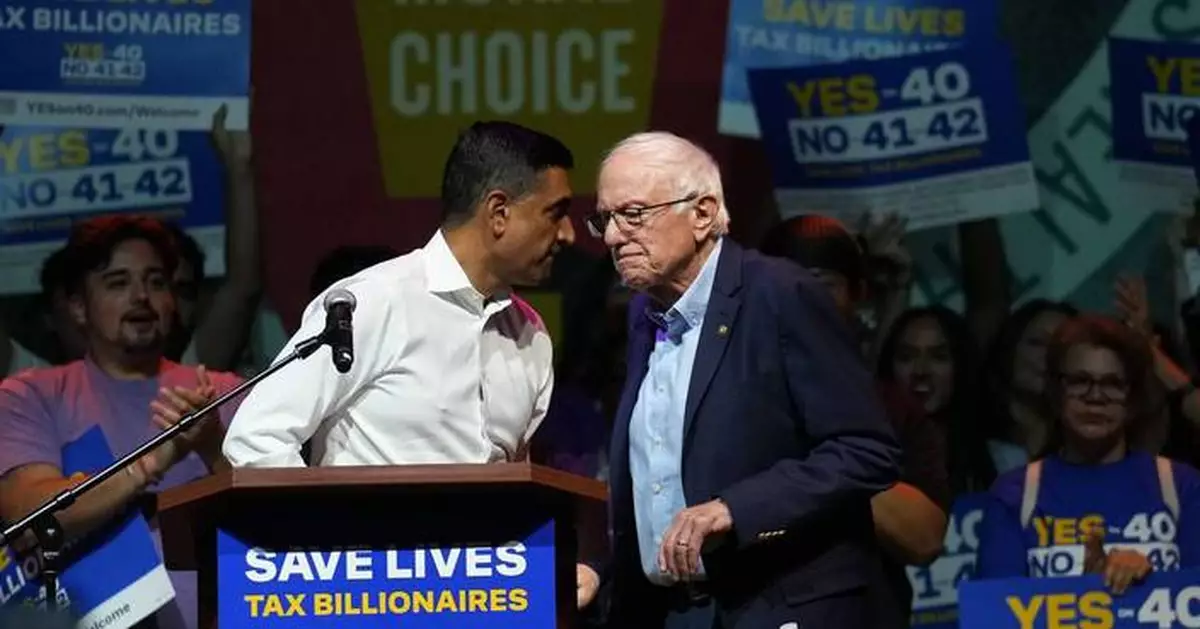
SACRAMENTO, Calif. (AP) — In an election with major wins for Democrats and progressives nationwide, California voters not only rejected the biggest test yet for a state wealth tax, they also approved a measure making it much harder to enact one in the future.
Proposition 40 would have imposed a one-time 5% tax on the wealth of Californians whose net worth exceeds $1 billion, with most of the money dedicated to healthcare. Just more than half — 52% — of voters rejected it. Meanwhile, they narrowly approved Proposition 42, which bans the state from enacting future taxes on people’s financial assets. State lawmakers can't override that; it can only be undone by voters with a future ballot measure.
“I don’t think you’re going to see such a good Democratic electorate in the near future,” said Wesley Hussey, a political science professor at California State University, Sacramento. “This was the time to pass something that was pretty lefty and progressive and had a lot of opposition.”
Nationally it was a good year for so-called “tax the rich” measures in other states, including Washington, where voters upheld a 9.9% tax on household income over $1 million. But California's measure was different because it would have taxed the assets, not the income, of the ultrarich.
And it targeted billionaires, who are significantly wealthier than millionaires and have far more assets to spend. A committee that opposed Proposition 40 and backed Proposition 42 raised more than $333 million, including large donations from tech billionaires such as Google co-founder Sergey Brin and former Google CEO Eric Schmidt. Collectively, the fight over taxing billionaires was one of the most expensive ballot battles in state history.
Outside observers say the fact that it failed in California, a heavily Democratic state often viewed as a liberal leader, is not surprising because of the sheer amount of money spent opposing it and the big-name Democrats who lined up against it. Gov. Gavin Newsom was among those warning it was a bad financial deal for the state. Opponents outspent supporters by 10 to 1.
But proponents of the wealth tax, which included SEIU United Healthcare Workers West, U.S. Sen. Bernie Sanders and U.S. Rep. Ro Khanna, are trying to frame the loss as progress toward holding billionaires accountable in the future. They have teased bringing the idea before voters again in 2028.
“The game is up, people have had it and this election is just the beginning,” Khanna said on election night.
Faced with pushback from Newsom, SEIU UHW offered to scale back its proposal in June just before it qualified for the ballot. The union proposed a 2% levy, down from 5%, but Newsom's office said the proposed tax remained fundamentally flawed. Efforts to make a deal fell apart, and the union proceeded despite a growing coalition of groups opposing the tax.
Opponents of the tax said its failure affirmed that voters understood the risks associated with it. They warned it would have driven billionaires and their tax money out of state, causing budget problems down the road. California relies heavily on the rich for its income tax revenue.
“We were hopefully optimistic based on the polls that voters would agree with us that Prop. 40 was just a horrible idea for the state and Prop. 42 provides some important protections going forward," said David Kline, a spokesperson for the California Taxpayers Association.
California voters didn’t completely repudiate the concept of taxing the wealthy at higher rates in this year’s election. They approved a measure to indefinitely extend a tax increase on individual incomes exceeding $371,000 to raise money for education.
Besides Washington, Colorado voters adopted a graduated income tax that imposes higher rates on people with higher income, including an 8.4% tax on income over $1 million. The revenue from both states' taxes will go toward education, healthcare and other services. Spending on the Washington and Colorado measures paled in comparison to the billionaire tax battle. Legislatures in Hawaii, Maine and Rhode Island also approved new taxes this year on people with incomes over $1 million.
California has a 1% income tax on millionaires that voters approved in 2004 to raise money for mental health services.
Carl Davis, research director at the nonprofit Institute on Taxation and Economic Policy, said the results indicated “a really good batting average” for backers of higher taxes for the wealthy. California's billionaire tax effort was hurt by divisions among organized labor over the measure, he said.
“I think the pendulum is swinging toward increased interest in taxing the rich,” he said.
Advocates for higher taxes on the wealthy plan to expand their push next year in a half-dozen states where Democrats recently won control of both legislative chambers and the governor's office, said Amber Wallin, executive director of the State Revenue Alliance, a nonprofit advocacy group for progressive tax policies.
“I think that the movement will only continue to grow,” Wallin said.
California's Proposition 42 bans new taxes on people's financial assets, business interests and intellectual property, as well as taxes that apply retroactively. The billionaire tax, for instance, would have applied to people living in the state as of Jan. 1, 2026, even though it would have taken effect the following year. That will now be prohibited.
California Gov.-elect Xavier Becerra, a Democrat who will take over from Newsom in January, opposed the billionaire tax. But he said recently that the amount of support it received sent “a clear signal” that people “don’t believe everybody in California is paying their fair share.” He said he wanted to correct that but didn’t specify how.
Lorena Gonzalez, president of the California Federation of Labor Unions, which supported Proposition 40, said opposition from groups like the California Teachers Association and Planned Parenthood Affiliates of California made it harder to pass the measure than if supporters had been fighting billionaires alone.
But she said this year’s ballot fight was just the start.
“We have to go back to the ballot,” Gonzalez said. “We’ve got to keep fighting.”
Associated Press writer David A. Lieb in Jefferson City, Missouri, contributed.
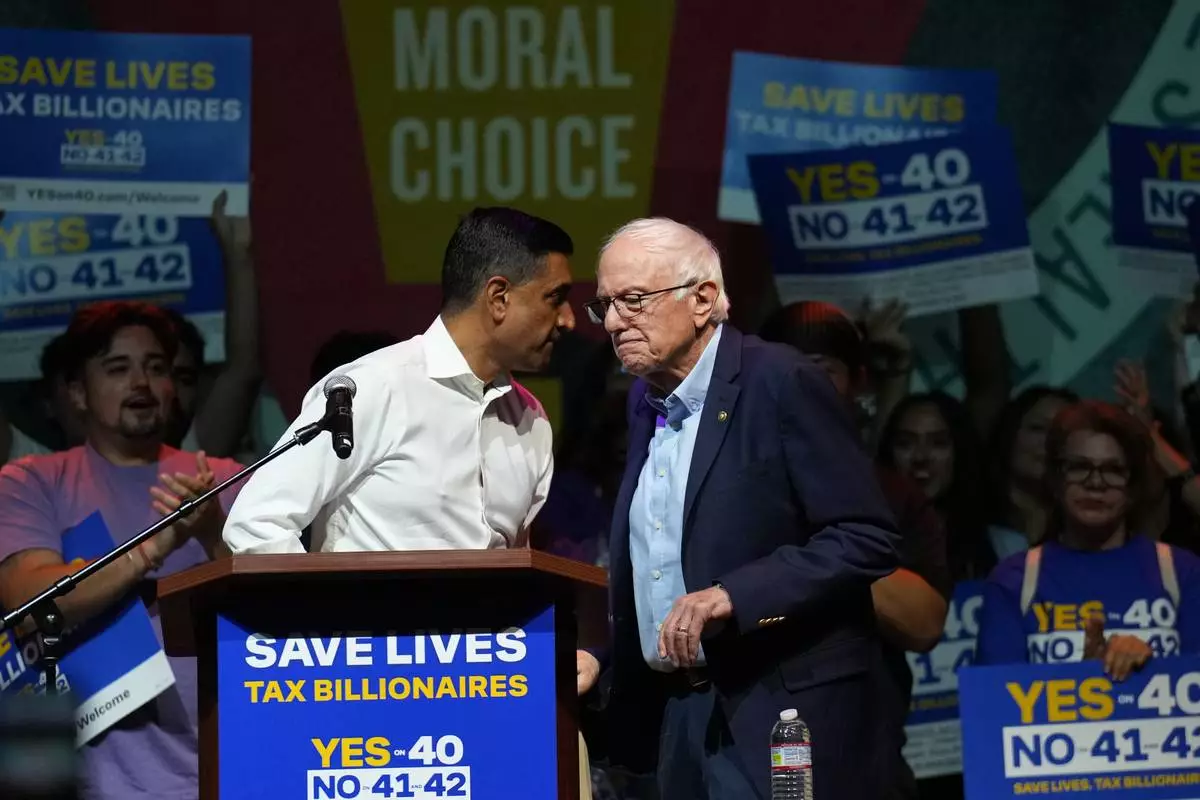
FILE - Sen. Bernie Sanders, I-Vt., right, takes the podium after being introduced by Rep. Ro Khanna, D-Calif., during a campaign rally in support of California Proposition 40, known as the billionaire tax, in Los Angeles, Oct. 5, 2026. (AP Photo/Jae C. Hong, File)