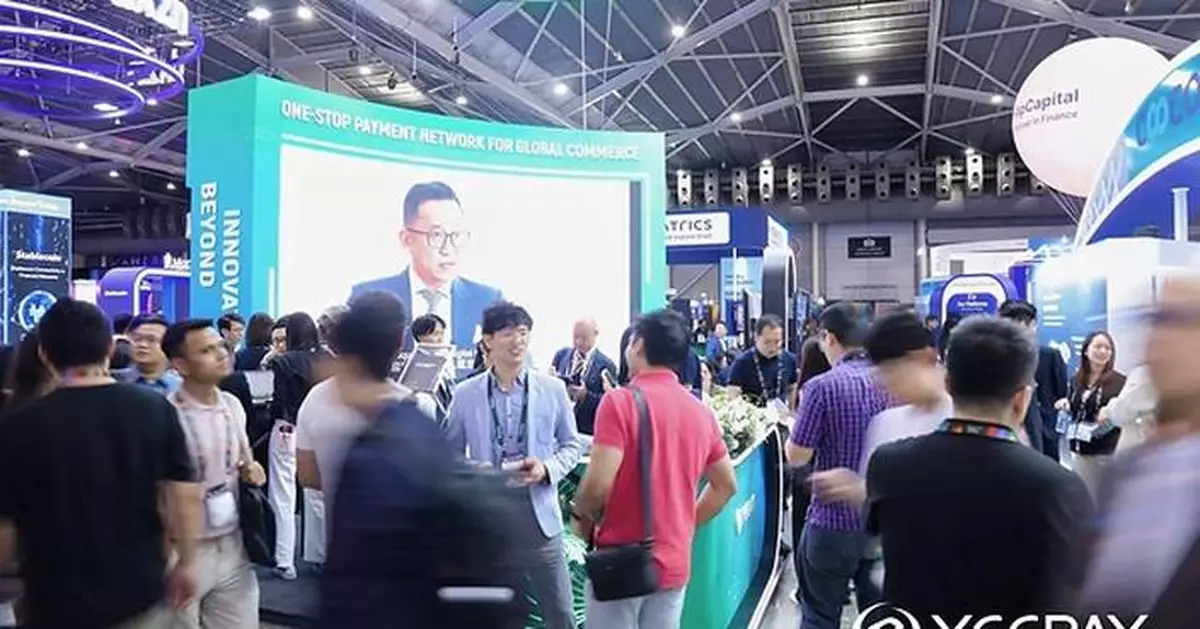
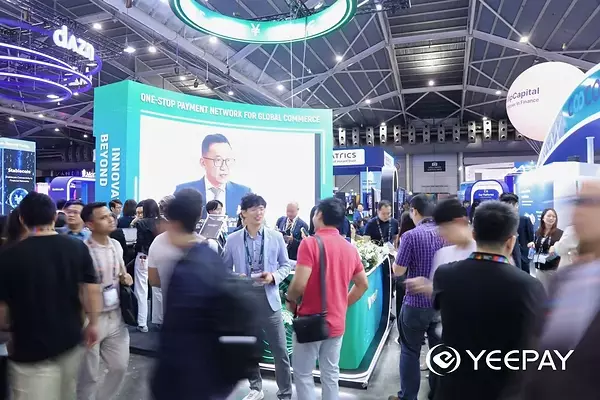
SINGAPORE, Nov. 23, 2026 /PRNewswire/ -- YeePay, a leading cross-border payment and transaction services provider, showcased its one-stop payment capabilities and expanded its international partnership network at the Singapore FinTech Festival (SFF) 2026, held November 18–20 at Singapore EXPO. The company signed strategic memoranda of understanding (MOUs) with Banking Circle, KBank and GLN, while announcing new partnerships with ClearBank and Finmo, marking another step in its efforts to strengthen global payment connectivity and support businesses expanding across borders.
This year's SFF brought together more than 70,000 participants from 142 countries and regions under the theme "The Coming Rewiring of the Financial System: New Risks. New Rules. New Growth." Against a backdrop of rapid advances in AI, payment innovation and cross-border settlement, YeePay demonstrated how its integrated payment infrastructure is helping businesses navigate increasingly complex international markets.
At its exhibition booth, YeePay presented its Global Enterprise Account, Pay to China solution, intelligent FX management capabilities, and emerging-market currency collection and payout services. Designed to facilitate two-way cross-border trade, these solutions support businesses across sectors including airlines & travel, B2B e-commerce, logistics and digital finance.
Beyond its product and partnership announcements, YeePay contributed to industry dialogue through a panel discussion titled "Evolving Together: How AI Is Reshaping Global Payments." Chen Yu, President and Co-Founder of YeePay, joined senior executives from J.P. Morgan, Standard Chartered, OCBC and Visa to explore how AI is transforming cross-border payments across the Asia-Pacific region.
"Technology alone does not define competitiveness in payments. A deep understanding of industry needs and merchants' real-world challenges is equally essential," said Chen Yu. "Drawing on years of experience working alongside global businesses, YeePay is building payment infrastructure that enables two-way international expansion—helping Chinese enterprises reach global markets while making China and the wider Asia-Pacific region more accessible to overseas businesses."
Terry Hua, CEO of YeePay Global, highlighted the persistent challenges businesses face when operating in emerging markets, including fragmented payment channels, high foreign exchange costs and lengthy settlement cycles.
"Emerging markets present significant opportunities for global businesses, but payment complexity remains a major barrier to expansion," said Terry. "YeePay continues to invest in local currency capabilities, combining real-time FX conversion with intelligent payment routing to simplify multi-currency operations for global merchants. Our approach is designed to support businesses in navigating applicable local requirements as they expand into new markets."
With more than 20 years of experience in B2B payments, YeePay operates through relevant licensed or regulated entities in Hong Kong SAR, the United States, Mexico, the United Kingdom and the Netherlands. Its global platform supports payment services in more than 200 countries and regions, with real-time foreign exchange capabilities covering over 100 currencies.
Singapore serves as a strategic Asia-Pacific hub for YeePay, providing a platform for closer collaboration with regional regulators, banking institutions and fintech partners. Building on its presence at SFF 2026, YeePay will continue expanding its global partnership network and investing in payment infrastructure that addresses the evolving needs of international businesses.
YeePay remains committed to building an open, secure and interconnected cross-border payment ecosystem that bridges Asia-Pacific and global markets, empowering businesses to pursue international growth through seamless, collaborative financial infrastructure.
** This press release is distributed by PR Newswire through automated distribution system, for which the client assumes full responsibility. **
YeePay Showcases One-Stop Payment Network and Expands Strategic Partnerships at Singapore FinTech Festival 2026
LISBON, Portugal, Nov. 23, 2026 /PRNewswire/ -- This is a report from China Daily:
The global race for artificial intelligence is often perceived as a competition over who controls the largest data centers. However, ModelBest offers a different perspective: how inclusive intelligence becomes depends on its accessibility and how widely it can be deployed.
This Chinese on-device AI unicorn has made efficiency the cornerstone of its overseas expansion strategy. By November, its self-developed MiniCPM series of models had recorded more than 70 million downloads worldwide.
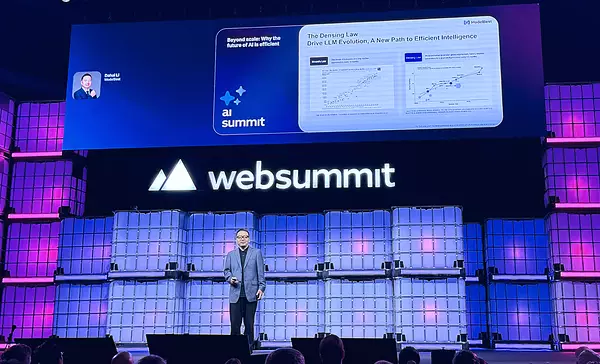
"MiniCPM is not just one model. It is an entire family," Li Dahai, CEO of ModelBest, said at the Web Summit 2026 in Lisbon, Portugal, which took place from Nov 9 to 12.
Each model serves a different form of intelligence, but they share one goal: higher intelligence density, faster speed, and lower cost on devices, he added.
That efficiency-first approach has been put to work abroad. In April, ModelBest revealed the Lao national model, LaoAI, which marked a landmark case of a Chinese AI company helping another nation build its own national AI foundation.
Built on the company's MiniCPM architecture and high-efficiency training methods, the system is integrated into G-Chat v2, the national government communications platform, and is used across government agencies and key industries.
Sovereign AI has largely been dominated by chipmakers, for whom sovereignty implies acquiring advanced computing power and constructing national data centers. LaoAI offers another path: instead of relying on a national supercomputing cluster, the team made multiple field research trips to Laos in the months leading up to the launch, building the system on high-efficiency model architecture rather than massive computing power.
The team also incorporated Lao culture and values into training through field research. The Lao translation capability of their model outperforms mainstream systems on international benchmarks.
Crucially, the underlying model and application programming interfaces are open to local developers. The complete model weights have been delivered to the Lao side, giving them control over everything from the model to the data.
"Efficiency is the key to making large model technology available to everyone," Li said. "In the Lao national model project, an 8-billion-parameter system achieved world-leading Lao-language capability. This demonstrates that developing countries need not wait for top-tier computing power to benefit from AI," he added.
The significance is more developmental than commercial: countries of the Global South no longer need access to high-end computing capacity to step into the AI era.
The same principle applies to businesses. Making AI affordable for small and medium-sized enterprises is often touted but rarely realized. ModelBest's on-device approach changes that. When inference happens on the device, small businesses need neither cloud capacity nor data uploads to access usable AI.
The technical foundation is what the company calls the "Densing Law". The capability density of large models doubles roughly every 3.5 months, reducing the number of parameters needed for a given level of intelligence.
For such businesses, on-device AI is not merely cheaper: it is their first realistic chance to possess AI capability, with data on-premises, no per-inference fees, and no dependence on network coverage.
From sovereign models to on-device intelligence, ModelBest's international narrative aims to share the benefits of China's AI advancements with more countries, ensuring that each nation can develop its own AI capabilities in its own languages.
This direction echoes national policy: China's 2026 Government Work Report endorsed open-source AI ecosystems, and this year's World Artificial Intelligence Conference and the World Internet Conference Wuzhen Summit both advanced initiatives for a fair, open and sustainable global AI ecosystem.
For ModelBest, the overseas initiatives represent a microcosm of this broader vision. By prioritizing efficiency and openness, AI can be extended to countries and businesses that have been waiting on the sidelines.
Beyond expanding access, ModelBest is also rethinking how AI itself is built. The next step is to use AI to build AI itself.
"This is not only a technological change; it is a fundamental shift in how intelligence is produced," Li said.
** This press release is distributed by PR Newswire through automated distribution system, for which the client assumes full responsibility. **
ModelBest opening up access to AI technology on an international scale