Support Fund for Wang Fuk Court in Tai Po rolls out New Beginning Support Grant for Flat Owners and Families of the Deceased
The Government announced today (November 24) that two new beginning support grants would be rolled out by the Support Fund for Wang Fuk Court in Tai Po (Support Fund), namely –
(1) New Beginning Support Grant for Flat Owners; and
(2) New Beginning Support Grant for Families of the Deceased
In accordance with the Chief Executive's instruction, the Government should make meticulous use of the Support Fund to provide appropriate assistance and tailored arrangements for the residents, assisting them in starting a new life as soon as possible. Therefore, the Steering Committee on the Support Fund led by the Deputy Chief Secretary for Administration had reviewed the work progress of the Support Fund, and deliberated on how to provide further support to the residents. It had decided to roll out two support grants, with the details as follows -
New Beginning Support Grant for Flat Owners
The Support Fund will provide owners of each of the flats in Wang Fuk Court with a new beginning support grant of $300,000. The grant will be disbursed in two installments: the first installment of $150,000 will be disbursed in end-December 2026, alongside the disbursement of the third installment of rental grant; and the second installment of $150,000 will be disbursed in end-June 2027, alongside the disbursement of the fourth installment of rental grant.
The relevant grant will be provided to all flat owners of Wang Fuk Court. If a flat owner has sold or is going to sell the flat title to the Government, the grant will be disbursed to the one who was the flat owner before the transfer of the title.
New Beginning Support Grant for Families of the Deceased
In view of the public's desire to offer greater support to the families of the deceased, and given that some of the deceased are non-flat owners, the Support Fund will provide another new beginning support grant for families of the deceased. A grant of $200,000 will be provided to families of each deceased and it will be disbursed in one installment in end-December 2026.
The above grants will be disbursed through the Social Welfare Department's "one social worker per household" mechanism. Flat owners and families of the deceased are not required to submit separate applications.
Mr Cheuk Wing-hing, Convenor of the Steering Committee on the Support Fund for Wang Fuk Court in Tai Po and Deputy Chief Secretary for Administration, said, "Since its establishment, the Support Fund has rolled out various support measures to render appropriate assistance to residents who temporarily lost their home, including helping them meet different urgent or essential expenses. As the different emergency or medium-term support measures have been steadily implemented and the Special Sales Exercise is largely completed, the flat owners and families of the deceased are progressing towards a new beginning. Therefore, pursuant to the instruction of the Chief Executive, the Support Fund has decided to roll out two grants to assist the flat owners and families of the deceased in addressing their needs in this new stage of life, embarking on a new beginning, and moving forward from the tragic event."
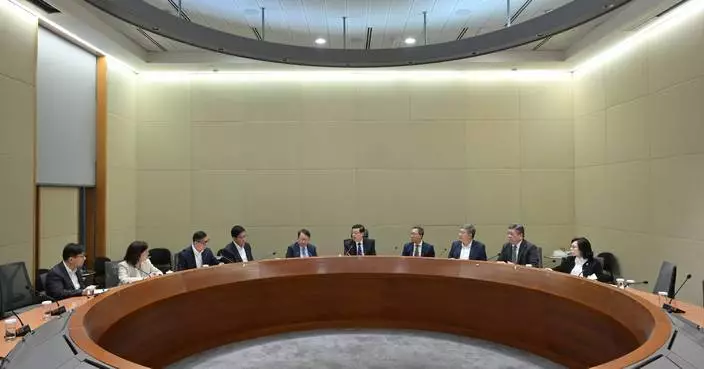
The Steering Committee on the Support Fund for Wang Fuk Court in Tai Po, convened by the Deputy Chief Secretary for Administration, is responsible for advising on matters such as the operation of the Support Fund, as well as supervising and monitoring the establishment and implementation of support measures under the Support Fund. The terms of reference of the Committee are:
1. To advise on the overall strategy, operation and procedures of the Support Fund;
2. To advise on the management and allocation of the Support Fund;
3. To oversee the usage of the Support Fund and the implementation progress of the support measures; and
4. To advise on other matters relating to the Support Fund.
The Committee comprises:
Deputy Chief Secretary for Administration (Convenor)
Secretary for Home and Youth Affairs
Secretary for Labour and Welfare
Secretary for Education
Secretary for Housing
Secretary for Health
Director of Information Services
Director of Social Welfare
Director of Home Affairs

Source: AI-found images
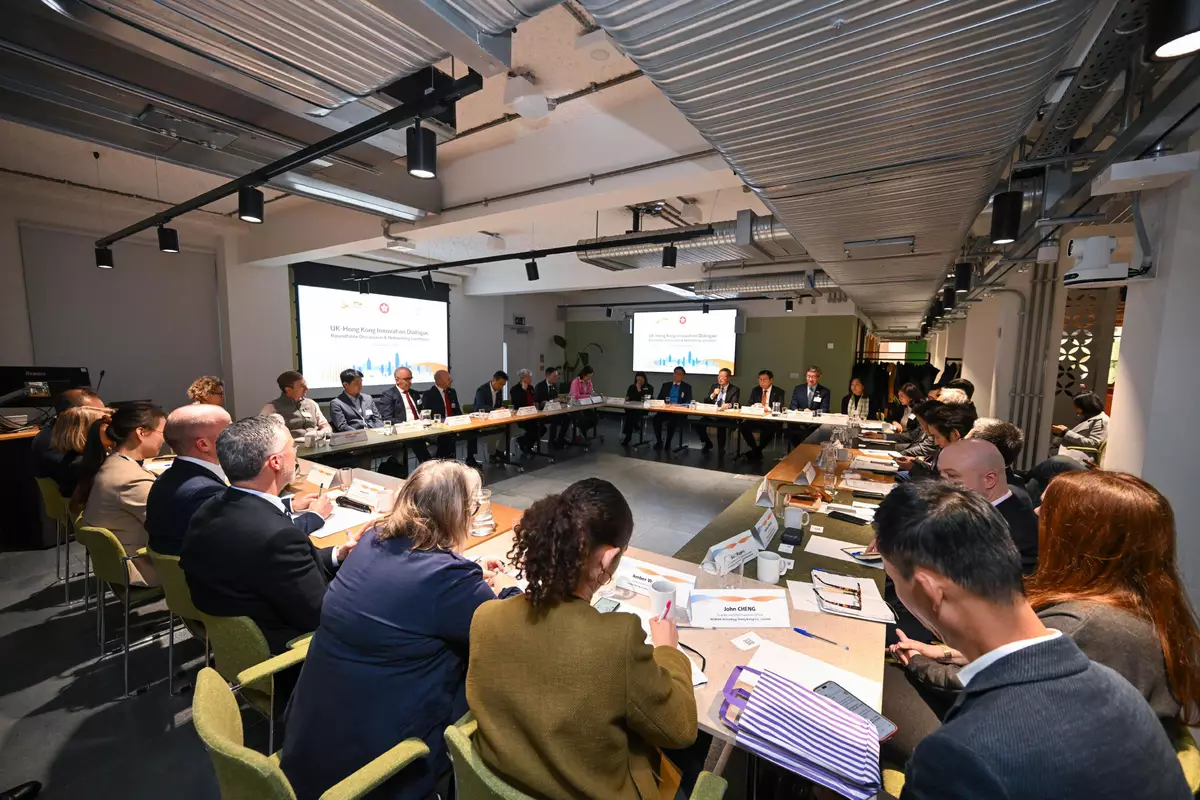
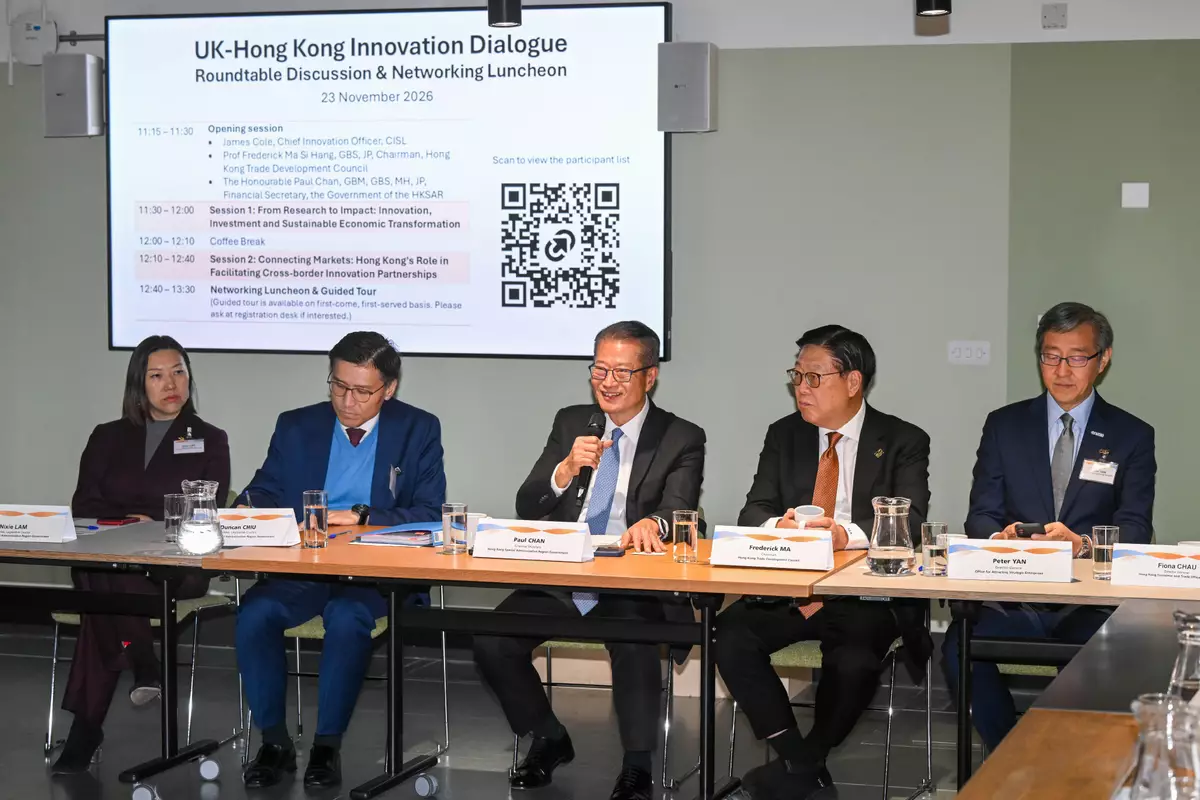
Speech by FS at UK-Hong Kong Innovation Dialogue (with photos/video)
Following is the speech by the Financial Secretary, Mr Paul Chan, at the UK-Hong Kong Innovation Dialogue,a roundtableco-organised by the Hong Kong Trade Development Council and the Cambridge Institute for Sustainability Leadership, in Cambridge today (November 23):
Fred (Chairman of the Hong Kong Trade Development Council, Professor Frederick Ma), Mr James Cole (Chief Innovation Officer of the Cambridge Institute for Sustainability Leadership),distinguished guests,ladies and gentlemen,
Good morning. My thanks to the Cambridge Institute for Sustainability Leadership for receiving us, and to the Hong Kong Trade Development Council for bringing us together.
This building began life in the 1930s as a telephone exchange, built to connect people who had something to say to each other. Ninety years later, I am pleased to see it doing the same job.
Most of my delegation from Hong Kong are founders of young technology companies, members of the Legislative Council, and with them are colleagues from our science parks, Cyberport, OASES (Office for Attracting Strategic Enterprises), InvestHK, Hong Kong Productivity Council, ASTRI (Hong Kong Applied Science and Technology Research Institute) and the Hong Kong Investment Corporation. We have come to listen as much as to speak.
Hong Kong and Britain already do a good deal of science together. Under InnoHK, our flagship research programme, more than 30 universities and institutes from around the world work with ours in joint laboratories. Eight of them are from Britain. The University of Cambridge is a partner in three centres, in fields from stem cell biology to advanced manufacturing.
UK Companies have taken the same path. For instance, AstraZeneca, headquartered in this city, has a research centre in Hong Kong. It manages more than 60 clinical trials there, and is incubating more than 30 young biotechnology companies separately. GSK and the University of Hong Kong have agreed to study the long-term benefits of the shingles vaccine.
The traffic runs both ways. Ecoinno, a Hong Kong company that makes plant-fibre alternatives to plastic, has taken partnership rather literally. Its office for Britain and Europe is under this roof.
Many of you know Hong Kong as a financial centre, and as a connector between the Chinese Mainland and the world. Our first Five-Year Plan, published in September, takes that role further. It puts innovation at its heart, so that Hong Kong becomes a source of new technologies in its own right.
What, then, can Hong Kong add to an idea born in Cambridge? I would point to three things: capital, connection and people.
First, capital. Deep technology takes time and needs to be funded at every stage. Our offer is complete fund-raising options, from the laboratory to the public markets.
The chain begins with private capital. Private equity and venture capital funds in Hong Kong manage about 250 billion US dollars. Proving a technology takes years, and that calls for patient capital. This is the role of the Hong Kong Investment Corporation. It leads a patient capital ecosystem. It has invested in more than 250 projects, and each dollar it commits draws in more than eight from the market.
The chain continues on our stock exchange. In 2018, we allowed biotechnology companies to list before they had earned any revenue. That asked investors to value a company by its science rather than its sales, something Cambridge has been doing for some time. Since then, more than 90 such companies have listed on our Stock Exchange, raising about 14 billion pounds.
Second, connection, and it runs in two directions.
One direction leads into the Chinese Mainland. The Greater Bay Area (GBA), of which Hong Kong is part, has 88 million people, a top notch innovation cluster, and a major base of advanced manufacturing. For a new technology, GBA is a testing ground, a production base and a market.
The closest link is at Hetao, where a science park in Hong Kong and its sister park in Shenzhen work together across the Shenzhen River. Our park is open since last December, and more than 100 companies and institutions have already moved in.
Life sciences show how this special gateway works. Our Five-Year Plan sets the aim of making Hong Kong the foremost centre in Asia for early-phase clinical trials. At Hetao, a joint platform lets researchers use data and biological samples on both sides of the boundary. A trial can then draw on a much larger pool of patients.
The route to market is opening as well. Hong Kong recognises Britain's regulator when registering medicines. So a medicine approved in this country can apply to us on the strength of that one approval, supported by local clinical data. Once registered, it may be approved for use in designated hospitals across the GBA. So far, 79 medicines and 100 medical devices have been approved under this scheme. And clinical data from Hong Kong is recognised by the Chinese national regulator, so it can support an application for approval across the Mainland.
The other direction leads from the Mainland to the world. Many Mainland technology companies are making Hong Kong their international base. As they enter new markets, they need partners who know how a product is certified and sold in Britain and in Europe. So Hong Kong is where innovation in Britain and China can meet, under the common law and with strong protection for intellectual property.
Third, people. Research follows talent, and talent looks for a place that is safe, open, well resourced, and with great potential. Hong Kong has five universities among the world's top hundred, and a growing number of leading scientists are choosing to work here. In the past year alone, two Nobel laureates in physics have joined the University of Hong Kong: Ferenc Krausz, the 2023 winner, and Andre Geim, known as the father of graphene.
Let me close with an invitation.
Begin with a partnership. The founders in my delegation are here to find research collaborators, customers, investors and opportunities to invest, and I hope you will meet them over lunch.
When the time is right, consider an office, a research base or a clinical development team in Hong Kong. Our Science Park would be glad to help, and the Hong Kong Investment Corporation would welcome the chance to invest side by side with Cambridge funds.
And when you come to raise capital for growth, consider a listing in Hong Kong, whether a primary listing or a secondary listing. We mark the occasion by striking a gong. It is louder than a bell, and far more satisfying.
Cambridge has long known how to turn curiosity into knowledge. Hong Kong can help to turn that knowledge into enterprise, and to carry it to a wider market. I believe the two strengths belong together.
Thank you. I look forward to the discussion.
Speech by FS at UK-Hong Kong Innovation Dialogue Source: HKSAR Government Press Releases
Speech by FS at UK-Hong Kong Innovation Dialogue Source: HKSAR Government Press Releases