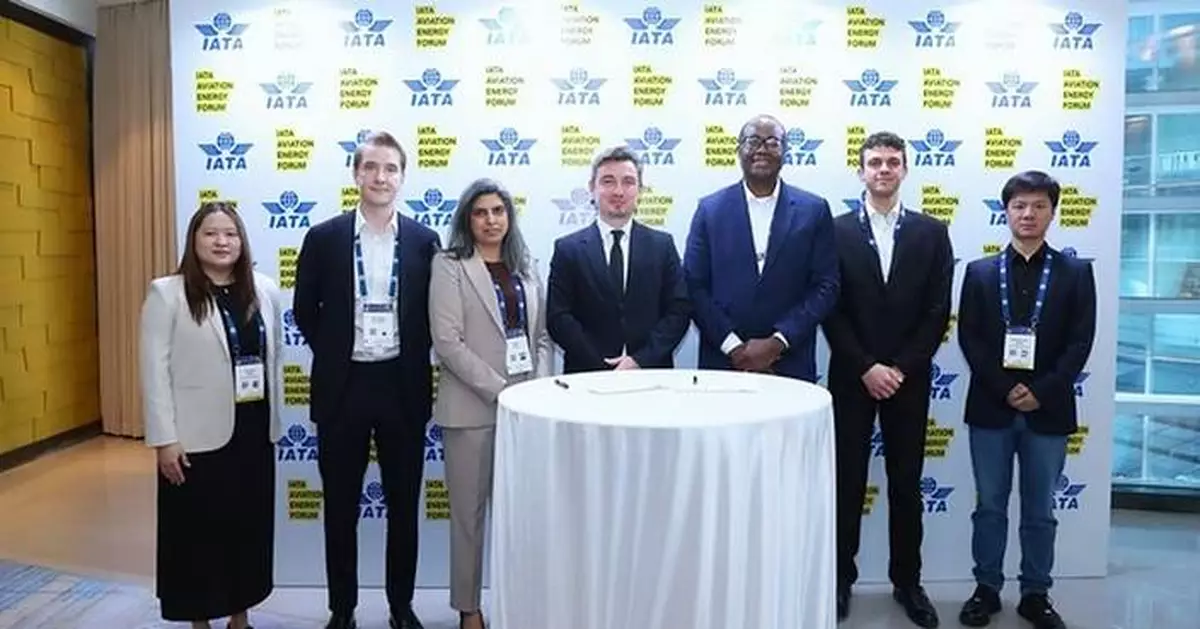
GUANGZHOU, China, Nov. 24, 2026 /PRNewswire/ -- Envision, a global leader in green technology, and the International Air Transport Association (IATA) signed a memorandum of understanding (MoU) at the IATA Aviation Energy Forum in Guangzhou to address three barriers to scaling up synthetic sustainable aviation fuel (eSAF): production efficiency, cost and inconsistent carbon accounting. The strategic collaboration will focus on power-to-liquid (PtL) technology, which uses renewable electricity and green hydrogen to produce liquid aviation fuel from carbon dioxide.
Envision and IATA will jointly publish a research report on eFuels and eSAF. Under the MoU, the partners will examine how renewable power and green hydrogen production can be integrated with fuel synthesis to improve efficiency. They will also explore ways to reduce production costs, assess policies that could make projects commercially viable, and study how more consistent carbon accounting practices and market mechanisms could support adoption by airlines.
Most sustainable aviation fuel (SAF) today is produced from oils and fats through the HEFA process. As IATA's Global Feedstock Assessment for SAF Production Outlook highlights, the limited supply of these feedstocks constrains long-term growth. PtL offers a route to expand SAF supply without relying on biomass and to reduce lifecycle emissions from aviation. Its commercial viability, however, depends heavily on the cost of renewable power and how efficiently producers use it. Envision brings practical experience in this area from its Chifeng Net-Zero Park in Inner Mongolia, where it uses renewable power to produce green hydrogen for ammonia synthesis. Green ammonia from the park has already been supplied as marine fuel.
"Aviation's transition will require a portfolio of solutions and eSAF has an important role to play alongside other sustainable fuels. By connecting abundant renewable energy with aviation's need for low-carbon liquid fuels, eSAF can open new pathways for the industry. As a global green technology company, Envision brings together expertise in renewable energy and integrated energy systems to advance eSAF towards a scalable solution for aviation," said Denis Zaica, SAF Global Head of Commercial, Envision Energy.
"eSAF has the potential to become an important part of air transport's decarbonization. But scaling new technologies takes more than ambition. It requires the aviation ecosystem, including energy companies, to work together, share expertise and learn from each other. Partnerships like this can help build the knowledge, business models and policy frameworks needed to turn eSAF's potential into a scalable solution," said Marie Owens Thomsen, Senior Vice President, Sustainability and Chief Economist, IATA.
Beyond the initial research, Envision and IATA will explore opportunities to assess next-generation eSAF production technologies, bring together participants across the supply chain and support wider industry adoption.
** This press release is distributed by PR Newswire through automated distribution system, for which the client assumes full responsibility. **
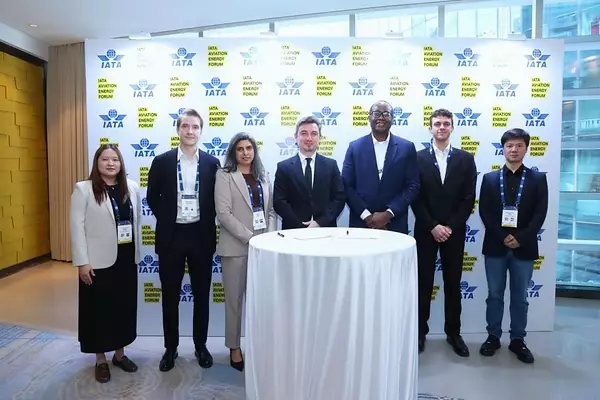
Envision Energy and IATA Launch Strategic Collaboration on eSAF
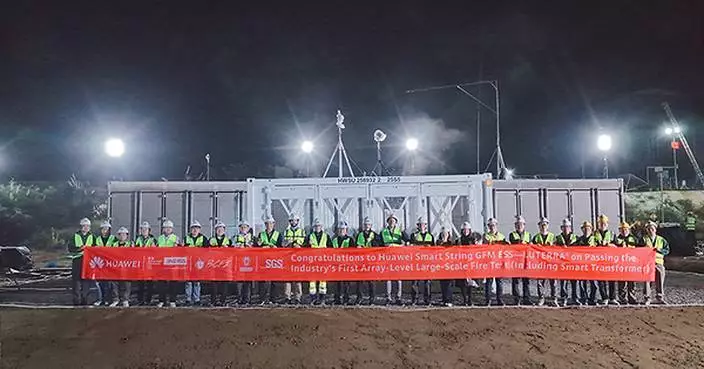
SHENZHEN, China, Nov. 24, 2026 /PRNewswire/ -- TÜV SÜD officially released the White Paper on Capability and Performance Grading for Grid Forming Energy Storage Units and Systems. TÜV SÜD also awarded Huawei's Smart String Grid Forming ESS Platform the world's first L4 certification for the highest grid-forming capability. This is the first time, globally, that an energy storage system has passed the L4 grid-forming capability certification. This marks the transition of grid-forming energy storage from technical verification to a new phase of industry maturity, where it is standardized, quantifiable, and certifiable. This certification sets a new benchmark for the stability and resilience of power systems with a high penetration of renewable energy.
Grid-Forming Energy Storage Is Evolving Toward System Support, and a Unified Framework for Capability Evaluation Is Urgently Needed
The proportion of renewable energy and power electronics devices in power systems continues to increase. As a result, new technology-based resources must gradually take over the inertia, voltage support, power oscillation damping, and other stability capabilities provided by traditional synchronous generators. Grid-forming energy storage systems integrate energy regulation with active grid-support capabilities. They are evolving from traditional energy storage devices into important stability resources for new power systems.
At the same time, different devices vary significantly in support scope, dynamic performance, islanding operation, and system restoration. The industry urgently needs a clear evaluation framework to answer "what grid-forming capabilities are available, what level they can reach, and how much system responsibility can be taken on."
Five-Level Grid-Forming Capability System: Making System Contributions Measurable and Verifiable
The newly released white paper proposes a five-level grid-forming capability maturity model, from L0 to L4. This model centers its evaluation on the actual contributions of devices and plants to the power system. It also clearly defines the capability evolution path from traditional grid-following through local voltage grid-forming, regional auxiliary grid-forming, and conditional full-domain grid-forming, to advanced full-domain grid-forming. The evaluation focus has expanded from whether a single function is available to the coverage of capabilities, performance levels, verification levels, and contributions to system resilience. This enables evidence-based assessment of different grid-forming capabilities and the selection of appropriate levels for varying application requirements.
The white paper focuses on core capabilities such as grid formation, frequency support, voltage support, system strength support, and fault support. Considering factors such as response speed, support strength, and operating boundaries, it drives grid-forming evaluation from functional descriptions toward measurable performance verification. It also extends verification requirements from individual devices to plants.
From L0 to L4: Grid-Forming Capability Steps Up Level by Level
Based on the actual contributions of devices and plants to the power system, the white paper divides grid-forming capability into five levels:
- L0 Traditional Grid-Following: relies on an external grid reference for operation and has no autonomous grid-forming capability.
- L1 Local Voltage Grid-Forming: autonomously establishes voltage and provides local voltage support.
- L2 Regional Auxiliary Grid-Forming: further enhances system strength and supports weak-grid operation and fault response.
- L3 Conditional Full-Domain Grid-Forming: provides inertia and frequency support and enables islanding operation and basic black start; the system still requires support from a small number of synchronous machines.
- L4 Advanced Full-Domain Grid-Forming: further provides wideband oscillation suppression, multi-unit grid-forming coordination, and complete system restoration capabilities, aimed at building system-level resilience.
Huawei Receives L4 Certification: System-Level Grid-Forming Capabilities Gain Third-Party Recognition
L4 "Advanced Full-Domain Grid-Forming" is the highest level in this model. In addition to voltage, frequency, system strength, and fault-support capabilities, it also requires wideband oscillation suppression, complete system restoration, and multi-unit grid-forming coordination capabilities. It focuses on plant-level performance, including advanced black start, seamless on/off-grid switching, and off-grid fault ride-through.
Huawei's Smart String Grid Forming ESS Platform has obtained the L4 certification, indicating that it meets the model's highest requirements for system support, dynamic stability, and coordinated restoration. With this certification, the highest level of grid-forming capability is no longer just part of an evaluation framework but a third-party-certified technical achievement. This also means grid-forming energy storage systems can play a greater role in stabilizing the grid and restoring power during complex disturbances, system separation, and outages. These capabilities lay the groundwork for the operation of future 100% renewable energy power systems.
From technological breakthroughs to capability grading, and from engineering verification to third-party certification, grid-forming energy storage is on a fast track to large-scale application. The release of this white paper and the world's first L4 certification provide the industry with clear capability reference points and a basis for application. This will further drive the coordinated development of equipment, standards, engineering, and markets, and help build safer, more stable, and more resilient new power systems.
** This press release is distributed by PR Newswire through automated distribution system, for which the client assumes full responsibility. **
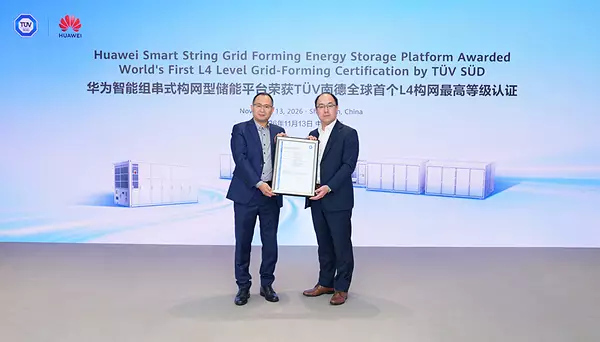
Huawei Smart String Grid Forming ESS Platform Receives the Industry's First Highest-Level (L4) Grid-Forming Capability Certification from TÜV SÜD