An eight-episode documentary, "30 Degrees North Latitude," has offered a Chinese perspective on human civilizations in the Northern Hemisphere's habitable zone.
Produced by China Media Group (CMG), the documentary tells the story of the emergence, development, and survival of early human civilizations in the habitable zone at 30 degrees north latitude, a belt that may have held the climate and conditions that allowed these societies to be born.
Focusing on the origins of civilization and cultural exchange and mutual learning, it explores key archaeological sites and cultural relics spanning 10 countries across four continents, pooling the wisdom of more than 100 scholars from China and abroad.
The documentary aired on the CCTV-9 Documentary Channel in October.

CMG documentary traces origins of human civilizations
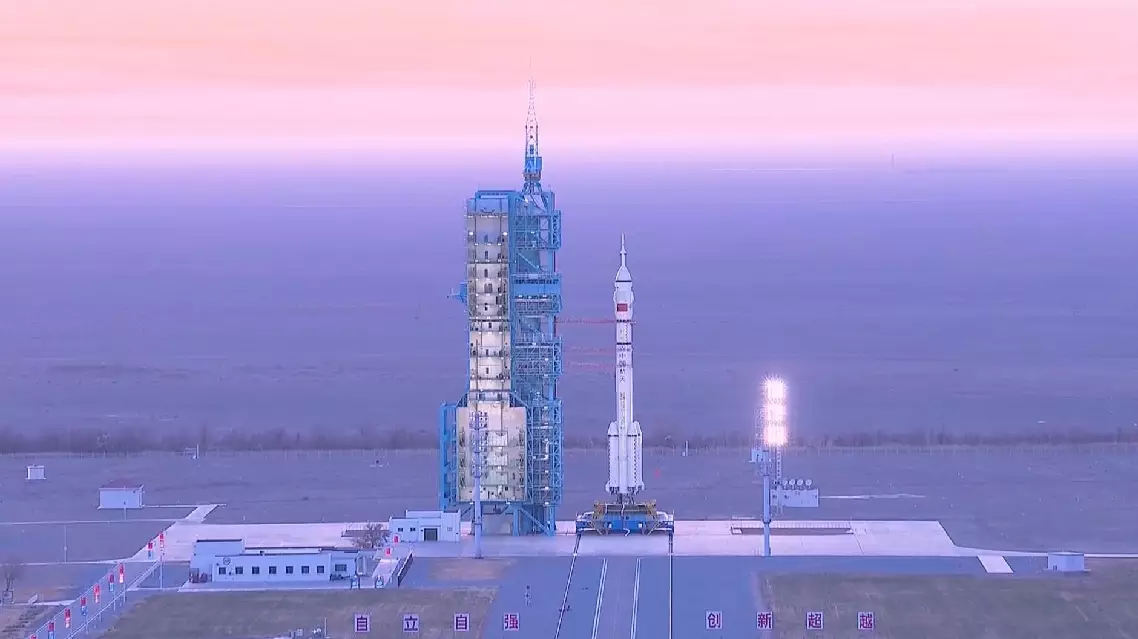
International space experts have congratulated China on the launch of the Shenzhou-24 crewed spaceship on Wednesday, saying that the country's space achievements are remarkable and international cooperation in China's space endeavors holds broad prospects.
The astronauts aboard the spaceship are mission commander and spacecraft pilot Tang Hongbo, flight engineer Wu Yi, and Pakistani astronaut Muhammad Zeeshan Ali, who is the first-ever foreign astronaut to visit Tiangong space station. The mission marks the first joint flight by Chinese and foreign astronauts in the history of China's manned space program.
"This mission is of milestone significance, as it marks the first time a foreign astronaut has entered China's space station. This is an extraordinary achievement that highlights China's leading position in the space field and its ambition to promote future development, pointing out a clear direction for continued progress," said Simeon Asenovski, deputy director-General of Space Research and Technology Institute under the Bulgarian Academy of Sciences.
Anatoly Alekseevich Petrukovich, director of the Space Research Institute under the Russian Academy of Sciences (IKI RAS), highlighted the trust that international partners place in China's space endeavors, citing the Pakistani astronaut's flight aboard a Chinese spacecraft as a concrete example of deepening cooperation that extends well beyond crewed spaceflight.
"It first and foremost reflects international partners' trust in China's space endeavors. I believe that international cooperation in China's space program has broad prospects. Beyond crewed spaceflight, China is also advancing international cooperation projects in areas such as low-Earth-orbit satellites, and has carried foreign scientific payloads on its lunar probes. I believe that China's space endeavors are entering a fast track of development, with scientific exploration missions being accelerated, the crewed space program advancing steadily, and dense launches of communication, remote sensing and lunar exploration satellites. China is joining the world's first tier in space industry," he said.
Int'l experts praise China's space achievements, see broad prospects for cooperation