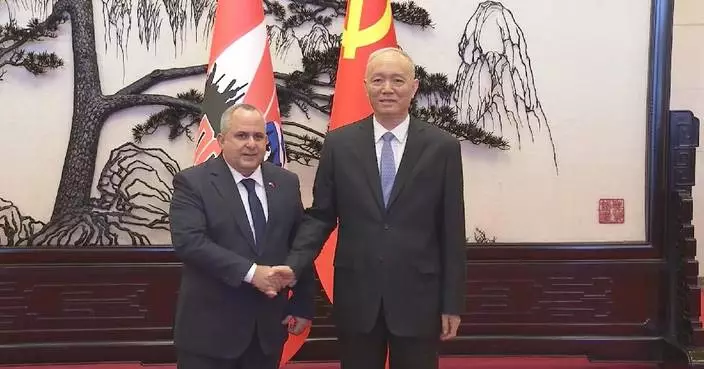
China does not interfere in other countries' internal affairs but supports their development, said Vladimir Imamovich Norov, Uzbekistan's former foreign minister and a former secretary-general of the Shanghai Cooperation Organization (SCO), in a recent interview in Beijing.
Speaking to the China Global Television Network (CGTN), Norov, a long-time witness of China's foreign policy, cited the SCO's Regional Anti-Terrorist Structure, established in Tashkent, Uzbekistan, in 2004, as an example.
The mechanism, he said, has enabled Central Asian countries and China to jointly counter terrorism and extremism, creating a stable and sustainable environment that opened the way to economic development.
Asked whether China had refrained from interfering in Uzbekistan's domestic politics and instead treated it and other Central Asian countries as equal partners, Norov recalled that in the early days of independence his country faced many challenges, above all terrorism and extremism.
"From 2004, by establishing this Regional Anti-Terrorist Structure, we are developing a stable and sustainable [environment]. We have a chance to develop our economy and so on. China is, in this way, supporting by developing the capacity of our law enforcement agencies, by training them, by supplying needed equipment for them and so on," he said.
Norov stressed that the cooperation is practical and centered on capacity building, noting that China helps strengthen law enforcement agencies and supplies needed equipment, and made clear that such efforts amount to support for development rather than interference in internal affairs.
"It is not interference in internal affairs. It is support to develop. It is important for us. It is mutually beneficial. That's why this cooperation is not focused on interference, but on supporting the Central Asian countries to develop their economy, to develop their potential and capacity, to find solutions themselves to their problems, and developing their infrastructure," he said.
Former Uzbek FM rejects 'interference' claims, says China supports joint development
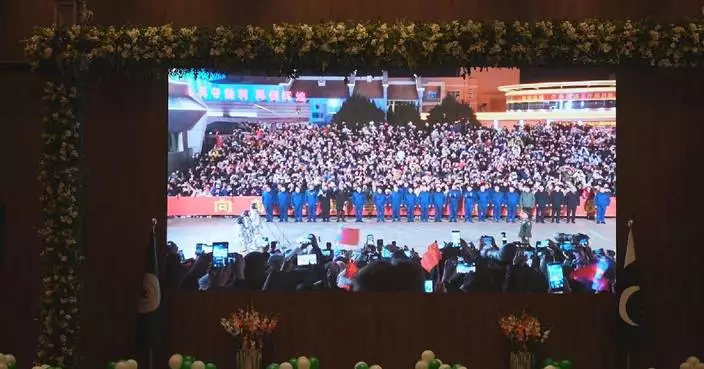
Pakistan's space community celebrated a landmark moment on Wednesday as China's Shenzhou-24 spacecraft carried the country's first astronaut toward China's Tiangong space station, a flight hailed as taking the deep-rooted Pakistan-China friendship into orbit.
The community gathered in Islamabad in the early morning to witness the launch live, as the spaceship, atop a Long March-2F carrier rocket, blasted off at 08:18 (Beijing time) from the Jiuquan Satellite Launch Center in northwest China, carrying Chinese astronauts Tang Hongbo and Wu Yi along with Pakistan's Muhammad Zeeshan Ali to the orbiting station.
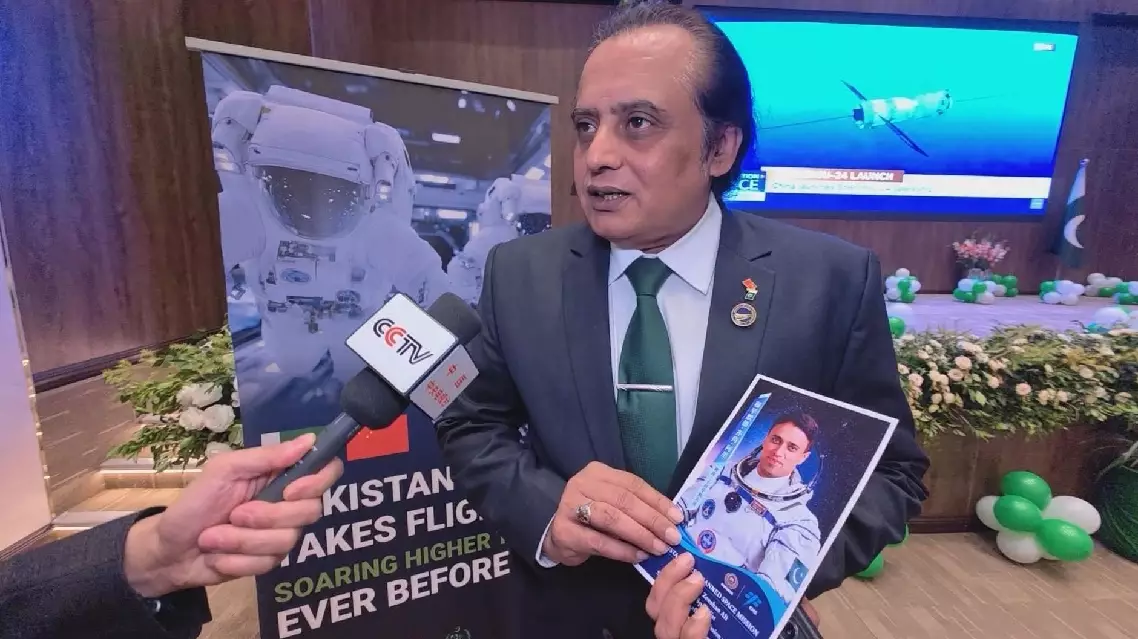
For Amjad Ali, director general of Space Application and Research at Pakistan Space and Upper Atmosphere Research Commission (SUPARCO), the liftoff crowned years of cooperation that has helped Pakistan build up its own space capabilities, and he voiced confidence that the momentum would only grow.
"We are always thinking very high of China because they have been helping us in most of the science and technology fields and keeping in view the pace of the China with respect to the science and technology. So we are also thinking high and we are also looking forward for a very good cooperation even in days to come," he said.
Zain Bukhari, general manager at SUPARCO, said the moment was extraordinary for Pakistan and held special meaning in the history of the two countries' profound friendship, noting that the scientific experiments planned for the mission are of a unique nature.
"Most importantly the kind of the experiments that Shenzhou-24 crew is going to take place is also of a unique nature because we published for the proposals in our country and we received almost 300 proposals and after that we have selected around three to four proposals that are going to be experimented on board in the environment of microgravity and the solar radiations," he said.
Najam Abbas Naqvi, chairman of the National Center of Geographic Information Systems (GIS) and Space Applications, described the mission as a symbol of the two countries' collaboration and a powerful sign of mutual trust.
"This is our national pride and this is the symbol of Pakistan-China collaboration and friendship. This is a wonderful sign of trust, friendship, relationship, technology and the transfer of the trainings and human resource," he said.
Marking a new chapter in Pakistan-China space ties, Ali is set to become the first foreigner to board Tiangong. Once in orbit, he will join the crew's routine work, primarily installing experiment samples and units and carrying out in-orbit tests, according to the China Manned Space Agency.
After a short-term joint flight, he will return to Earth aboard the Shenzhou-23 spacecraft alongside two of its crew members.
Pakistani community hails historic Shenzhou-24 launch as friendship reaches new height