BRUSSELS (AP) — European Union leaders will seek on Thursday to bridge major differences over the bloc’s long-term budget and agree on a big new loan to help Ukraine meet its economic and military needs next year.
The new joint budget is a statement of the EU’s ambitions in the world and is financed mostly by the 27 member countries based on the size of their economies. The 2028-2034 package could amount to between 1% and 1.2% of the bloc’s gross national income.
Click to Gallery
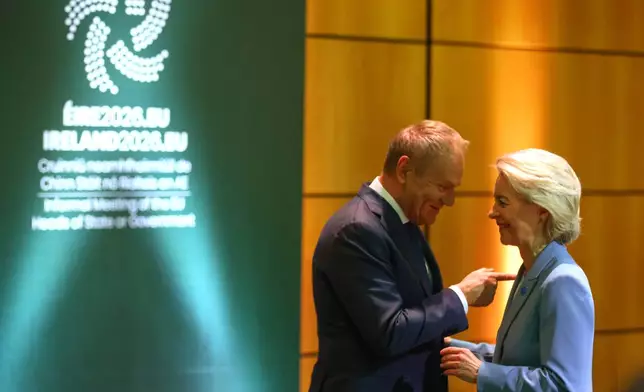
Poland's Prime Minister Donald Tusk speaks to European Commission President Ursula von der Leyen during the EU Summit in Dublin, Friday, Nov. 13, 2026.(AP Photo/Peter Morrison)
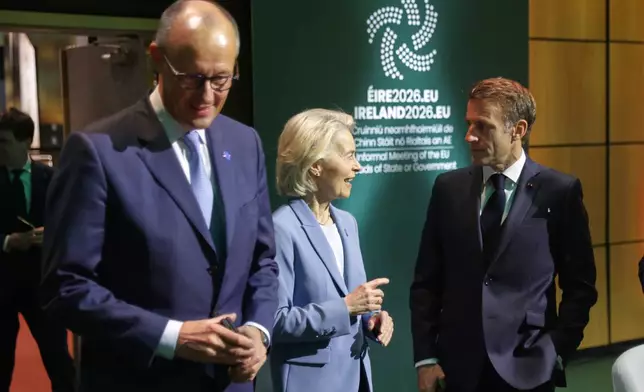
Germany's Chancellor Friedrich Merz, from left, European Commission President Ursula von der Leyen and French President Emmanuel Macron speak during the EU Summit in Dublin, Friday, Nov. 13, 2026.(AP Photo/Peter Morrison)
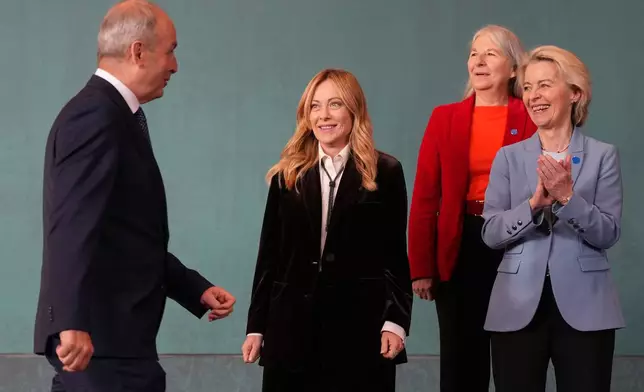
Ireland's Prime Minister Micheál Martin, left, walks past Italy's Prime Minister Giorgia Meloni, second left, and European Commission President Ursula von der Leyen to take part in the group photo during the EU Summit in Dublin, Friday, Nov. 13, 2026. (AP Photo/Virginia Mayo)
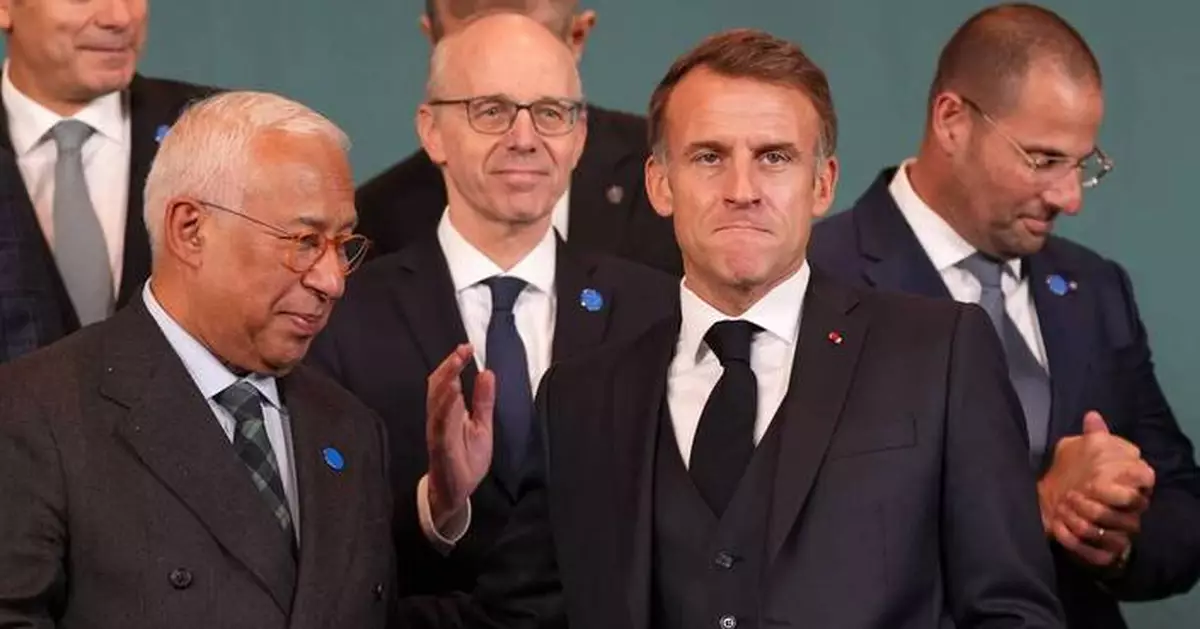
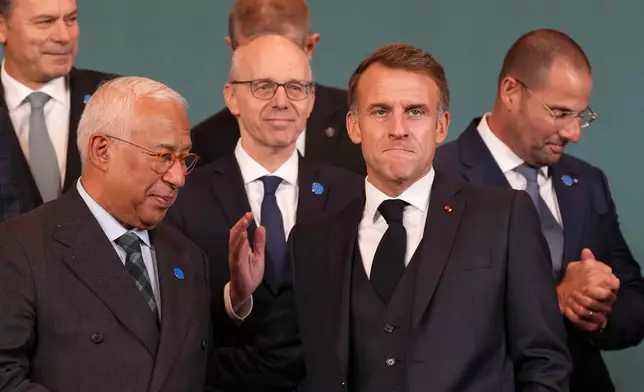
French President Emmanuel Macron stands next to European Council President Antonio Costa during the EU Summit in Dublin, Friday, Nov. 13, 2026.(AP Photo/Virginia Mayo)
“The time has come to reach an agreement,” European Council President António Costa wrote in a summit invitation letter. Last weekend, he tabled a new proposal to solve the budget riddle, cutting about 10% off the original European Commission plan.
Costa, who will chair the two-day meeting in Brussels, said that leaders have “the responsibility to find a balanced agreement that will allow the European Union to take on the challenges ahead.”
Complicating things are upcoming elections in France, Italy and Poland next year and in Spain on Sunday. The hard right leads in surveys in France and winners in Poland and Spain are tough to predict. New governments could make it even harder to agree on a deal next year if one isn't found by the end of next month.
The EU is divided into hard-to-move camps when it comes to the budget. They’re getting even tougher to budge as Europe’s debt strife spreads and countries are forced into greater defense spending over Russia’s almost five-year-long war on Ukraine.
Around a third of countries are so-called net contributors that pay in more than they get back in allocations. Germany, Austria, the Netherlands and Sweden are the most vocal in their opposition to being asked to cough up even more and demand belt-tightening.
A large group of countries, led by France and Italy and dubbed the “friends of cohesion,” staunchly defends funds that protect farmers and pay for infrastructure projects in relatively poor member countries, to help bring them up to EU standards.
Those policies make up about two thirds of the entire budget.
But most countries also want to direct spending to new areas, as the EU confronts challenges like supporting Ukraine as it fights off a Russian invasion and remaining competitive in the face of high energy prices and trade tensions with the U.S. and China.
Costa has proposed an EU-wide tax on digital services to raise money. It would be drawn from online advertising and money that companies make from user data and could amount to 5 billion euros ($5.5 billion) a year.
Ukraine is a big part of the budget puzzle. The spending package foresees a 100 billion-euro ($110 billion) envelope for Ukraine over seven years. The leaders must also decide on a new 45 billion-euro ($49.4 billion) loan for the country.
Earlier this month, German Chancellor Friedrich Merz threatened to hold up a budget agreement if there were no “collective commitment” made to Ukraine by all member countries, “without exception.”
Bulgaria, the Czech Republic, Hungary and Slovakia oppose using funds for military aid to Ukraine. In a letter to Costa, Merz said that helping “Ukraine is a matter of our indivisible European security, and so must be the burden sharing for that support.”
Nearly a year ago, EU leaders endorsed a loan of 90 billion euros ($99 billion) to cover most of the Ukrainian government's needs for two years. But Russia’s intensified attacks on energy and civilian infrastructure, along with disruptions to Black Sea trade, are straining Ukraine’s finances.
The commission again plans to raise money for the loans on capital markets, with 20 billion euros ($22 billion) earmarked for the economy and 25 billion euros ($27 billion) for the armed forces.
Costa plans to present his proposal to the leaders, then let them break up into smaller groups and for bilateral talks. He plans to share his conclusions with all 27 at the end, probably on Friday.
EU diplomats say that an agreement is more likely to be sealed when they meet again next month.
Whatever happens, missing the end of December target doesn't mean that money runs out. Nations have another year, but much time is needed to adopt legislation on spending programs and approve it all so money can be flowing by January 2028. All 27 member countries and the European Parliament must endorse it.
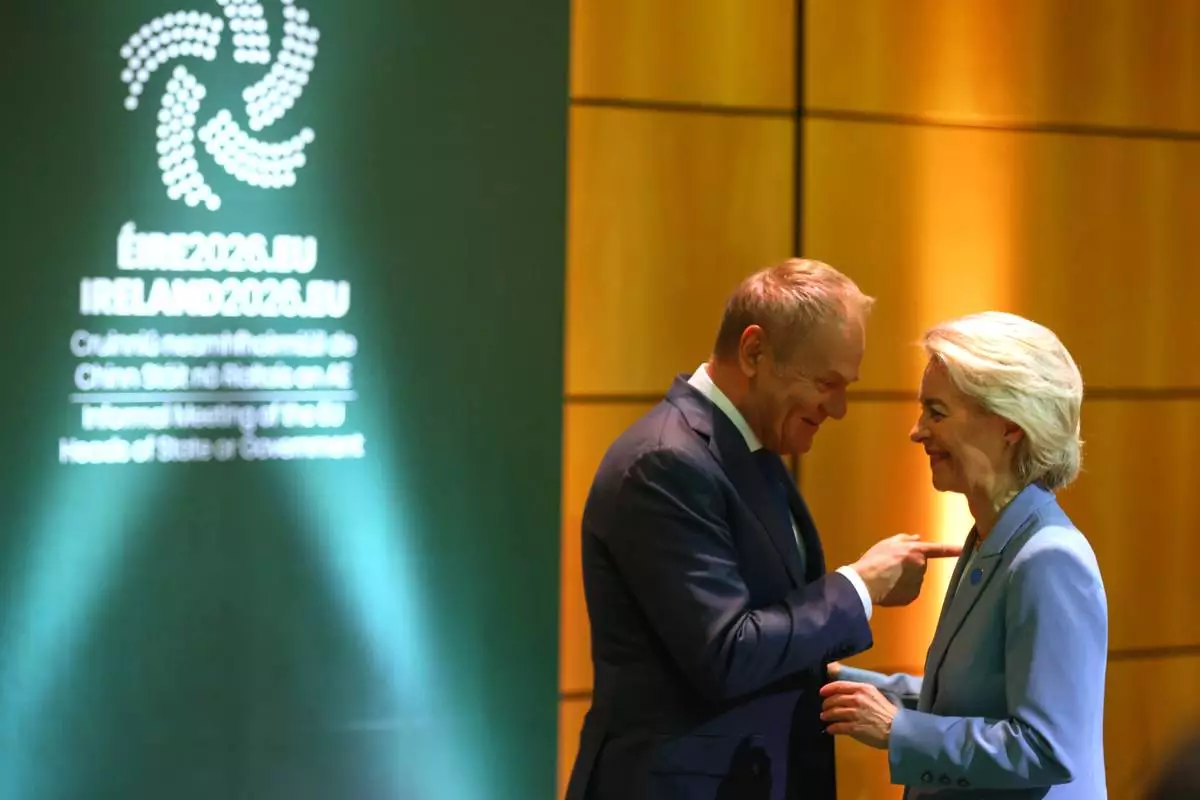
Poland's Prime Minister Donald Tusk speaks to European Commission President Ursula von der Leyen during the EU Summit in Dublin, Friday, Nov. 13, 2026.(AP Photo/Peter Morrison)
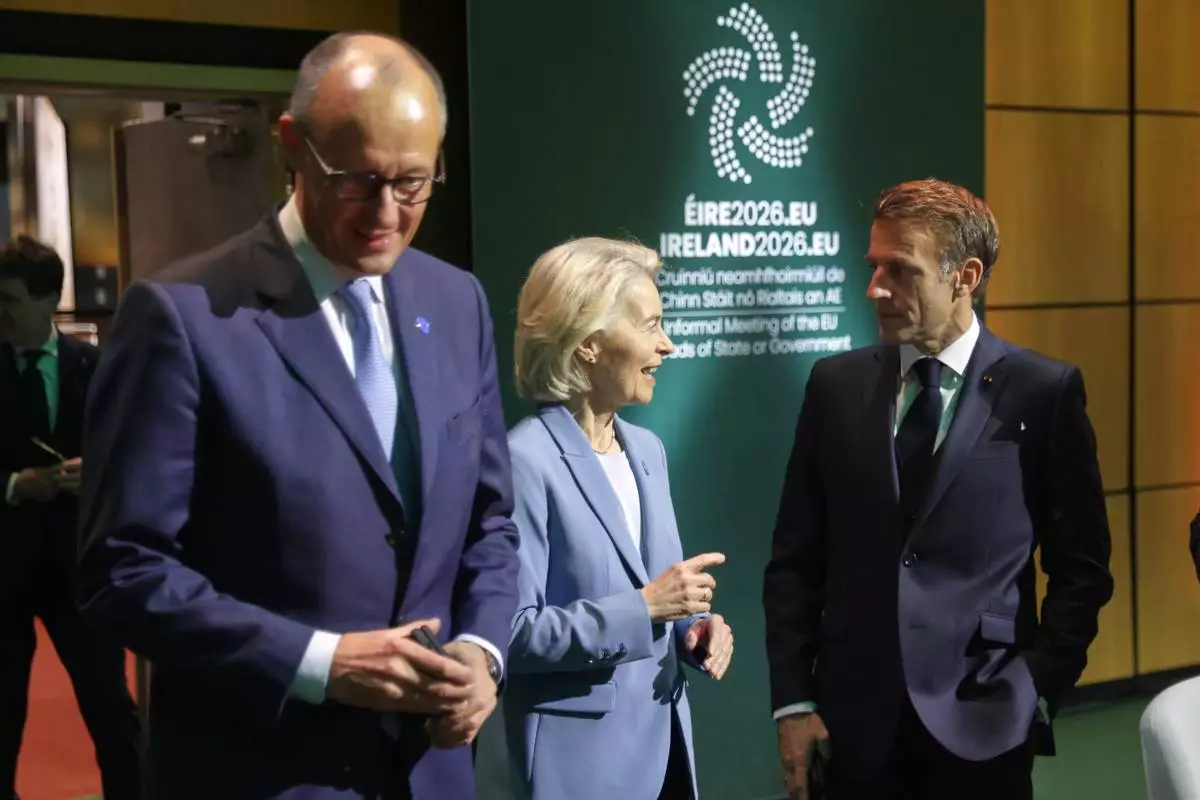
Germany's Chancellor Friedrich Merz, from left, European Commission President Ursula von der Leyen and French President Emmanuel Macron speak during the EU Summit in Dublin, Friday, Nov. 13, 2026.(AP Photo/Peter Morrison)
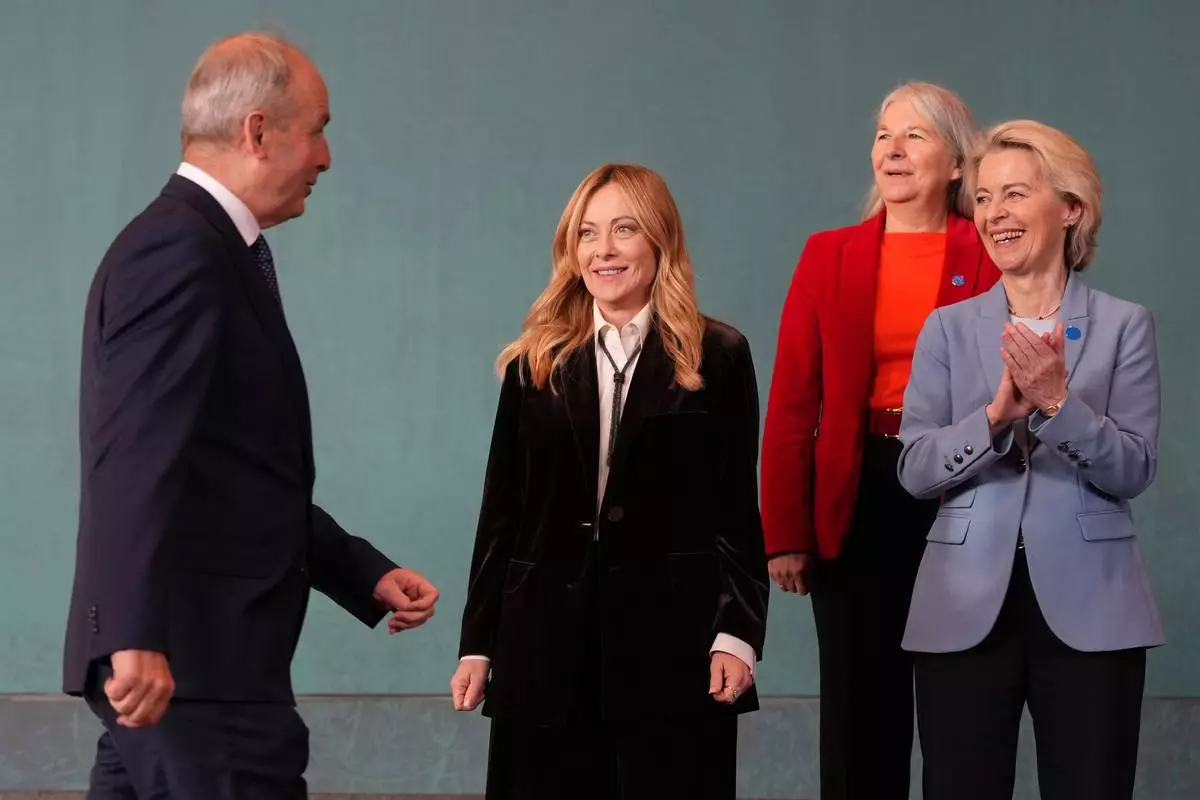
Ireland's Prime Minister Micheál Martin, left, walks past Italy's Prime Minister Giorgia Meloni, second left, and European Commission President Ursula von der Leyen to take part in the group photo during the EU Summit in Dublin, Friday, Nov. 13, 2026. (AP Photo/Virginia Mayo)
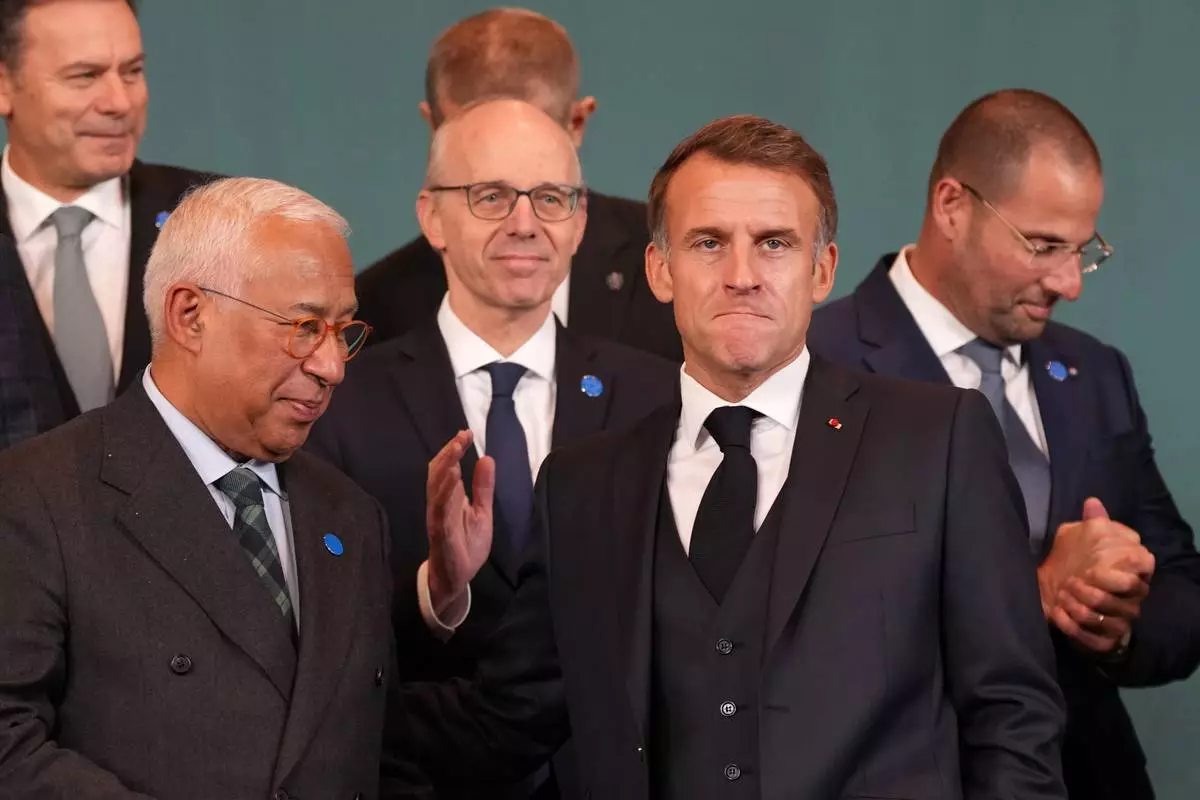
French President Emmanuel Macron stands next to European Council President Antonio Costa during the EU Summit in Dublin, Friday, Nov. 13, 2026.(AP Photo/Virginia Mayo)
BRISBANE, Australia (AP) — Cricket is imploding again 8 1/2 years after the cheating scandal dubbed “Sandpapergate.”
Longtime Australia teammates are calling each other out over their conflicting versions of what happened. There have been accusations of scapegoating, of lies and cover-ups. Pot shots are coming from outside and within the inner-sanctum.
Three Australian players received unprecedented bans over a plot to illegally tamper with the ball during a test match — the traditional, five-day version of cricket — in March 2018 against South Africa in what was already an acrimonious series.
An autobiography published by retired batter Usman Khawaja in early November alleged that everyone in the Australia squad and staff knew of the sandpaper plan but let captain Steve Smith, vice-captain David Warner and Cameron Bancroft — who was literally caught red-handed — take the fall. Smith and Warner accepted 12-month bans from Cricket Australia and returned in 2019. Bancroft was suspended for nine months, and never re-established his spot in the Australian team.
Warner and Bancroft, among others, supported Khawaja's claim. Pat Cummins, the incumbent Australia captain who was among the bowlers in that match, described Khawaja's claim as “complete and utter nonsense.” His three longtime partners in Australia's so-called bowling “cartel ” have also distanced themselves from the plot.
Smith has so far maintained a silence.
The initial Cricket Australia investigation, conducted within a matter of days, leveled the blame on three members of the team. Questions are being raised now about why all players, coaches and support staff weren't interviewed as part of the investigation.
Some critics have torched Khawaja's decision to reopen the biggest scandal in decades in Australian cricket and questioned his motives. Backers have praised Khawaja's courage for speaking out and acknowledging the win-at-all-costs mentality that typified the team of that era, even if he went public only after retiring. Khawaja said the Australians should have accountability as a team.
Intense media coverage has renewed focus on Warner’s central role in the sandpaper plot. Bancroft, for the first time publicly, stated it was Warner's idea.
Just like their counterparts in baseball, cricket players are capable of devising devious ways of getting extra movement on a thrown ball. It's sometimes known as “ball management.” What made Sandpapergate such a scandal was the sheer brazenness of it.
Tampering usually involves either making one half of the ball rough or unpicking the stitches in the seam. Teeth, fingernails, bottle caps, zippers, dirt and grit have been used to gouge the ball. Wet candy, mints, gum and glue have been used on the cricket ball. Saliva was typically used to shine one side of the ball — to make it swing through the air — until that was banned in 2020 during the health crisis of the COVID-19 era.
Some famous players — it’s a long list but here are a few names, all former captains: Mike Atherton of England, Sachin Tendulkar of India, Faf du Plessis of South Africa — have been accused of or sanctioned by the International Cricket Council for ball tampering. Their punishments amounted to fines or comparatively minor suspensions.
The abrasive sheets of paper have always been used to rub the face and edges of cricket bats, which are made of willow. Cummins says there's still sandpaper in the locker rooms to use on bats. He said it was also used in practice sessions to scuff the outside surface of the leather balls so that batters could prepare to face deliveries that swing through the air unconventionally.
But using it on the field, during the game, that's extraordinary. And that's what got the Australian team into this prolonged mess.
Some wonder why this case was treated so harshly. Cricket Australia administrators recognized the sport's long-established status in the national consciousness, and realized the Sandpapergate scandal brought the game into disrepute and shattered the team’s standing in the community.
Michael Kasprowicz, a former test fast bowler and Cricket Australia director, told Australian Associated Press that the hard line taken was probably more about perception than tampering.
“I know from a board point of view at the time, it wasn’t about damaging the ball. It was about damaging the brand,” he said.
Bancroft was the initial face in the scandal, after South African television broadcast footage of him with the sandpaper on the field.
He published a roughly 4,500-word account of his recollections after Khawaja, Warner and Cummins made public statements.
“It was not just the three of us ... It was the whole team,” Bancroft said. He felt “freed” after finally telling his story, he said, adding that the “final straw” was a news conference staged by Cummins that “made me feel angry, betrayed and alone.”
Warner responded to the initial fallout from Khawaja’s book by supporting his longtime friend and saying Cricket Australia’s investigation into the scandal was “rushed and botched. ”
But Cummins, in a 70-minute stand-up news conference, accused Khawaja of being “casual” and “flippant.”
“When he says we all knew, if by that he means that we knew sandpaper was going out in the field, he’s 100% wrong,” Cummins said.
In a clearout after the 2018 series, head coach Darren Lehmann, who has denied any knowledge of the plot, was replaced by Justin Langer, who was succeeded by Andrew McDonald in 2022. Veteran wicketkeeper Tim Paine replaced Smith as test captain before Cummins took over in 2021.
Cricket Australia has a new CEO, Todd Greenberg, who has ruled out reopening the Sandpapergate investigation but plans to establish an independent forum for the players. He said the sport's administrators aren't taking any side of the debate.
Former Australia captain Greg Chappell, who was embroiled in the so-called “Underarm” controversy in the 1980s, wants the “bickering” to stop.
“What worries me is that it’s dividing people who love the same game,” he wrote in a column for cricinfo.com, “and I fear it will open chasms inside a team that has to take the field together.”
See AP’s full cricket coverage here
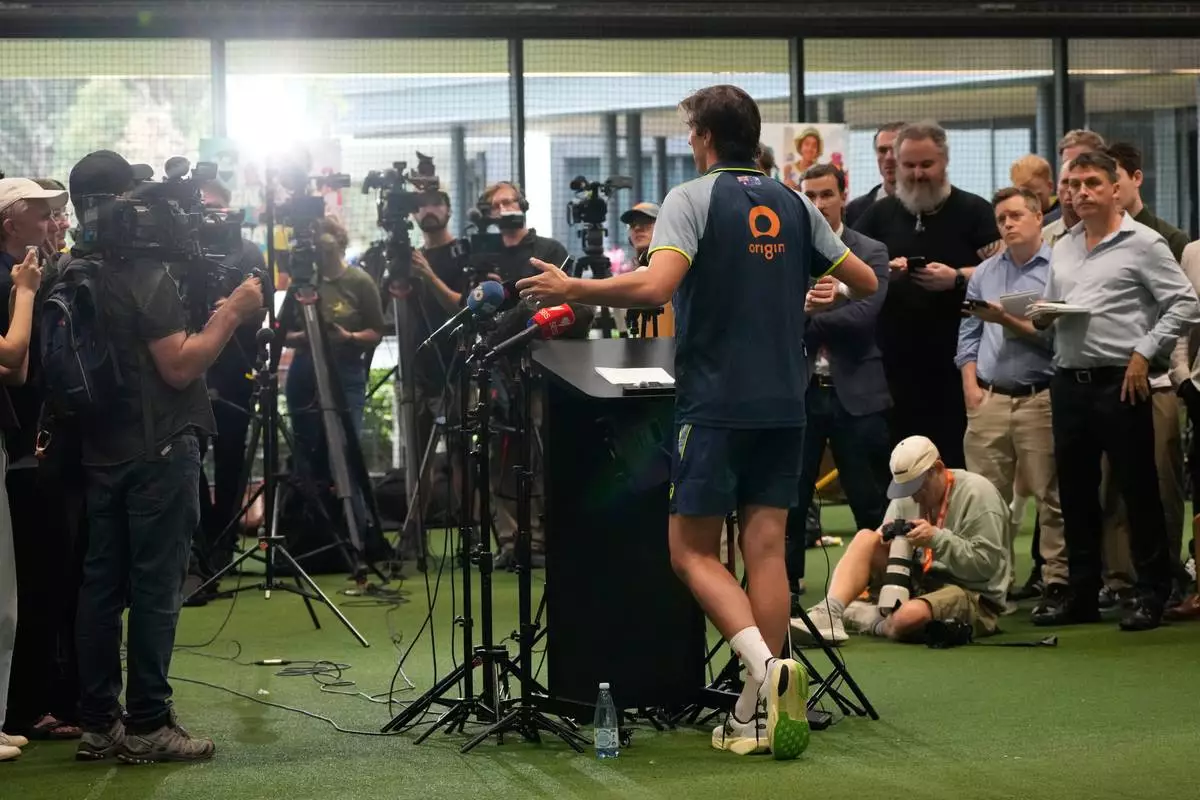
Australia men’s cricket captain Pat Cummins speaks in Sydney, Friday, Nov. 13, 2026, about the Sandpapergate cheating scandal. (AP Photo/Rick Rycroft)
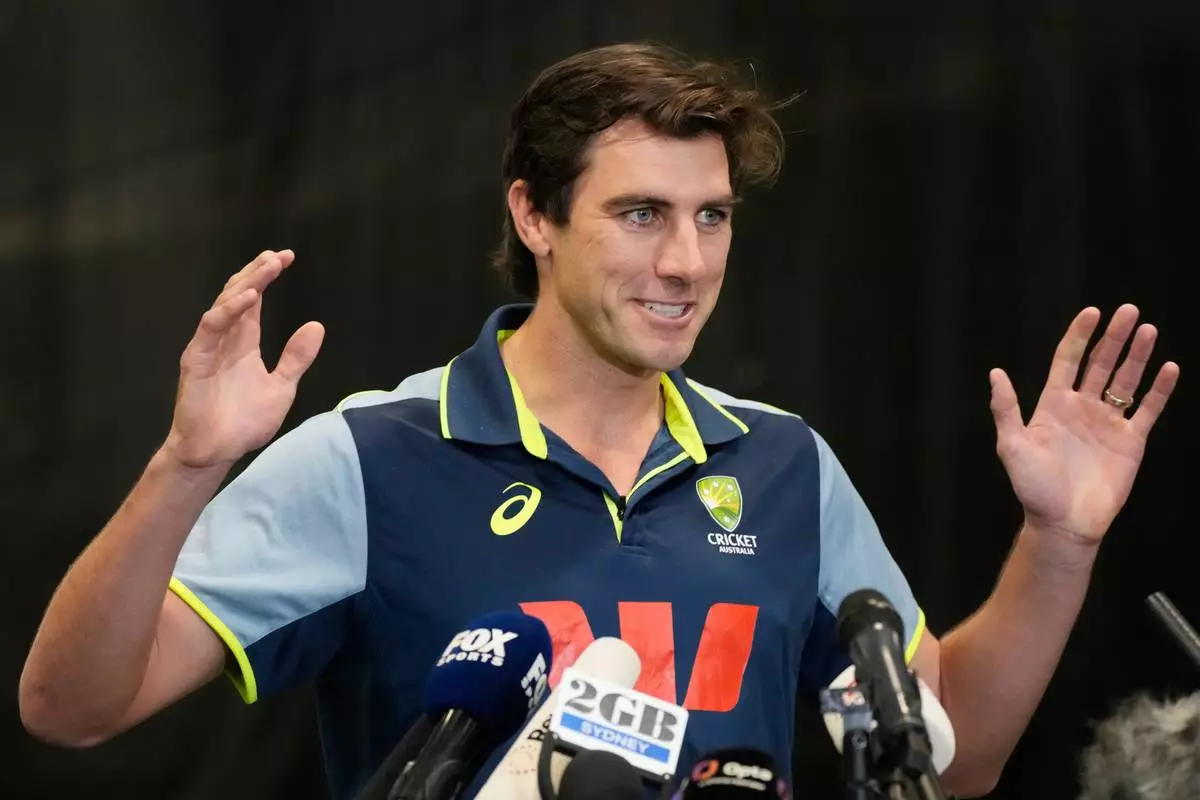
Australian men's cricket team captain Pat Cummins speaks in Sydney, Friday, Nov. 13, 2026, about the so-called Sandpapergate cheating scandal. (AP Photo/Rick Rycroft)
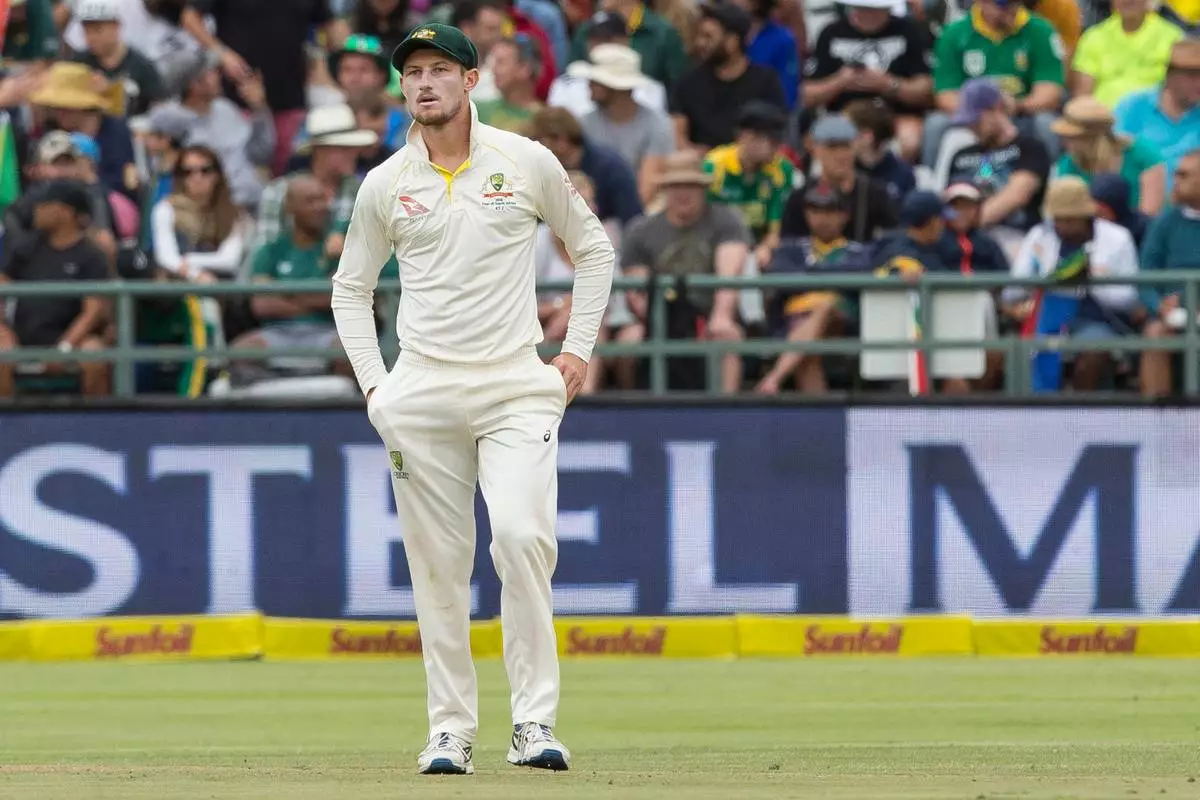
FILE - Cameron Bancroft of Australia reacts during the third day of the third cricket test between South Africa and Australia at Newlands Stadium, in Cape Town, South Africa, Saturday, March 24, 2018. (AP Photo/Halden Krog,File)
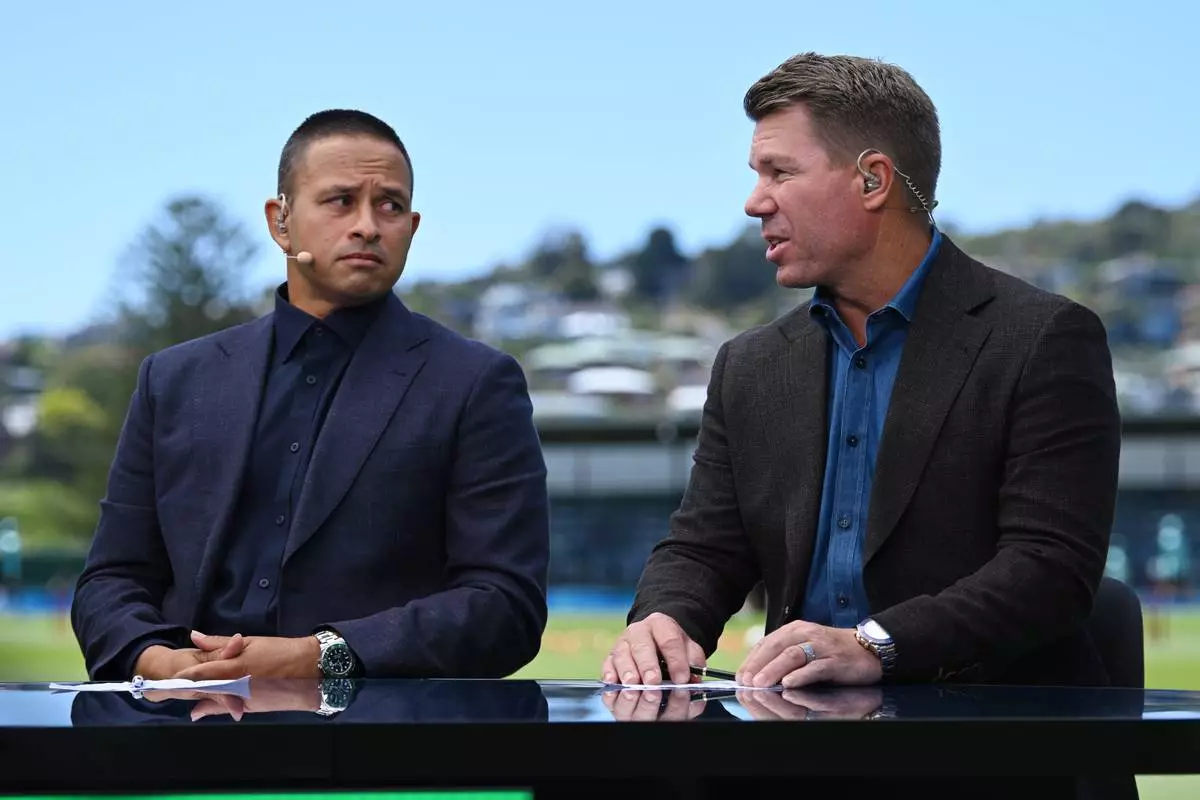
Former Australian cricket players Usman Khawaja, left, and David Warner speak before the start of the one-day international cricket match between Australia and England in Hobart, Australia, Wednesday, Nov. 18, 2026. (James Ross/AAP Image via AP)
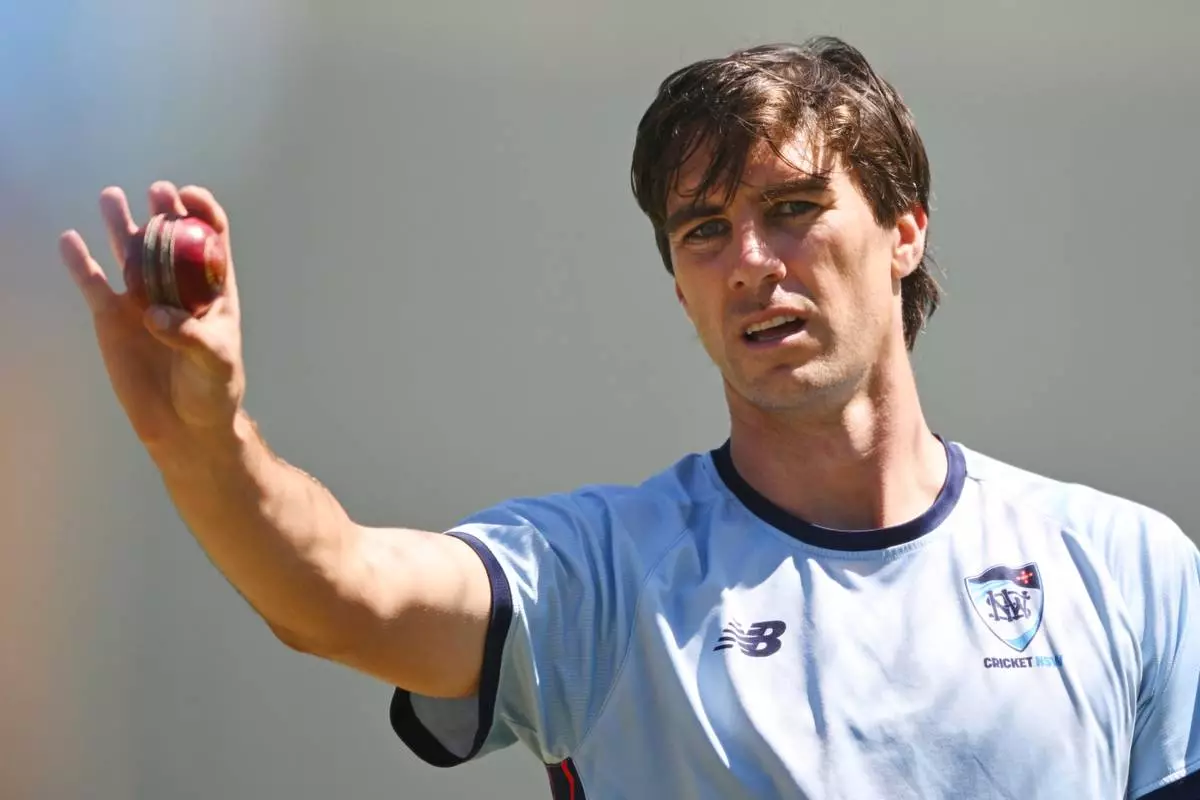
Australian cricket captain Pat Cummins reacts during a team training session for his state team in Sydney, Thursday, Nov. 19, 2026. (Dean Lewins/AAP Image via AP)