Speech by FS at Networking Keynote Luncheon in Amsterdam (with photos/video)
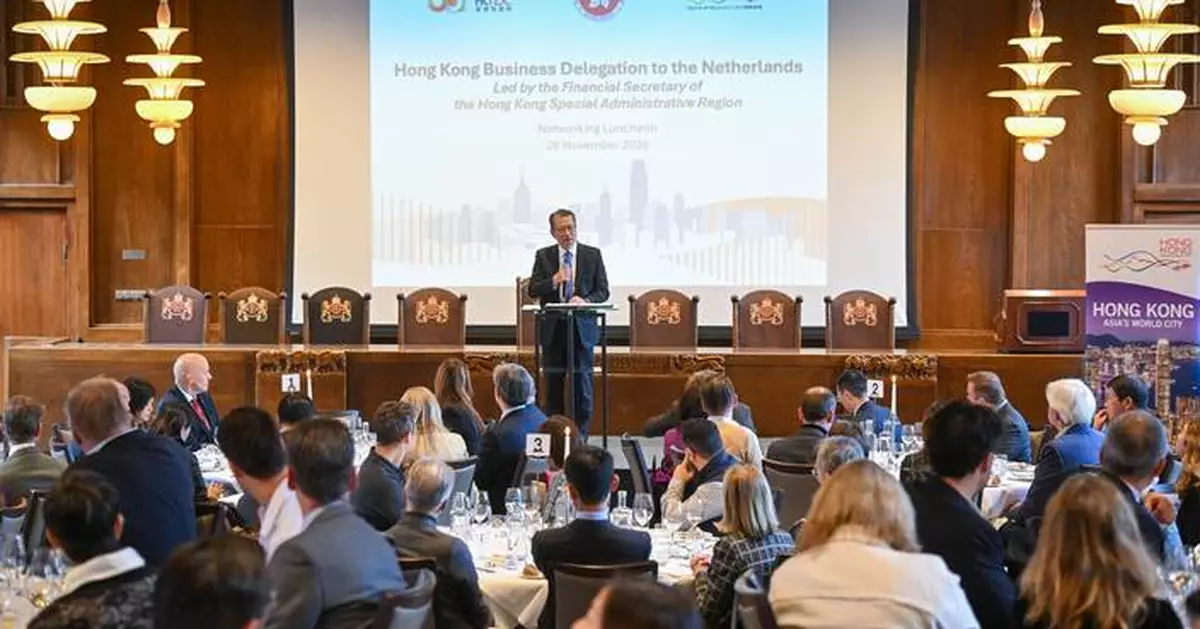
The following is the speech by the Financial Secretary, Mr Paul Chan, at the Networking Keynote Luncheon in Amsterdam, co-organised by the Hong Kong Economic and Trade Office in Brussels and the Hong Kong Trade Development Council, today (November 26, Amsterdam time):
Fred (Chairman of the Hong Kong Trade Development Council, Professor Frederick Ma), Theo (Chairman of the Netherlands Hong Kong Business Association, Mr Theo Wit), Hans (Co-Founder and Vice Chairman of the Board, Pharvaris, Mr Hans Schikan), distinguished guests, ladies and gentlemen,
Good afternoon. Let me first thank the Hong Kong Economic and Trade Office in Brussels and the Hong Kong Trade Development Council for bringing together so many distinguished leaders from business, finance and innovation in the Netherlands.
Let me begin with what we have in common. The Netherlands and Hong Kong both live by trade. Neither of us has a large home market, so we have always looked outward. In each of our economies, the value of trade is larger than the economy itself. We both punch well above our weight.
That is why we both keep our doors open: open to goods, to technology, to capital and to talent. It is also why we watch the state of the world economy so closely. For a large economy, open trade is perhaps an advantage. For economies such as ours, it is a condition of survival.
Economies that depend on the wider world learn to look far ahead, and here the Netherlands sets the standard. You plan your dikes and your coastline to the end of the century. Your pension system has been ranked the best in the world for four years in a row, to the envy of many elsewhere in Europe. So I hope that a plan of five years will strike you as a modest proposal.
My subject this afternoon is Hong Kong's First Five-Year Plan: what it means for finance and innovation, and how we can work together and prosper.
Let me begin with where Hong Kong stands. Our economy grew by about 5.1 per cent in the first nine months of this year, and the momentum into the fourth quarter remains strong. We expect growth of about 4.8 per cent or above for the year as a whole. The unemployment rate has edged down to 3.8 per cent. Inflation remains low, at about 1.7 per cent.
Home prices have been rising again since the middle of last year, by about 10per cent to 11per cent in total. The office market is also stabilising, and rents are starting to edge up in our core business districts.
Capital inflows have also been strong at a time of global uncertainty. Bank deposits have risen by 8.1 per cent, to more than €2.4 trillion. Hong Kong-domiciled funds drew net inflows of about €16 billion in the first three quarters of this year.
These results rest on our enduring institutional strengths under "one country, two systems". Hong Kong keeps the common law, a judiciary exercising powers independently, and a simple and low tax regime. Capital, goods, talent and information move freely. We remain a separate customs territory, with our own currency, pegged to the US dollar since 1983.
These foundations tell an investor what will stay for the long term. Our First Five-Year Plan tells an investor where we are going in the next few years.
You may ask why an open market economy needs a plan. It is because the investments that matter most take time. A laboratory, a university campus or a new industry cannot be built within a single budget year. Businesses need policy certainty; they value predictability and consistency. Your own Central Planning Bureau began work in 1945 under Jan Tinbergen, who later shared the first Nobel Prize in economics. I like to think he would have approved of our initiative.
The direction itself is clear. Our Plan is aligned with the 15th National Five-Year Plan, because the Mainland is our hinterland. We align with its direction of development, and then take a hard, businesslike look at where our competitive advantages lie. In that way we find our position, and with the support of the Central Government we can move forward and grow further.
Those of you in the financial markets will know this well. Over the years, through the various Connect schemes, the support of the Central Government has increased the liquidity of our market. It has also strengthened our unique competitiveness in global finance.
The current national plan gives priority to a modern industrial system, and to greater strength in science and technology. China is now known as much for what it invents as for what it manufactures.
Within that strategy, Hong Kong's direction is, in a nutshell, four centres and one hub. Three of the centres are familiar to you: finance, trade, and shipping together with aviation. The fourth is innovation and technology. The hub is for talent, not only from the Chinese Mainland but from all over the world. In the interest of time, I shall focus on finance and innovation, because they resonate strongly with your own priorities.
Let me start with finance, and with our stock market. Last year, our market raised about 33 billion euros through new listings, ranking first in the world. This year the momentum has been stronger still. In the first ten months, more than 120 companies listed on our exchange. Together they raised about 40per cent more than in the whole of last year.
That position was built over a number of years. When I took up this office in 2017, one of the first questions I put to my colleagues and our regulators was why companies such as Alibaba had gone to the United States to list, and not to Hong Kong. We had to change that.
In 2018, we introduced the first round of reforms. We allowed companies with weighted voting rights structures to list. We also allowed biotechnology companies with no record of profit, and even no revenue, to go public once they had reached certain scientific milestones. Our approach is full disclosure, and let the market decide.
Since then, biotechnology listings in Hong Kong have been very strong. We are now the second-largest biotechnology fundraising centre in the world, just behind New York. In recent years, recognising the importance of biotechnology and hard technology, we have added dedicated chapters to our listing rules to speed up the listing of such companies. Our stock market can thus move in step with the underlying economy.
Looking ahead, we have asked ourselves what it means to be an international financial centre. It cannot be the stock market alone. We need to broaden what we offer in fixed income, currencies and commodities. That is why we published a ten-point roadmap for fixed income and currencies, or the FIC roadmap, setting out our direction and priorities. It is available online, and I invite you to take a look.
In asset and wealth management, given the current geopolitical situation, we have been an unintended beneficiary, as investors seek a safe harbour. Capital flows into Hong Kong have been very strong. What we offer is not only safety but also proximity to the Chinese Mainland market, and that means opportunity.
We spoke a good deal about biotechnology this morning. If you go to Hangzhou or Shanghai, you will be struck by the founders and innovators there. They are young and energetic, and full of novel ideas. In a way, this is the future. Indeed, the value of out-licensing deals struck by Mainland biotechnology companies reached a record high last year, at more than US$130 billion.
To return to finance, our core belief is this. Finance can be a strong sector in its own right, but we must also use it to help other sectors prosper. We call this strategy "Finance+".
That is why Hong Kong offers a technology company a full range of funding options, from start-up to public listing. Private equity and venture capital funds manage about US$250 billion in our city, second in Asia only to the Mainland.
We have also set up the Hong Kong Investment Corporation. It started with about HK$62 billion. It uses that capital to work with international capital, and to invest in the sectors we wish to develop: the industries of tomorrow, including hard technology. We do not mind investing small, investing early and investing for the long term.
It has been very successful. For every dollar the Corporation invests, eight dollars of international long-term capital follow. We have even formed co-investment funds with sovereign wealth funds from the Middle East.
So much for "Finance+". The other priority that deserves attention is artificial intelligence, a topic that is both popular and sensitive. We are aware of the risks, including those concerning the ethical use of AI. In the interest of time, I shall focus on economic development.
Our ambition is twofold. First, we are developing AI as a core industry. Second, as with finance, we are using AI to help other sectors transform and upgrade, or even redefine their business models.
To develop AI as a core industry, we are advancing on several fronts. AI needs computing power, algorithms, data, application scenarios, capital and talent, and we are providing all of these.
For AI to benefit other sectors, we must prepare our people, so that they learn to embrace it and do not fear it. We call this "AI for All". Our education and vocational training institutions are offering programmes to suit people of different interests and abilities.
On innovation and technology, one point worth mentioning is our collaboration with the other cities of the Greater Bay Area: Shenzhen, Guangzhou and seven other Mainland cities, as well as Macao. The Greater Bay Area has a population of 88 million, comparable to that of a large European country. Its combined GDP is about US$2 trillion, or about US$25,000 per head. In purchasing power terms, its consumption power is very strong. It is therefore both a large market and a base of formidable innovative capability.
Our approach is to work together. Our universities are very strong. In AI, three of them rank among the top 30 in the world. Our two medical schools also rank among the global top 40. They are our springboard for working with the other cities of the Greater Bay Area.
That is the thinking behind the Northern Metropolis. If you have not been there, please let us know when you next visit Hong Kong. I would be glad to arrange a visit, so that you can see our science parks and meet our people there.
Let me take biotechnology and health sciences as an example. Many pharmaceutical companies, including GSK and AstraZeneca, are keenly interested in a market of 1.4 billion people. They ask where they can obtain biological samples, and where they can conduct clinical trials. They also ask how, having done so, they can obtain approval for their products.
Our answer, and it is already taking shape, is a park on the boundary with Shenzhen. We call it Hetao, which means the Loop. Part of the park is in Hong Kong, and the other part is across the boundary in Shenzhen. The two are connected. Within the park, biological samples, data, researchers and information will be able to move freely. Pharmaceutical companies can therefore conduct their clinical trials there.
With clinical trials and regulatory collaboration there, the time for pharmaceutical products to reach the market will be shortened. That is the attraction, and it explains why some American and European pharmaceutical companies are already there. If you are interested, please speak to my colleague Cordelia (Chairman of Hong Kong Science and Technology Parks, Ms Cordelia Chung) and others, who are in the audience today.
Business aside, let me say a word about lifestyle. We work hard because we want to enjoy life. To the younger innovators of the Netherlands in particular, I say: you are most welcome.
Hong Kong is very safe, and law and order are excellent. We impose no duty on wine, so please enjoy it. We have more than 200 Michelin-recommended restaurants. They are not all in five-star hotels, and many are in our neighbourhoods, waiting to be explored.
Our hiking trails are impressive, as those of you who have seen the film "Four Trails" will know. If you have not, you can watch it on board Cathay Pacific on your next flight to Hong Kong. We have wonderful trails and wonderful beaches.
Many of you are young, and may wish to bring your families. They are most welcome too. We have more than 50 international schools, offering American, British, French, German and other curricula. So you need not worry about your children's schooling, or about their path to higher education back home. Our own universities are excellent as well.
Finally, Hong Kong is always open and always welcoming. Please join us. Thank you.
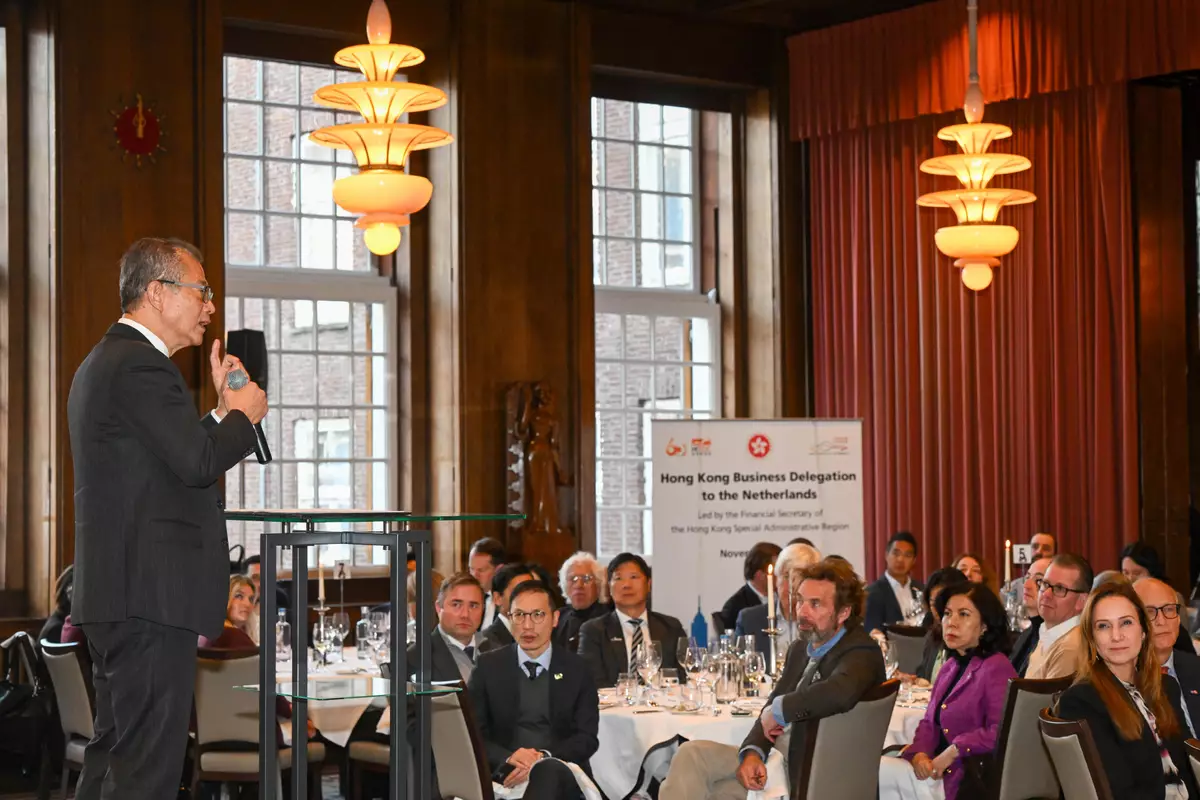
Speech by FS at Networking Keynote Luncheon in Amsterdam Source: HKSAR Government Press Releases
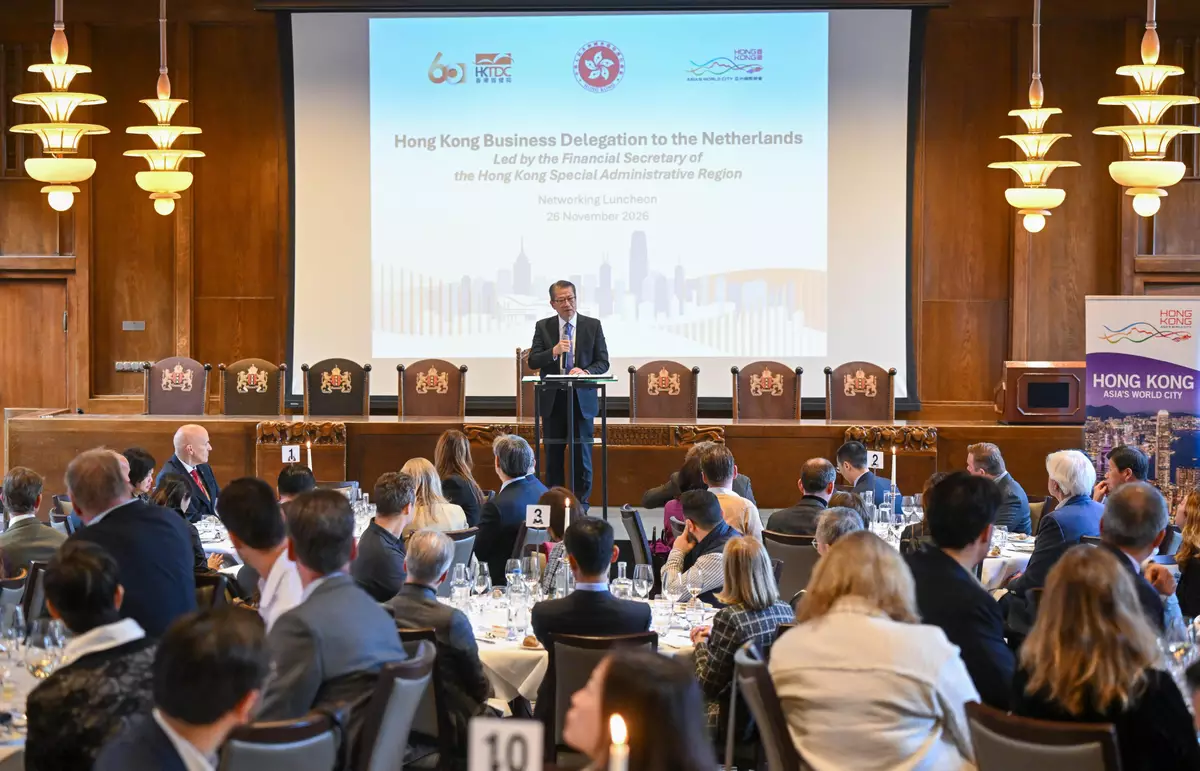
Speech by FS at Networking Keynote Luncheon in Amsterdam Source: HKSAR Government Press Releases