BEIJING, Nov. 27, 2026 /PRNewswire/ -- TME Uni Chart has officially launched on JOOX, the international music streaming platform under Tencent Music Entertainment Group (TME). Music fans across the globe can now view and engage with the full chart on JOOX, stream hit tracks, and support their favourite artists and songs.
As one of the flagship chart products under the authoritative TME Chart, TME Uni Chart adheres to the mission of "Charting Real Popularity Through Data". Drawing on authentic user‑behaviour data across multiple platforms, it calculates track performance based on three core dimensions: streaming popularity, sales performance and recommendation index. A comprehensive set of metrics including streams, favourites and shares are incorporated, alongside robust anti‑manipulation validation mechanisms. Widely recognised within the industry as a credible benchmark for measuring mainstream reception of new Chinese‑language releases, the chart documents shifting trends across the Chinese‑language music scene and delivers reliable market‑heat insights for musicians, record labels, brands and music audiences.
As TME's overseas streaming hub, JOOX has built a strong presence across Hong Kong SAR, Macao SAR, Thailand, Malaysia, Indonesia and other markets. Boasting a massive global music library, sophisticated localised operations and a well‑developed fan‑interaction ecosystem, JOOX delivers fresh, trendy and diverse music content to young audiences in different regions, and has built a substantial regional user base. With deep insights into Southeast Asian listeners' musical tastes, JOOX serves as a key gateway for Chinese‑language music to reach young overseas audiences, featuring strong capabilities in localised content distribution and social‑driven music discovery.
User streaming and engagement data generated on JOOX has long been factored into TME Uni Chart's calculation system. The official roll‑out of TME Uni Chart on JOOX brings dual value: overseas fans can keep up‑to‑date with new Chinese‑language music trends and gain greater exposure to Chinese‑language artists and their latest works, breaking down geographical barriers for Chinese‑language music. In addition, overseas users can directly take part in TME Uni Chart voting‑related campaigns within JOOX, enabling domestically‑popular releases to gain further traction and momentum in international markets.
Moving forward, TME Uni Chart will work hand‑in‑hand with JOOX to discover high‑quality Chinese‑language music productions, support Chinese‑language music in reaching broader global audiences, and allow music fans at home and abroad to experience the charm of Chinese‑language pop music together.
** This press release is distributed by PR Newswire through automated distribution system, for which the client assumes full responsibility. **

Spotlighting Trends in Chinese-Language Music: TME Uni Chart Is Now on JOOX
As AI agents move into production, organizations are treating AI as a governed and measured business resource
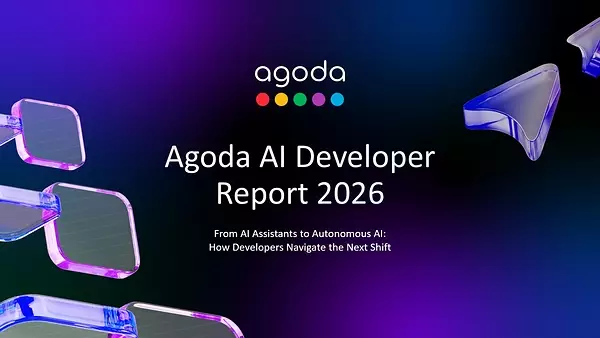
SINGAPORE, Nov. 27, 2026 /PRNewswire/ -- A year after developers across Southeast Asia and India were largely writing their own rules for AI, organizations are now stepping in to govern it, according to new findings from Agoda's AI Developer Report 2026. As AI agents move from experimentation into production, companies are treating AI less as an open tool and more as a managed business resource, with usage limits, guidelines, and cost controls.
The shift shows most in how access to AI is managed. Four in five developers now work under some form of usage limit, including token quotas, usage caps, or budget restrictions. These controls scale with organizational size, from 41% of developers at small organizations (1 to 50 employees) to more than 91% at organizations with over 1,000 employees. The report finds these limits are as much a governance tool as a cost mechanism, shaping how and where AI is used across the organization.
Formal guidance is also associated with stronger adoption. Developers at organizations with established AI guidelines report production or broad agent use at 56%, compared with 43% at organizations without them, and codebase readiness at 40%, compared with 30%.
Managing risk has become a leadership priority. Nearly a third of respondents (31%) identify managing AI risk as engineering leadership's biggest challenge over the next 12 months, ahead of integrating AI into workflows (21%) and upskilling existing talent (18%). Engineering leaders surveyed for the report note that policy alone is not enough. Some argue the larger gap is literacy rather than policy: decision-makers need to understand what they are deploying well enough to know what governance it requires. In regulated environments, the challenge is more structural, as legal or regulatory requirements may restrict how sensitive data can be used with external AI services.
Idan Zalzberg, Chief Technology Officer at Agoda, said: "Last year, developers across the region were building their own guardrails for AI. This year, organizations are catching up. As AI agents take on more of the work, AI becomes something companies have to manage like any other business resource, with visibility into who uses it, what it costs, and whether the output can be trusted. The goal of governance is not to slow developers down. It is to let them use AI at scale, safely."
At Agoda, this approach is built into the company's engineering infrastructure. Its GenAI Proxy serves as a unified layer that authenticates usage, enforces limits, monitors costs, and supports compliance across multiple model providers. Because switching between models is straightforward, teams can evaluate them offline and on live traffic, matching each task to the most suitable model, from frontier models for complex work to smaller, lower-cost models for routine tasks.
The Agoda AI Developer Report 2026 was commissioned by Agoda and conducted in partnership with Macramé Consulting. It surveyed over 800 software developers and engineering leaders across India, Indonesia, Malaysia, the Philippines, Singapore, Thailand, and Vietnam, and includes insights from regional companies such as Omise, SCB 10X, and dataxet. It examines how developers are navigating the shift from AI assistants to autonomous AI agents.
For more information and to download the free report, visit Agoda AI Developer Report 2026.
** This press release is distributed by PR Newswire through automated distribution system, for which the client assumes full responsibility. **
Four in five developers in Southeast Asia and India now work under AI usage limits, Agoda report finds