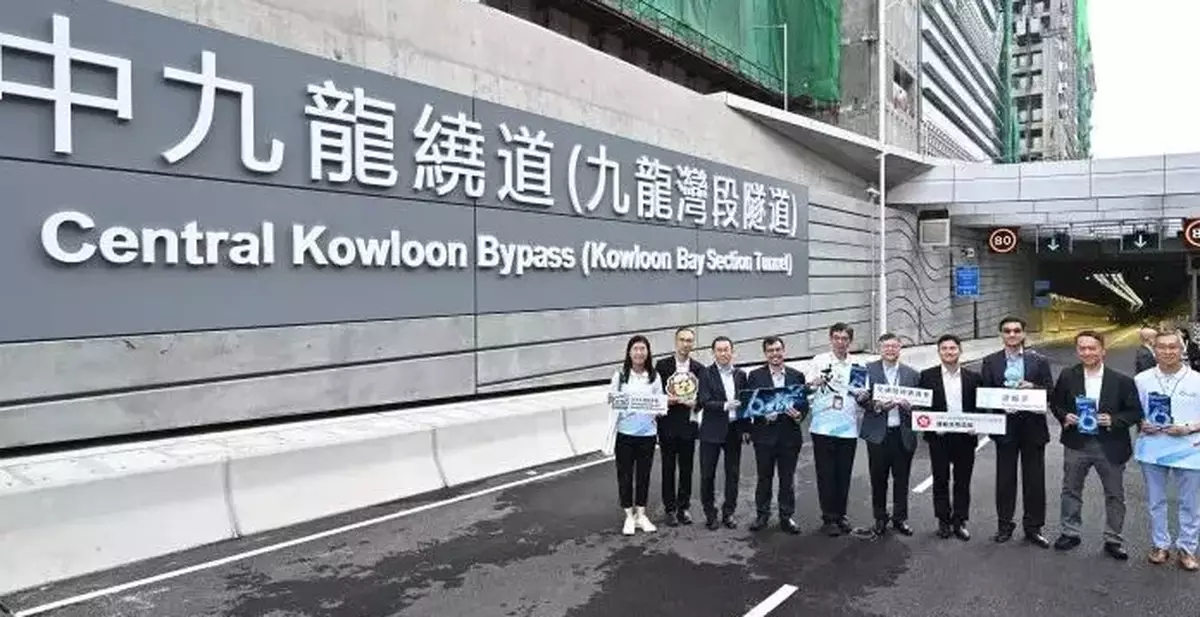
Press briefing and media visit held today on commissioning of Central Kowloon Bypass (Kowloon Bay Section) on December 6
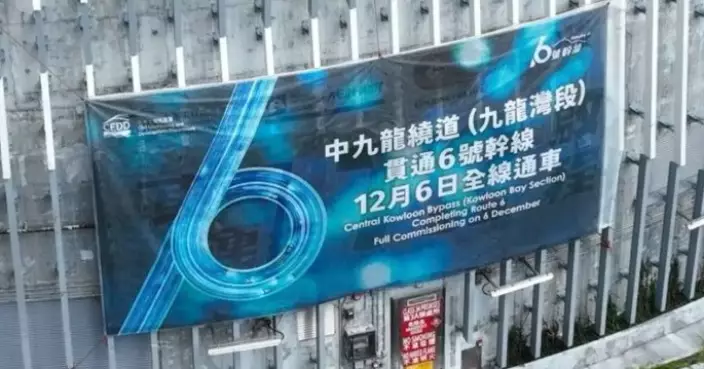
The Central Kowloon Bypass (Kowloon Bay Section) (CKB (KB Section)) will be commissioned at 7am on December 6 (Sunday), signifying the full commissioning of the 12.5-kilometre-long Route 6 and marking another milestone in the development of Hong Kong's transport infrastructure. The Civil Engineering and Development Department (CEDD), together with the Transport Department (TD) and the Hong Kong Police Force (HKPF), held a joint press briefing today (November 27) on the detailed arrangements for the commissioning of the CKB (KB Section), and arranged a media visit to the CKB (KB Section).
The Central Kowloon Bypass (Kowloon Bay Section) (CKB (KB Section)) will be commissioned at 7am on December 6 (Sunday). Photo source: FB image
A spokesman for the CEDD said, "The CKB (KB Section), together with the already commissioned CKB (Yau Ma Tei Section) and the Tseung Kwan O - Lam Tin Tunnel, form Route 6, linking Tseung Kwan O, Kowloon East and Kowloon West. Upon the commissioning of Route 6, the journey time between Tseung Kwan O and Yau Ma Tei during peak hours is expected to be substantially reduced to about 12 minutes, and traffic between Kowloon East and Kowloon West will also be effectively diverted, bringing considerable convenience to the public."
At the press briefing, representatives of the CEDD, the TD and the HKPF introduced to the media the project highlights and construction challenges of the CKB (KB Section), its benefits, as well as the traffic enforcement and control arrangements after its commissioning.
The CKB (KB Section) is about 3.4km long, with 3.1km in the form of tunnels. Various innovative technologies were adopted in its construction. Among others, the subsea tunnel section was constructed using two 14-metre-wide Tunnel Boring Machines, avoiding the need for reclamation and maintaining the operation of waterfront facilities to minimise the impact on the daily lives of the public. More than 95 per cent of the tunnel structures were constructed using prefabricated components, enhancing construction safety and efficiency. An Autonomous Air-ground Co-operative Tunnel Inspector system was co-developed by the project team and the Hong Kong Productivity Council to improve inspection efficiency and reduce the risks associated with working at height. In addition, with the use of Multi-trade Integrated Mechanical, Electrical, and Plumbing alongside smart construction robotics during construction, the project achieved Hong Kong's infrastructure goals of enhancing quantity, speed, efficiency and quality.

The Civil Engineering and Development Department. Photo source: reference image
After the press briefing, media representatives boarded press coaches arranged by the CEDD to visit the tunnel, experiencing the convenience brought by the bypass and gaining a better understanding of the tunnel facilities and the design of the connecting roads.
To help motorists familiarise themselves with the driving routes in advance, the relevant driving guide and videos have been uploaded to the CKB (KB Section) project website (route6-ckbkb.hk/driving-guide_en).