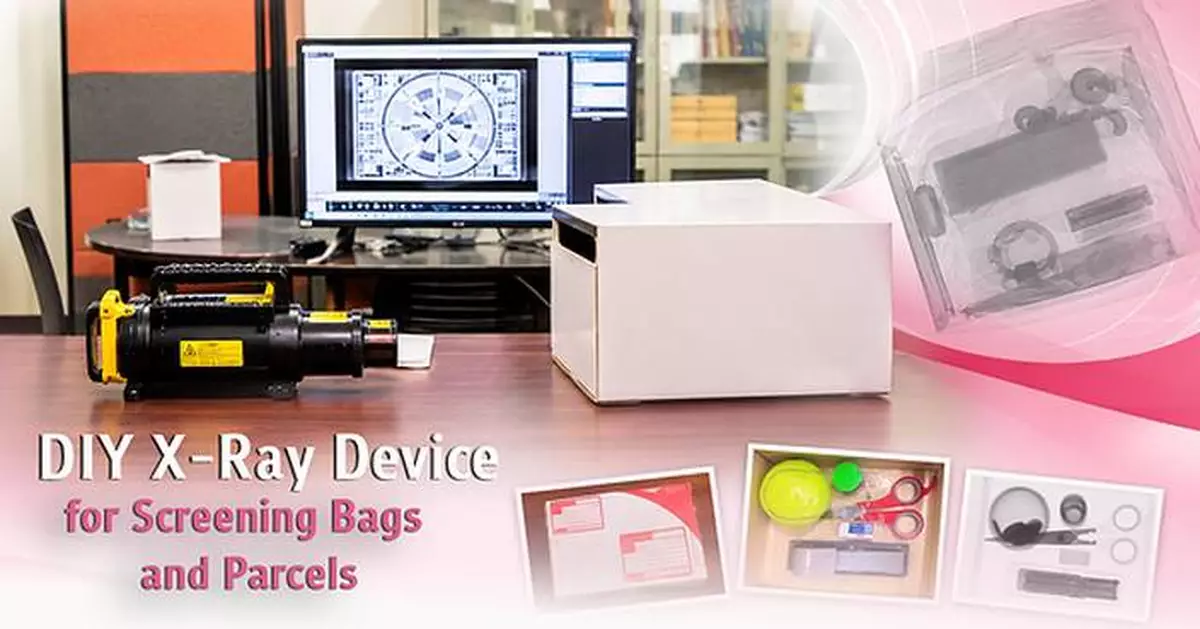
BANGKOK, Nov. 27, 2026 /PRNewswire/ -- Today, millions of parcels pass through postal services and private delivery companies as online shopping continues to grow. Yet their contents are often unknown, raising concerns about concealed weapons and other dangerous items. How can bags and parcels be screened widely without relying on imported X-ray machines that cost millions of baht and are mainly available at international airports and other high-security locations?
A team from the Department of Nuclear Engineering, Faculty of Engineering, Chulalongkorn University, comprising Assoc. Prof. Nares Chankow, Dr. Dhanut Saengchantra, Mr. Phongyuth Sriploy, Mr. Prathan Mirattanaprai, and Miss Siripreeya Pipatpunlop, offers a solution to this dilemma. The team designed and built an entire X-ray and gamma-ray imaging device based on the physical phenomena of fluoroscopy in combination with a modern-day digital camera using a simple but effective approach: combining a nearly century-old physics principle with an ordinary digital camera. The resulting device can screen bags and parcels at a fraction of the cost of commercial X-ray machines.
How the Idea Began
The idea behind the X-ray device was straightforward. Assoc. Prof. Nares explained that imaging with 'phosphor screens'—sheets that glow when exposed to radiation—has been around for nearly a century. Newer radiographic technologies offering higher resolution have largely replaced this method, but its key advantage remains, namely that it is less costly. Meanwhile, digital cameras have advanced considerably, producing sharper images, and their connection to computers makes image adjustments easier. Bringing the two technologies together offers opportunity in solving the problem of screening parcels and packages.
Today, phosphor screens are used mainly in medical imaging of the human body. The Department of Nuclear Engineering's research team, however, saw another application: inspecting bags and parcels for concealed explosives, firearms, and other illegal items. This serves a very different purpose from medical imaging, and few have pursued building such equipment themselves.
In 2011, the team designed and assembled an X-ray imaging device and supplied it to the Fine Arts Department to examine artifacts in the National Museums without damaging these historically valuable objects. The device remains in use today and has since been adapted to produce three-dimensional images. It takes two images from left and right positions separated by approximately the distance between human eyes. Then two images are displayed on a 3D television to reveal depth. The principle mirrors human vision: each eye sees a slightly different view; the brain combines them into a single 3D image.
How the Device Works
Assoc. Prof. Nares explained that when X-rays or gamma rays pass through an object, the amount of radiation that emerges varies according to the thickness and type of material of the object. When this radiation reaches the phosphor screen, the screen glows with varying brightness. Areas receiving more radiation appear brighter, while those where dense objects block the radiation appear darker. He compared this to "Nang Talung" or "Thai shadow puppetry," in which light from behind the puppets creates contrasting dark silhouettes and bright areas that reveal their shapes.
A digital camera takes a picture of the light-and-dark image on the phosphor screen. Assoc. Prof. Nares noted that the camera must avoid direct exposure to radiation, which would interact with its image sensor—whether a CCD (charge-coupled device) or CMOS (complementary metal-oxide-semiconductor)—and introduce image noise. To address this, the team installed a mirror at a 45-degree angle inside the enclosure. The mirror reflects the screen's image toward a camera positioned away from the direct path of the radiation.
All these components are housed in an L-shaped, lightproof plywood box designed and built by the team.
The phosphor screen is mounted at the front, with an aluminum sheet covering it to prevent outside light from interfering with the image. The digital camera sits in a separate compartment within the same box, capturing the reflected image and sending it to a laptop screen in real time. Operators can quickly view, adjust, and analyze the images without developing film as in traditional X-ray imaging.
Cost: A Key Advantage
The clearest difference between this device and airport baggage scanners or medical X-ray machines is the price. Commercial X-ray machines that use a single row of radiation detectors to scan an image section by section and assemble the results cost millions of baht. By comparison, the materials and components for the Chula team's X-ray imaging device cost no more than 50,000 baht, excluding the separate X-ray generator, which costs around one million baht. The gamma-ray imaging version costs no more than 80,000 baht, excluding the radiation source. These imaging devices therefore cost a fraction of a complete imported X-ray system, although the radiation source must be purchased separately.
Imaging Performance
Assoc. Prof. Nares emphasized that the device is not intended to match the image resolution of medical X-ray machines or equipment used to detect tiny cracks or air pockets in metal castings. Such applications require exceptionally detailed images. For security screening of bags and parcels, however, the aim is to distinguish the shapes of concealed objects and determine whether they resemble firearms, ammunition, or bags containing suspicious items. This level of detail can be achieved with inexpensive, standard phosphor screens and a midrange camera, keeping costs much lower while still meeting practical screening needs.
The device also matches commercial machines in speed, taking just 10–30 seconds to image a parcel. Airport X-ray scanners, by contrast, move baggage past a single row of radiation detectors, capturing successive sections and assembling them into an image. Imaging time can be reduced further by increasing the camera's sensitivity setting or the radiation intensity, although this may slightly reduce image detail.
Operational Safety
Assoc. Prof. Nares explained that the radiation used in this imaging system has relatively low energy, making suitable shielding reasonably straightforward to design. The differences between X-rays and gamma rays are explained below.
X-rays are produced by an electrically powered generator, making them easier to control, and the machine can be switched on when needed and switched off immediately afterward. This makes radiation safety easier to manage. Gamma rays, however, come from radioactive materials that continuously emit radiation and cannot be switched off. When not in use, the gamma-ray source must therefore remain in a specifically designed shielded container. During imaging, the source is temporarily moved out of the container through a guide tube.
For practical use, the team proposes a concrete tunnel with a conveyor belt to carry bags and parcels, similar to airport baggage screening systems. This would keep operators away from the irradiation area during operation. With an X-ray system, configuring the generator to operate only during screening would further reduce operators' exposure.
Testing with Different Radiation Sources
The team tested the device under various conditions, adjusting X-ray and gamma-ray energy levels, camera settings, and exposure times. They also compared two phosphor screens made from the same material, gadolinium oxysulfide, but with different densities: the standard DRZ model and the high-density PI-200 model. The Japanese-made screens can accommodate gamma-ray energies of up to approximately 500 kiloelectron volts (keV).
For gamma-ray imaging, the team tested two isotopes: iridium-192, with an average energy of approximately 320 keV and a half-life of 74 days, and selenium-75, with an average energy of approximately 280 keV and a longer half-life of 120 days. Half-life has practical implications: the radiation emitted by the source decreases by half over each half-life, requiring twice the exposure time to obtain an image. Since exposures take only seconds, extending the imaging time is manageable and reduces the need to replace the source frequently.
The tests showed that X-rays produced images with good sharpness and contrast. Gamma-ray images from both iridium-192 and selenium-75 were less sharp and had lower contrast but were still clear enough to detect concealed objects inside bags and parcels.
The team tested a range of objects, including parcels containing mixed items such as scissors, staplers, and a tennis ball with coins hidden inside. Other test objects included a steel pipe containing stones and steel pieces with concealed drilled holes. In every case, the images revealed the internal shapes clearly enough to determine whether further inspection was needed.
Social Impact and Next Steps
According to Assoc. Prof. Nares this research addresses two connected needs in Thai society. The first concerns the safety of the general public. With uncertainty about the contents of parcels delivered each day, affordable screening equipment accessible to schools, government offices, and private delivery companies could help reduce the risks posed by concealed dangerous objects.
The second concerns the economic benefits. Producing such equipment locally at a fraction of the cost of imported systems would lower costs and give organizations with limited budgets greater access to security screening technology.
"Several organizations have already contacted us asking for advice on developing the equipment. Our team is happy to offer guidance or training so that interested organizations can build their own devices, rather than focusing solely on manufacturing them for sale. We believe sharing knowledge will make this technology more widely accessible."
– Assoc. Prof. Nares
"Some Thai companies have now begun producing key components such as X-ray tubes. With continued support, this could help reduce reliance on imports over the long term," Assoc. Prof. Nares said. He added that, for researchers, the satisfaction of developing an innovation comes from seeing the knowledge and technology passed on and put to good use, rather than selling as many devices as possible. "The best research is research that is put into practice and helps solve society's problems sustainably", he emphasized.
Looking ahead, he sees potential applications beyond detecting firearms and ammunition, particularly in food safety screening. These could include detecting foreign materials in food products—a risk that he believes still receives too little public attention.
In conclusion, the Chula Team presents this simple, low-cost X-ray imaging device consisting of a phosphor screen, a mirror, a digital camera and an L-shape plywood box. This innovation shows that meeting society's needs does not always require expensive, cutting-edge technology. Sometimes, the answer lies in thoughtfully combining basic nuclear engineering knowledge with readily available equipment.
Continue reading a full article on the website: https://www.chula.ac.th/en/highlight/431558/
Chulalongkorn University has been ranked Thailand's No. 1 university for the 17th consecutive year (since 2009) in the newly released QS World University Rankings 2026. The university is ranked 221st in the world and places among the world's Top 100 in two key indicators: Academic Reputation (89th) and Employment Outcomes (64th).
** This press release is distributed by PR Newswire through automated distribution system, for which the client assumes full responsibility. **
Chula Engineering's DIY X-Ray Imaging Device Using a Phosphor Screen and Plywood Box to Screen Bags and Parcels for Suspicious Objects