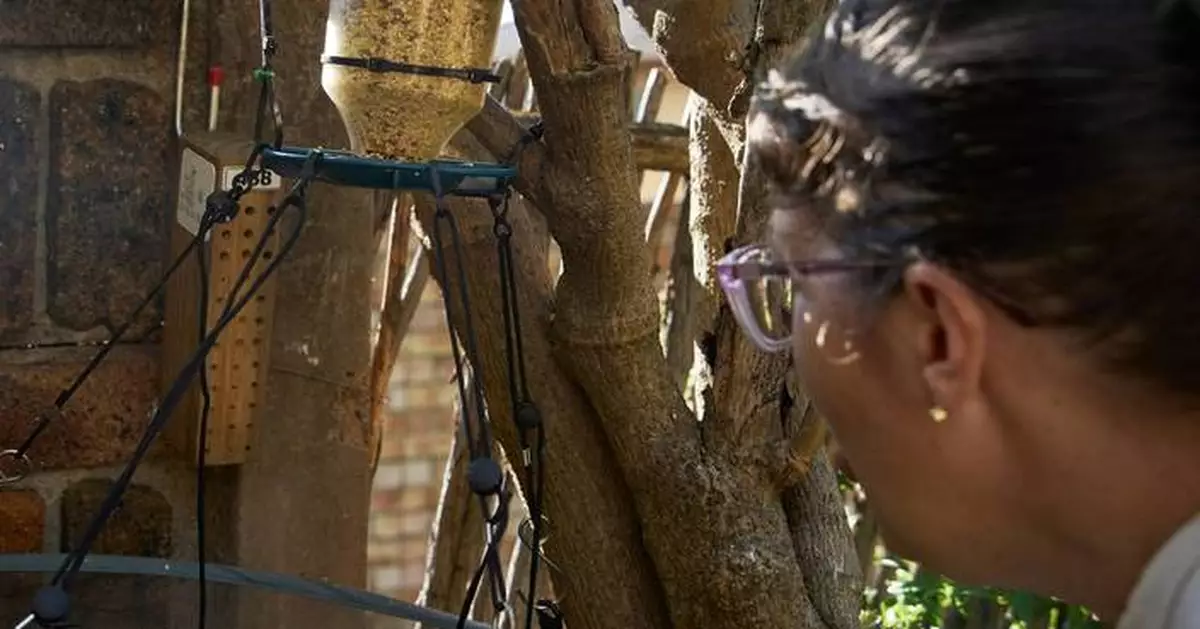
JOHANNESBURG (AP) — Just before checkout on a warm spring morning in South Africa, a solitary bee peeks outside one of the world’s smallest hotels and then retreats to her room: a small hole drilled into untreated pine.
Monitoring this tiny, black guest is Celia Haupt of Johannesburg, a banking analyst-cum-bee hotelier who owns one of the 510 bee hotels distributed to volunteers across her city and Cape Town.
As they report on the bees, these citizen scientists are themselves being monitored as part of UrbanBEE, a project exploring how cities shape solitary bee diversity and how engaging with overlooked pollinators can reconnect city dwellers with nature.
Haupt, for one, has spent months watching her bee hotel. She thinks of its guests as “little homebodies” who love their cozy holes but are happy to meet the neighbors now and then.
“They pop their heads out, and I feel like they’re chatting to me,” Haupt told The Associated Press. “For a solitary bee, they’re not so anti-social. Maybe these are the extroverted introverts.”
The hive-dwelling managed western honeybee is among the world’s best-studied insects, but most of the more than 20,000 bee species known worldwide are solitary, making them harder to locate and monitor.
South Africa alone has roughly 1,300 bee species, most of them solitary, and they also help pollinate wild plants and crops as they stock their nests with pollen and nectar for their young, burrowing underground or filling cavities in wood or hollow stems.
UrbanBEE grew out of a pandemic-era project involving 347 Johannesburg residents, led by University of the Witwatersrand researcher Chevonne Reynolds. The expanded project, funded by the European Union-backed Biodiversa+ partnership, includes parallel studies in Budapest, Hungary; Turin, Italy; and Vienna, Austria. The volunteers began submitting weekly photographs in October 2025.
Comparing hotels across African and European cities could show how climate, vegetation, development and socioeconomic conditions affect bee diversity and how collecting data changes how people value urban nature. Researchers also hope a standardized approach can be adapted for other cities as the world gets warmer.
For many participants, learning about biodiversity started with recognizing creatures they hadn’t realized were bees.
“Now I know that not every flying insect is a fly,” Johannesburg citizen scientist Guinivere Pedro said.
Sage Naidoo pointed out a tiny guest using its rear end to guard her room in a hotel hanging from a tree on the Wits campus.
“If you look at this, you might think that it’s an ant with wings, but it’s actually a solitary bee,” said Naidoo, a PhD candidate helping to coordinate the South African campaign. He identified her as an Allodapula, a species that can remain with their young in small social nests. “In my opinion, they’re the cutest type of bee that we have.”
Other species close their nests with mud, plant fibers, leaves, colorful flower petals or a thin, cellophane-like membrane. Behind the seals, young bees develop on stores of pollen and nectar left by their mothers.
“If a leaf cutter enters your hotel, you’ll typically see this bright pop of green,” Naidoo said.
Haupt’s hotel had plenty of rooms but no guests for about two months as a friendly competition intensified. Weekly occupancy maps became informal scoreboards as participants compared arrivals and noted whose hotel was filling fastest.
“Everyone wants to be doing better than their neighbor,” Naidoo said. “It was like, ’My bee hotel has 20 bees, whereas yours has five.'”
The effort brought Haupt and her daughter closer and rekindled a connection with a former schoolmate she had known only from a distance 40 years earlier as they commiserated over their vacancies and, eventually, celebrated arrivals.
“Here we were bonding over a lack of occupancy in the bee hotel, then joy over the bee hotel, and a little bit of rivalry,” Haupt said.
Haupt finally welcomed her first guest after moving her hotel to catch the morning sun. She named the bee “Yoncé,” naturally.
When Pedro joined UrbanBEE, she announced on LinkedIn that she had finally become a property owner: “Finally, I have a hotel of my own,” she said. “It’s just a very small one.”
After a few weeks without guests, Pedro moved her hotel to a sheltered spot, where bees appeared seemingly overnight.
Preliminary results show people changing their gardening practices to attract more pollinators as they've been drawn into the hotels' miniature dramas. Naidoo said researchers also found hotels being occupied earlier in Johannesburg than in cooler and windier Cape Town.
A year later, Pedro's hotel is nearly full. She has planted more flowers, left parts of her garden undisturbed and even taken birding courses.
“The bees revealed to me how much life there is in the garden,” she said. “Once you notice the first small thing, the next small thing presents itself.”
AP Africa news: https://apnews.com/hub/africa

Celia Haupt points at two bee hotels mounted on the wall of her house in Johannesburg, South Africa, Oct. 26, 2026. (AP Photo/Alfonso Nqunjana)
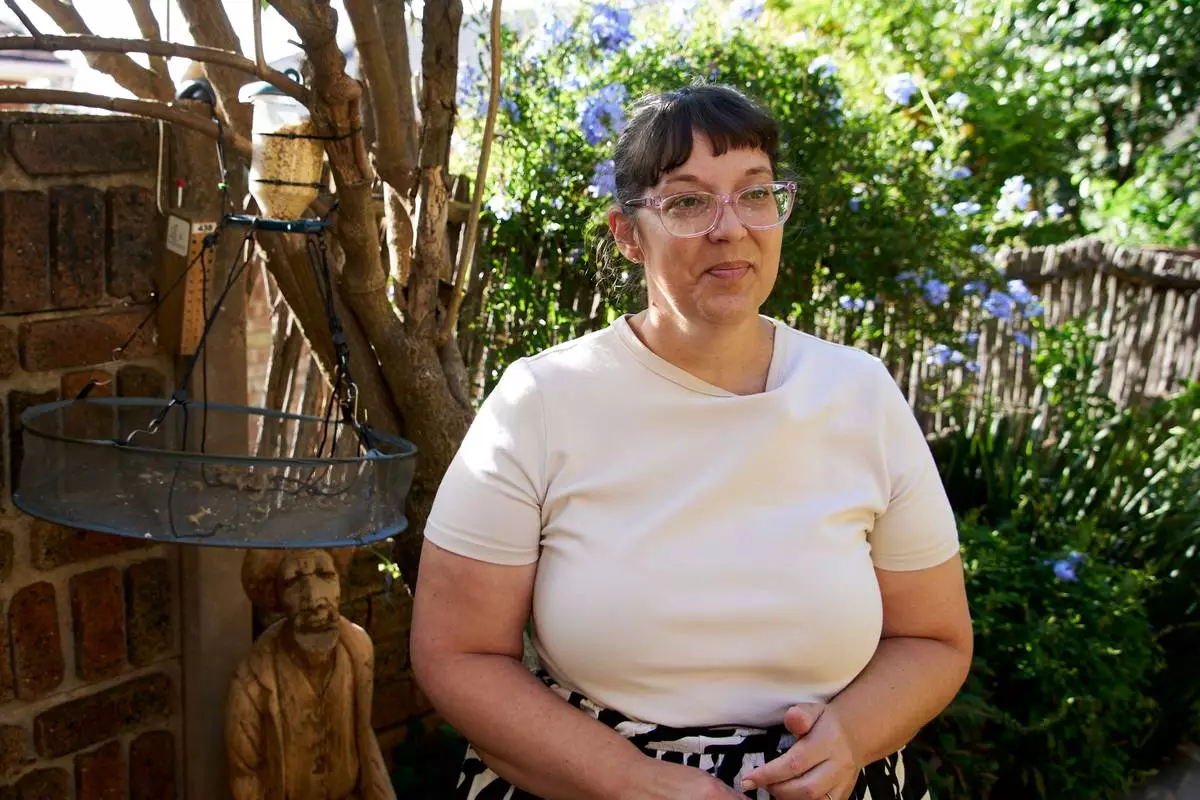
Johannesburg citizen scientist Guinivere Pedro stands in front of a bee hotel at her house in Johannesburg, South Africa, Oct. 28, 2026. (AP Photo/Alfonso Nqunjana)
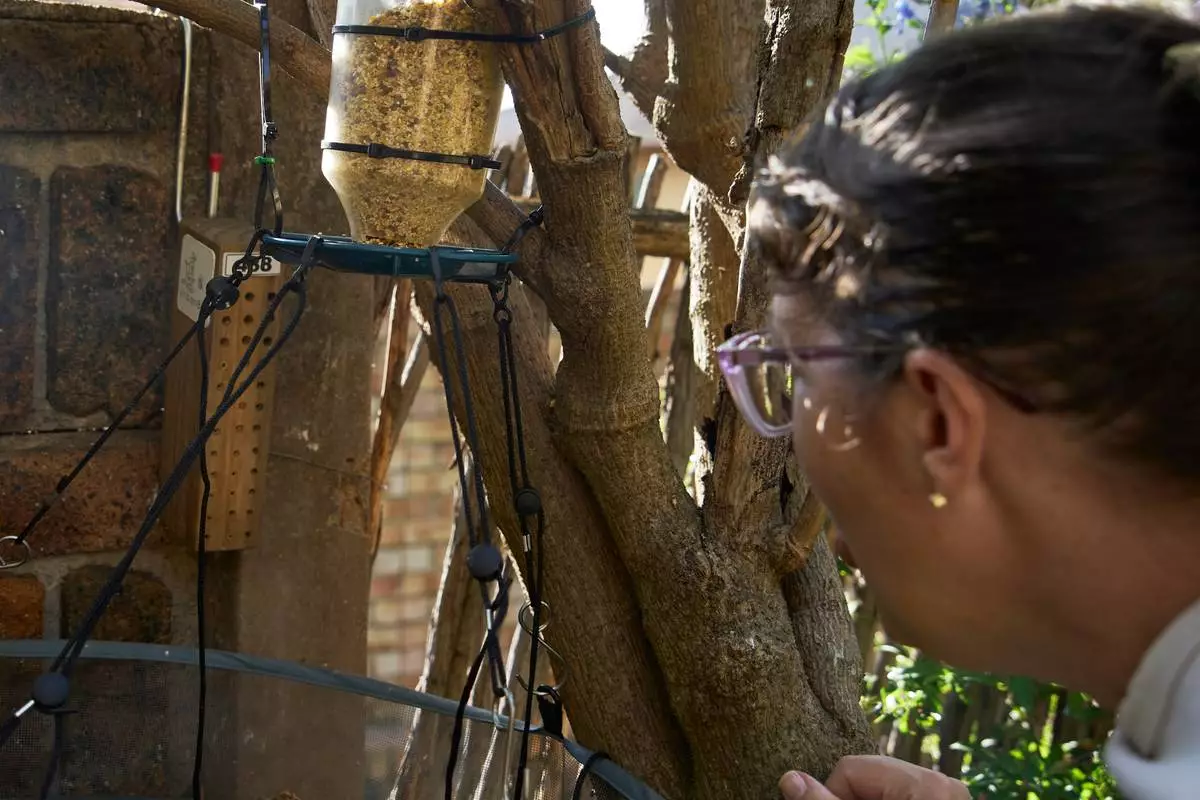
Johannesburg citizen scientist Guinivere Pedro looks at a bee hotel at her house in Johannesburg, South Africa, Oct. 28, 2026. (AP Photo/Alfonso Nqunjana)
Heavy rain over flooded East Coast communities began easing Friday, and power was slowly restored to hundreds of thousands of customers as some places stayed on guard for high-tide flooding following a round of holiday storms.
The storms snarled travel and downed trees and power lines. The intense weather led to water rescues from New York to Virginia. In New York City, preparations were underway to hold Macy’s Thanksgiving Day Parade on Saturday after an unprecedented postponement because of rain and high winds.
Elsewhere, wet snow fell as far south as the Tennessee Valley and freezing rain moved across northern New England. The storm system is expected to leave the region Saturday morning, bringing drier conditions into Sunday. Cold rain was reported in parts of the Midwest, including the Ohio Valley and the lower Great Lakes.
Another storm system in the Northwest brought rain along coastal Oregon. More snow was forecast in the Cascade Range and in mountain passes in Montana and Wyoming.
Conditions were expected to improve across the entire eastern U.S., “but this huge system will take some time to weaken,” the National Weather Service said. Coastal flood warnings were posted from New Jersey to Virginia.
The number of power outages, which peaked Thursday at more than 900,000, fell to 230,000 by late Friday evening as crews worked to restore electricity, according to poweroutage.us. Pennsylvania had the most, followed by Missouri, where snow caused problems.
In Hampton, Virginia, the storm toppled a beloved landmark at Grandview Beach: a weathered, leafless tree known as the “Grieving Tree” or the “Shell Tree.” Visitors regularly decorated its branches with seashells, and it became a popular subject for photographers.
After surviving many storms, the tree “may have finally met its match,” local meteorologist Ricky Matthews said on Facebook, sharing a photograph.
Cynthia Battles, 70, said the storm ripped a two-story deck off her waterfront cottage in Oak Orchard, Delaware, and sent waves crashing through a sliding glass door. Glass was everywhere, her pontoon boat was in pieces and her partner’s boat was submerged.
Battles was drying out photographs and important documents. Some treasured books were ruined.
“I know it’s stuff — you can’t take it with you — but it’s the stuff that I need,” said Battles, who did not know if the cottage could be saved.
Part of a fishing pier collapsed in Virginia Beach, Virginia, closing a 3-mile (4.8-kilometer) section of beach, including the boardwalk, the city said.
Downtown merchants in Avalon, New Jersey, scrambled to pump out saltwater after some of the most significant tides in the seaside community’s history. Santa Claus was scheduled to arrive on a fire truck by evening to light the Christmas tree.
Conditions were a “million times better than they were 24 hours ago,” borough business administrator Scott Wahl said.
Water flooded the garage and surrounded the property of Cheryl McKenna of Ocean City, New Jersey, keeping her family inside for six hours on the holiday.
“Our family’s been here for 36 years,” McKenna said. “But honestly, we’re thinking, is this the right place for us to be? We’re now retired, and we want to stay down here, but how often can we continue to do this?”
Part of Tennessee was under a winter storm warning for up to an inch of snow Friday, after rain turned into light snow on Thanksgiving. Conditions were calmer in the Midwest than the previous day, when as much as 15 inches (38 centimeters) of snow fell in eastern Missouri. The ice arena in Wentzville, Missouri, was empty when the roof caved in.
Waves driven by high tides caused flooding along the Pacific coast and continued to affect train service. Buses were pressed into service as Amtrak’s Pacific Surfliner canceled or shortened more than a dozen trains between San Diego and Los Angeles.
Record tides along the California coast prompted evacuations from Humboldt County in the far north to Ventura County near Los Angeles.
Heavy snow was expected in parts of Montana and Wyoming. A renewed surge of moisture associated with an atmospheric river across the Pacific Northwest moved toward the northern Rockies, the weather service said.
Associated Press writers Anna Wilder in Austin, Texas, Tassanee Vejpongsa in Philadelphia, and Ed White in Detroit contributed.
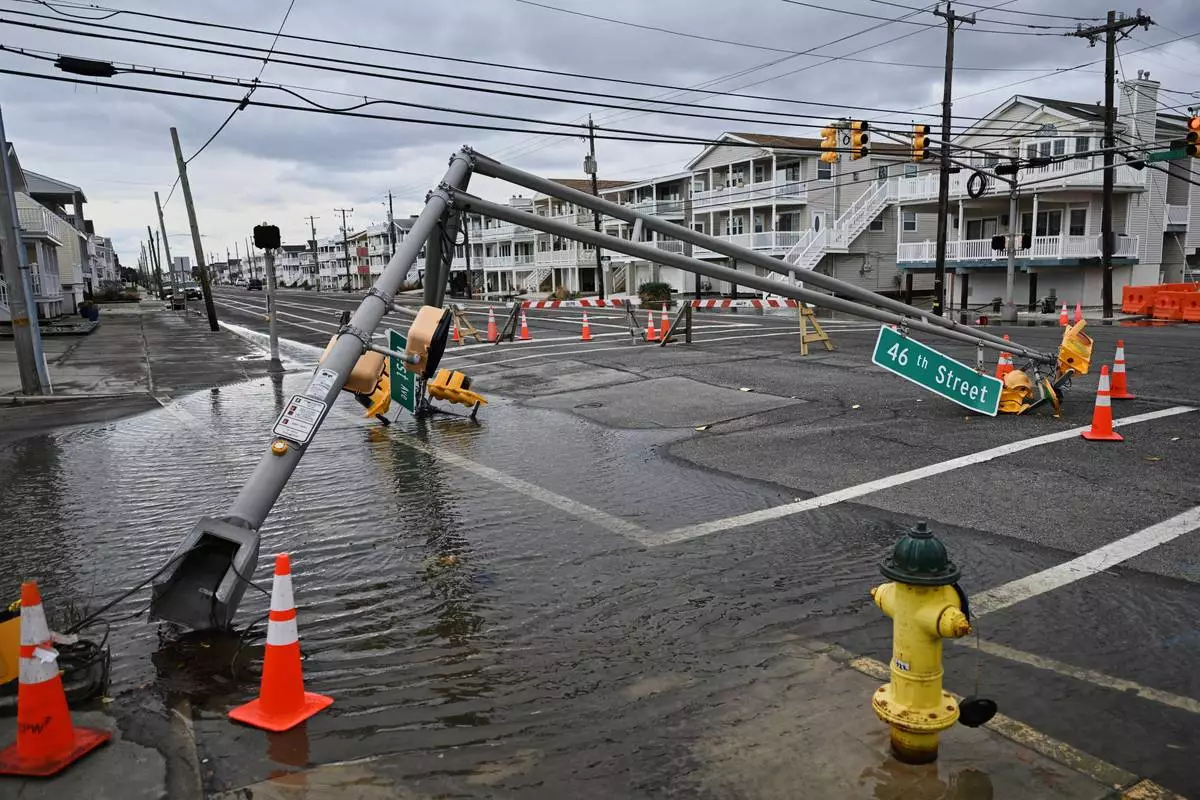
A damaged traffic light pole lies across a flooded street in Ocean City, N.J., Friday, Nov. 27, 2026, after heavy rain on Thursday. (AP Photo/Allie Ippolito)
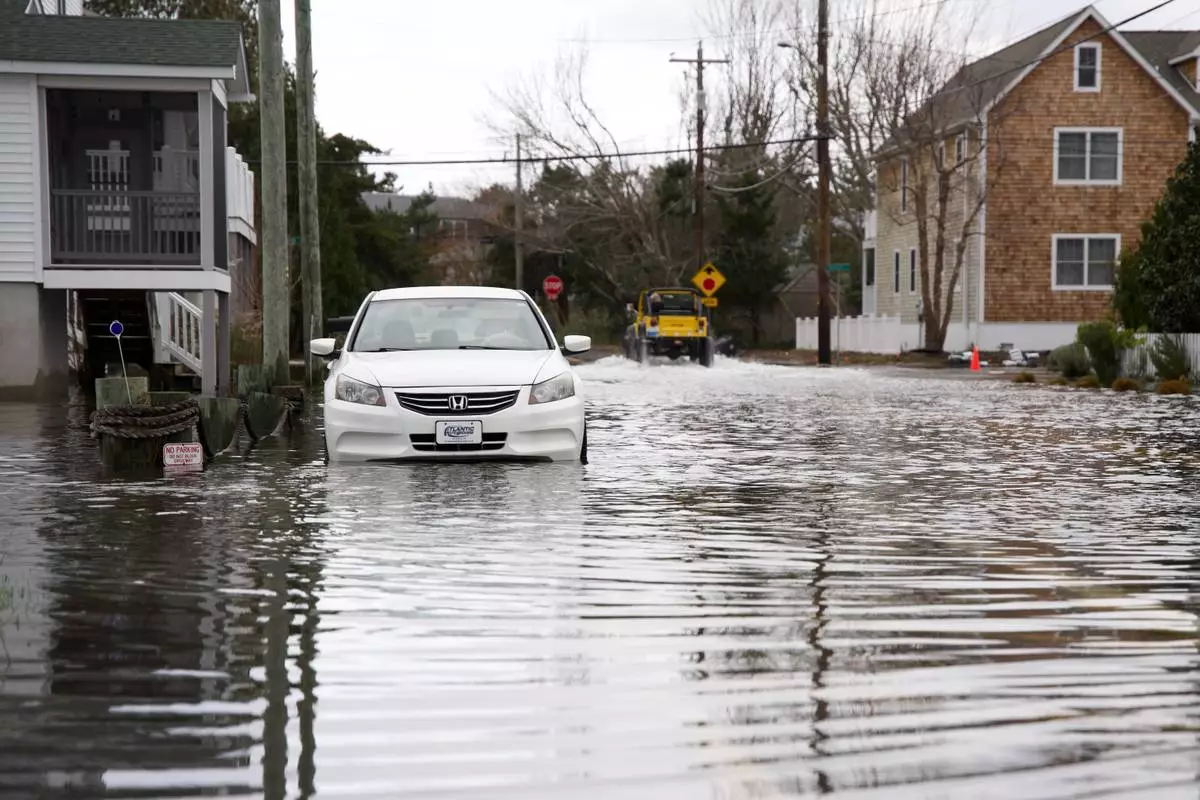
A residential neighborhood experiences flooding following a nor'easter storm in Lewes, Del., Friday, Nov. 27, 2026. (AP Photo/Mingson Lau)
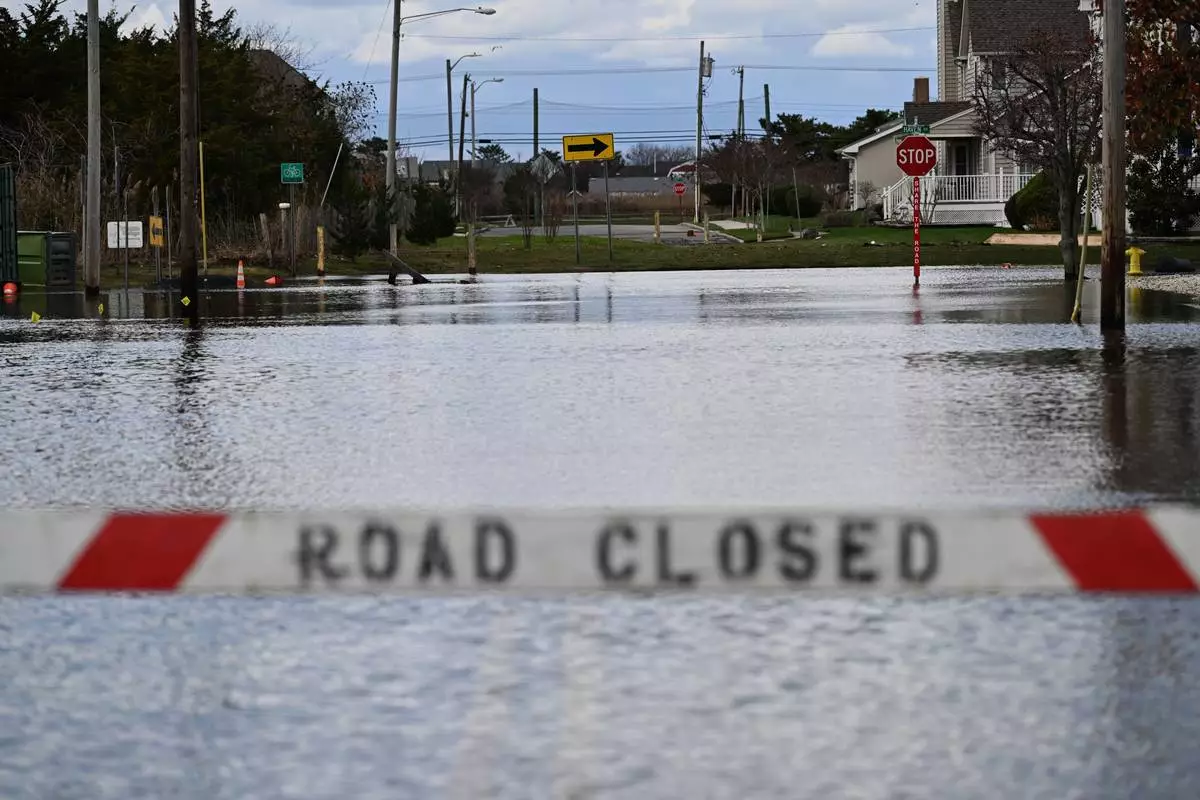
Flooding is seen in Ocean City, N.J., Friday, Nov. 27, 2026, after heavy rains the previous day. (AP Photo/Allie Ippolito)
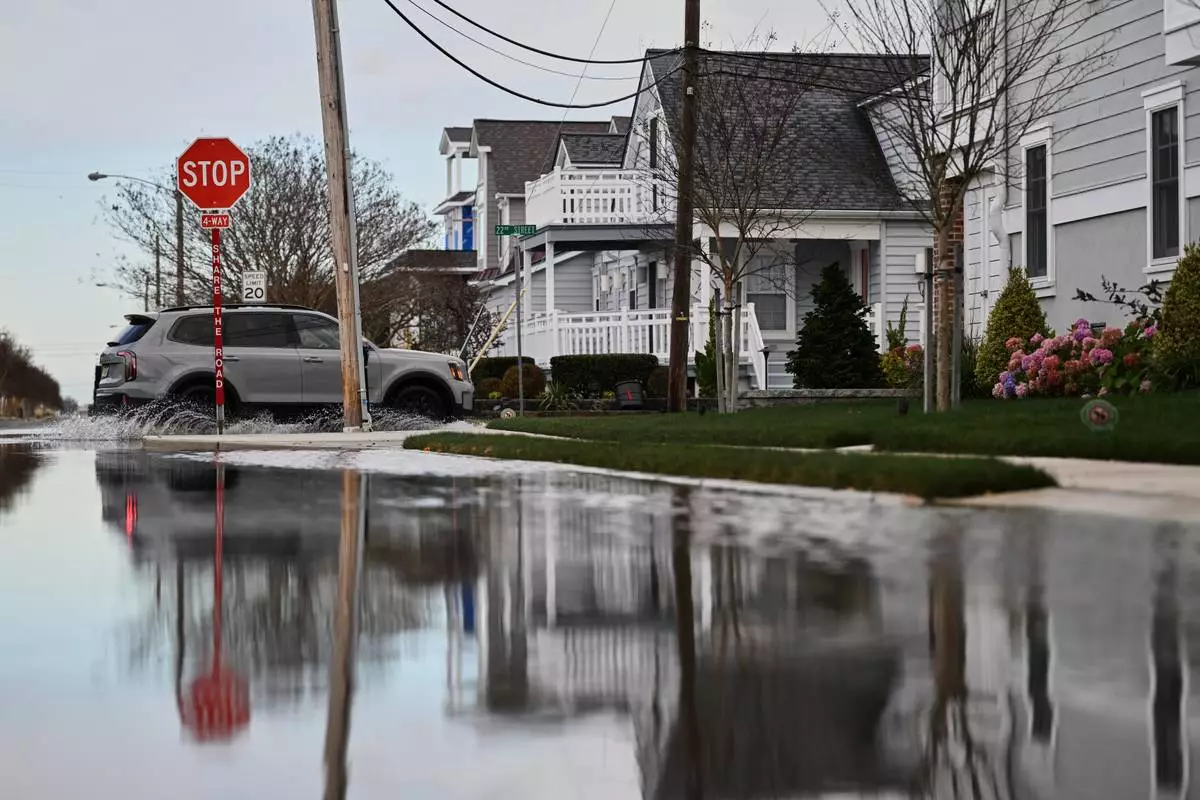
Flooding is seen in Ocean City, N.J., Friday, Nov. 27, 2026, after heavy rains the previous day. (AP Photo/Allie Ippolito)
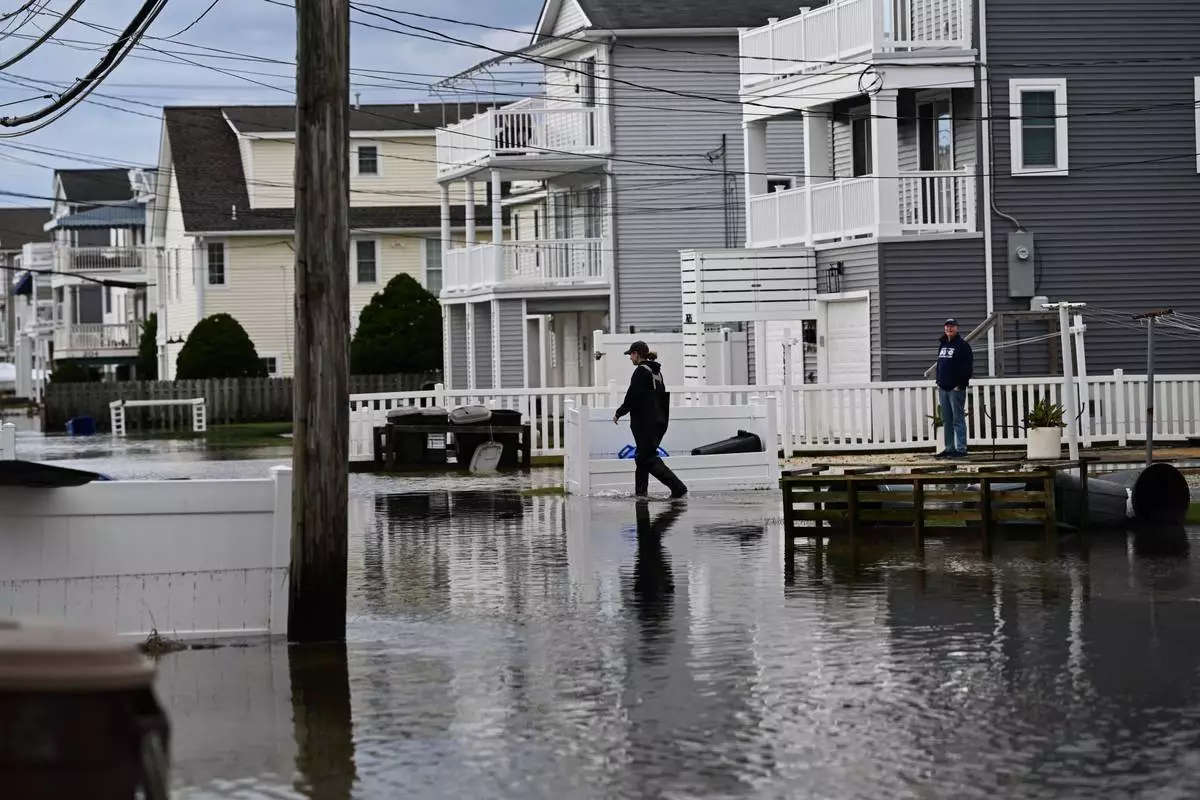
People walk on water as flooding is seen in Ocean City, N.J., Friday, Nov. 27, 2026, after heavy rains the previous day. (AP Photo/Allie Ippolito)
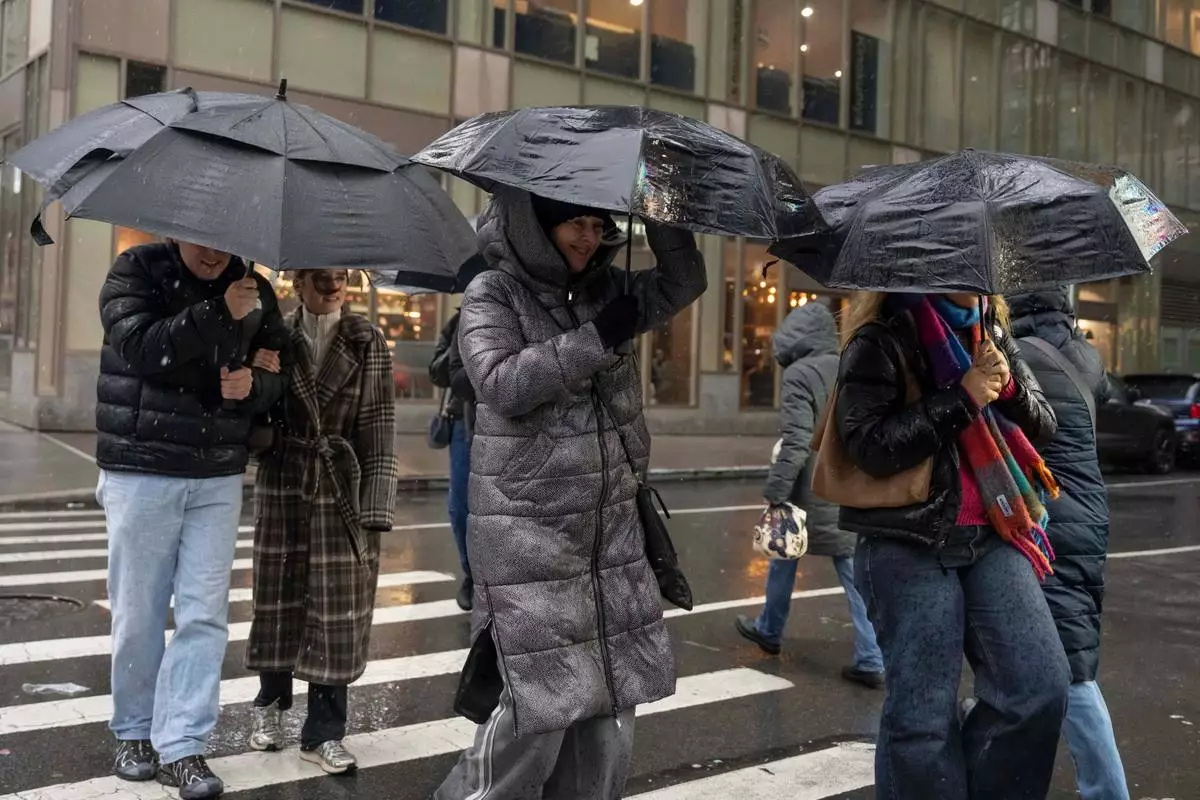
Pedestrians shield themselves with umbrellas as they walk in the rain on Thanksgiving Day in New York, Thursday, Nov. 26, 2026. (AP Photo/Yuki Iwamura)
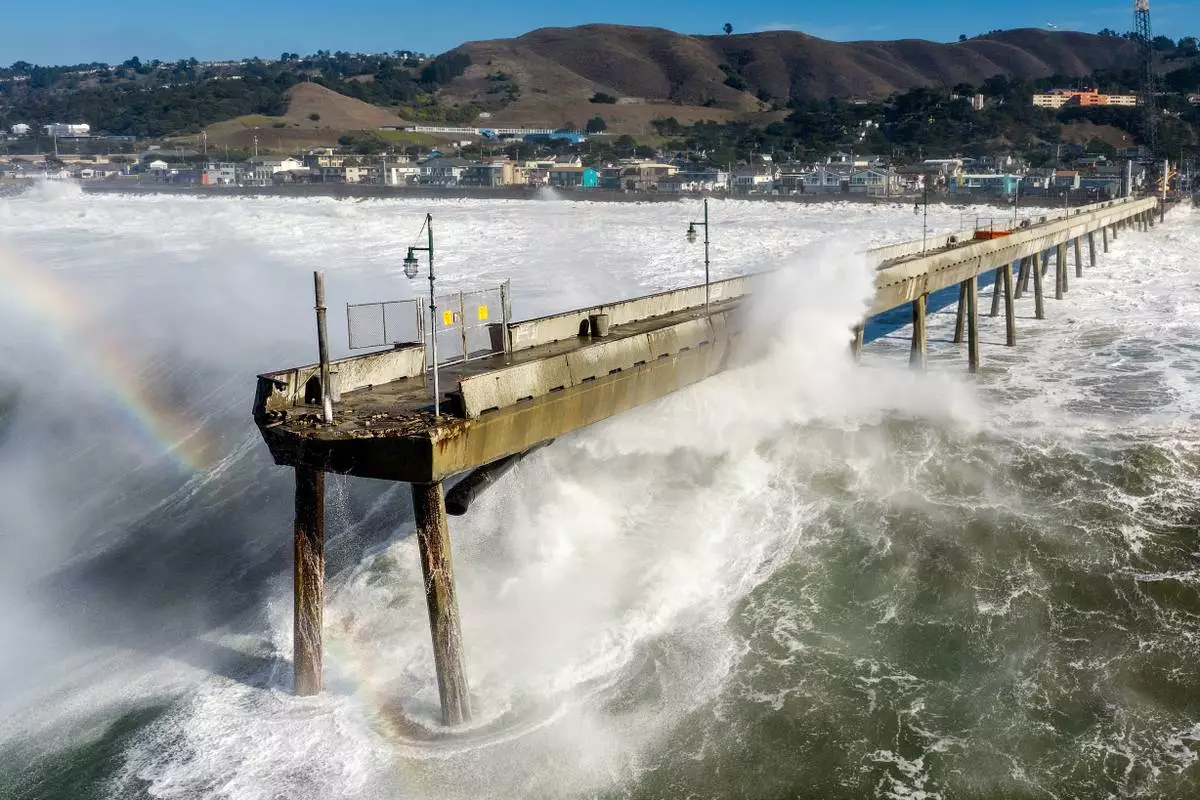
Waves pound the Pacifica Municipal Pier after a portion collapsed during high surf and tides in Pacifica, Calif., Wednesday, Nov. 25, 2026. (AP Photo/Noah Berger)
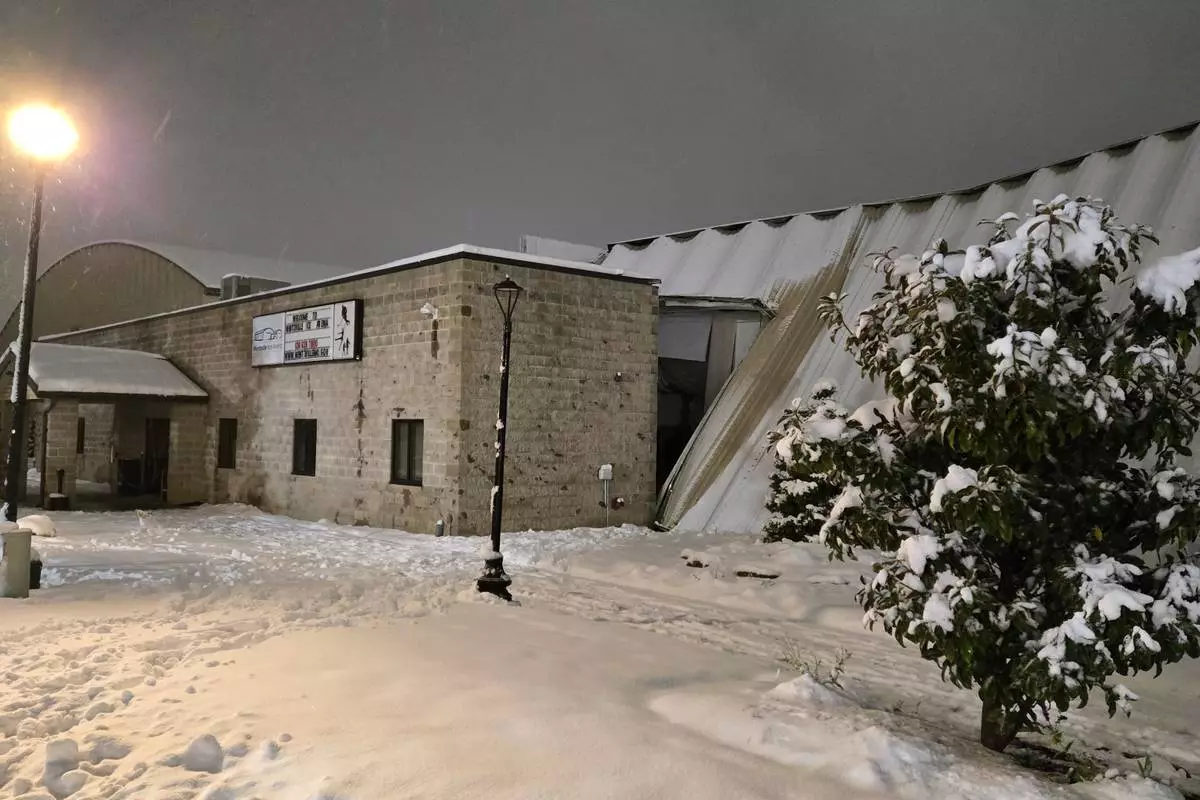
This photo provided by Mike Lueck, shows the roof of Wentzville Ice Arena after it collapsed in Wentzville, Mo., Thursday, Nov. 26, 2026. (City of Wentzville Parks and Recreation via AP)
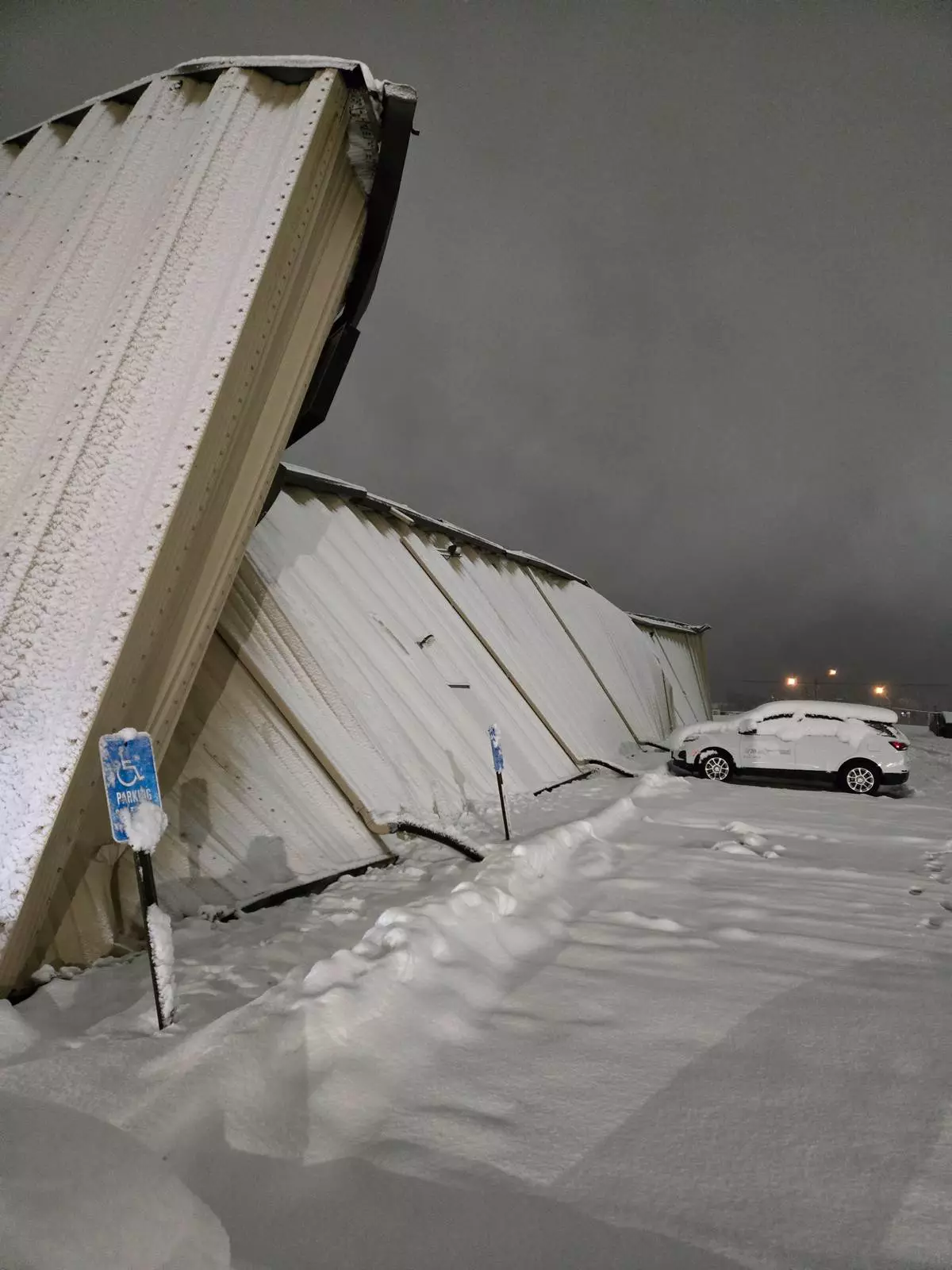
This photo provided by Mike Lueck shows the roof of Wentzville Ice Arena after it collapsed in Wentzville, Mo., Thursday, Nov. 26, 2026. (City of Wentzville Parks and Recreation via AP)