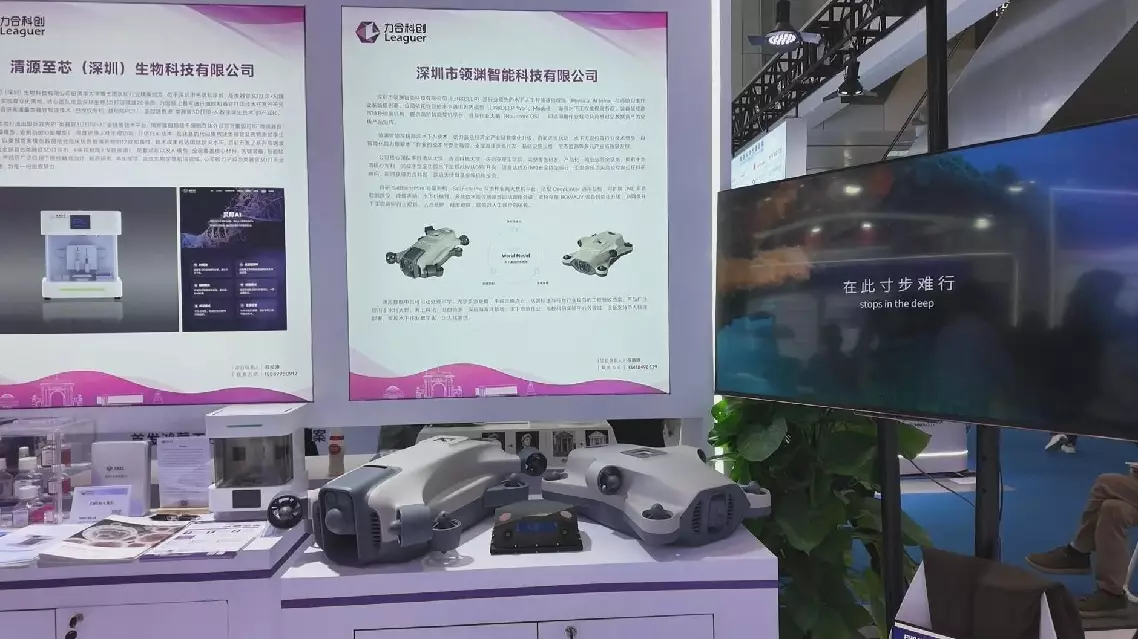
A new generation of intelligent underwater products is grabbing visitors' attention at the 28th China Hi-Tech Fair (CHTF) in Shenzhen. Designed to tackle challenges in underwater positioning, communication and complex operating environments, these smart exhibits exemplify how embodied AI is finding applications in a new frontier.
One standout at the fair was a remarkably compact device making its debut at this year's event: general-purpose data-collection robot for underwater data acquisition.
The underwater intelligent equipment can carry a variety of sensors and dexterous operating tools, dive to depths of up to 500 meters, complete data-collection tasks for various underwater engineering projects, and transmit the data back to the ground data center in real time.
This startup team collected over 100,000 hours of real underwater data. By using multi-dimensional information such as vision, acoustics, and underwater flow fields, the underwater intelligent equipment is able to understand the underwater environment, which will provide a basis for decision-making for its next actions.
"The underwater equipment is able to achieve spatial understanding, thereby improving the efficiency and autonomy of the entire industry," said exhibitor Zhang Huibo.
Another standout at the fair was an underwater robot in a large water tank, drawing attention for its flexible movement and hovering.
The research and development team integrated years of accumulated hardware and software expertise into this device. It can not only withstand powerful undercurrent impacts, but also carry 15 kilograms of equipment for various underwater operations. Furthermore, it possesses intelligent capabilities such as autonomous path planning, real-time obstacle avoidance, and underwater terrain mapping. "Our product can be widely used in areas such as offshore oil, offshore wind, and aquaculture. In each specific scenario, it carries different attachments to deliver purpose-built value," said exhibitor He Dengwei.
The three-day CHTF opened on Thursday in the tech hub in south China's Guangdong Province, drawing around 5,000 companies and institutions from more than 120 countries and regions.
AI-integrated underwater smart devices wow visitors at high-tech fair in Shenzhen
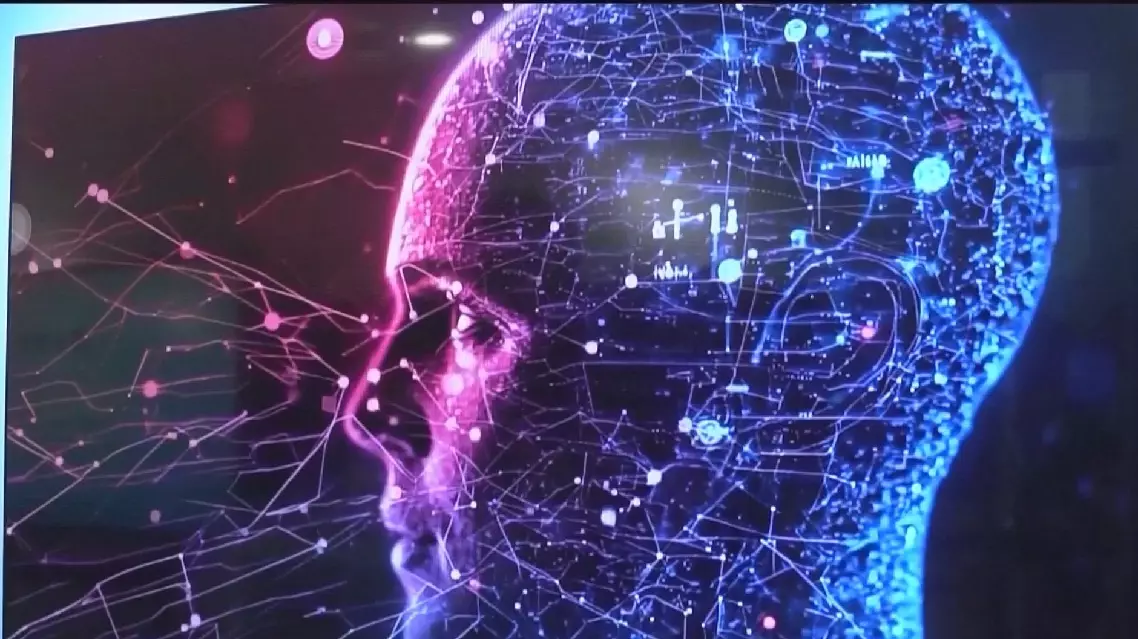
Mathematicians from the United States and Canada have urged caution over claims of an AI-assisted proof of the Riemann hypothesis, while acknowledging artificial intelligence's growing role in discovery.
The bombshell claim had the math world buzzing last week. Levent Alpoge, a mathematician at AI company Anthropic, announced he had worked with the company's AI model, Claude, to solve the 167-year-old Riemann hypothesis.
Proposed in 1859 by German mathematician Bernhard Riemann, the hypothesis concerns the distribution of prime numbers. Primes, such as 2, 3, 5 and 7, are natural numbers greater than 1 that are divisible only by 1 and themselves. The hypothesis points to an underlying mathematical pattern in their seemingly random distribution along the number line.
It is one of the seven Millennium Prize Problems, each carrying a 1 million U.S. dollars prize for a correct solution. A proof would have far-reaching implications across mathematics and could also have implications in fields such as cryptography and physics.
The announcement has sparked widespread discussion, as some researchers warn that AI-assisted proofs could fundamentally alter how mathematics is practiced.
"So in the past, constructing and verifying proof went hand in hand with understanding it, because the construction and verification naturally produces human experts in the proof. But now the proof is partially constructed by an outside entity which is AI, and the verification is done formally using a computer language that is hard to read by humans. And the scale and the speed of this whole process is so large that human mathematicians cannot maintain the same level of understanding of the proof," said Ghaith Hiary, professor of the Department of Mathematics at the Ohio State University in the U.S.
Regarding the long-term impact of AI on mathematical research, many mathematicians agreed that AI is transforming traditional research methods. At the same time, they viewed it as a powerful new tool that can help mathematicians tackle deeper and more ambitious problems.
"It's a massive danger, but mathematics is singled out because in some sense it's very clear what the goals are. So you can tell the computer 'this is your goal.' If you say 'write a beautiful poem or haiku' or something, it's not clear what the goal is. So what you can see in the mathematics is an extraordinary progress, but in a form that computer is very well equipped to do," said Andrew Granville, Canadian Research Chair in number theory at the University of Montreal.
"I think what this means is that our pursuits, our goals have to be a lot higher and much more ambitious to make use of this new technology," said Hiary.
Mathematicians urge caution over AI-assisted breakthrough on 167-year-old math problem