High-precision robotic cancer surgery, once available only at leading hospitals in major cities, has now reached a county-level hospital in south China, as homegrown technology brings advanced medical care to primary-level healthcare institutions.
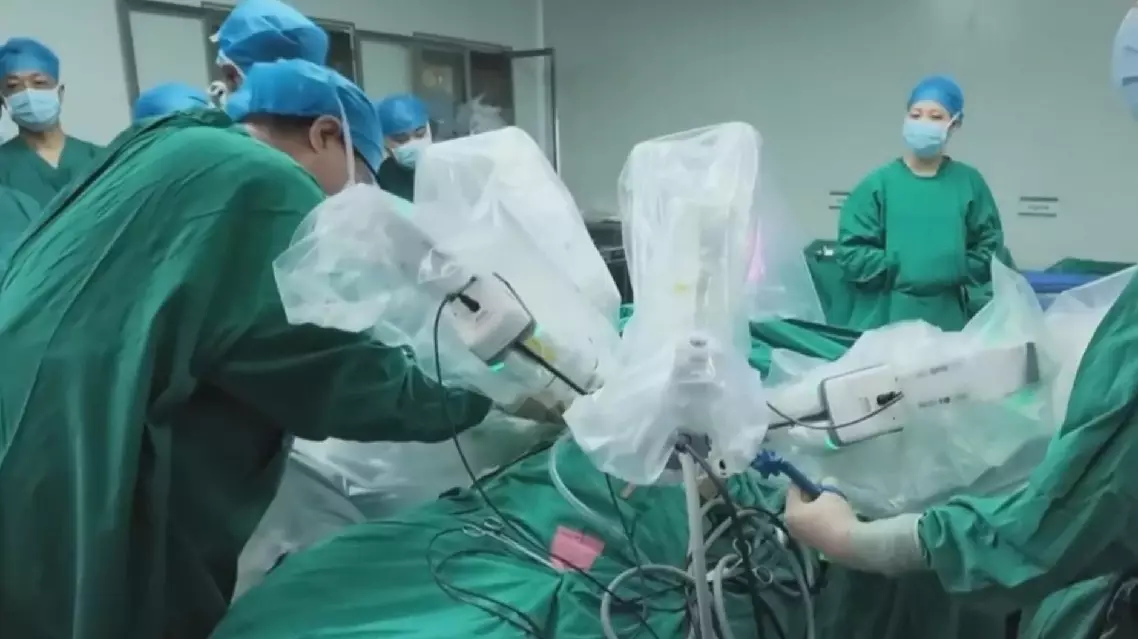
Professor Song Wu, a gastrointestinal specialist, recently performed surgery to remove an early-stage intestinal tumor. Instead of standing over the patient, he operated a surgical robot remotely from a console situated across the operating room.
Since August, Kaiping Central Hospital in the county-level city of Kaiping in south China's Guangdong Province has been using a domestically developed modular surgical robot. Surgeons there have already performed operations on more than ten patients using the system.
"This is a modular surgical robot independently developed in China. It is mobile and flexible, compatible with operations across general abdominal, hepatobiliary and gynecological surgery," said Song.
Unlike integrated alternatives, this modular robot does not require a custom-built operating room and can be moved easily, making it far more accessible for county-level hospitals. Its split design of console and robotic arms also paves the way for more possibilities.
"Looking ahead, this technology could help deliver standardized cross-site telesurgery for patients in remote regions," said Song.
Equipped with high-definition 3D vision, the robot offers precision and dexterity that far exceed the human hand. It allows surgeons to resect tumors accurately while preserving maximum organ function.
Robotic surgery has sparked strong interest among local surgeons, with a structured training roadmap to guide them along the learning curve.
"Surgeons first train on this simulator, then move on to animal experiments and formal assessments. Qualification for robotic surgery typically takes around six months," said Zhang Shijie, chief physician at Kaiping Central Hospital.
The impact is already being felt by patients. Returning for a three-month follow-up after colon tumor resection, one patient expressed her astonishment at the technology.
"I used to think advanced surgical robots were only available in big cities. I never expected we'd have one here in Kaiping. I recovered well from minimally invasive surgery, got my stitches out within the week," said the patient.
Meanwhile, Chinese researchers continue to push the frontiers of surgical robotics. Emerging technologies are equipping these systems with advanced navigation and 3D perception capabilities, allowing them to track lesions with unprecedented precision and even map delicate nerve fiber bundles inside the brain.
"We have developed China's first optical tracking system, electronic positioning system and structured-light 3D imaging system for surgical robots," said Yang Rongqian, associate professor at South China University of Technology in Guangzhou, the provincial capital of Guangdong.
The support goes beyond merely providing robotic equipment. Medical experts, including Professor Song from the First Affiliated Hospital of Sun Yat-sen University, are actively working at the Kaiping Central Hospital to strengthen local medical specialties and train doctors, bringing top-tier provincial medical expertise directly to the county level.
Homegrown surgical robot brings advanced medical care to small county in China