A defiant and occasionally exasperated Taylor Swift insisted during a whirlwind hour of testimony Thursday that a Denver disc jockey grabbed her bare backside and held on for a long time during a meet-and-greet before a concert.

In this courtroom sketch, pop singer Taylor Swift speaks from the witness stand during a trial. ( AP)
The pop superstar used explicit language that seemed designed to avoid sugar-coating what she said was a sexual assault when she posed for a picture with David Mueller in 2013.
Click to Gallery
In this courtroom sketch, pop singer Taylor Swift speaks from the witness stand during a trial. ( AP)
Pop singer Taylor Swift's lawyers Jesse P. Schaudies, Jr., left, and Douglas Baldridge leave the federal courthouse after the fourth day in a civil trial. (AP Photo/David Zalubowski)
Tree Paine, publicist for pop singer Taylor Swift, is escorted from the federal courthouse after attending the fourth day in a civil trial.(AP Photo/David Zalubowski)
Radio personality Eddie Haskell, talks to reporters after testifying in the civil trial for pop singer Taylor Swift. (AP Photo)
In this courtroom sketch, radio station official Herschel Coomer, who goes by the air name of Eddie Haskell, testifies in the civil trial for pop singer Taylor Swift.( AP Photo)
"He stayed attached to my bare ass-cheek as I lurched away from him," Swift testified in federal court during a trial over dueling lawsuits in the case.
"It was a definite grab. A very long grab," she said at one point.
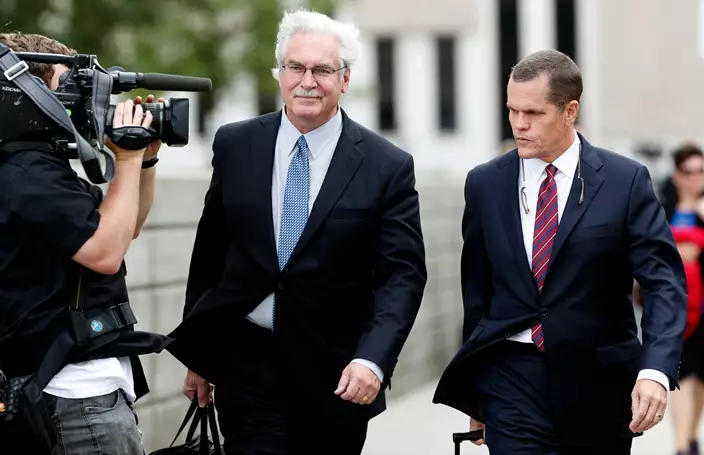
Pop singer Taylor Swift's lawyers Jesse P. Schaudies, Jr., left, and Douglas Baldridge leave the federal courthouse after the fourth day in a civil trial. (AP Photo/David Zalubowski)
The singer-songwriter used the word "ass" dozens of times on the witness stand, sometimes sarcastically, in her testy exchange with Mueller's attorney that occasionally elicited chuckles — even from the eight-member jury.
Swift got a laugh from people in the courtroom when she said her security guard, Greg Dent, saw Mueller "lift my skirt" but someone would have had to have been underneath her to see the actual groping — "and we didn't have anyone positioned there."
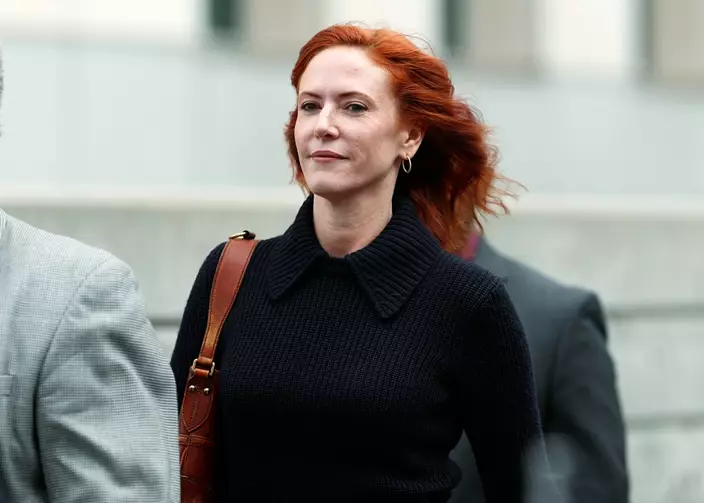
Tree Paine, publicist for pop singer Taylor Swift, is escorted from the federal courthouse after attending the fourth day in a civil trial.(AP Photo/David Zalubowski)
Swift was more serious when asked her reaction to Mueller being fired.
"I'm being blamed for the unfortunate events of his life that are a product of his decisions, not mine," she told jurors.
"Do you think Mr. Mueller got what he deserved?" his attorney Gabriel McFarland asked.
"I don't feel anything about Mr. Mueller. I don't know him. ... I think what he did was despicable and horrifying and shocking."

Radio personality Eddie Haskell, talks to reporters after testifying in the civil trial for pop singer Taylor Swift. (AP Photo)
Mueller, his hair white compared to his image from the photo op, stared at a table while the singer-songwriter testified.
He denies groping Swift and claims in his lawsuit that he was falsely accused and lost his job because of the allegation.
His lawsuit seeks up to $3 million in damages, though Mueller has said he's not seeking a specific amount — just a chance to clear his name and salvage his career.
Swift countersued, alleging sexual assault. She is seeking a symbolic $1 judgment that holds Mueller responsible.
Testimony ended for the day and will resume Friday.
After the photo was taken, Swift testified, she tried to get as far away Mueller as she could. She said she told him and his girlfriend, who was also in the photo, "thank you for coming" in a monotone voice before they left.
Swift said she was stunned and did not say anything to Mueller or halt the meet-and-greet after he left because she did not want to disappoint several dozen people waiting in line for photos with her.
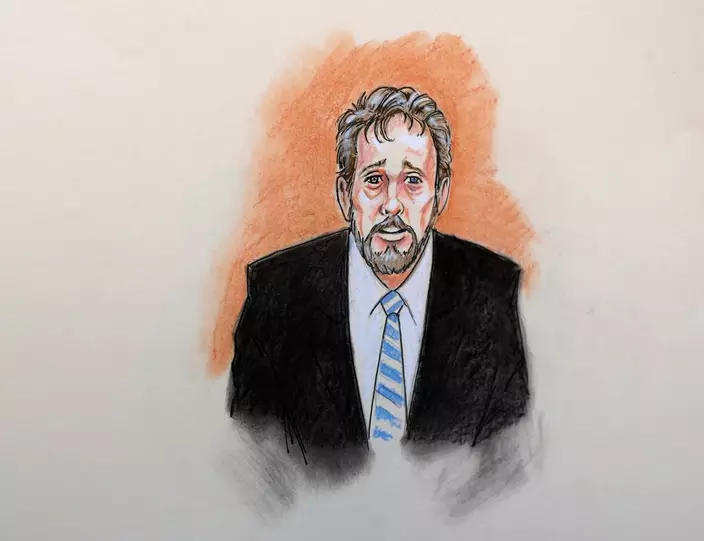
In this courtroom sketch, radio station official Herschel Coomer, who goes by the air name of Eddie Haskell, testifies in the civil trial for pop singer Taylor Swift.( AP Photo)
Taylor Swift's mother testified Wednesday that she and her daughter's managers decided to tell Mueller's bosses that he had assaulted the singer, hoping he would be fired but not asking them to do so.
Andrea Swift also said she didn't contact police in order to protect her daughter, saying she didn't want the incident to "define her life."
Taylor Swift said Thursday that the photo sent by her liaison to the general manager of the radio station where Mueller worked showed the exact moment that he groped her.
In the image, shown to jurors during opening statements but not publicly released, Mueller's hand is behind Swift, just below her waist. Both are smiling.
Mueller has testified that the photo was "weird and awkward," but he insisted that he touched Swift in the ribs, not in the rear.
He testified his hand was touching her skirt after he put his arm around her and their arms got crossed:
"My hand was at rib-cage level and apparently it went down," he said.
Swift said she did not need the photo to remember Mueller.
"I want people to have a good time at my meet-and-greets at concerts," she said. "I don't want people to grab my ass at meet-and-greets at my concerts."
Evidently satisfied with Swift's testimony, her attorney, Douglas Baldridge, declined to question her after McFarland finished.
Thursday's final witness was Stephanie Simbeck, a photographer who works for Swift and took the picture of her and Mueller.
Simbeck said she knew something was wrong as she shot the photo.
She testified that Swift later told her what happened, looked at a photo and pointed out Mueller as the person responsible.
Earlier, Hershel Coomer, a supervisor at the country music station where Mueller worked, took the witness stand and denied a claim by Mueller that Coomer had said he groped Swift at an event for radio directors at Pepsi Center in Denver.
Coomer said he first heard about the claim two years after Mueller was fired from KYGO. Coomer called it a lie.
MEXICO CITY (AP) — When a male driver from a popular rideshare app asked Ninfa Fuentes for her phone number during a ride through Mexico City, she froze. But when he repeatedly pressed her about her Valentine’s Day plans, a rush of terror flooded her body.
What should have been a quiet ride home at the end of the workday three years ago turned into a nightmare that many women in Mexico experience daily: holding their breath until they know they've made it home alive.
“I felt like I was dying,” Fuentes, 48, said. An international economics researcher and a survivor of sexual violence, she has not used public transportation or ride-hailing services since.
The conversation around startling levels of sexual harassment and gender-based violence came roaring back this week after Mexico’s first woman president, Claudia Sheinbaum, was captured in video being groped by a drunk man.
Following the incident, Sheinbaum said she had pressed charges against the man and unveiled a plan to make sexual harassment a crime across all Mexican states — a bid to make it easier for women to report such assaults in a country where an average of 10 women are killed daily.
After her frightening rideshare app experience, Fuentes turned to AmorrAs, a self-managed feminist network that provides safe transportation — and support — for women in Mexico City and its suburbs.
AmorrAs seeks to offer a solution to the endemic problem of sexual harassment and other forms of gender-based violence that women routinely face on Mexico’s rideshare apps and public transit.
The network was founded by 29-year-old Karina Alba following the 2022 killing of Debanhi Escobar, who was found dead days after getting out of a taxi on a dark highway in the northern city of Monterrey.
Alba founded AmorrAs with the hope of providing safe rides for women, choosing her mother, taxi driver Ruth Rojas, to be the network’s first driver. The network now has more than 20 women-only “ally” drivers, serving more than 2,000 women per year.
“My dream was to contribute to society in some way," said Alba. “I decided to do so by creating a safe space for women, one where they can live with dignity and free from violence.”
On a recent afternoon, 38-year-old Dian Colmenero received a WhatsApp message from Alba confirming that the woman she was going to drive was waiting at her workplace. On the receiving end, the passenger read a message with the trip details, her “ally” driver’s name and number, and a reassuring pink heart emoji. Her “ally” driver would be with her soon.
For security reasons, women have to schedule their rides with AmorrAs in advance by filling a form. The price for each ride then varies based on the distance traveled.
Colmenero, who works in marketing when she is not driving with AmorrAs, stole a kiss from her partner and petted her old Yorkie before heading out to one of the city’s financial districts.
“Before driving with AmorrAs, I had experienced violence on public transport, on the subway, and even with ride-hailing apps,” she said. “I once had to ride with a driver who told me and my partner that he had beaten up several women.”
Colmenero greeted her regular passenger, Ninfa Fuentes, with a warm hug. They chatted about their families, the book Fuentes is writing and their shared recent ADHD diagnosis.
As the noise of the Mexican capital’s traffic rattles the car, Fuentes peers out the window, confident that she will arrive home safe and sound.
According to the National Public Security System’s Executive Secretariat, Mexico has reported 61,713 sex crimes so far in 2025, including 8,704 reports of sexual harassment.
The National Citizen Observatory on Femicide says sex crimes in Mexico are the least reported due to the high level of stigma surrounding them and the lack of credibility authorities often extend to women’s reports.
Lawyer Norma Escobar, 32, collaborates with AmorrAs, offering legal support to women who say they have been harassed or assaulted.
On more than one occasion, Escobar said she heard a forensic doctor in the gender crimes department of the Mexico state’s Attorney General’s Office dismiss women filing a sexual assault complaint, telling them “Nothing has happened to you, there have been worse cases.”
Escobar, who handles harassment cases on the street and on public transportation, said that the absence of a forensic doctor has on occasions prevented women from officially filing a report.
A spokesperson from Mexico state’s Attorney General’s Office, when reached by The Associated Press, said they had no knowledge of the doctor's alleged comment, but when problems have been discovered the office has taken action against those involved.
Experts and advocates say the history of violence against women in Mexico is rooted in deep-seated cultural machismo and systemic gender inequality, alongside a justice system riddled with problems.
“Seeing that the authorities downplay it, women end up often giving up on their cases,” said Escobar, noting that when it comes to ensuring women's access to justice, "there is a lack of attention, commitment and professionalism from authorities.”
Like many other women in Mexico, Nejoi Meddeb, 30, always traveled with her hand locked on the door handle so she could escape if needed. That is how 23-year-old Lidia Gabriela Gómez died in 2022 when she jumped out of a moving taxi in Mexico City after the driver took a different route than the one she had requested.
Maria José Cabrera, a 28-year-old engineer, said she was followed by a man when she got off a minibus on her way to the train. She ran to take refuge in the subway car reserved for women only. On another occasion, in one of the city’s mixed subway cars, she said a man touched her inappropriately and, by the time she reacted, he was gone.
Cabrera, who now rides with AmorrAs, said she also avoided wearing skirts and never went anywhere without making sure that someone she trusts was monitoring her journey — a common internalized protocol for many women in Mexico.
“For me, AmorrAs represents being able to do things I couldn’t do before," said Cabrera. "I really enjoy going to concerts. It shouldn’t be like that but if it weren’t for them, I probably wouldn’t be able to do it.”
Follow AP’s coverage of Latin America and the Caribbean at https://apnews.com/hub/latin-america

Ninfa Fuentes leaves work in the Santa Fe neighborhood of Mexico City to head home to the State of Mexico, Thursday, Nov. 6, 2025. (AP Photo/Claudia Rosel)

Diana Guzman, a driver with the feminist transportation collective AmorrAs, back to camera, hugs customer Ninfa Fuentes as she drops her off at her home in the State of Mexico, Thursday, Nov. 6, 2025. (AP Photo/Claudia Rosel)

Diana Guzman, a driver with AmorrAs, a feminist transportation collective that offers rides to women who prefer alternatives to public transit due to safety concerns, drives a passenger home in the State of Mexico, Thursday, Nov. 6, 2025. (AP Photo/Claudia Rosel)
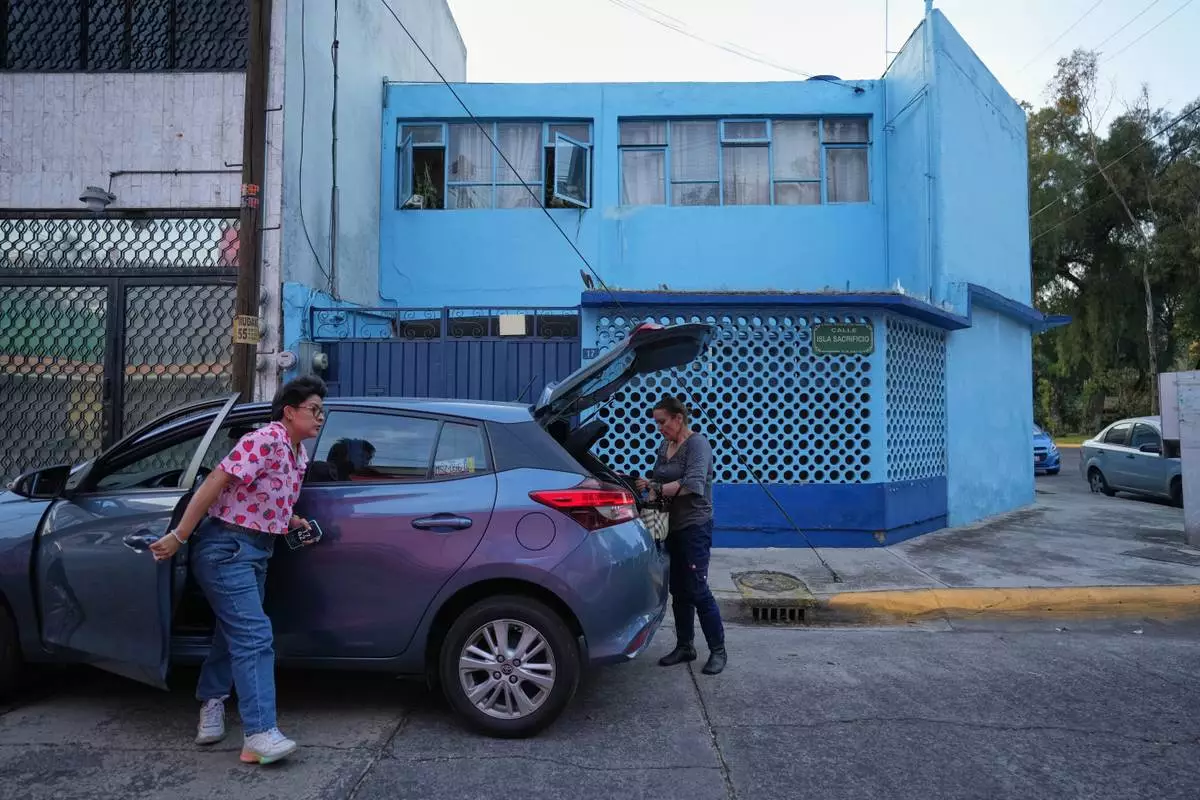
Diana Guzman, left, a driver with the feminist transportation collective AmorrAs, and passenger Ninfa Fuentes, right, arrive at Fuentes' home in the State of Mexico, Thursday, Nov. 6, 2025. (AP Photo/Claudia Rosel)
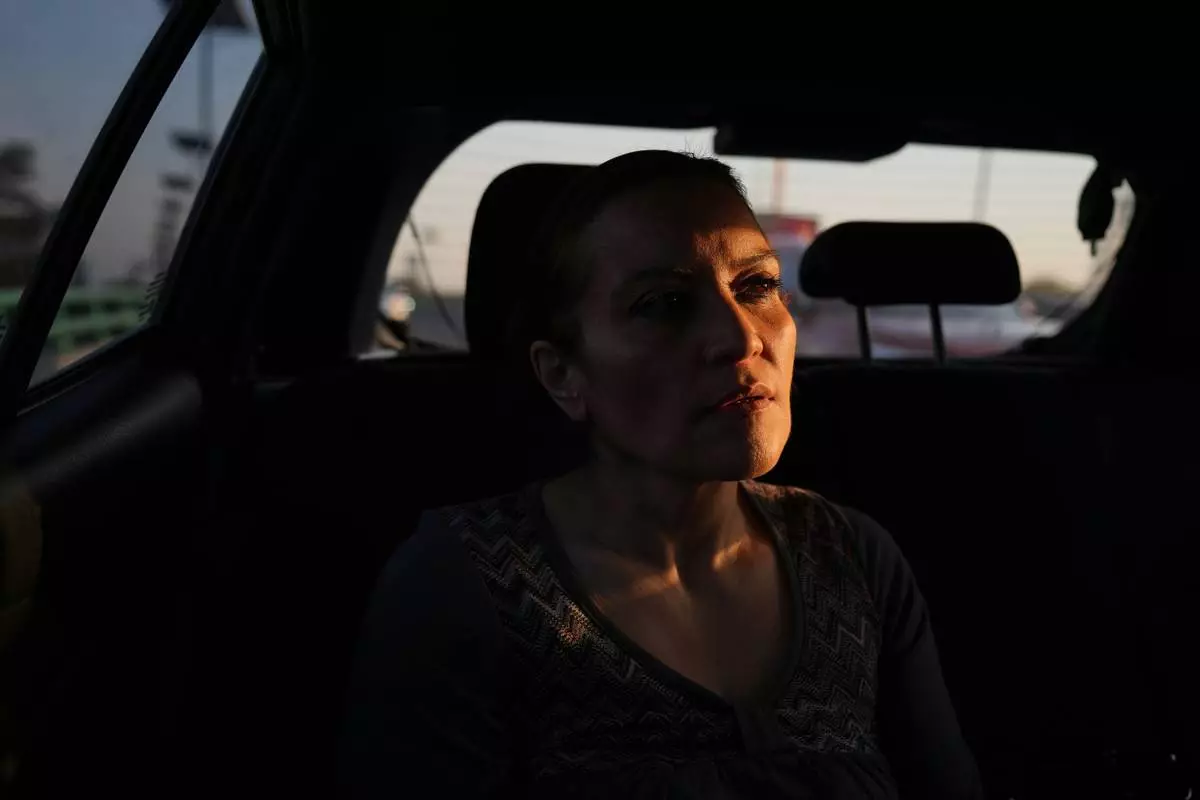
Ninfa Fuentes enters the back seat of a taxi organized by AmorrAs, a feminist transportation collective that offers rides to women who prefer alternatives to public transit due to safety concerns, in Mexico City, Thursday, Nov. 6, 2025. (AP Photo/Claudia Rosel)