MEXICO CITY (AP) — When a male driver from a popular rideshare app asked Ninfa Fuentes for her phone number during a ride through Mexico City, she froze. But when he repeatedly pressed her about her Valentine’s Day plans, a rush of terror flooded her body.
What should have been a quiet ride home at the end of the workday three years ago turned into a nightmare that many women in Mexico experience daily: holding their breath until they know they've made it home alive.
Click to Gallery
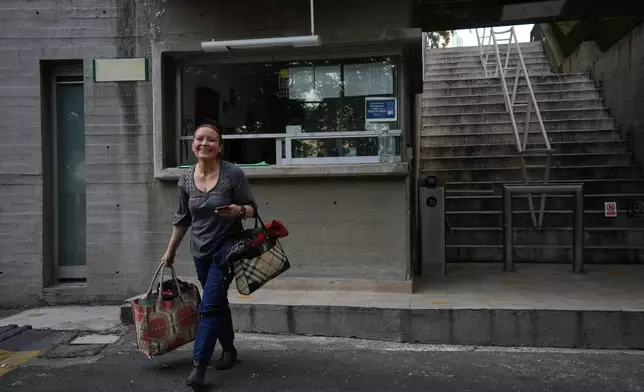
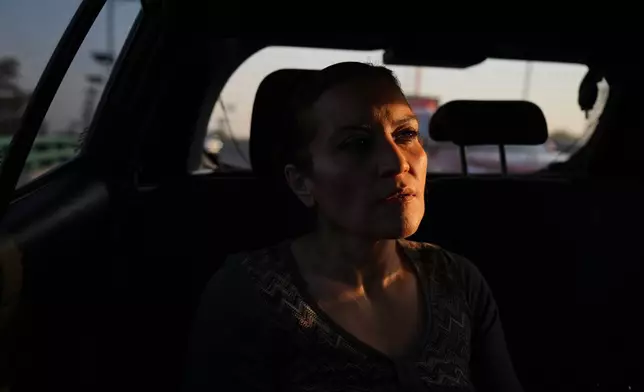
Ninfa Fuentes leaves work in the Santa Fe neighborhood of Mexico City to head home to the State of Mexico, Thursday, Nov. 6, 2025. (AP Photo/Claudia Rosel)
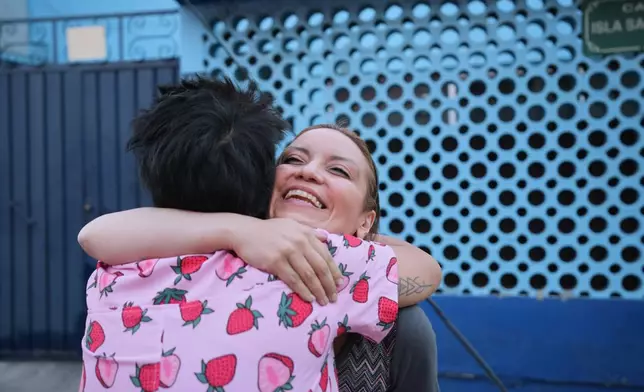
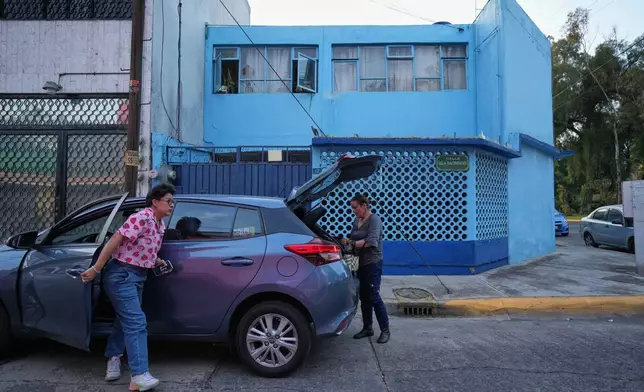
Diana Guzman, a driver with the feminist transportation collective AmorrAs, back to camera, hugs customer Ninfa Fuentes as she drops her off at her home in the State of Mexico, Thursday, Nov. 6, 2025. (AP Photo/Claudia Rosel)
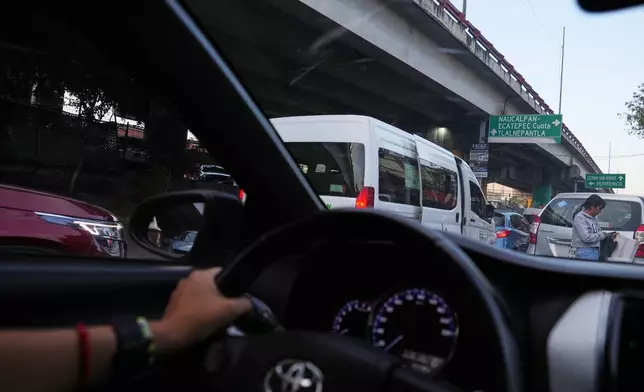
Diana Guzman, a driver with AmorrAs, a feminist transportation collective that offers rides to women who prefer alternatives to public transit due to safety concerns, drives a passenger home in the State of Mexico, Thursday, Nov. 6, 2025. (AP Photo/Claudia Rosel)
Diana Guzman, left, a driver with the feminist transportation collective AmorrAs, and passenger Ninfa Fuentes, right, arrive at Fuentes' home in the State of Mexico, Thursday, Nov. 6, 2025. (AP Photo/Claudia Rosel)
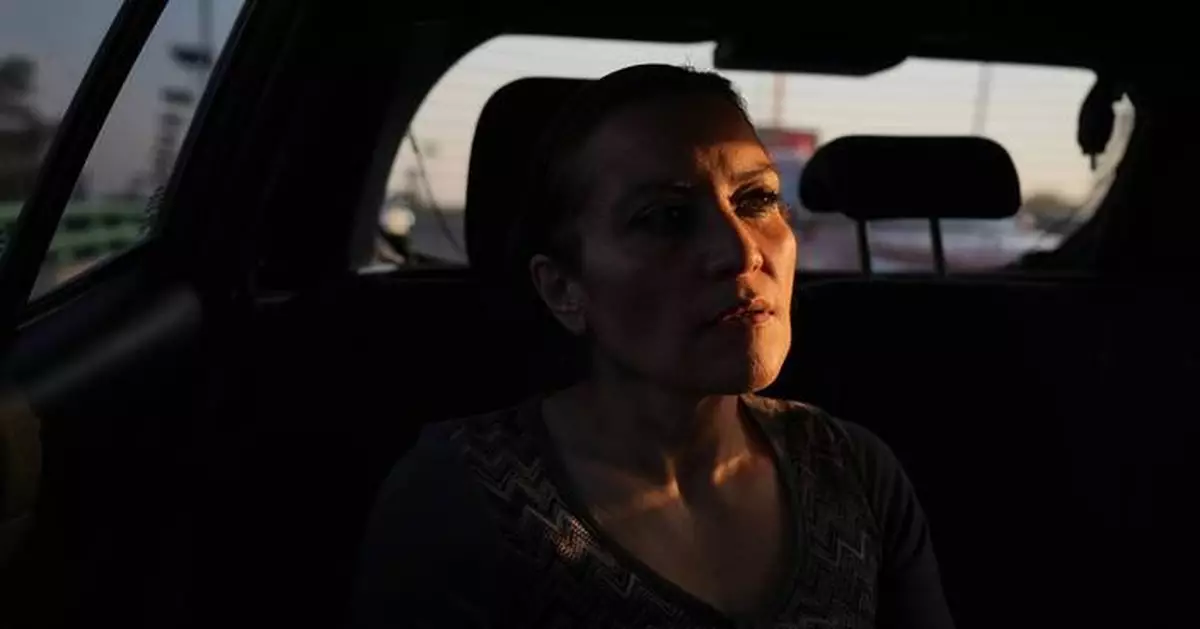
Ninfa Fuentes enters the back seat of a taxi organized by AmorrAs, a feminist transportation collective that offers rides to women who prefer alternatives to public transit due to safety concerns, in Mexico City, Thursday, Nov. 6, 2025. (AP Photo/Claudia Rosel)
“I felt like I was dying,” Fuentes, 48, said. An international economics researcher and a survivor of sexual violence, she has not used public transportation or ride-hailing services since.
The conversation around startling levels of sexual harassment and gender-based violence came roaring back this week after Mexico’s first woman president, Claudia Sheinbaum, was captured in video being groped by a drunk man.
Following the incident, Sheinbaum said she had pressed charges against the man and unveiled a plan to make sexual harassment a crime across all Mexican states — a bid to make it easier for women to report such assaults in a country where an average of 10 women are killed daily.
After her frightening rideshare app experience, Fuentes turned to AmorrAs, a self-managed feminist network that provides safe transportation — and support — for women in Mexico City and its suburbs.
AmorrAs seeks to offer a solution to the endemic problem of sexual harassment and other forms of gender-based violence that women routinely face on Mexico’s rideshare apps and public transit.
The network was founded by 29-year-old Karina Alba following the 2022 killing of Debanhi Escobar, who was found dead days after getting out of a taxi on a dark highway in the northern city of Monterrey.
Alba founded AmorrAs with the hope of providing safe rides for women, choosing her mother, taxi driver Ruth Rojas, to be the network’s first driver. The network now has more than 20 women-only “ally” drivers, serving more than 2,000 women per year.
“My dream was to contribute to society in some way," said Alba. “I decided to do so by creating a safe space for women, one where they can live with dignity and free from violence.”
On a recent afternoon, 38-year-old Dian Colmenero received a WhatsApp message from Alba confirming that the woman she was going to drive was waiting at her workplace. On the receiving end, the passenger read a message with the trip details, her “ally” driver’s name and number, and a reassuring pink heart emoji. Her “ally” driver would be with her soon.
For security reasons, women have to schedule their rides with AmorrAs in advance by filling a form. The price for each ride then varies based on the distance traveled.
Colmenero, who works in marketing when she is not driving with AmorrAs, stole a kiss from her partner and petted her old Yorkie before heading out to one of the city’s financial districts.
“Before driving with AmorrAs, I had experienced violence on public transport, on the subway, and even with ride-hailing apps,” she said. “I once had to ride with a driver who told me and my partner that he had beaten up several women.”
Colmenero greeted her regular passenger, Ninfa Fuentes, with a warm hug. They chatted about their families, the book Fuentes is writing and their shared recent ADHD diagnosis.
As the noise of the Mexican capital’s traffic rattles the car, Fuentes peers out the window, confident that she will arrive home safe and sound.
According to the National Public Security System’s Executive Secretariat, Mexico has reported 61,713 sex crimes so far in 2025, including 8,704 reports of sexual harassment.
The National Citizen Observatory on Femicide says sex crimes in Mexico are the least reported due to the high level of stigma surrounding them and the lack of credibility authorities often extend to women’s reports.
Lawyer Norma Escobar, 32, collaborates with AmorrAs, offering legal support to women who say they have been harassed or assaulted.
On more than one occasion, Escobar said she heard a forensic doctor in the gender crimes department of the Mexico state’s Attorney General’s Office dismiss women filing a sexual assault complaint, telling them “Nothing has happened to you, there have been worse cases.”
Escobar, who handles harassment cases on the street and on public transportation, said that the absence of a forensic doctor has on occasions prevented women from officially filing a report.
A spokesperson from Mexico state’s Attorney General’s Office, when reached by The Associated Press, said they had no knowledge of the doctor's alleged comment, but when problems have been discovered the office has taken action against those involved.
Experts and advocates say the history of violence against women in Mexico is rooted in deep-seated cultural machismo and systemic gender inequality, alongside a justice system riddled with problems.
“Seeing that the authorities downplay it, women end up often giving up on their cases,” said Escobar, noting that when it comes to ensuring women's access to justice, "there is a lack of attention, commitment and professionalism from authorities.”
Like many other women in Mexico, Nejoi Meddeb, 30, always traveled with her hand locked on the door handle so she could escape if needed. That is how 23-year-old Lidia Gabriela Gómez died in 2022 when she jumped out of a moving taxi in Mexico City after the driver took a different route than the one she had requested.
Maria José Cabrera, a 28-year-old engineer, said she was followed by a man when she got off a minibus on her way to the train. She ran to take refuge in the subway car reserved for women only. On another occasion, in one of the city’s mixed subway cars, she said a man touched her inappropriately and, by the time she reacted, he was gone.
Cabrera, who now rides with AmorrAs, said she also avoided wearing skirts and never went anywhere without making sure that someone she trusts was monitoring her journey — a common internalized protocol for many women in Mexico.
“For me, AmorrAs represents being able to do things I couldn’t do before," said Cabrera. "I really enjoy going to concerts. It shouldn’t be like that but if it weren’t for them, I probably wouldn’t be able to do it.”
Follow AP’s coverage of Latin America and the Caribbean at https://apnews.com/hub/latin-america

Ninfa Fuentes leaves work in the Santa Fe neighborhood of Mexico City to head home to the State of Mexico, Thursday, Nov. 6, 2025. (AP Photo/Claudia Rosel)

Diana Guzman, a driver with the feminist transportation collective AmorrAs, back to camera, hugs customer Ninfa Fuentes as she drops her off at her home in the State of Mexico, Thursday, Nov. 6, 2025. (AP Photo/Claudia Rosel)

Diana Guzman, a driver with AmorrAs, a feminist transportation collective that offers rides to women who prefer alternatives to public transit due to safety concerns, drives a passenger home in the State of Mexico, Thursday, Nov. 6, 2025. (AP Photo/Claudia Rosel)
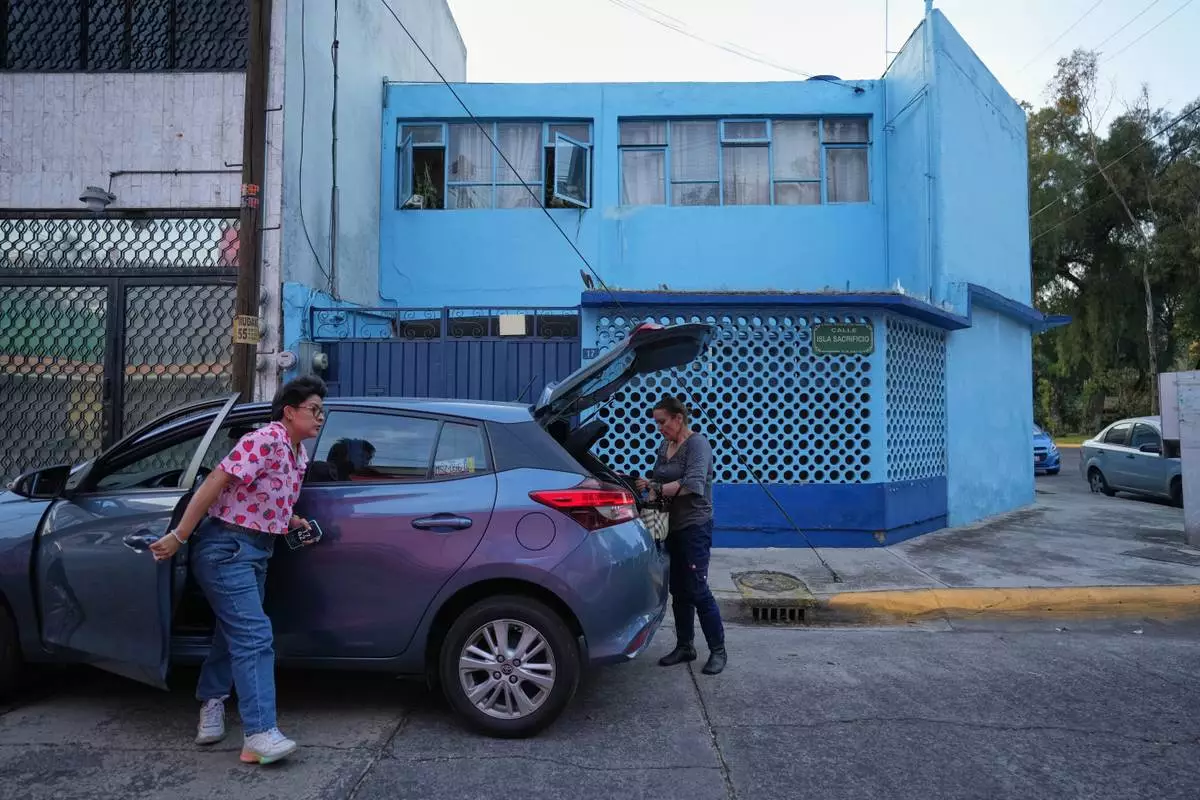
Diana Guzman, left, a driver with the feminist transportation collective AmorrAs, and passenger Ninfa Fuentes, right, arrive at Fuentes' home in the State of Mexico, Thursday, Nov. 6, 2025. (AP Photo/Claudia Rosel)
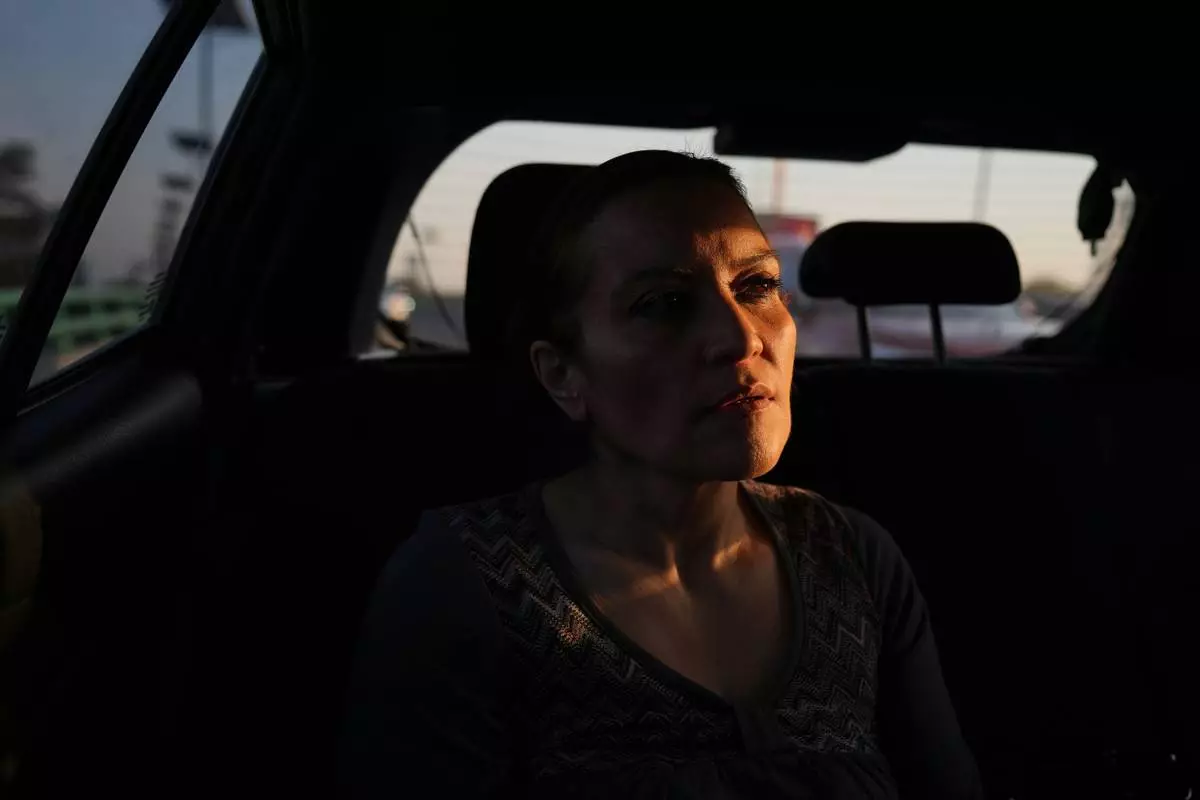
Ninfa Fuentes enters the back seat of a taxi organized by AmorrAs, a feminist transportation collective that offers rides to women who prefer alternatives to public transit due to safety concerns, in Mexico City, Thursday, Nov. 6, 2025. (AP Photo/Claudia Rosel)
VILNIUS, Lithuania (AP) — Belarus freed Nobel Peace Prize laureate Ales Bialiatski, key opposition figure Maria Kolesnikova and dozens of other political prisoners on Saturday, capping two days of talks with Washington aimed at improving ties and getting crippling U.S. sanctions lifted on a key Belarusian agricultural export.
President Alexander Lukashenko pardoned 123 prisoners, Belarus’ state news agency, Belta, reported. In exchange, the U.S. said it was lifting sanctions on the Eastern European country's potash sector,
A close ally of Russia, Minsk has faced Western isolation and sanctions for years. Lukashenko has ruled the nation of 9.5 million with an iron fist for more than three decades, and the country has been repeatedly sanctioned by the West for its crackdown on human rights and for allowing Moscow to use its territory during the 2022 invasion of Ukraine.
John Coale, the U.S. special envoy for Belarus who met with Lukashenko in Minsk on Friday and Saturday, described the talks to reporters as “very productive" and said normalizing relations between the two countries was “our goal,” Belta reported.
“We’re lifting sanctions, releasing prisoners. We’re constantly talking to each other,” Coale said, adding that the relationship between the U.S. and Belarus was moving from “baby steps to more confident steps” as they increased dialogue, the Belarusian news agency reported.
Belarus has released hundreds of prisoners since July 2024. Among the 123 freed Saturday were a U.S. citizen, six citizens of U.S. allied countries, and five Ukrainian citizens, a U.S. official told The Associated Press in an email. The official, who spoke on condition of anonymity to discuss private diplomatic negotiations, described the release as “a significant milestone in U.S.-Belarus engagement” and “yet another diplomatic victory” for U.S. President Donald Trump.
The official said Trump’s engagement so far “has led to the release of over 200 political prisoners in Belarus, including six unjustly detained U.S. citizens and over 60 citizens of U.S. Allies and partners.”
Pavel Sapelka, an advocate with the Viasna rights group, confirmed to the AP that Bialiatski and Kolesnikova were among those released.
Bialiatski, a human rights advocate who founded Viasna, was in jail when he was awarded the Nobel Peace Prize in 2022 along with the prominent Russian rights group Memorial and Ukraine’s Center for Civil Liberties. He was later convicted of smuggling and financing actions that violated public order — charges that were widely denounced as politically motivated — and sentenced to 10 years in 2023.
Bialiatski told the AP by phone Saturday that his release after 1,613 days behind bars came as a surprise — in the morning, he was still in an overcrowded prison cell.
“It feels like I jumped out of icy water into a normal, warm room, so I have to adapt. After isolation, I need to get information about what’s going on," said Bialiatski, who seemed energetic but pale and emaciated in post-release videos and photos.
He vowed to continue his work, stressing that “more than a thousand political prisoners in Belarus remain behind bars simply because they chose freedom. And, of course, I am their voice."
Kolesnikova, meanwhile, was a key figure in the mass protests that rocked Belarus in 2020 and is a close ally of an opposition leader in exile, Sviatlana Tsikhanouskaya.
Known for her close-cropped hair and trademark gesture of forming a heart with her hands, Kolesnikova became an even greater symbol of resistance when Belarusian authorities tried to deport her in September 2020. Driven to the Ukrainian border, she briefly broke away from security forces at the frontier, tore up her passport and walked back into Belarus.
The 43-year-old professional flutist was convicted in 2021 on charges including conspiracy to seize power and sentenced to 11 years in prison.
Among the others who were released, according to Viasna, was Viktar Babaryka — an opposition figure who had sought to challenge Lukashenko in the 2020 presidential election, widely seen as rigged, before being convicted and sentenced to 14 years in prison on charges he rejected as political.
Viasna reported that the group's imprisoned advocates, Valiantsin Stefanovic and Uladzimir Labkovich, and prominent opposition figure Maxim Znak were also freed. But it later said it was clarifying its report about Stefanovic's release, and Bialiatski told the AP that Stefanovic had not been freed, though he hopes he will be soon.
Most of the freed prisoners were sent to Ukraine, Franak Viachorka, Tsikhanouskaya’s senior adviser, told the AP. Eight or nine others, including Bialiatski, were being sent to Lithuania on Saturday, and more prisoners will be taken to the Baltic country in the next few days, Viachorka said.
Ukrainian authorities confirmed that Belarus had handed over 114 civilians, including five Ukrainian nationals. Freed Belarusian nationals “at their request” and “after being given necessary medical treatment” will be taken to Poland and Lithuania, they said.
Lukashenko’s press secretary, Natalya Eismont, said those released were sent to Ukraine because Kyiv was to free several imprisoned Belarusian and Russian nationals as part of the deal, although Ukrainian officials haven't confirmed the claim yet.
When U.S. officials last met with Lukashenko in September, Washington eased some of the sanctions on Belarus while Minsk released more than 50 political prisoners.
“The freeing of political prisoners means that Lukashenko understands the pain of Western sanctions and is seeking to ease them,” Tsikhanouskaya, the opposition leader in exile, told the AP on Saturday.
She added: “But let’s not be naive: Lukashenko hasn’t changed his policies, his crackdown continues and he keeps on supporting Russia’s war against Ukraine. That’s why we need to be extremely cautious with any talk of sanctions relief, so that we don't reinforce Russia's war machine and encourage continued repressions.”
Belarus, which previously accounted for about 20% of global potash fertilizer exports, has been forced to sharply cut them after Western sanctions targeted state producer Belaruskali and cut off transit through Lithuania’s port in Klaipeda, the country’s main export route.
“Sanctions by the U.S., EU and their allies have significantly weakened Belarus’s potash industry, depriving the country of a key source of foreign exchange earnings and access to key markets,” Anastasiya Luzgina, an analyst at the Belarusian Economic Research Center BEROC, told the AP, noting that Minsk likely hopes this paves the way for easing the more painful European sanctions.
The latest round of U.S.-Belarus talks also touched on Venezuela, as well as Russia's ongoing invasion of Ukraine, Belta reported.
Coale told reporters that Lukashenko had given “good advice” on how to address the war, saying that Lukashenko and Russian President Vladimir Putin were “longtime friends” with “the necessary level of relationship to discuss such issues.”
The U.S. official told the AP that “continued progress in U.S.-Belarus relations" also requires steps to resolve tensions between Belarus and neighboring Lithuania, which is a member of the EU and NATO.
Lithuanian President Gitanas Nauseda welcomed the prisoners’ release, praising their “remarkable courage” in a post on X and adding that “Lithuania stands with them and all who strive for freedom.”
The Lithuanian government this week declared a national emergency over security risks posed by meteorological balloons sent from Belarus. The balloons forced Lithuania to repeatedly shut down its main airport, stranding thousands of people.
Associated Press writer Matthew Lee in Washington contributed to this report.

A woman holds an Old Belarusian flag as she stands waiting released Belarusian prisoners at the U.S. Embassy in Vilnius, Lithuania, on Saturday, Dec. 13, 2025. (AP Photo/Mindaugas Kulbis)
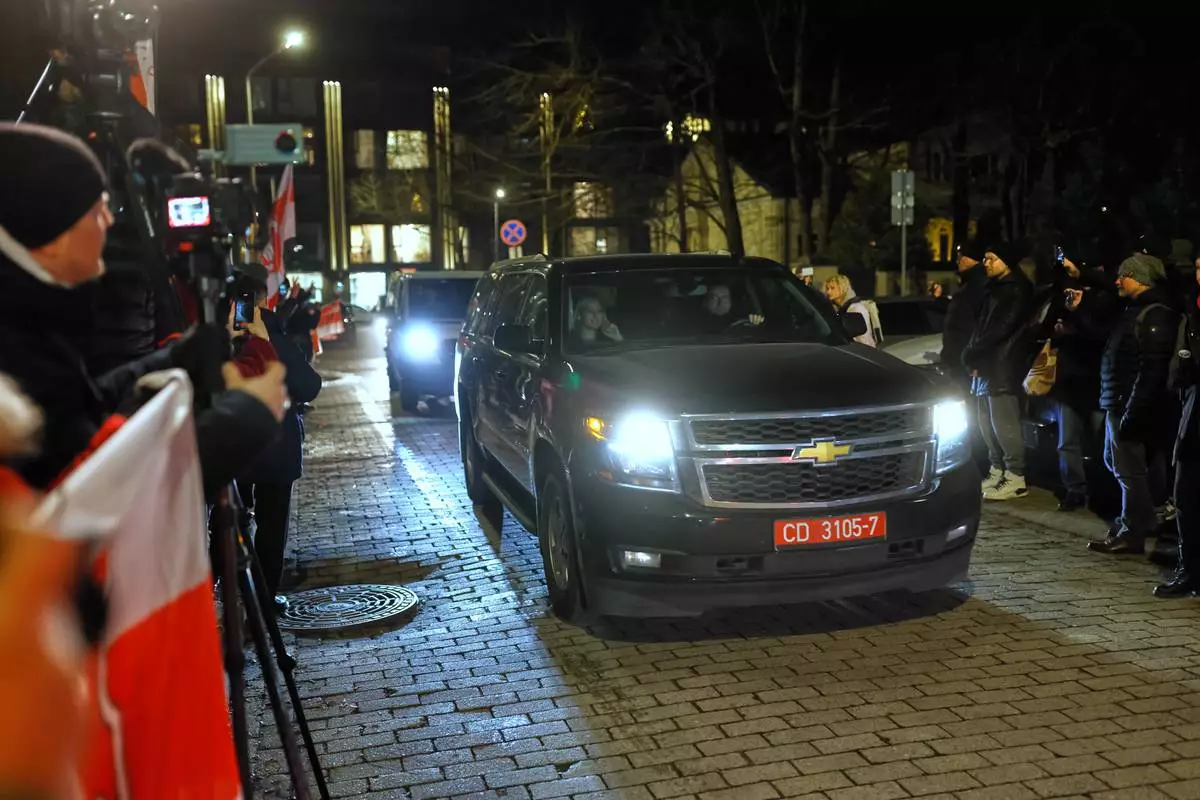
A motorcade arrives at the U.S. Embassy in Vilnius, Lithuania, on Saturday, Dec. 13, 2025. (AP Photo/Mindaugas Kulbis)
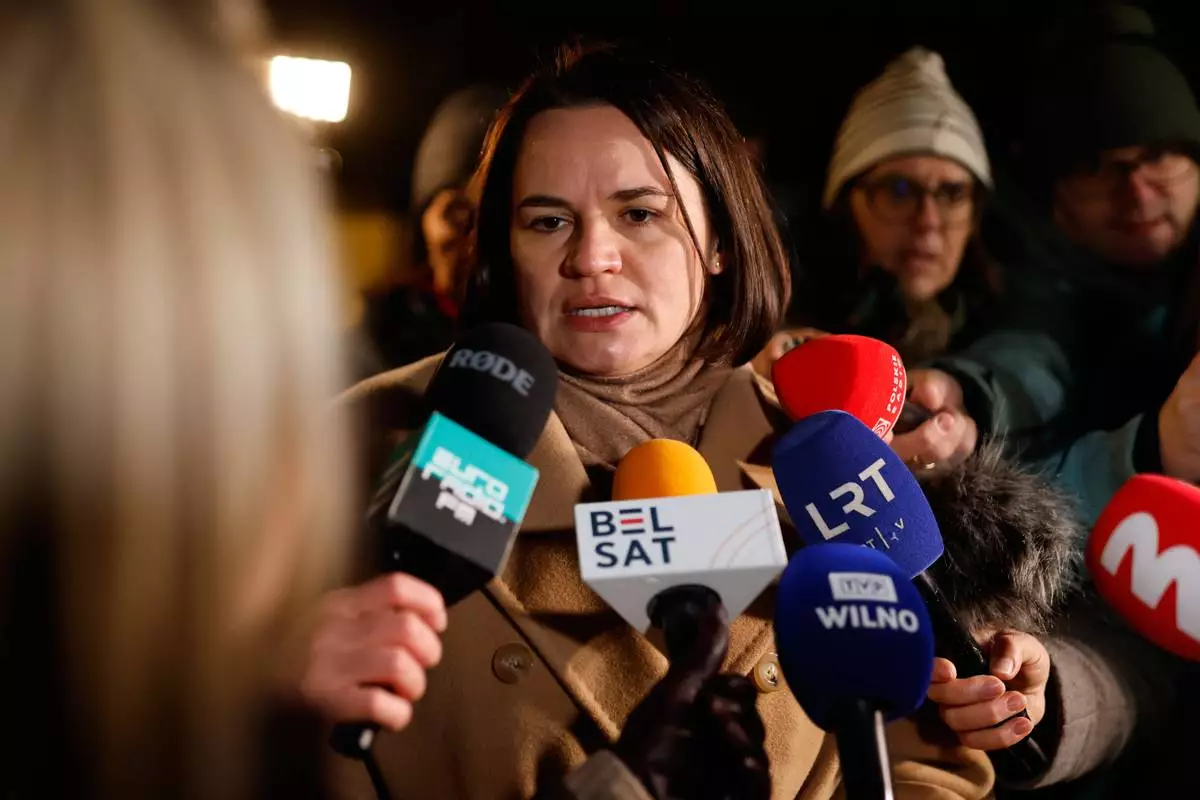
Belarusian opposition leader Sviatlana Tsikhanouskaya speaks to journalists as she waits to meet released Belarusian prisoners at the U.S. Embassy in Vilnius, Lithuania, on Saturday, Dec. 13, 2025. (AP Photo/Mindaugas Kulbis)
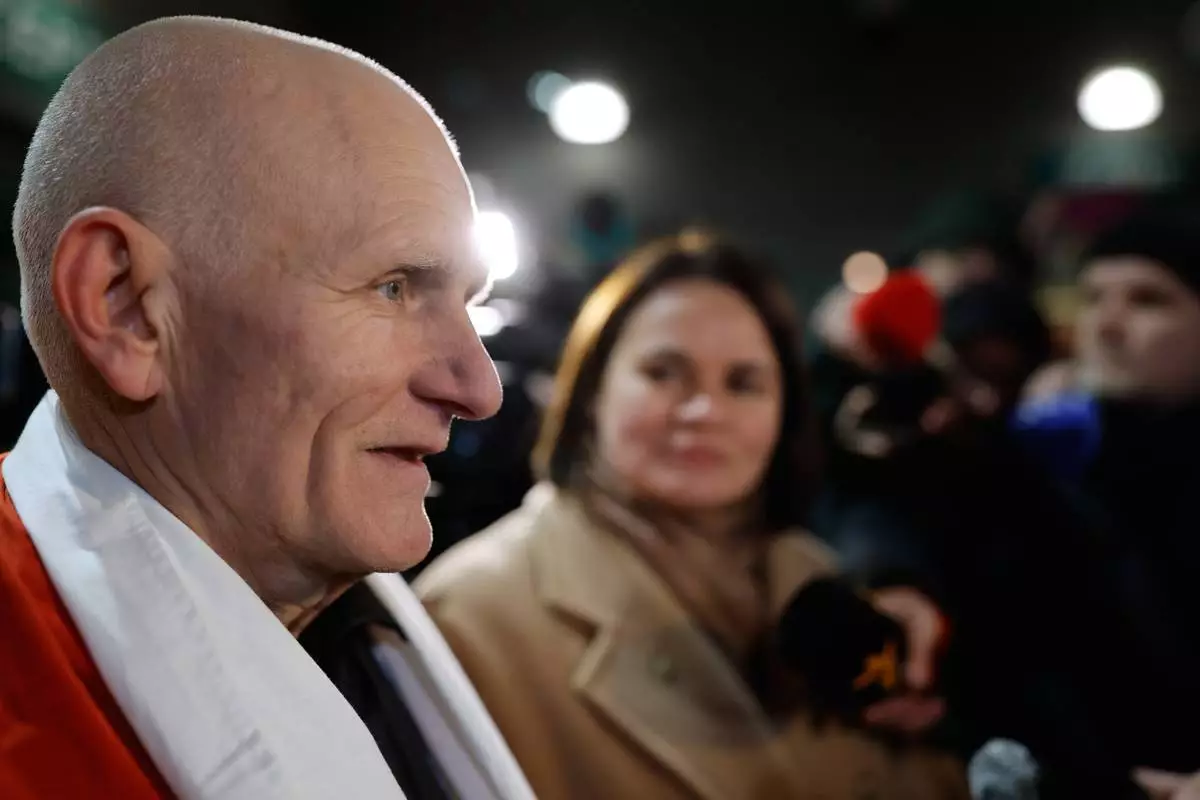
Nobel Peace Prize laureate Ales Bialiatski, one of released Belarusian prisoners, arrives at the U.S. Embassy in Vilnius, Lithuania, on Saturday, Dec. 13, 2025, as Belarusian opposition leader Sviatlana Tsikhanouskaya, background stands near. (AP Photo/Mindaugas Kulbis)
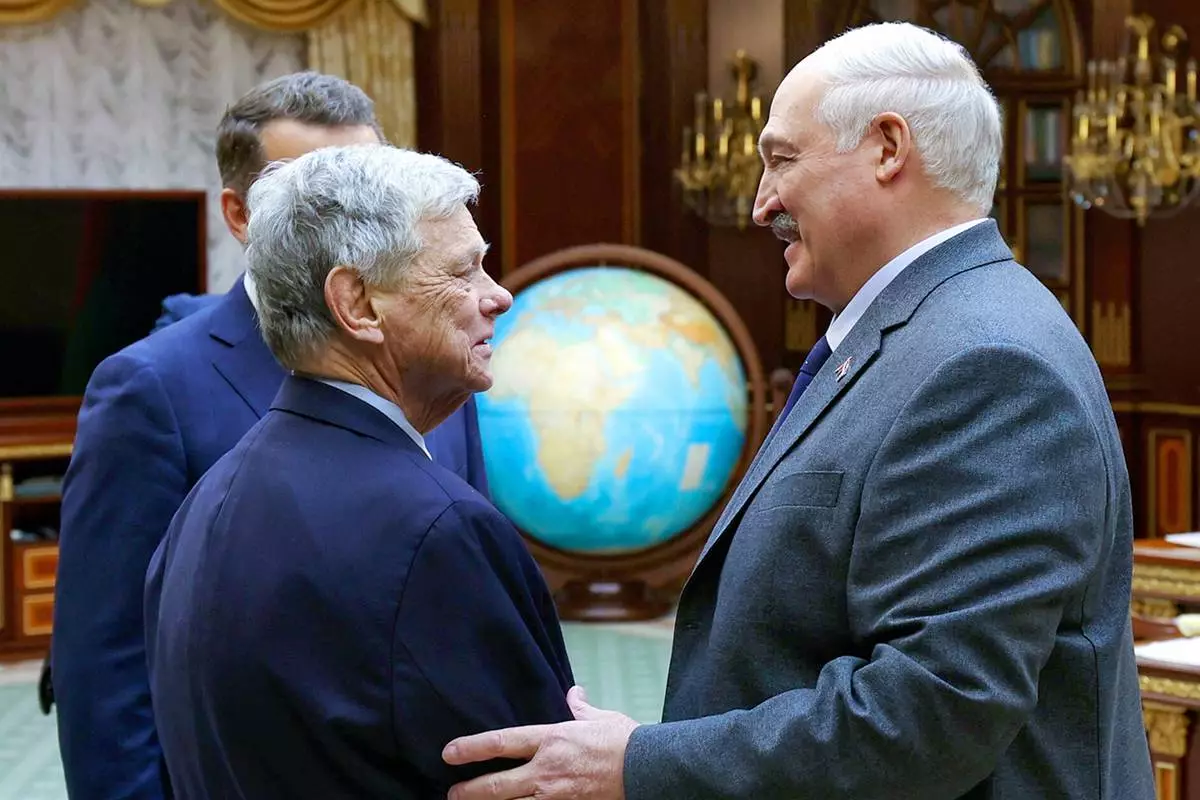
In this photo released by Belarusian presidential press service, Belarusian President Alexander Lukashenko, right, and U.S. Presidential envoy John Coale shake hands during their meeting in Minsk, Belarus, Friday, Dec. 12, 2025. (Belarusian Presidential Press Service via AP)