Facebook envisions its new Watch feature as TV designed for social media, a place where users comment, like and interact with show creators, stars and each other — and never leave.
It's a potential threat to Twitter, YouTube, Netflix and other services for watching video, including old-fashioned TV. Yet its success is far from guaranteed.
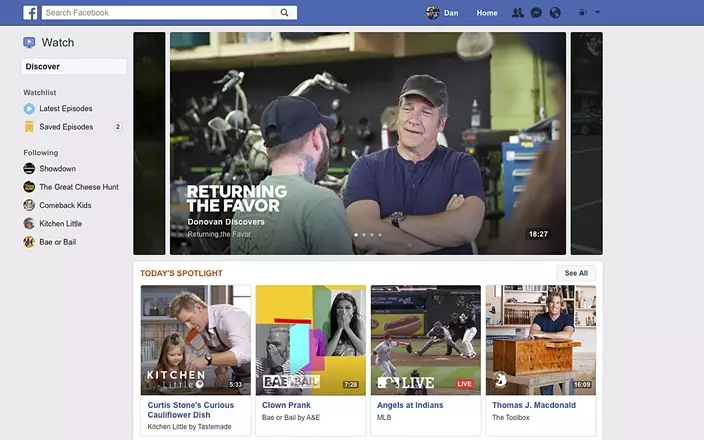
A screenshot demonstrating Facebook's new Watch feature, which is dedicated to live and recorded video. (AP Photo)
While people watch a lot of videos on Facebook, these are mostly shared by their friends, seen as users scroll down their main news feed.
Getting people to see Facebook as a video service is like Walmart trying to sell high fashion, or McDonald's peddling high-end food, said Joel Espelien, senior analyst with The Diffusion Group, a video research firm.
Sure, it's possible, but something is off.
"It's very difficult to change people's core perception of what your brand is," he said.
Facebook has already had a special video section, but it mainly shows a random concoction of "suggested" videos. The new Watch section replaces this. Some U.S. users got Watch on Thursday; others will get it over time.
The idea behind Watch is to let people find videos and series they like, keep up with them as new episodes appear, and interact with the show's stars, creators and other fans. People's own tastes, as well as those of their friends, will be used to recommend videos.
Daniel Danker, a product director for video at Facebook, said the most successful shows will be the ones that get people interacting with each other.
"Live does that better than almost anything," he said.
Facebook wants to feature a broad range of shows on Watch, including some exclusive to Facebook. Users who already follow certain outlets, say, BuzzFeed, will get recommended shows from those pages.
But Espelien wonders whether Facebook users will tap (or click) the Watch tab when with another tap of the finger they can "click over to Hulu or Netflix or whatever."
Though Facebook might want you to think otherwise, Espelien said there's no boundary keeping you from straying.
Advertising details are still being hashed out, but typically the shows will have five to 15-second ad breaks. Facebook said show creators will decide where the ads go, so they can be inserted during natural breaks.
But it might be a tough sell for advertisers used to a predictable, reliable audience that television has had, Forrester Research analyst Jim Nail said in an email. Facebook's big challenge, he said, will be to train users "to establish a Watch habit."
Meta has cut a trio of deals to power its artificial intelligence data centers, securing enough energy to light up the equivalent of about 5 million homes.
The parent company of Facebook on Friday announced agreements with TerraPower, Oklo and Vistra for nuclear power for its Prometheus AI data center that is being built in New Albany, Ohio. Meta announced Prometheus, which will be a 1-gigawatt cluster spanning across multiple data center buildings, in July. It's anticipated to come online this year.
Financial terms of the deals with TerraPower, Oklo and Vistra were not disclosed.
The Mark Zuckerberg-led Meta said in a statement on Friday that the three deals will support up to 6.6 gigawatts of new and existing clean energy by 2035. A single gigawatt, according to a general industry standard for utilities, can power about 750,000 homes.
“These projects add reliable and firm power to the grid, reinforce America’s nuclear supply chain, and support new and existing jobs to build and operate American power plants,” the company said.
Meta said its agreement with TerraPower will provide funding that supports the development of two new Natrium units capable of generating up to 690 megawatts of firm power with delivery as early as 2032. The deal also provides Meta with rights for energy from up to six other Natrium units capable of producing 2.1 gigawatts and targeted for delivery by 2035.
Meta will also buy more than 2.1 gigawatts of energy from two operating Vistra nuclear power plants in Ohio, in addition to the energy from expansions at the two Ohio plants and a third Vistra nuclear power plant in Pennsylvania.
Vistra said that electricity from the three power plants — Beaver Valley in Pennsylvania and Davis-Besse and Perry in Ohio — will still run through the mid-Atlantic grid for all electricity customers. It also said the agreements with Meta “provide certainty” for it to ask federal regulators for 20-year license renewals for the reactors.
Tech companies have been under pressure in the stressed mid-Atlantic grid — which includes Ohio and Pennsylvania — to build new power sources to supply the entire electricity needs of their new data centers there.
Jesse Jenkins, an assistant professor of engineering at Princeton University who specializes in energy systems, said bringing Prometheus online without a new power source for it will only increase electricity rates across the mid-Atlantic grid.
Ratepayers in the mid-Atlantic are already paying higher electricity bills to support new and proposed data centers.
The deal with Oklo, which counts OpenAI's Sam Altman as one of its largest investors, will help to develop a 1.2 gigawatt power campus in Pike County, Ohio to support Meta’s data centers in the region.
The nuclear power agreements come after Meta announced in June that it reached a 20-year deal with Constellation Energy.
Associated Press writer Marc Levy in Harrisburg, Pennsylvania, contributed to this report.
FILE -A Meta logo is shown on a video screen at LlamaCon 2025, an AI developer conference, in Menlo Park, Calif., April 29, 2025. (AP Photo/Jeff Chiu, File)