After more than five decades of battle in Colombia's jungles, the nation's largest rebel movement initiated the launch of its political party Sunday at a concrete convention center in the capital, vowing to upend the country's traditional conservatism with the creation of an alternative leftist coalition.
The Revolutionary Armed Forces of Colombia will transform into a political party under a new, still-to-be-announced name as part of a historic peace deal signed last year. The accords guarantee the ex-combatants 10 seats in Congress and the same funding the state provides to the nation's 13 other political parties, in addition to a half-million dollars in funding to begin a think tank to develop their political ideology.
Click to Gallery
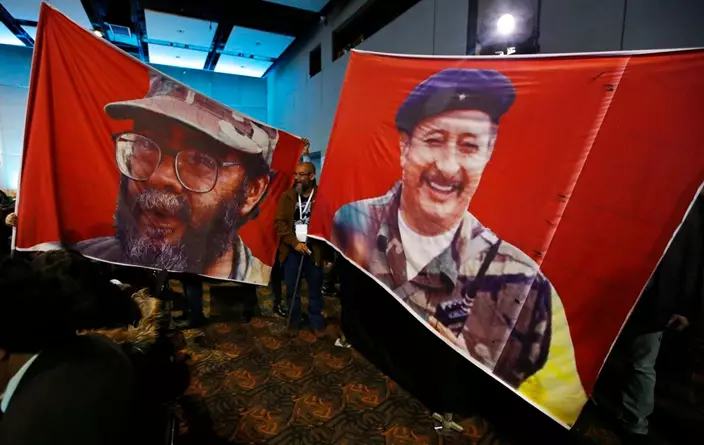
The images of late leaders of the Revolutionary Armed Forces of Colombia (FARC) Alfonso Cano, left, and Victor Suarez Rojas, also known as Jorge Briceno or Mono Jojoy, hang during the FARC's National Congress in Bogota, Colombia, Sunday, Aug, 27, 2017. (AP Photo/Fernando Vergara)
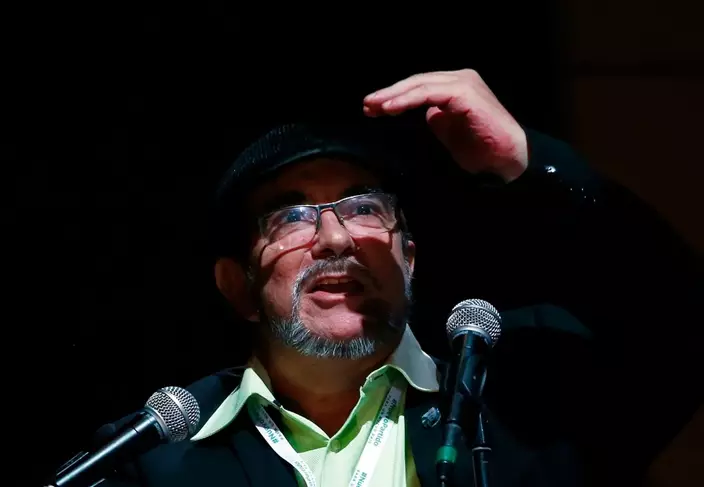
Rodrigo Londono, also known as Timoleon Jimenez or Timochenko, the top commander of the Revolutionary Armed Forces of Colombia (FARC) speaks to an audience of former guerrillas during the FARC's National Congress in Bogota, Colombia, Sunday, Aug. 27, 2017. (AP Photo/Fernando Vergara)
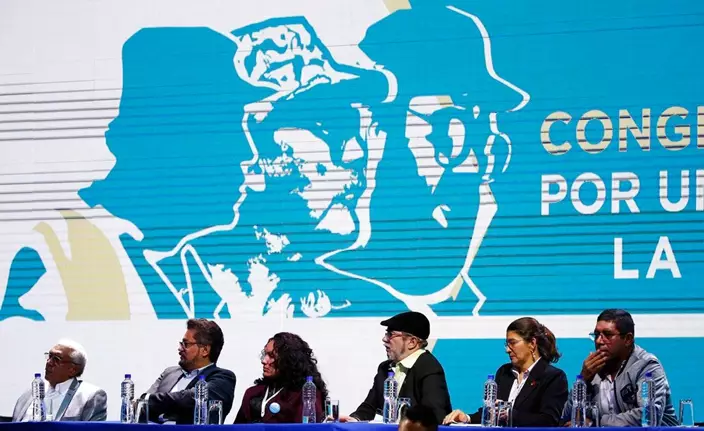
Leaders of the Revolutionary Armed Forces of Colombia (FARC) sit before an audience of former guerrillas as they lead the FARC's National Congress in Bogota, Colombia, Sunday, Aug, 27, 2017. (AP Photo/Fernando Vergara)
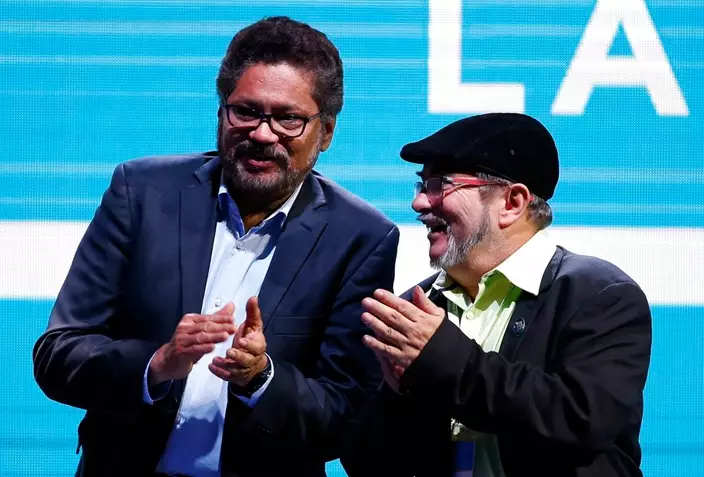
Rodrigo Londono, right, also known as Timoleon Jimenez or Timochenko, the top commander of the Revolutionary Armed Forces of Colombia (FARC), applauds next to fellow rebel leader Ivan Marquez, before an audience of former guerrillas as they lead the FARC's National Congress in Bogota, Colombia, Sunday, Aug, 27, 2017. (AP Photo/Fernando Vergara)
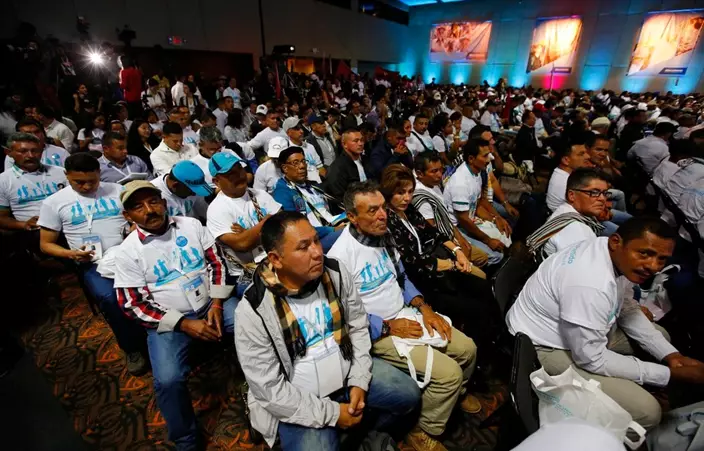
Former rebels of the Revolutionary Armed Forces of Colombia (FARC) attend the FARC's National Congress in Bogota, Colombia, Sunday, Aug. 27, 2017.(AP Photo/Fernando Vergara)
The images of late leaders of the Revolutionary Armed Forces of Colombia (FARC) Alfonso Cano, left, and Victor Suarez Rojas, also known as Jorge Briceno or Mono Jojoy, hang during the FARC's National Congress in Bogota, Colombia, Sunday, Aug, 27, 2017. (AP Photo/Fernando Vergara)
"We are taking an extraordinary step in the history of the common people's struggle in Colombia," said Rodrigo Londono, better known by his nom de guerre Timochenko, to an audience of former guerrillas dressed in white T-shirts with the hashtag #NuveoPartido (#NewParty) on the back.
"This doesn't mean we are renouncing in any way our fundamental principles or societal project," he said.
Rodrigo Londono, also known as Timoleon Jimenez or Timochenko, the top commander of the Revolutionary Armed Forces of Colombia (FARC) speaks to an audience of former guerrillas during the FARC's National Congress in Bogota, Colombia, Sunday, Aug. 27, 2017. (AP Photo/Fernando Vergara)
The organization has signaled that it will adhere to its Marxist roots and focus on winning votes from peasants, workers and the urban middle class with a social justice platform, but it faces opposition from many who identify the guerrillas with kidnappings and terrorism.
A poll released in August found that fewer than 10 percent of Colombians said they had total confidence in the rebels as a political party and a large majority said they'd never vote a former guerrilla into Congress.
"They're not going to be received very warmly in most of Colombia," said Adam Isacson of the Washington Office on Latin America think tank. "Their human rights record hurt them. Their media image is terrible. Most Colombians quite simply aren't socialists or communists."
But, he added, "All is not lost. A message of wanting to redistribute wealth and undo economic injustice could probably do quite well in a lot of poor areas of Colombia."
Leaders of the Revolutionary Armed Forces of Colombia (FARC) sit before an audience of former guerrillas as they lead the FARC's National Congress in Bogota, Colombia, Sunday, Aug, 27, 2017. (AP Photo/Fernando Vergara)
The group's entrance into politics has been met with fierce resistance from leaders like former President Alvaro Uribe, one of the peace agreement's staunchest critics. After passing a law earlier this year ratifying the group as a political party, the nation's Supreme Court is now debating the legislation's constitutionality. Critics say the former rebels shouldn't be allowed to participate in politics before first going through a special peace tribunal.
"The fact that a war criminal could become the president of Colombia makes no sense," former Peace Commissioner Camilo Gomez said at a recent court hearing.
Supporters like Ivan Cepeda of the leftist Alternative Democratic Pole contend that political incorporation of the group known as the FARC is the best means of ensuring a lasting peace.
"We have had to pay a very high cost in lives, in infrastructure ... that today we are saving with the end of the conflict," Cepeda said. "It's more an investment in the democracy of Colombia."
Rodrigo Londono, right, also known as Timoleon Jimenez or Timochenko, the top commander of the Revolutionary Armed Forces of Colombia (FARC), applauds next to fellow rebel leader Ivan Marquez, before an audience of former guerrillas as they lead the FARC's National Congress in Bogota, Colombia, Sunday, Aug, 27, 2017. (AP Photo/Fernando Vergara)
The FARC was formed in the early 1960s by guerrillas affiliated with Colombia's Communist Party. Over the next 53 years the battle between the rebels, government forces and right-wing paramilitaries claimed at least 250,000 lives, left another 60,000 people missing and displaced millions, becoming the region's longest-running conflict.
Four years of negotiations in Havana between rebel leaders and the government culminated with the signing of a peace accord in which guerillas agreed to turn over their arms, confess their crimes in a special peace tribunal that will spare most of any jail time, and turn over their war spoils as reparation to victims.
The agreement also addresses thorny issues like how to reduce Colombia's booming coca production and provide economic alternatives to poor farmers. The U.S. once labeled the FARC one of the world's largest drug trafficking organizations.
Colombian voters rejected the accord by a razor-thin majority in a post-signing referendum but a modified version with relatively minor changes was later approved by the legislature. A poll this summer by the Colombian firm Politmetrica found that optimism about the peace process has declined since last October's referendum, from 67 percent of those surveyed to just about 53 percent.
The conference launched Sunday is expected to gather 1,000 former combatants from around the nation and define the FARC's political platform. In a document leaked this spring — called the "April Theses" in a nod to Bolshevik leader Vladimir Lenin's directive by the same name — the FARC leadership described its political party as rooted in "Marxism, Leninism, emancipatory Bolivarian thought and the people's revolutionary ideology."
Former rebels of the Revolutionary Armed Forces of Colombia (FARC) attend the FARC's National Congress in Bogota, Colombia, Sunday, Aug. 27, 2017.(AP Photo/Fernando Vergara)
The rebel leader known by the nom de guerre of Pastor Alape said the party's would quickly seek a leftist coalition to advance implementation of the peace accords.
FARC leaders have toyed with keeping their same acronym and changing their name to the Alternative Revolutionary Force of Colombia, but the idea hasn't received a warm reception.
"If the FARC intend to grow it's a mistake," journalist Angel Becassino told news magazine Semana. The acronym "signifies a past that generates a lot of confrontation."
Hanging over the FARC's political transition is a bloody past: As many as 3,000 members of a FARC-aligned political party were gunned down by right-wing paramilitary assassins, sometimes in concordance with state intelligence services, during an earlier attempt at peace in the 1980s. Already, nearly two dozen former FARC members or their relatives have been assassinated since the end of hostilities, Cepeda said.
"What would kill the peace process is if they're not protected and a lot of their leaders and activists are killed and nothing happens," Isacson said. "Then you're looking at a new wave of violence."