
China's major archaeological discoveries were selected from the list of significant archaeological finds announced by the State Administration of Cultural Heritage (SACH) from 2011 to 2016.
Each year, 10 significant finds are selected from a group of candidates that date from the Paleolithic era to the Qing Dynasty (1644-1911). The selection is organized by the Archaeological Society of China and China Culture Relics Newspaper, and supervised by the State Administration of Cultural Heritage.
Click to Gallery
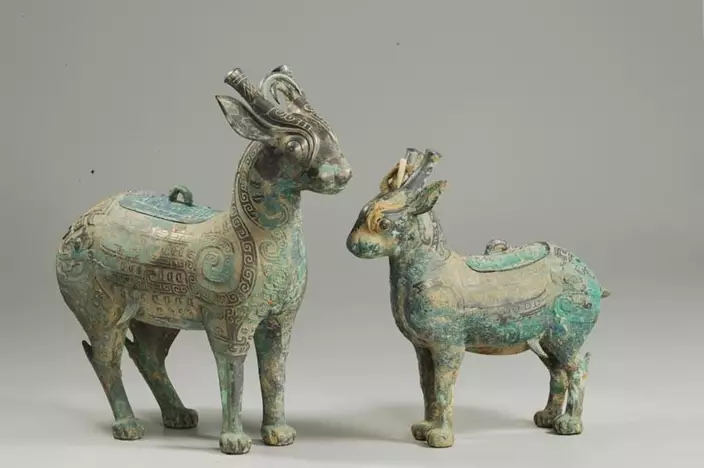
Bronze figurines of beasts were unearthed from the Shigushan Tomb dating from the Western Zhou Dynasty in Baoji, Shaanxi province. (File Photo)
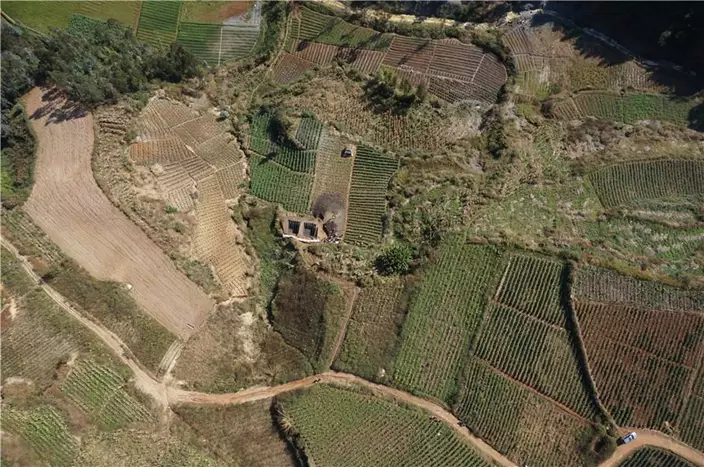
An aerial photo of the Gantangqing Paleolithic sites in Jiangchuan county, Southwest China's Yunnan province. (File Photo)
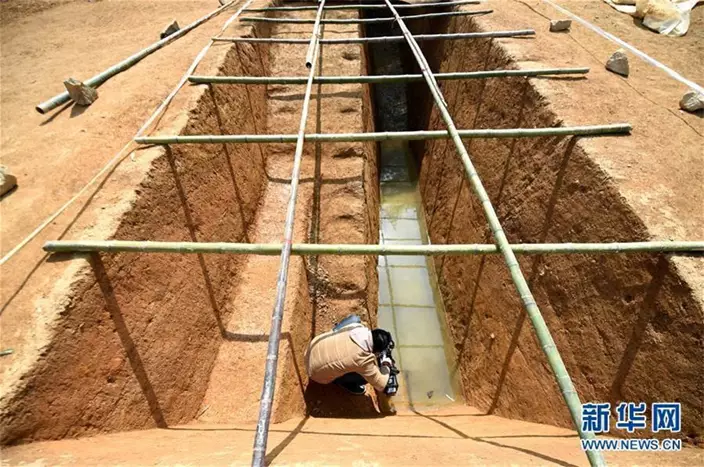
A photographer takes a picture of the archaeological excavation site in Pingyao township, Hangzhou city, Zhejiang province, March 15, 2016. Archeologists have excavated 11 dikes near the ancient city of Liangzhu that existed about 4,500 to 5,300 years ago in the Yuhang district of Hangzhou. (File Photo/Xinhua)
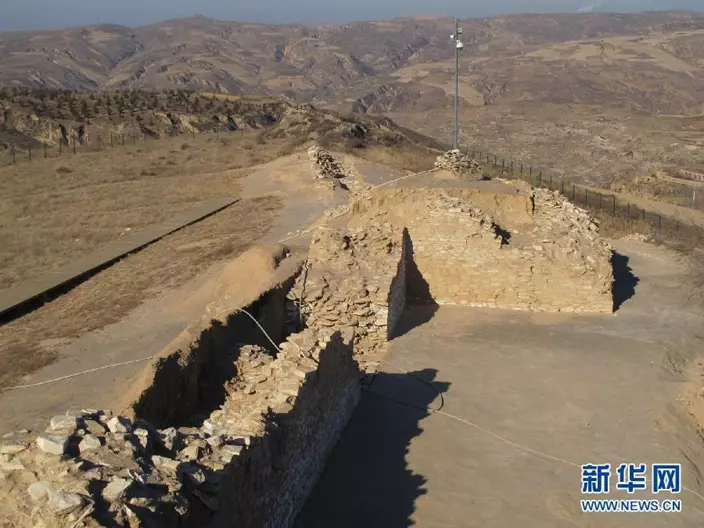
A section of ancient city wall is seen at the Shimao Ruins in Shenmu county, Shaanxi province. (File photo/Xinhua)
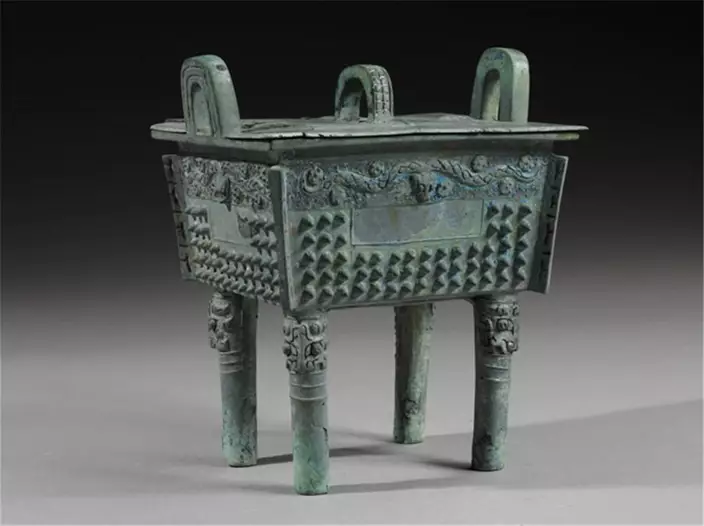
A bronze tripod is unearthed from the Yejiashan cemetery for the Dukes of Zeng State in Suizhou, Hubei province. (File photo/Chinese Archaeology)
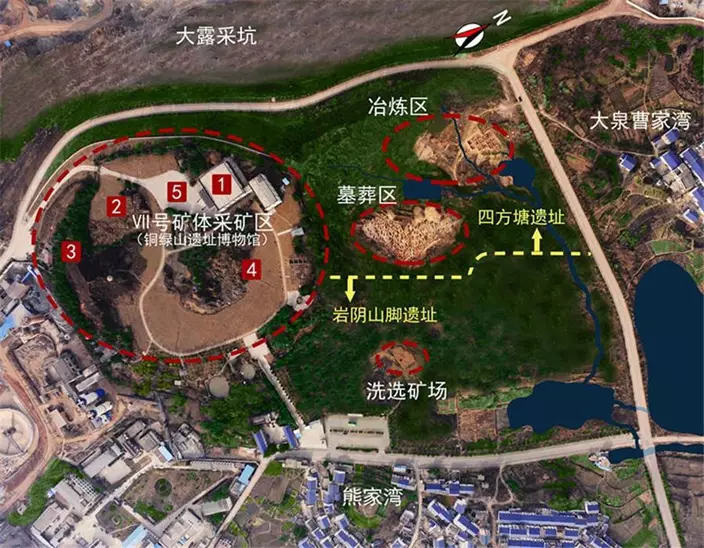
A file photo illustrates the Sifangtang site in Daye city, Central China's Hubei province. (File Photo)
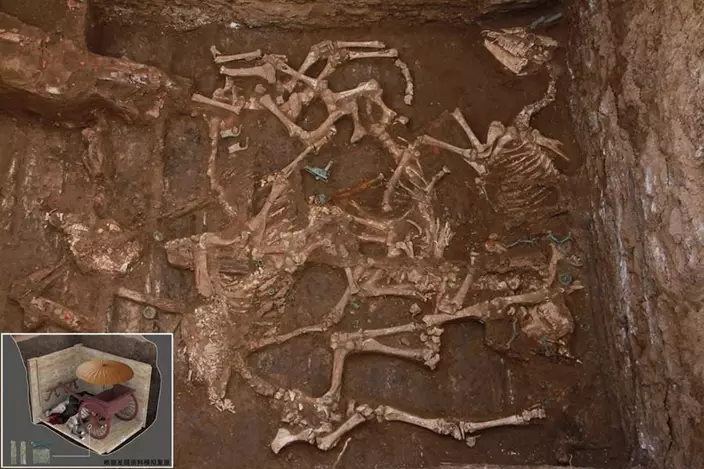
Horse remains in a Xuechi sacrificial ritual site, Fengxiang county, Shaanxi province, Qin (221 to 206 BC) to Han (206 BC to 220 AD) dynasties. (File photo)
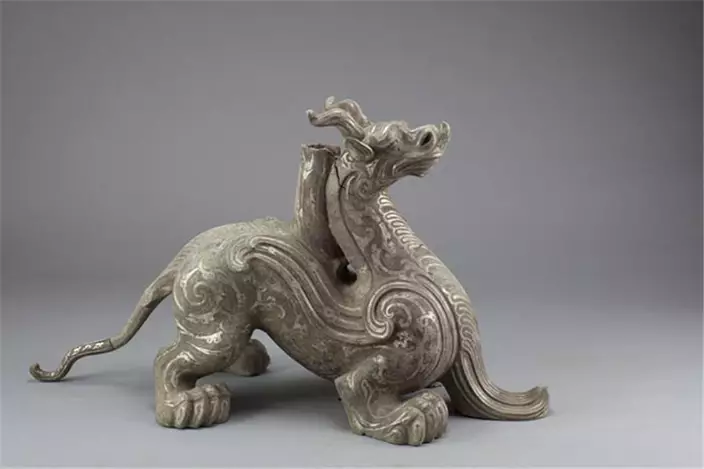
Bronze figurine of a beast is unearthed from the Western Han Jiangdu Imperial Mausoleum in Xuyi, Jiangsu province. (File photo)
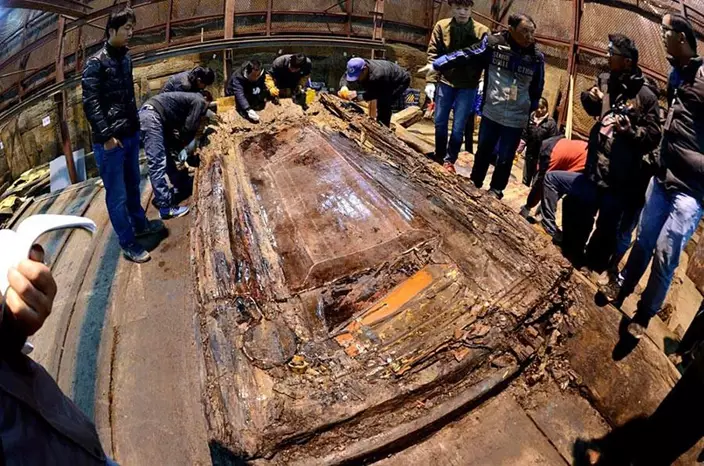
Archaeologists clear the upper layer of the main coffin of Marquis Haihun's tomb. (File photo by Guo Jing/China Daily)
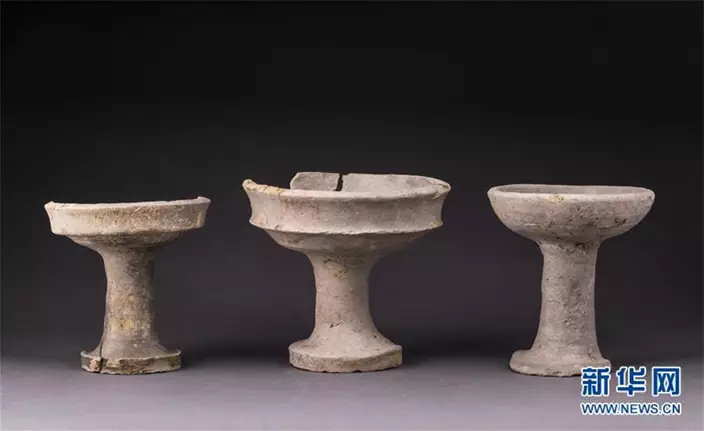
Pedastal food containers made of pottery were found at the Luxian ancient city site, Tongzhou district, Beijing, Han Dynasty. (File photo/Xinhua)
These major archaeological discoveries cover a rich variety of sites, ranging from the cemetery, kiln, Buddhist remains, sunken ships, granary sites and mining sites, and some of them are relatively rare archaeological findings. These discoveries provide crucial information and bring new perspective to academic research.
The following selection of China's major archaeological discoveries is listed according to chronological order from the Paleolithic era to the Qing Dynasty (1644-1911).
Bronze figurines of beasts were unearthed from the Shigushan Tomb dating from the Western Zhou Dynasty in Baoji, Shaanxi province. (File Photo)
Shigushan Tomb of the Western Zhou Dynasty (c.11th century-771 BC), Baoji, Shaanxi Province
A total of 230 sets of burial offerings were unearthed from 15 burials in the cemetery, including 92 bronze ritual vessels with inscriptions and clan symbols.
Some of the vessels with inscriptions are important for the establishment of a finer chronological framework of Western Zhou remains.
The discovery provides important clues to study Western Zhou burial practices, as well as its history, culture and ritual system.
The Shigushan Tomb of the Western Zhou Dynasty in Baoji of Northwest China's Shaanxi province was listed in China's top 10 archaeological discoveries in 2013.
An aerial photo of the Gantangqing Paleolithic sites in Jiangchuan county, Southwest China's Yunnan province. (File Photo)
Gantangqing Paleolithic sites in Yunnan Province
An Early Pleistocene site in Jiangchuan, Southwest China's Yunnan province, has given archaeologists insight into the lives of people in the region millions of years ago.
More than 28 bone artifacts and over 10 wooden artifacts were found at the site. These may be the world's earliest wooden artifacts, dating back to one million years ago.
A relic that used fire was also found at the site. Firewood was put toward the center, which was heavily carbonized near the center section.
Besides, there were carbon deposits accumulated in the center. Fossils of seeds and bones of animals provided evidence of the diet of prehistoric people and how they foraged.
The finds are of special value and meaning for research in terms of human living patterns, origins and development under the ancient environment background. Meanwhile, the discovery, excavation and research of this site provide new evidence for the theory of local origins of ancient human beings in East Asia.
Gantangqing Paleolithic sites in Yunnan province were listed among China's top 10 archaeological discoveries in 2015.
A photographer takes a picture of the archaeological excavation site in Pingyao township, Hangzhou city, Zhejiang province, March 15, 2016. Archeologists have excavated 11 dikes near the ancient city of Liangzhu that existed about 4,500 to 5,300 years ago in the Yuhang district of Hangzhou. (File Photo/Xinhua)
Liangzhu hydraulic project site in Hangzhou, Zhejiang Province
Researchers attribute the disappearance of the Neolithic Liangzhu culture, which dates back about 5,000 years in the Yangtze River delta, to environmental changes, such as floods.
However, the discovery of a hydraulic project at a site in Yuhang district, on the northern outskirts of Hangzhou, East China's Zhejiang province, shows that people at the time were adept at building city-states and protecting them from rising waters.
During excavation, the ruins of several large man-made mounds were found, which turned out to be dikes that formed three reservoirs.
The project, which is believed to be one of the earliest of its kind in China, comprises 11 dams that protected Liangzhu's ancient cities from summer floods. Also, they formed water reserves that served as transportation channels.
Liangzhu hydraulic project site in Hangzhou was listed among China's top 10 archaeological discoveries in 2015.
A section of ancient city wall is seen at the Shimao Ruins in Shenmu county, Shaanxi province. (File photo/Xinhua)
Shimao Ruins in Shenmu county, Shaanxi Province
Located in Shenmu County of Shaanxi province, the Shimao Ruins date from the late Longshan Period (about 2350 to 1950 BC) to the Xia Dynasty (c.21st century-16th century BC). The site was a huge stone city covering more than four square kilometers.
The Shimao Ruins consist of three parts, including an imperial town and inner and outer cities. The size of the ruins is much larger than similar ruins, such as the Liangzhu Ruins and Taosi Ruins. Many precious relics haven been unearthed, including a large number of carved jade and mural fragments.
The Neolithic Shimao Ruins are believed to be the biggest prehistoric city ruins found in China. The find has had a significant impact in changing historical studies about Chinese civilization.
Digging began in 2011, and archaeologists have made discoveries dating back over 4,000 years, redefining China's history of building city walls. Jade knives and other objects also have been unearthed.
About 70 to 80 skulls from young women have been found. It is believed they were killed and subsequently buried in a mass grave here.
The Shimao city ruins will go down in history as one of the definitive archaeological finds of the century thus far. Its significance cannot be underestimated, as it redefines previous studies on Chinese civilization.
Shimao Ruins in Shenmu county of Shaanxi province were listed among China's top 10 archaeological discoveries in 2012.
A bronze tripod is unearthed from the Yejiashan cemetery for the Dukes of Zeng State in Suizhou, Hubei province. (File photo/Chinese Archaeology)
Yejiashan cemetery for the Dukes of Zeng State in Suizhou, Hubei Province
Yejiashan cemetery for Dukes of Zeng State is in Jiangzhai village, Xihe town of Suizhou, Central China's Hubei Province.
Some 65 burials and one pit with sacrificial horses have been found at the site, together with 739 pieces (sets) of bronze, ceramic, porcelain, and lacquer relics, as well as wooden, jade and stone objects.
Scripts related to Marquis Zeng and Marquis Zeng Jian also were discovered on the bronzes unearthed from several tombs, indicating that the graveyard should be related to the Zeng State or Marquis Zeng during the early Western Zhou Dynasty (c. 11th century-771 BC).
The discovery is of great significance in several aspects. It was the first discovery of a high-level noble cemetery, like the Yejiashan cemetery, in Hubei's archaeological history during past 30 years.
The well-preserved artifacts unearthed are of great value to study the Western Zhou culture in the Han River reaches in Hubei.
The excavation may also become an important breakthrough for studying the Zeng State during the Western Zhou Dynasty.
Yejiashan cemetery for the Dukes of Zeng State in Suizhou of Hubei Province was listed as one of China's top 10 archaeological discoveries in 2012.
A file photo illustrates the Sifangtang site in Daye city, Central China's Hubei province. (File Photo)
Sifangtang site at Tonglushan, Hubei Province
Archaeologists discovered tombs at mining sites that could date back to as early as the Western Zhou Dynasty (1100-771 B.C.) and the Spring and Autumn Period (770 - 475 BC).
The excavation covers an area of 2,275 square meters and 135 tombs were discovered.
More than 170 pieces of bronze, pottery and jade relics were retrieved from these tombs in Daye city, Central China's Hubei province.
Archaeologists believe that some of the tomb occupants could have been managers of the mine, whose burial objects were weapons used to protect the site. Others, buried with malachite and iron ore, could be miners or technicians.
An examination of cinders found bronze content between 0.49 and 0.68 percent, suggesting a high level of skill in smelting.
A variety of people were buried in the cemetery regarding their social status and occupations. It is thus vital to cast light upon the labor resource and management of miners in ancient China during the Western Zhou Dynasty and the Spring and Autumn Period.
Sifangtang site at Tonglushan, Hubei province was listed as one of China's top 10 archaeological discoveries in 2015.
Horse remains in a Xuechi sacrificial ritual site, Fengxiang county, Shaanxi province, Qin (221 to 206 BC) to Han (206 BC to 220 AD) dynasties. (File photo)
Xuechi ritual site of the Qin and Han Dynasties in Fengxiang, Shaanxi Province
The Xuechi ritual site is the first archaeological discovery of the Si ritual complex recorded in ancient texts, which consists of an altar, surrounding wall, plaza, roads, pits and buildings. Actually, it is the earliest and largest “royal altar” from the Qin and Han dynasties.
The site was the formal venue for holding national sacrifices to heaven, led by the kings and the emperors from the Qin State to the Han Dynasty.
The site both proved the historical records that near the Yongcheng city there was a national ritual venue, and provided important material for the research of national ritual activities from the Eastern Zhou Period to the Han Dynasty.
The discovery is of great academic value for the ritual system and politics in the Qin and the Han Period, as well as Chinese ancient ritual culture among others.
Bronze figurine of a beast is unearthed from the Western Han Jiangdu Imperial Mausoleum in Xuyi, Jiangsu province. (File photo)
Western Han Jiangdu Imperial Mausoleum in Xuyi, Jiangsu Province
Liu Fei's mausoleum has been found in present-day Xuyi county, East China's Jiangsu province.
Threatened by quarrying, archaeologists from the Nanjing Museum performed a "rescue excavation" of the site from 2009 to 2011.
The mausoleum contains three main tombs, 11 attendant tombs, two chariot-and-horse pits, two weaponry pits and the remains of an enclosure wall that originally encompassed the complex.
Together, more than 10,000 sets of fine artifacts, such as exquisite items made of bronze, silver, gold, and jade, have been unearthed.
Later, evidence showed the deceased in tomb No.1 was Liu Fei, first king of Jiangdu State of the Western Han Dynasty.
The Western Han Jiangdu Imperial Mausoleum in Xuyi of Jiangsu province was listed as one of China's top 10 archaeological discoveries in 2011.
Archaeologists clear the upper layer of the main coffin of Marquis Haihun's tomb. (File photo by Guo Jing/China Daily)
Marquis Haihun's tomb in Nanchang, Jiangxi province
The 2,000-year-old tomb of Haihunhou turned out to be the most complete Western Han Dynasty (206 BC - 25 AD) cemetery ever found. The marquis's tomb near Nanchang, capital of East China's Jiangxi province, is one of the few imperial tombs that has not been looted. More than 10,000 artifacts have been unearthed so far.
A seal inside the coffin bore the characters for Liu He, confirming his identity and adding to the weight of evidence already provided by another seal, along with inscriptions on gold coins and bamboo slips.
The owner of the main tomb, Liu He, was the grandson of Emperor Wu. The emperor was the greatest ruler of the Han Dynasty, which was one of the most prosperous periods in China's history. Liu was given the title "Haihunhou" (Marquis of Haihun) after he was deposed as emperor after only 27 days, dethroned by the royal clan because of his lack of talent and morals. Haihun is the ancient name of a very small kingdom to the north of Jiangxi.
Marquis Haihun's tomb in Nanchang of East China's Jiangxi province was listed in China's top 10 archaeological discoveries in 2015.
Pedastal food containers made of pottery were found at the Luxian ancient city site, Tongzhou district, Beijing, Han Dynasty. (File photo/Xinhua)
Ancient Lu County of the Han Dynasty in Tongzhou, Beijing
In coordination with the construction of the sub-center, Beijing carried out an archaeological survey, reconnaissance and excavation, which led to the discovery of the ancient city remains of Lu in Beijing's Tongzhou district.
Archaeologists prospected an area of 1.22 million square meters (122 hectares), excavated over 40,000 square meters and discovered the site of the ancient Han Dynasty city of Lu and the surrounding tomb cluster.
Located at Gucheng village in Lucheng township of Tongzhou district, the site of the ancient city of Lu is square-like in shape with a total area of around 350,000 square meters.
Roads dating from the Ming, Qing, Liao, Jin and Han dynasties have been excavated in the northern part of the city, moat remains were discovered outside the city wall foundations and a large area containing Han Dynasty cultural remains were found outside the moat remains south of the city.
The ancient city of Lu mark the only Han Dynasty city remains discovered in Tongzhou. According to historical records, the city of Lu was the administrative center of Lu county in the Han Dynasty.
Altogether 1,146 tombs dating from the Warring States Period to the Ming and Qing dynasties were excavated within a radius of two kilometers, centering on the city remains, which provide important materials for a comprehensive study of the city of Lu.
The city remains of Lu have been relatively well preserved and filled the archaeological study gap of a county-level city of the Han Dynasty.
The structures and offerings of the burials provide valuable data for research on the development of this area overn a long time span.
Ancient Lu County of the Han Dynasty in Tongzhou of Beijing was listed among China's top 10 archaeological discoveries in 2016.