A top Emirati security official has said the only way for "Qatar's crisis" to end is if Doha gave up hosting the 2022 FIFA World Cup, his comments coming amid the ongoing diplomatic dispute between the energy-rich nation and four Arab countries.
Dubai security Lt. Gen. Dhahi Khalfan, known for being outspoken on Twitter, later wrote Monday his "personal analysis" of what he described as the financial pressure Doha faces in hosting the games had been misunderstood.
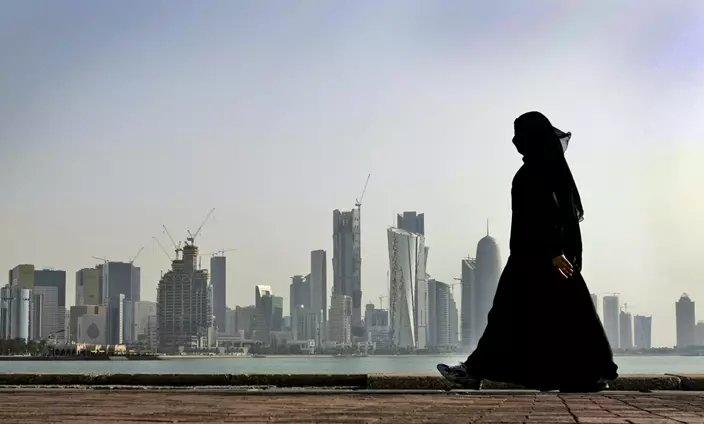
FILE- In this May 14, 2010 file photo, a Qatari woman walks in front of the city skyline in Doha, Qatar. The U.S. military says it has halted some military exercises with Gulf countries over the ongoing diplomatic dispute targeting Qatar. (AP Photo/Kamran Jebreili, File)
But his remarks came as lobbying firms backed by the four nations opposing Qatar in the diplomatic dispute increasingly target the upcoming soccer competition in their criticism.
The tournament has not come up in the demands previously made by the boycotting countries, though losing the World Cup would represent a bitter defeat for the tiny peninsular nation that's pushed itself onto the world stage with its bid and its Al-Jazeera satellite news network.
Qatari officials did not respond to requests for comment on Monday. However, the 2022 tournament's head in Qatar told The Associated Press on Friday the boycott poses "no risk" to the competition being held.
Bahrain, Egypt, Saudi Arabia and the United Arab Emirates all cut diplomatic ties and began a boycott of Qatar on June 5 , in part over allegations that Doha supports extremists and has overly warm ties to Iran.
Qatar has long denied funding extremists and restored full diplomatic ties to Iran amid the dispute. Doha shares a massive offshore natural gas field with Iran that makes its citizens incredibly wealthy.
On Sunday night, Khalfan targeted the FIFA tournament in his tweets.
"If the World Cup leaves Qatar, Qatar's crisis will be over ... because the crisis is created to get away from it," he wrote.
He added: "The cost is bigger than what the Hamadein have planned," likely referring to Qatar's former ruling emir Sheikh Hamad bin Khalifa Al Thani and former Foreign Minister Hamad bin Jassim Al Thani. Some believe both still wield influence within Qatar's current government now ruled by the former emir's son, Sheikh Tamim bin Hamad Al Thani.
Khalfan, who previously has written controversy-catching tweets about Israel and U.S. President Donald Trump, also wrote that Qatar "is no longer our concern," suggesting media in the boycotting countries dial back their coverage of the dispute.
By Monday night, Khalfan returned to Twitter to write that his tweets were his "personal analysis."
"I said Qatar is faking a crisis and claims it's besieged so it could get away from the burdens of building expensive sports facilities for the World Cup," he tweeted.
"That's why Qatar isn't ready and can't host the next World Cup," he added.
As the crisis has dragged on despite mediation by Kuwait, the United States and European nations, Qatar's opponents have begun targeting its hosting of the FIFA cup. They've pointed to allegations of corruption surrounding Qatar's winning bid, as well as the conditions that laborers working in Qatar face in building infrastructure for the games.
While FIFA ethics investigators found that the Qataris used a full range of lavishly funded state and sports agencies to win the 2010 vote to host the tournament, authorities concluded there was no "evidence of any improper activity by the bid team."
When Qatar's sole land border with Saudi Arabia was closed and sea traffic cut off by the boycott, World Cup organizers were forced to instigate a "Plan B," including bringing in supplies from Turkey.
Asked about Khalfan's comments, FIFA said Monday: "We do not comment on speculation."
Hassan al-Thawadi, Qatar World Cup supreme committee secretary-general, told the AP on Friday that the project remained on time despite that.
"We are aiming to make sure that this World Cup leaves a legacy for the people of the Middle East (and) is an opportunity to transform our region towards a sustainable and stable future," he said.
DUBAI, United Arab Emirates (AP) — Satellite images are beginning to be released giving a glimpse into the toll of the Iran war, with ships ablaze in an Iranian port and destroyed buildings at an American base.
Information has so far been scarce about the damage being done across the Middle East, particularly when it’s inside closed military facilities, since the start of the war on Feb. 28.
The images come from Planet Labs PBC, a San Francisco-based firm used by media outlets, including The Associated Press. Planet Labs has put a two-week delay on its imagery becoming public citing concerns its imagery could be used by “adversarial actors.”
High-resolution images also have been published by competing firms. Other providers, like the U.S. Geological Survey, have been publishing lower-resolution imagery as well that’s been useful.
The U.S. and Israel have been striking a wide variety of targets, including leadership figures, military bases, missile and air defense sites and positions of the paramilitary Revolutionary Guard and its volunteer force, the Basij. Iran has responded with drone and missile fire targeting Israel and nearby Gulf Arab nations.
Here’s a look at what’s visible in a selection of Planet Labs’ pictures, as well as others.
Some of the most dramatic images from Planet Labs so far have been in Bandar Abbas, home to a major Iranian military port next to the crucial Strait of Hormuz connecting the Persian Gulf to the Arabian Sea.
Images taken on March 2 show ships ablaze at the port. The U.S. military’s Central Command has been targeting Iran’s naval assets and says it has sank or damaged more than 100 Iranian vessels so far in the war.
The island kingdom of Bahrain, home of the U.S. Navy’s 5th Fleet, has seen heavy Iranian fire targeting both military bases and oil installations. A March 1 image shot by Planet Labs shows a major building at the base destroyed, as well as two radomes — geodesic domes covering radar antennas — likely by Iranian missile and drone fire.
The Navy has not offered a clear breakdown in the damage done so far at the base, but Iran has repeatedly claimed to have attacked it. Online videos have also shown incoming fire targeting the base. During the 12-day war in June, Iran attacked and destroyed a similar radome at Al Udeid Air Base in Qatar used for secure communications.
Satellite images, taken March 15 by an Airbus Defence and Space Pléiades Neo satellite and analyzed by The Associated Press, show damage at Abu Dhabi’s Al Dhafra Air Base. Damage can be seen at one set of hangars to the northwest of the facility. Another hangar to the southeast of the facility appears shredded by fire, with an adjacent hangar sustaining roof damage. It’s unclear what was in the hangars.
Al Dhafra typically hosts some 2,000 American troops and has served as a major base of operations for everything from armed drones to F-35 stealth fighters in recent years. The U.S. military for years only vaguely referred to Al Dhafra as a base in “southwest Asia” before the UAE became more willing to acknowledge the American presence there.
In Abu Dhabi, the capital of the United Arab Emirates, there’s damage seen at France's Camp de la Paix naval base. Satellite images from March 3 show damage to two large hangar-like buildings at the facility. The base is near Zayed Port, in Abu Dhabi, and close to its Cultural District that includes the Louvre Abu Dhabi and other major museums both open and still under construction.
The U.S. Geological Survey’s Landsat satellites also have been key in spotting major fires. Imagery from Landsat taken on Monday showed a fire at Dubai International Airport after an Iranian drone strike set a fuel tanker ablaze at the world’s busiest airport for international travel, causing a plume of noxious black smoke.
Another fire was also seen on Monday at Oman's southern port in Salalah, which came under attack from suspected Iranian drones on March 11, though Tehran has denied it launched them in its campaign targeting Gulf Arab states. The fire apparently has been burning since then.

This satellite image taken by a U.S. Geological Survey Landsat satellite shows the fire after an Iranian drone attack targeting the Dubai International Airport in Dubai, United Arab Emirates, Monday, March 16, 2026. (U.S. Geological Survey via AP)

This satellite image taken by a U.S. Geological Survey Landsat satellite shows a fire days after a suspected Iranian attack targeting the port in Salalah, Oman, Monday, March 16, 2026. (U.S. Geological Survey via AP)