A spacewalking astronaut successfully replaced a blurry camera outside the International Space Station on Friday, but had to contend with a balky jetpack and a frayed safety tether.
Both jetpacks and safety ties are crucial for saving a flyaway astronaut.
NASA said Joe Acaba was always securely attached to the orbiting outpost and never in any danger during the nearly seven-hour spacewalk.
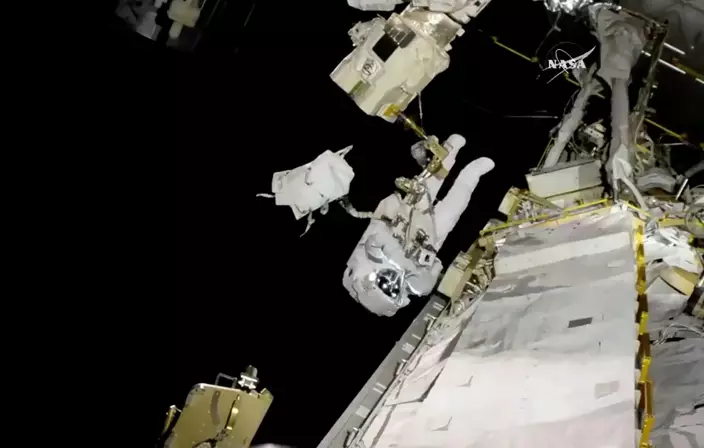
In this image from video made available by NASA, astronaut Joe Acaba performs a spacewalk outside the International Space Station on Friday, Oct. 20, 2017. The 250-mile-high complex is currently home to three Americans, two Russians and one Italian. (NASA via AP)
But one of his tethers had to be replaced shortly after he and station commander Randy Bresnik floated outside. Mission Control noticed the red lifeline was frayed and worn. Bresnik went back to the air lock to get Acaba a spare.
Then five hours into the spacewalk, Mission Control saw that the right handle on Acaba's emergency jetpack was popped open — again. Bresnik once more went to his crewmate's assistance, even offering some tape to keep it down.
After consulting for several minutes in Houston, flight controllers declared the jetpack unreliable and ordered Acaba back inside, once he was done greasing the new robot arm on the space station's big robot arm. He finished the lube job, then headed in.
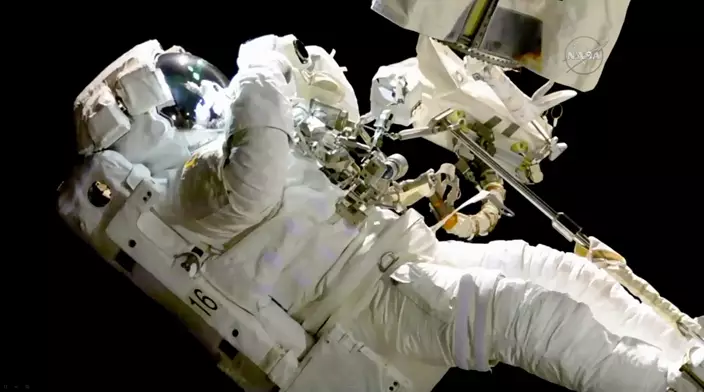
In this image from video made available by NASA, astronaut Joe Acaba performs a spacewalk outside the International Space Station on Friday, Oct. 20, 2017. Acaba was barely outside an hour when he had to replace one of his safety tethers. Spacewalking astronauts always have more than one of these crucial lifelines in case one breaks. They also wear a jetpack in case all tethers fail and they need to fly back to the space station. (NASA via AP)
Bresnik acknowledged things didn't go as planned, "with all the stuff that happened today and the challenges we had." But he thanked everyone for their hard work and diligence.
In the end, only a couple minor chores were left undone.
"Great work today," Mission Control radioed as the spacewalk came to a close.
It was the third spacewalk in two weeks for U.S. astronauts. Bresnik went out on all three; he was accompanied by Mark Vande Hei to install the new robotic hand on Oct. 5 and lubricate it on Oct. 10.
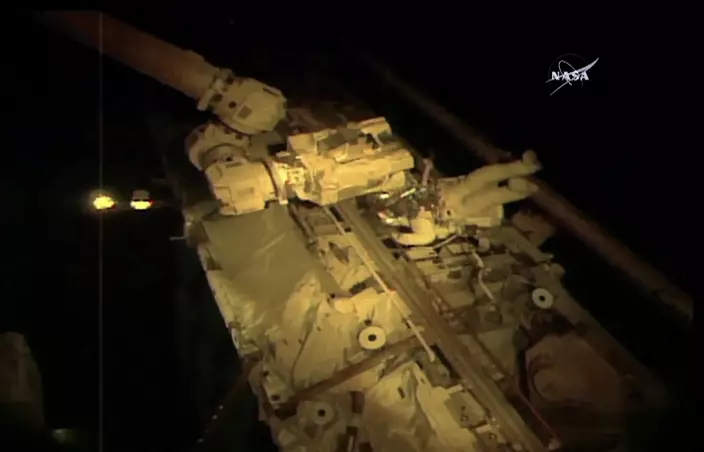
This still image provided by NASA shows astronaut Joe Acaba during a spacewalk at the International Space Station on Friday, Oct. 20, 2017. Commander Randy Bresnik floated accompanied by Acaba, teacher-turned-astronaut . Their main job is to replace a blurry camera on the new robotic hand that was installed by spacewalkers two weeks ago. (NASA via AP)
Each spacewalker wears a jetpack for use in an emergency. It's available in case an astronaut's multiple tethers fail and allows the spacewalker to fly back to the station. It's been tested by orbiting astronauts — years ago — but never called into urgent action.
Earlier, Acaba provided necessary focus to the space station's robot arm.
He unbolted a blurry camera from the new robotic hand installed two weeks ago. He then popped in a spare, which flight controllers quickly tested from Houston. The replacement provided crisp, clear views.
Sharp focus is essential when the space station's robot hand grabs an arriving supply ship and anchors it. The next delivery is a few weeks away, prompting the quick camera swap-out.
Orbital ATK, one of NASA's commercial shippers, plans to launch a cargo ship from Virginia on Nov. 11.
Acaba and the station's commander, Randy Bresnik, were supposed to go spacewalking earlier this week. But NASA needed extra time to add the camera repair to their chores.
Friday's spacewalk — expected to be the last one for the year — also saw the astronauts installing a high-definition camera, replacing a fuse and removing thermal insulation from spare electronics. Early next year, astronauts will replace the hand on the opposite side of the 58-foot robot arm, Canada's main contribution to the space station. The original latching mechanisms are showing wear and tear since the arm's launch in 2001.
The 250-mile-high complex is currently home to three Americans, two Russians and one Italian.
A one-time high school and middle school teacher, Acaba is the first astronaut of Puerto Rican heritage; his parents were born there. He ventured out on Friday's spacewalk as the station soared above the hurricane-ravaged island, where much of his extended family lives.
"There's a whole line of people looking up and smiling today as you get ready to head out the door," Bresnik told him.
WASHINGTON (AP) — President Donald Trump said Wednesday that the United States has seized an oil tanker off the coast of Venezuela as tensions mount with the government of President Nicolás Maduro.
Using U.S. forces to take control of a merchant ship is incredibly unusual and marks the Trump administration’s latest push to increase pressure on Maduro, who has been charged with narcoterrorism in the United States. The U.S. has built up the largest military presence in the region in decades and launched a series of deadly strikes on alleged drug-smuggling boats in the Caribbean Sea and eastern Pacific Ocean. The campaign is facing growing scrutiny from Congress.
“We’ve just seized a tanker on the coast of Venezuela, a large tanker, very large, largest one ever seized, actually,” Trump told reporters at the White House, later adding that "it was seized for a very good reason.”
Trump did not offer additional details. When asked what would happen to the oil aboard the tanker, Trump said, “Well, we keep it, I guess.”
The seizure was led by the U.S. Coast Guard and supported by the Navy, according to a U.S. official who was not authorized to comment publicly and spoke on the condition of anonymity. The official added that it was conducted under U.S. law enforcement authority.
The Coast Guard members were taken to the oil tanker by helicopter from the aircraft carrier USS Gerald R. Ford, the official said. The Ford is in the Caribbean Sea after arriving last month in a major show of force, joining a fleet of other warships.
Video posted to social media by Attorney General Pam Bondi shows people fast-roping from one of the helicopters involved in the operation as it hovers just feet from the deck.
The Coast Guard members can be seen later in the video moving throughout the superstructure of the ship with their weapons drawn.
Bondi wrote that “for multiple years, the oil tanker has been sanctioned by the United States due to its involvement in an illicit oil shipping network supporting foreign terrorist organizations.”
Venezuela’s government said in a statement that the seizure “constitutes a blatant theft and an act of international piracy.”
“Under these circumstances, the true reasons for the prolonged aggression against Venezuela have finally been revealed. … It has always been about our natural resources, our oil, our energy, the resources that belong exclusively to the Venezuelan people,” the statement said.
The U.S. official identified the seized tanker as the Skipper.
The ship departed Venezuela around Dec. 2 with about 2 million barrels of heavy crude, roughly half of it belonging to a Cuban state-run oil importer, according to documents from the state-owned company Petróleos de Venezuela S.A., commonly known as PDVSA, that were provided on the condition of anonymity because the person did not have permission to share them.
The Skipper was previously known as the M/T Adisa, according to ship tracking data. The Adisa was sanctioned by the U.S. in 2022 over accusations of belonging to a sophisticated network of shadow tankers that smuggled crude oil on behalf of Iran’s Revolutionary Guard and Lebanon's Hezbollah militant group.
The network was reportedly run by a Switzerland-based Ukrainian oil trader, the U.S. Treasury Department said at the time.
Venezuela has the world’s largest proven oil reserves and produces about 1 million barrels a day.
PDVSA is the backbone of the country’s economy. Its reliance on intermediaries increased in 2020, when the first Trump administration expanded its maximum-pressure campaign on Venezuela with sanctions that threaten to lock out of the U.S. economy any individual or company that does business with Maduro’s government. Longtime allies Russia and Iran, both also sanctioned, have helped Venezuela skirt restrictions.
The transactions usually involve a complex network of shadowy intermediaries. Many are shell companies, registered in jurisdictions known for secrecy. The buyers deploy so-called ghost tankers that hide their location and hand off their valuable cargoes in the middle of the ocean before they reach their final destination.
Maduro did not address the seizure during a speech before a ruling-party organized demonstration in Caracas, Venezuela’s capital. But he told supporters that the country is “prepared to break the teeth of the North American empire if necessary.”
Maduro has insisted the real purpose of the U.S. military operations is to force him from office.
Sen. Chris Van Hollen, D-Md., a member of the Senate Foreign Relations Committee, said the U.S. seizing the oil tanker cast doubt on the administration’s stated reasons for the military buildup and boat strikes.
“This shows that their whole cover story — that this is about interdicting drugs — is a big lie,” the senator said. “This is just one more piece of evidence that this is really about regime change — by force.”
Vincent P. O’Hara, a naval historian and author of “The Greatest Naval War Ever Fought,” called the seizure “very unusual” and "provocative." Noting that the action will probably deter other ships from the Venezuela coastline, he said, "If you have no maritime traffic or access to that, then you have no economy.”
The seizure comes a day after the U.S. military flew a pair of fighter jets over the Gulf of Venezuela in what appeared to be the closest that warplanes had come to the South American country’s airspace. Trump has said land attacks are coming soon but has not offered more details.
The Trump administration is facing increasing scrutiny from lawmakers over the boat strike campaign, which has killed at least 87 people in 22 known strikes since early September, including a follow-up strike that killed two survivors clinging to the wreckage of a boat after the first hit.
Some legal experts and Democrats say that action may have violated the laws governing the use of deadly military force.
Lawmakers are demanding to get unedited video from the strikes, but Defense Secretary Pete Hegseth told congressional leaders at a classified briefing Tuesday that he was still weighing whether to release it.
The Coast Guard referred a request for comment about the tanker seizure to the White House.
Goodman reported from Miami, and Garcia Cano from Caracas, Venezuela. Associated Press writers Lisa Mascaro and Alanna Durkin Richer in Washington, Rebecca Boone in Boise, Idaho, and Susan Haigh in Hartford, Connecticut, contributed to this report.
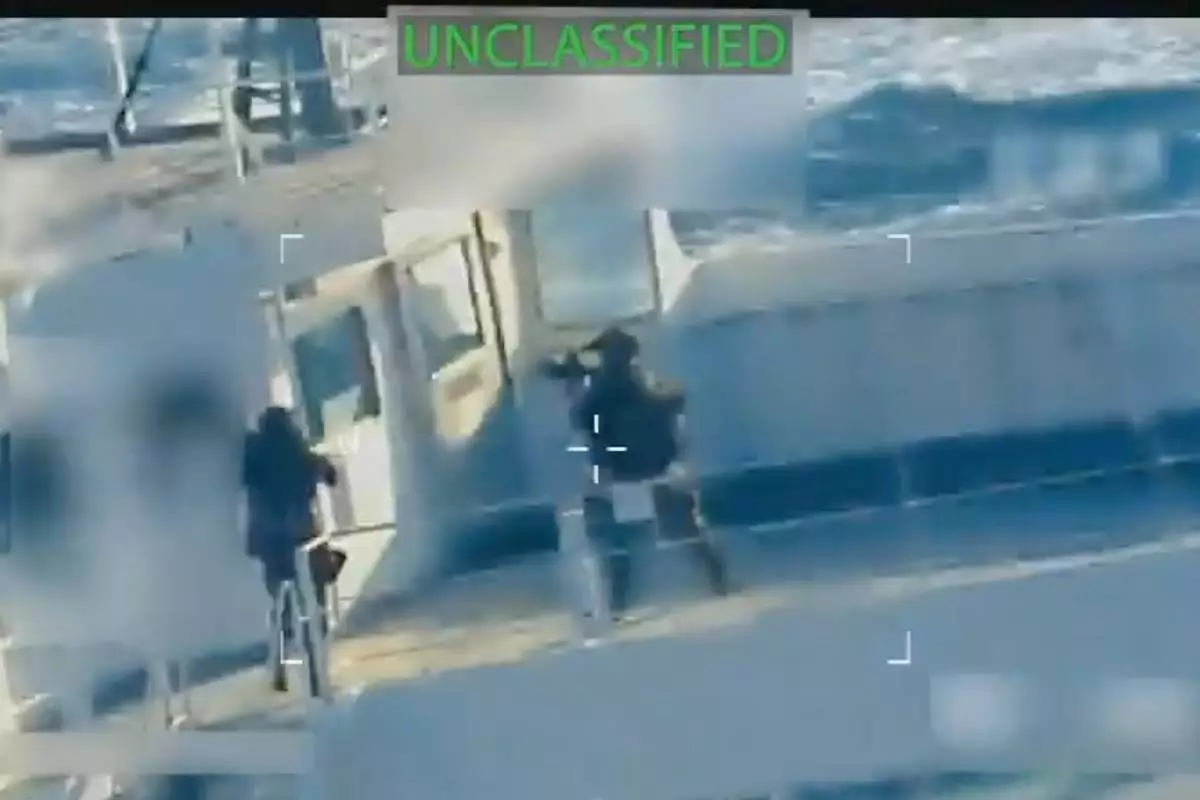
This image from video posted on Attorney General Pam Bondi's X account, and partially redacted by the source, shows an oil tanker being seized by U.S. forces off the coast of Venezuela, Wednesday, Dec. 10, 2025. (U.S. Attorney General's Office/X via AP)
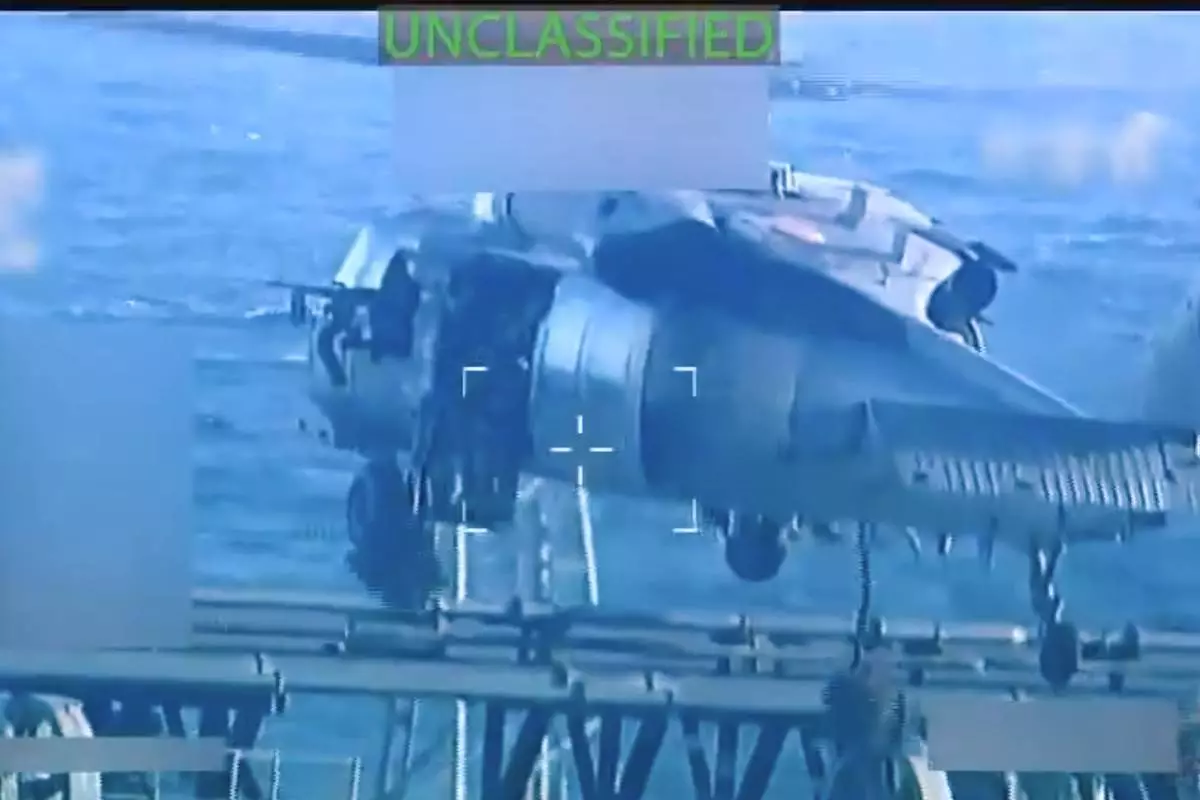
This image from video posted on Attorney General Pam Bondi's X account, and partially redacted by the source, shows an oil tanker being seized by U.S. forces off the coast of Venezuela, Wednesday, Dec. 10, 2025. (U.S. Attorney General's Office/X via AP)
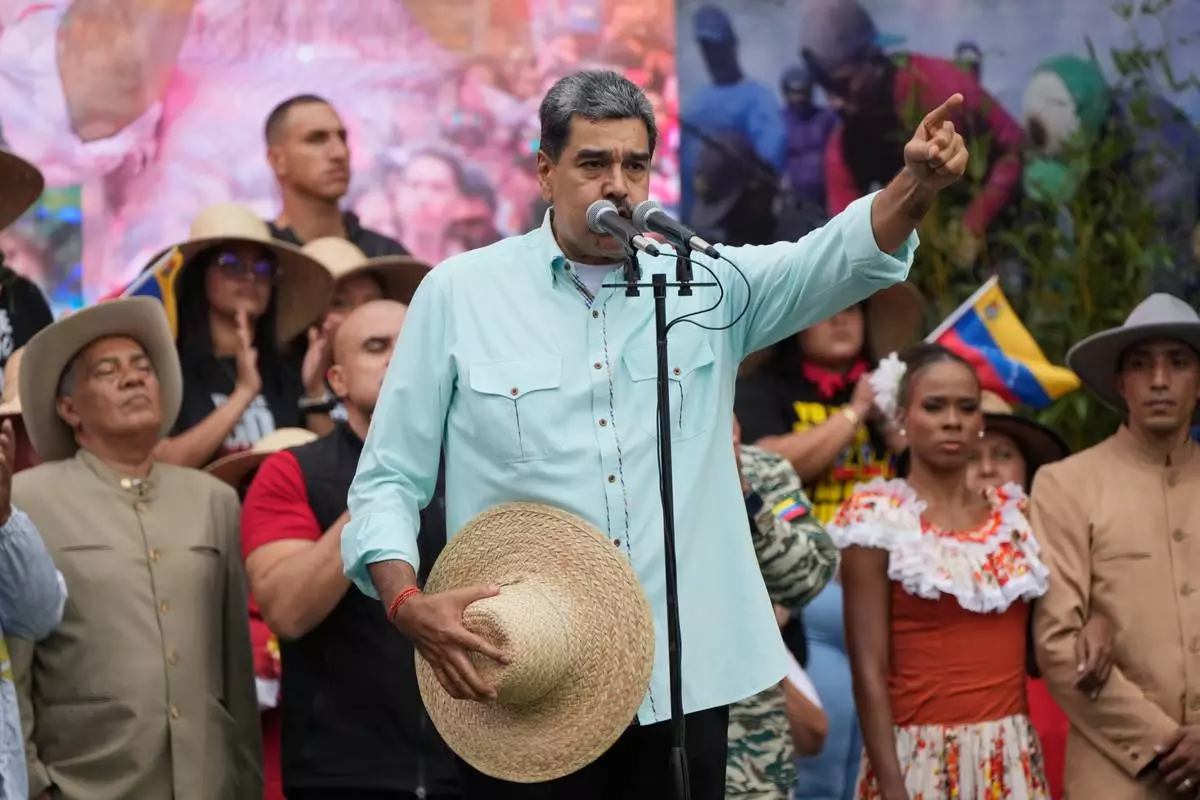
Nicolas Maduro speaks at a rally marking the anniversary of the Battle of Santa Isabel, which took place during Venezuela's 19th-century Federal War, in Caracas, Venezuela, Wednesday, Dec. 10, 2025. (AP Photo/Ariana Cubillos)
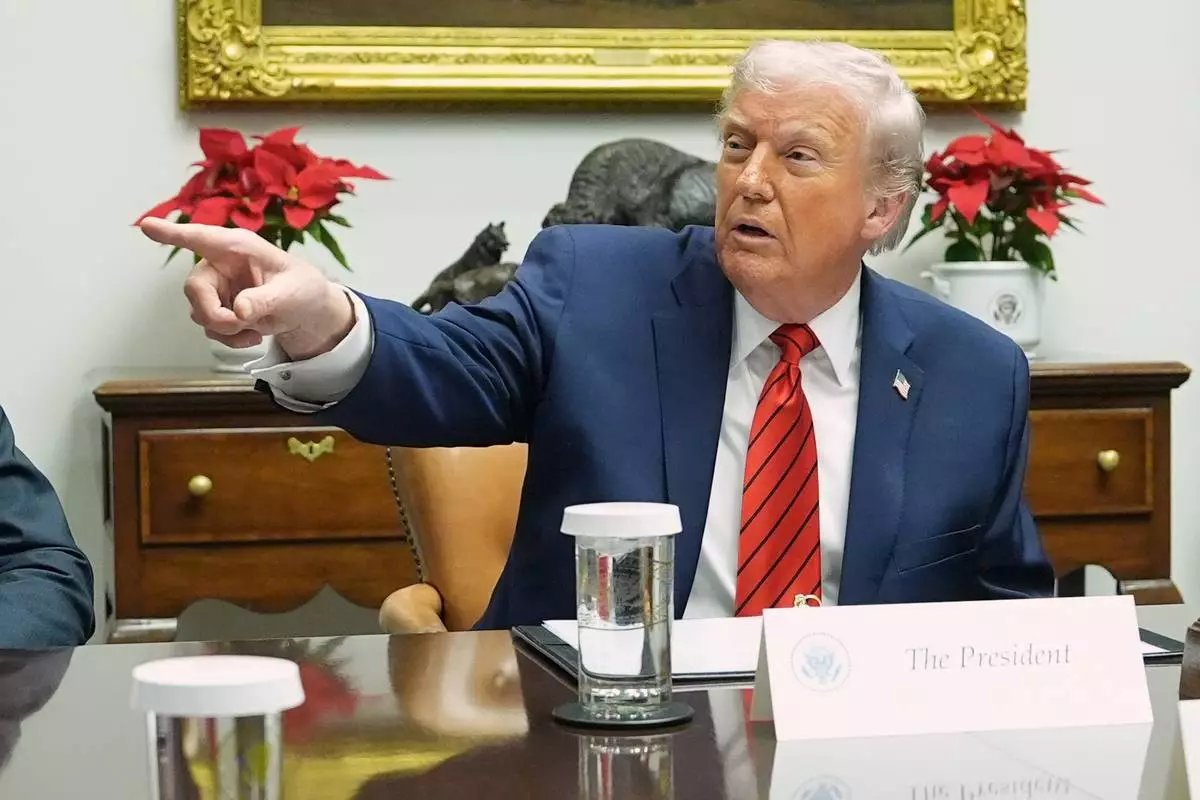
President Donald Trump speaks during a roundtable in the Roosevelt Room of the White House, Wednesday, Dec. 10, 2025, in Washington. (AP Photo/Evan Vucci)