
Skip to Content Facebook Feature Image

Trump to push China on trade, North Korea during 2-day visit

News

Trump to push China on trade, North Korea during 2-day visit
News

News

Trump to push China on trade, North Korea during 2-day visit

2017-11-08 19:32 Last Updated At:19:32

President Donald Trump will push China on trade and North Korea during a two-day visit in which he will cajole, flatter and scold the rising Asian power.
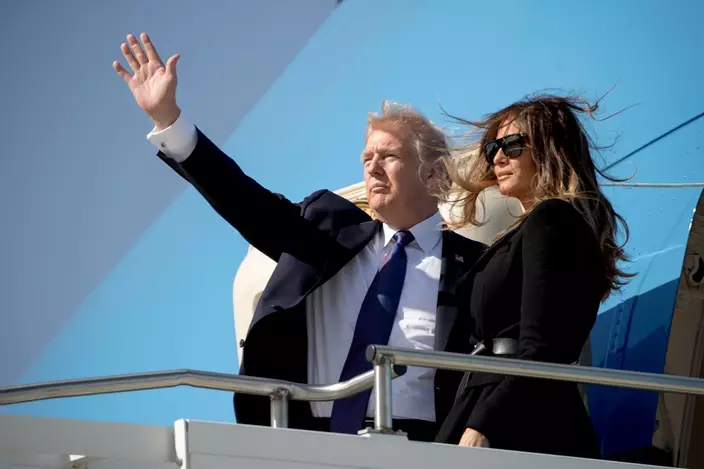
U.S. President Donald Trump and first lady Melania Trump board Air Force One at Osan Air Base in Pyeongtaek, South Korea, Wednesday, Nov. 8, 2017, to travel to Beijing. Trump is on a five-country trip through Asia traveling to Japan, South Korea, China, Vietnam and the Philippines. (AP Photo/Andrew Harnik)
U.S. President Donald Trump and first lady Melania Trump board Air Force One at Osan Air Base in Pyeongtaek, South Korea, Wednesday, Nov. 8, 2017, to travel to Beijing. Trump is on a five-country trip through Asia traveling to Japan, South Korea, China, Vietnam and the Philippines. (AP Photo/Andrew Harnik)

White House aides view Trump's visit as the centerpiece of his lengthy Asia tour. Trump, who is mired in consistently low approval ratings at home, will encounter newly emboldened Chinese President Xi Jinping, who recently consolidated power in his country, while Trump's every utterance will be studied by allies anxious to see if his inward-looking "America First" mantra could cede power in the region to China.

More Images
U.S. President Donald Trump and first lady Melania Trump board Air Force One at Osan Air Base in Pyeongtaek, South Korea, Wednesday, Nov. 8, 2017, to travel to Beijing. Trump is on a five-country trip through Asia traveling to Japan, South Korea, China, Vietnam and the Philippines. (AP Photo/Andrew Harnik)

U.S. President Donald Trump and first lady Melania Trump board Air Force One at Osan Air Base in Pyeongtaek, South Korea, Wednesday, Nov. 8, 2017, to travel to Beijing. Trump is on a five-country trip through Asia traveling to Japan, South Korea, China, Vietnam and the Philippines. (AP Photo/Andrew Harnik)

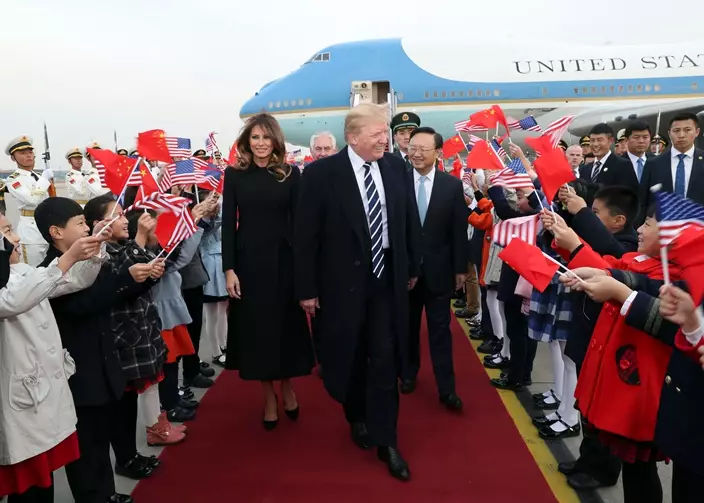
In this photo released by Xinhua News Agency, children wave U.S. and Chinese flags as U.S. President Donald Trump and first lady Melania Trump arrive at Beijing Airport, Wednesday, Nov. 8, 2017, in Beijing. Trump is on a five-country trip through Asia traveling to Japan, South Korea, China, Vietnam and the Philippines. (Pang Xinglei/Xinhua via AP)
In this photo released by Xinhua News Agency, children wave U.S. and Chinese flags as U.S. President Donald Trump and first lady Melania Trump arrive at Beijing Airport, Wednesday, Nov. 8, 2017, in Beijing. Trump is on a five-country trip through Asia traveling to Japan, South Korea, China, Vietnam and the Philippines. (Pang Xinglei/Xinhua via AP)

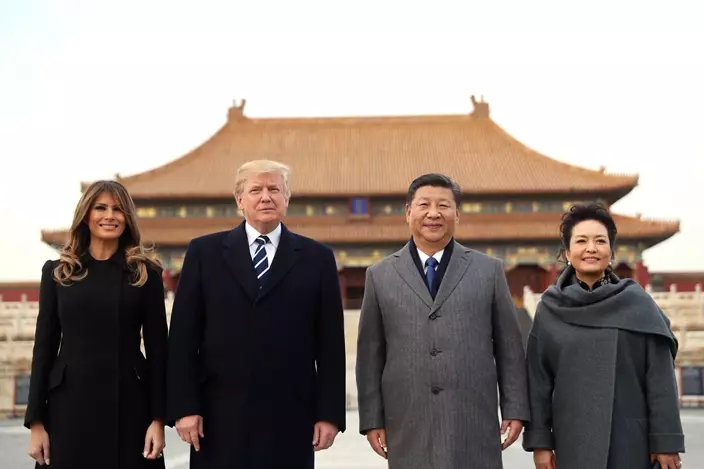
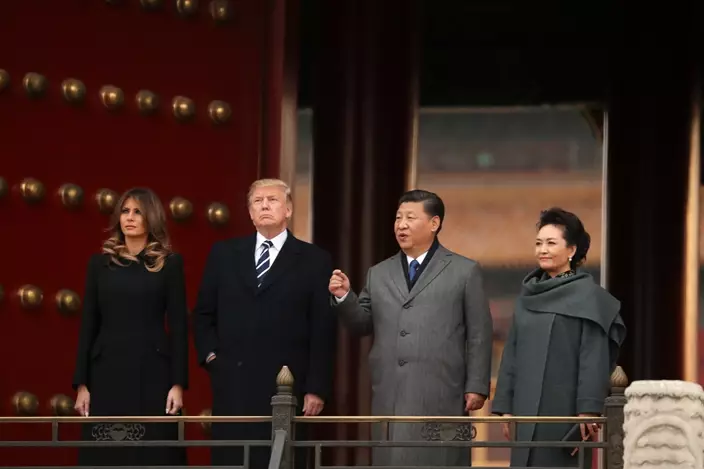
President Donald Trump, second left, first lady Melania Trump, left, Chinese President Xi Jinping, second right, and his wife Peng Liyuan, right, stand together as they tour the Forbidden City, Wednesday, Nov. 8, 2017, in Beijing, China. Trump is on a five country trip through Asia traveling to Japan, South Korea, China, Vietnam and the Philippines. (AP Photo/Andrew Harnik)
President Donald Trump, second left, first lady Melania Trump, left, Chinese President Xi Jinping, second right, and his wife Peng Liyuan, right, stand together as they tour the Forbidden City, Wednesday, Nov. 8, 2017, in Beijing, China. Trump is on a five country trip through Asia traveling to Japan, South Korea, China, Vietnam and the Philippines. (AP Photo/Andrew Harnik)

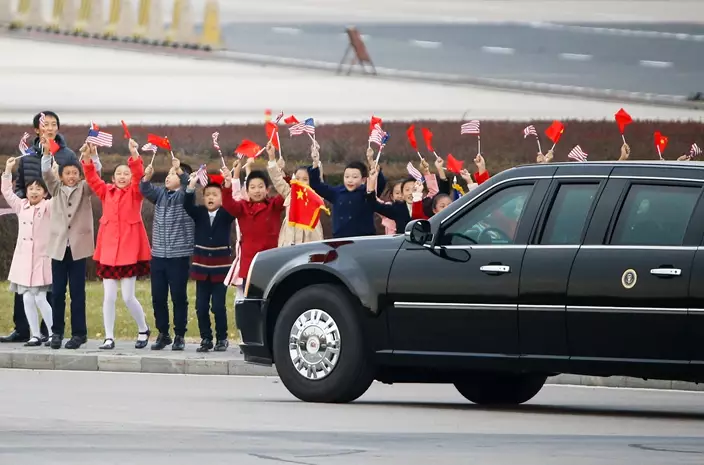
Children wave to the car carrying U.S. President Donald Trump and first lady Melania Trump after arriving in Beijing, China, Wednesday, Nov. 8, 2017. (Thomas Peter/Pool Photo via AP)
Children wave to the car carrying U.S. President Donald Trump and first lady Melania Trump after arriving in Beijing, China, Wednesday, Nov. 8, 2017. (Thomas Peter/Pool Photo via AP)

U.S. President Donald Trump, first lady Melania Trump, Chinese President Xi Jinping and his wife Peng Liyuan, right, stand together as they tour the Forbidden City, Wednesday, Nov. 8, 2017, in Beijing, China. Trump is on a five-country trip through Asia traveling to Japan, South Korea, China, Vietnam and the Philippines. (AP Photo/Andrew Harnik)
U.S. President Donald Trump, first lady Melania Trump, Chinese President Xi Jinping and his wife Peng Liyuan, right, stand together as they tour the Forbidden City, Wednesday, Nov. 8, 2017, in Beijing, China. Trump is on a five-country trip through Asia traveling to Japan, South Korea, China, Vietnam and the Philippines. (AP Photo/Andrew Harnik)

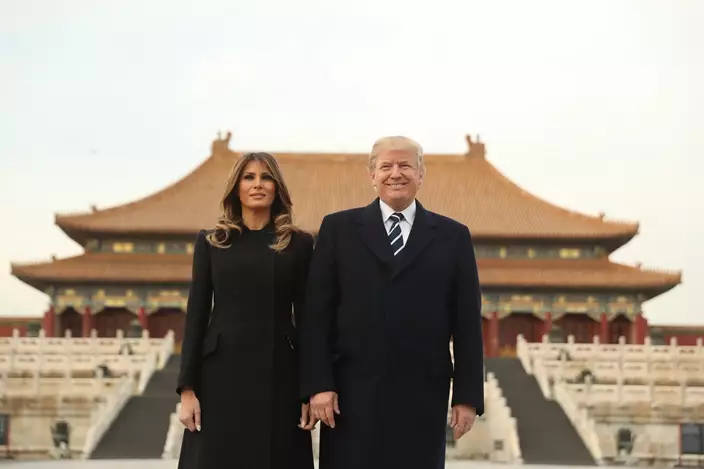
U.S. President Donald Trump and first lady Melania Trump pose during a tour of the forbidden city, Wednesday, Nov. 8, 2017, in Beijing, China. Trump is on a five country trip through Asia traveling to Japan, South Korea, China, Vietnam and the Philippines. (AP Photo/Andrew Harnik)

U.S. President Donald Trump and first lady Melania Trump pose during a tour of the forbidden city, Wednesday, Nov. 8, 2017, in Beijing, China. Trump is on a five country trip through Asia traveling to Japan, South Korea, China, Vietnam and the Philippines. (AP Photo/Andrew Harnik)

In this photo released by Xinhua News Agency, children wave U.S. and Chinese flags as U.S. President Donald Trump and first lady Melania Trump arrive at Beijing Airport, Wednesday, Nov. 8, 2017, in Beijing. Trump is on a five-country trip through Asia traveling to Japan, South Korea, China, Vietnam and the Philippines. (Pang Xinglei/Xinhua via AP)

In this photo released by Xinhua News Agency, children wave U.S. and Chinese flags as U.S. President Donald Trump and first lady Melania Trump arrive at Beijing Airport, Wednesday, Nov. 8, 2017, in Beijing. Trump is on a five-country trip through Asia traveling to Japan, South Korea, China, Vietnam and the Philippines. (Pang Xinglei/Xinhua via AP)

Before arriving in Beijing on Wednesday, Trump used an address to the National Assembly in Seoul, South Korea, to deliver a stern message to China, North Korea's biggest trade partner. Trump urged "responsible nations" to unite and stop supporting North Korea.

President Donald Trump, second left, first lady Melania Trump, left, Chinese President Xi Jinping, second right, and his wife Peng Liyuan, right, stand together as they tour the Forbidden City, Wednesday, Nov. 8, 2017, in Beijing, China. Trump is on a five country trip through Asia traveling to Japan, South Korea, China, Vietnam and the Philippines. (AP Photo/Andrew Harnik)

President Donald Trump, second left, first lady Melania Trump, left, Chinese President Xi Jinping, second right, and his wife Peng Liyuan, right, stand together as they tour the Forbidden City, Wednesday, Nov. 8, 2017, in Beijing, China. Trump is on a five country trip through Asia traveling to Japan, South Korea, China, Vietnam and the Philippines. (AP Photo/Andrew Harnik)

"You cannot support, you cannot supply, you cannot accept," he said, calling on "every nation, including China and Russia," to fully implement recent U.N. Security Council resolutions on North Korea.

Children wave to the car carrying U.S. President Donald Trump and first lady Melania Trump after arriving in Beijing, China, Wednesday, Nov. 8, 2017. (Thomas Peter/Pool Photo via AP)

Children wave to the car carrying U.S. President Donald Trump and first lady Melania Trump after arriving in Beijing, China, Wednesday, Nov. 8, 2017. (Thomas Peter/Pool Photo via AP)

Trump is expected to demand that China curtail its dealings with Pyongyang and expel North Korean workers. Trump has praised China for taking some steps against Pyongyang but urged them to do more, as administration officials believe the border between China and North Korea remains a trade corridor.

"I want to just say that President Xi -- where we will be tomorrow, China -- has been very helpful. We'll find out how helpful soon," Trump said Tuesday night in Seoul. "But he really has been very, very helpful. So China is out trying very hard to solve the problem with North Korea."

The White House is banking on Trump's personal rapport with Xi to drive the negotiations. Trump has frequently showered praise on Xi, who recently became the nation's most powerful leader in decades, including with a trip to Trump's Florida estate for a summit.

U.S. President Donald Trump, first lady Melania Trump, Chinese President Xi Jinping and his wife Peng Liyuan, right, stand together as they tour the Forbidden City, Wednesday, Nov. 8, 2017, in Beijing, China. Trump is on a five-country trip through Asia traveling to Japan, South Korea, China, Vietnam and the Philippines. (AP Photo/Andrew Harnik)

U.S. President Donald Trump, first lady Melania Trump, Chinese President Xi Jinping and his wife Peng Liyuan, right, stand together as they tour the Forbidden City, Wednesday, Nov. 8, 2017, in Beijing, China. Trump is on a five-country trip through Asia traveling to Japan, South Korea, China, Vietnam and the Philippines. (AP Photo/Andrew Harnik)

"He's a powerful man. I happen to think he's a very good person. Now with that being said, he represents China, I represent the U.S.A., so, you know, there's going to always be conflict," Trump recently told the Fox Business Network. "People say we have the best relationship of any president-president, because he's called president also. Now some people might call him the king of China. But he's called president."

The president and first lady Melania Trump were greeted at the airport by dozens of children who waved U.S. and Chinese flags and jumped up and down. They sipped tea with Xi and his wife, Peng Liyuan, received a private tour of the Forbidden City, Beijing's ancient imperial palace, including a performance by young opera students before dinner. Trump said afterward that he's "having a great time" in China.

White House officials point to the summit in Florida this spring, an event partly defined by Trump telling his Chinese counterpart about the missile strike he ordered on Syria while the two men dined on chocolate cake. But experts in the region suggest that Xi may be playing Trump.

"Trump keeps portraying his relationship with XI as great pals but that's wildly naive," said Mike Chinoy, an expert on East Asia policy at the U.S.-China Institute at the University of Southern California. "The Chinese have figured out how to play Trump: flatter him. And there's nothing the Chinese do better than wow foreign diplomats."

Trump talked tough during his campaign about fixing American's trade relationship with China and labeling it a "currency manipulator." But he has signaled that he would take it easy on Beijing if it will help with the nuclear threat from North Korea.

"Trump has mortgaged the whole U.S.-China relationship to get the Chinese on board with the North Korea plan," Chinoy said. "He is now coming at it from a position of weakness."

White House officials have said that if Trump were to chide Xi about human rights or democratic reforms he would likely do it privately. Andrew Nathan, a political science professor and China expert at Columbia University, said Trump's "infatuation" with Xi was reminiscent of former Secretary of State Henry Kissinger's fascination with Zhou Enlai, the first Premier of the People's Republic of China.

"For Trump, Xi is wish fulfillment: 'I wish I could be as powerful as that guy!'" Nathan said.

One uncertainty for Trump: whether he will be able to use Twitter in China, which has banned the social media platform. Though the United States could enable it to work, the White House declined to comment on whether Trump would tweet from China.

Trump arrived in Beijing after two days in Seoul, where he largely avoided the inflammatory rhetoric — like dubbing North Korean dictator Kim Jong Un "Little Rocket Man" — that has defined his approach to Pyongyang. But he also warned North Korea in his speech to "not underestimate us. And do not try us."

U.S. President Donald Trump and first lady Melania Trump pose during a tour of the forbidden city, Wednesday, Nov. 8, 2017, in Beijing, China. Trump is on a five country trip through Asia traveling to Japan, South Korea, China, Vietnam and the Philippines. (AP Photo/Andrew Harnik)

U.S. President Donald Trump and first lady Melania Trump pose during a tour of the forbidden city, Wednesday, Nov. 8, 2017, in Beijing, China. Trump is on a five country trip through Asia traveling to Japan, South Korea, China, Vietnam and the Philippines. (AP Photo/Andrew Harnik)

He also sounded an optimistic note while in South Korea, saying confidently, if vaguely, that "ultimately, it'll all work out" while shifting views and expressing hope that diplomacy could resolve the tensions. Trump also underlined U.S. military options, noting that three aircraft carrier groups and a nuclear submarine had been deployed to the region.

But he said "we hope to God we never have to use" the arsenal.

One hoped-for message to Pyongyang went unsent. Though the White House had previously indicated that Trump would not visit the heavily fortified demilitarized zone separating North and South Korea, plans had been in the works for him to make an unannounced visit Wednesday morning.

Trump boarded the Marine One helicopter and flew to within five minutes of the DMZ when U.S. military pilots and Secret Service agents determined the fog was too thick to safely land. The helicopter returned to Seoul and Trump waited nearly an hour for the weather to clear.

The fog did not lift in time.

ATLANTA (AP) — Donald Trump would not be the first president to invoke the Insurrection Act, as he has threatened, so that he can send U.S. military forces to Minnesota.

But he'd be the only commander in chief to use the 19th-century law to send troops to quell protests that started because of federal officers the president already has sent to the area — one of whom shot and killed a U.S. citizen.

The law, which allows presidents to use the military domestically, has been invoked on more than two dozen occasions — but rarely since the 20th Century's Civil Rights Movement.

Federal forces typically are called to quell widespread violence that has broken out on the local level — before Washington's involvement and when local authorities ask for help. When presidents acted without local requests, it was usually to enforce the rights of individuals who were being threatened or not protected by state and local governments. A third scenario is an outright insurrection — like the Confederacy during the Civil War.

Experts in constitutional and military law say none of that clearly applies in Minneapolis.

“This would be a flagrant abuse of the Insurrection Act in a way that we've never seen,” said Joseph Nunn, an attorney at the Brennan Center for Justice's Liberty and National Security Program. “None of the criteria have been met.”

William Banks, a Syracuse University professor emeritus who has written extensively on the domestic use of the military, said the situation is “a historical outlier” because the violence Trump wants to end “is being created by the federal civilian officers” he sent there.

But he also cautioned Minnesota officials would have “a tough argument to win” in court, because the judiciary is hesitant to challenge “because the courts are typically going to defer to the president” on his military decisions.

Here is a look at the law, how it's been used and comparisons to Minneapolis.

George Washington signed the first version in 1792, authorizing him to mobilize state militias — National Guard forerunners — when “laws of the United States shall be opposed, or the execution thereof obstructed.”

He and John Adams used it to quash citizen uprisings against taxes, including liquor levies and property taxes that were deemed essential to the young republic's survival.

Congress expanded the law in 1807, restating presidential authority to counter “insurrection or obstruction” of laws. Nunn said the early statutes recognized a fundamental “Anglo-American tradition against military intervention in civilian affairs” except “as a tool of last resort.”

The president argues Minnesota officials and citizens are impeding U.S. law by protesting his agenda and the presence of U.S. Immigration and Customs Enforcement officers and Customs and Border Protection officers. Yet early statutes also defined circumstances for the law as unrest “too powerful to be suppressed by the ordinary course” of law enforcement.

There are between 2,000 and 3,000 federal authorities in the Minneapolis-St. Paul metro area, compared to Minneapolis, which has fewer than 600 police officers. Protesters' and bystanders' video, meanwhile, has shown violence initiated by federal officers, with the interactions growing more frequent since Renee Good was shot three times and killed.

“ICE has the legal authority to enforce federal immigration laws,” Nunn said. “But what they're doing is a sort of lawless, violent behavior” that goes beyond their legal function and “foments the situation” Trump wants to suppress.

“They can't intentionally create a crisis, then turn around to do a crackdown,” he said, adding that the Constitutional requirement for a president to “faithfully execute the laws” means Trump must wield his power, on immigration and the Insurrection Act, “in good faith.”

Courts have blocked some of Trump's efforts to deploy the National Guard, but he'd argue with the Insurrection Act that he does not need a state's permission to send troops.

That traces to President Abraham Lincoln, who held in 1861 that Southern states could not legitimately secede. So, he convinced Congress to give him express power to deploy U.S. troops, without asking, into Confederate states he contended were still in the Union. Quite literally, Lincoln used the act as a legal basis to fight the Civil War.

Nunn said situations beyond such a clear insurrection as the Confederacy still require a local request or another trigger that Congress added after the Civil War: protecting individual rights. Ulysses S. Grant used that provision to send troops to counter the Ku Klux Klan and other white supremacists who ignored the 14th and 15th amendments and civil rights statutes.

During post-war industrialization, violence erupted around strikes and expanding immigration — and governors sought help.

President Rutherford B. Hayes granted state requests during the Great Railroad Strike of 1877 after striking workers, state forces and local police clashed, leading to dozens of deaths. Grover Cleveland granted a Washington state governor's request — at that time it was a U.S. territory — to help protect Chinese citizens who were being attacked by white rioters. President Woodrow Wilson sent troops to Colorado in 1914 amid a coal strike after workers were killed.

Federal troops helped diffuse each situation.

Banks stressed that the law then and now presumes that federal resources are needed only when state and local authorities are overwhelmed — and Minnesota leaders say their cities would be stable and safe if Trump's feds left.

As Grant had done, mid-20th century presidents used the act to counter white supremacists.

Franklin Roosevelt dispatched 6,000 troops to Detroit — more than double the U.S. forces in Minneapolis — after race riots that started with whites attacking Black residents. State officials asked for FDR's aid after riots escalated, in part, Nunn said, because white local law enforcement joined in violence against Black residents. Federal troops calmed the city after dozens of deaths, including 17 Black residents killed by local police.

Once the Civil Rights Movement began, presidents sent authorities to Southern states without requests or permission, because local authorities defied U.S. civil rights law and fomented violence themselves.

Dwight Eisenhower enforced integration at Central High School in Little Rock, Arkansas; John F. Kennedy sent troops to the University of Mississippi after riots over James Meredith's admission and then pre-emptively to ensure no violence upon George Wallace's “Stand in the Schoolhouse Door” to protest the University of Alabama's integration.

“There could have been significant loss of life from the rioters” in Mississippi, Nunn said.

Lyndon Johnson protected the 1965 Voting Rights March from Selma to Montgomery after Wallace's troopers attacked marchers' on their first peaceful attempt.

Johnson also sent troops to multiple U.S. cities in 1967 and 1968 after clashes between residents and police escalated. The same thing happened in Los Angeles in 1992, the last time the Insurrection Act was invoked.

Riots erupted after a jury failed to convict four white police officers of excessive use of force despite video showing them beating a Rodney King, a Black man. California Gov. Pete Wilson asked President George H.W. Bush for support.

Bush authorized about 4,000 troops — but after he had publicly expressed displeasure over the trial verdict. He promised to “restore order” yet directed the Justice Department to open a civil rights investigation, and two of the L.A. officers were later convicted in federal court.

President Donald Trump answers questions after signing a bill that returns whole milk to school cafeterias across the country, in the Oval Office of the White House, Wednesday, Jan. 14, 2026, in Washington. (AP Photo/Alex Brandon)

President Donald Trump answers questions after signing a bill that returns whole milk to school cafeterias across the country, in the Oval Office of the White House, Wednesday, Jan. 14, 2026, in Washington. (AP Photo/Alex Brandon)

Recommended Articles