Skip to Content Facebook Feature Image

Video shows officer shooting defendant in Utah courthouse

News

Video shows officer shooting defendant in Utah courthouse
News

News

Video shows officer shooting defendant in Utah courthouse

2018-03-14 17:57 Last Updated At:17:57

Dramatic video released Monday shows a U.S. marshal firing four times at close range at a defendant inside a Utah federal courthouse after he rushed the witness stand, jumped and swung with a pen at a shackled witness who barely backed out of the way.
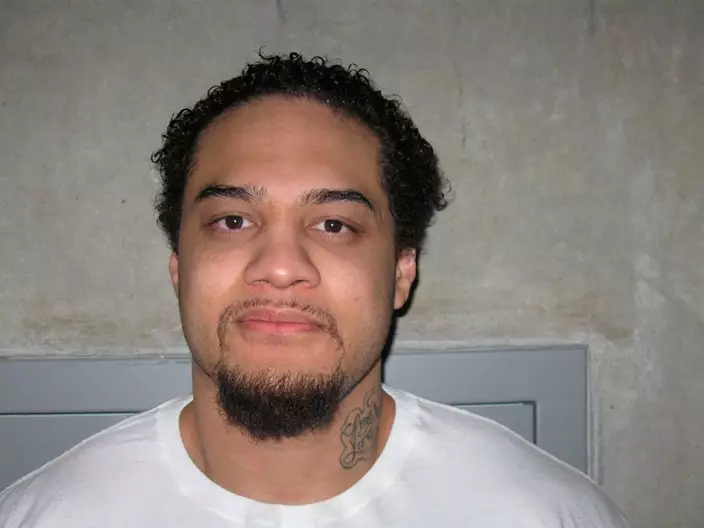
This 2014 photo provided by the Utah Department of Corrections shows Siale Angilau. Dramatic video released Monday, March 12, 2018, shows a U.S. marshal firing four times at close range at Angilau inside a Utah federal courthouse after he rushed the witness stand, jumped and swung with a pen at a shackled witness who barely backed out of the way. (Utah Department of Corrections via AP)

This 2014 photo provided by the Utah Department of Corrections shows Siale Angilau. Dramatic video released Monday, March 12, 2018, shows a U.S. marshal firing four times at close range at Angilau inside a Utah federal courthouse after he rushed the witness stand, jumped and swung with a pen at a shackled witness who barely backed out of the way. (Utah Department of Corrections via AP)

The 24-second footage from the 2014 gang-related racketeering trial was released after a media coalition including The Associated Press argued it was a public record in an important police use-of-force case.

The video shows defendant Siale Angilau, a 25-year-old member of the Tongan Crip gang, calmly rising from his seat beside his attorney during the witness testimony and grabbing his lawyer's pen.

As someone yells, "whoa, whoa, whoa" but before any officers could react, Angilau sprinted toward the witness and leaped with his right arm cocked overhead with the pen in hand.

The man jumped back to avoid being hit as Angilau fell feet-first over the front of the witness stand.

That's when the unidentified U.S. marshal shot Angilau four times.
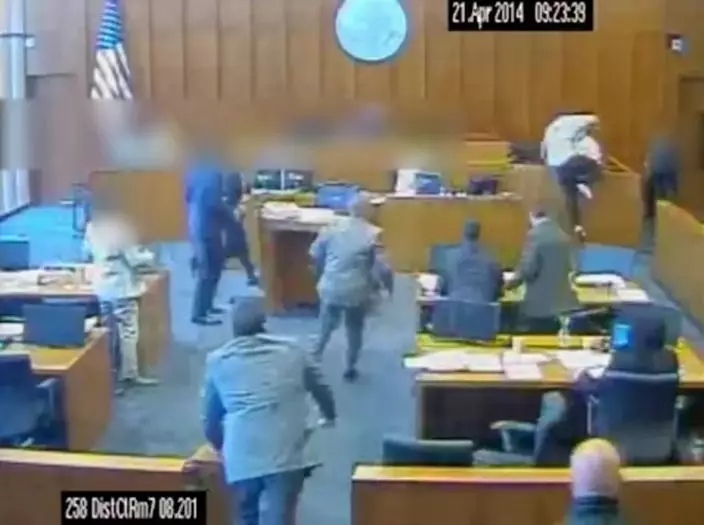
A woman cried out in horror while other law enforcement in suits ran toward the witness stand. Angilau's defense attorney jumped under a desk while prosecutors stood in shock.

A bailiff swiftly moved to block the entrance to the front of the court and pointed at people in the gallery and told them to stay still with his right hand on his holstered weapon.

"Get on the ground," someone yelled in the direction of Angilau.

"Drop the pen. Drop the pen out of your hand," yelled an officer standing over Angilau.

As U.S. District Judge Tena Campbell was escorted out of the courtroom, someone called 911 at the end of the released video.

The unidentified U.S. marshal was cleared of any wrongdoing shortly after the shooting. Lynzey Donahue, a spokeswoman for the Marshals Service, said in a statement the video "demonstrates how quickly violence can erupt, in any situation." She said the FBI cleared the officer of any wrongdoing and that a review board found the use of force was within agency policy.

Donahue also pointed to a ruling Friday from U.S. District Judge John Dowdell when he dismissed the Angilau's family's wrongful death suit, citing the video as proof that the U.S. marshal who is referred to as Jane Doe in his ruling acted reasonably. The family argued Angilau only had a pen and the four shots fired were excessive.

"Having carefully reviewed the video of Mr. Angilau's swift flight from counsel table, his vault over the witness stand with pen in hand, and his attempt to violently attack the shackled witness, the court has little difficulty determining that (Jane) Doe's use of force to immediately stop Angilau's attack was objectively reasonable under the totality of the circumstances," Dowdell wrote.

The Angilau family attorney, Bob Skyes, offers a contradictory point of view. He said the video shows that the marshal "panicked" and should have used other methods to subdue Angilau. He points out that Angilau was already down on the ground for the final three shots and that a courtroom full of officers could have stopped him to stop him before he harmed anyone with the pen.

"There was no need to use deadly force," Sykes said. "They weren't entitled to use the death penalty on him for an assault."

Sykes said the Angilau family hasn't decided if they'll appeal the ruling throwing out the wrongful death lawsuit.

Angilau was one of 17 people named in a 2010 indictment accusing Tongan Crip members of assault, conspiracy, robbery and weapons offenses. He was the last defendant in the case to stand trial, with previous defendants being sentenced to 10 to 30 years in prison.

A mistrial was declared after the shooting.

The Department of Justice wanted the video kept under seal over concerns it could lead to retaliatory gang violence. Faces of the judge, attorneys and jurors are blurred out. The agency declined comment Monday about the release of the video.

The media coalition including the AP fought for several years with government attorneys to have the video released publicly, arguing that the shooting raised questions about police use of force and upholding the principle of open courts.

Department of Justice attorneys said the media organizations wanted the video to "sell newspapers."
DUBAI, United Arab Emirates (AP) — Iran's top diplomat insisted Sunday that Tehran's strength came from its ability to “say no to the great powers," striking a maximalist position just after negotiations with the United States over its nuclear program and in the wake of nationwide protests.

Foreign Minister Abbas Araghchi, speaking to diplomats at a summit in Tehran, signaled that Iran would stick to its position that it must be able to enrich uranium — a major point of contention with President Donald Trump, who bombed Iranian atomic sites in June during the 12-day Iran-Israel war.

While Iranian President Masoud Pezeshkian praised the talks Friday in Oman with the Americans as “a step forward,” Araghchi's remarks show the challenge ahead. Already, the U.S. moved the aircraft carrier USS Abraham Lincoln, ships and warplanes to the Middle East to pressure Iran into an agreement and have the firepower necessary to strike the Islamic Republic should Trump choose to do so.

“I believe the secret of the Islamic Republic of Iran’s power lies in its ability to stand against bullying, domination and pressures from others," Araghchi said. "They fear our atomic bomb, while we are not pursuing an atomic bomb. Our atomic bomb is the power to say no to the great powers. The secret of the Islamic Republic’s power is in the power to say no to the powers.”

Araghchi's choice to explicitly use an “atomic bomb” as a rhetorical device likely wasn't accidental. While Iran has long maintained its nuclear program is peaceful, the West and the International Atomic Energy Agency say Tehran had an organized military program to seek the bomb up until 2003.

Iran had been enriching uranium up to 60% purity, a short, technical step to weapons-grade levels of 90%, the only non-weapons state to do so. Iranian officials in recent years had also been increasingly threatening that the Islamic Republic could seek the bomb, even while its diplomats have pointed to Iranian Supreme Leader Ayatollah Ali Khamenei’s preachings as a binding fatwa, or religious edict, that Iran wouldn’t build one.

Pezeshkian, who ordered Araghchi to pursue talks with the Americans after likely getting Khamenei's blessing, also wrote on X on Sunday about the talks.

“The Iran-U.S. talks, held through the follow-up efforts of friendly governments in the region, were a step forward,” the president wrote. “Dialogue has always been our strategy for peaceful resolution. ... The Iranian nation has always responded to respect with respect, but it does not tolerate the language of force.”

It remains unclear when and where, or if, there will be a second round of talks. Trump, after the talks Friday, offered few details but said: “Iran looks like they want to make a deal very badly — as they should.”

During Friday's talks, U.S. Navy Adm. Brad Cooper, the head of the American military's Central Command, was in Oman. Cooper's presence was likely an intentional reminder to Iran about the U.S. military presence in the region. Cooper later accompanied U.S. special envoy Steve Witkoff and Jared Kushner, Trump's son-in-law, to the Lincoln out in the Arabian Sea after the indirect negotiations.

Araghchi appeared to be taking the threat of an American military strike seriously, as many worried Iranians have in recent weeks. He noted that after multiple rounds of talks last year, the U.S. “attacked us in the midst of negotiations."

“If you take a step back (in negotiations), it is not clear up to where it will go,” Araghchi said.

FILE - Iranian Foreign Minister Abbas Araghchi listens to a question in a joint press briefing with his Omani counterpart Sayyid Badr Albusaidi after their meeting in Tehran, Iran, Monday, Dec. 30, 2024. (AP Photo/Vahid Salemi,File)

FILE - Iranian Foreign Minister Abbas Araghchi listens to a question in a joint press briefing with his Omani counterpart Sayyid Badr Albusaidi after their meeting in Tehran, Iran, Monday, Dec. 30, 2024. (AP Photo/Vahid Salemi,File)

Recommended Articles