COPENHAGEN, Denmark (AP) — The makers of mobile apps designed to help shoppers identify and boycott American goods say they saw a surge of interest in Denmark and beyond after the recent flare-up in tensions over U.S. President Donald Trump's designs on Greenland.
The creator of the “Made O’Meter” app, Ian Rosenfeldt, said he saw around 30,000 downloads of the free app in just three days at the height of the trans-Atlantic diplomatic crisis in late January out of more than 100,000 since it was launched in March.
Click to Gallery
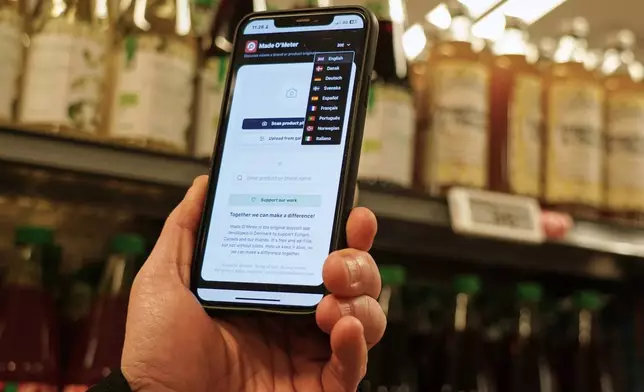
Ian Rosenfeldt, the creator of "Made O'Meter" mobile app, demonstrates how shoppers can use the application in different languages to identify and boycott American goods in a grocery store in Copenhagen, Wednesday, Jan. 28, 2026. (AP Photo/James Brooks)

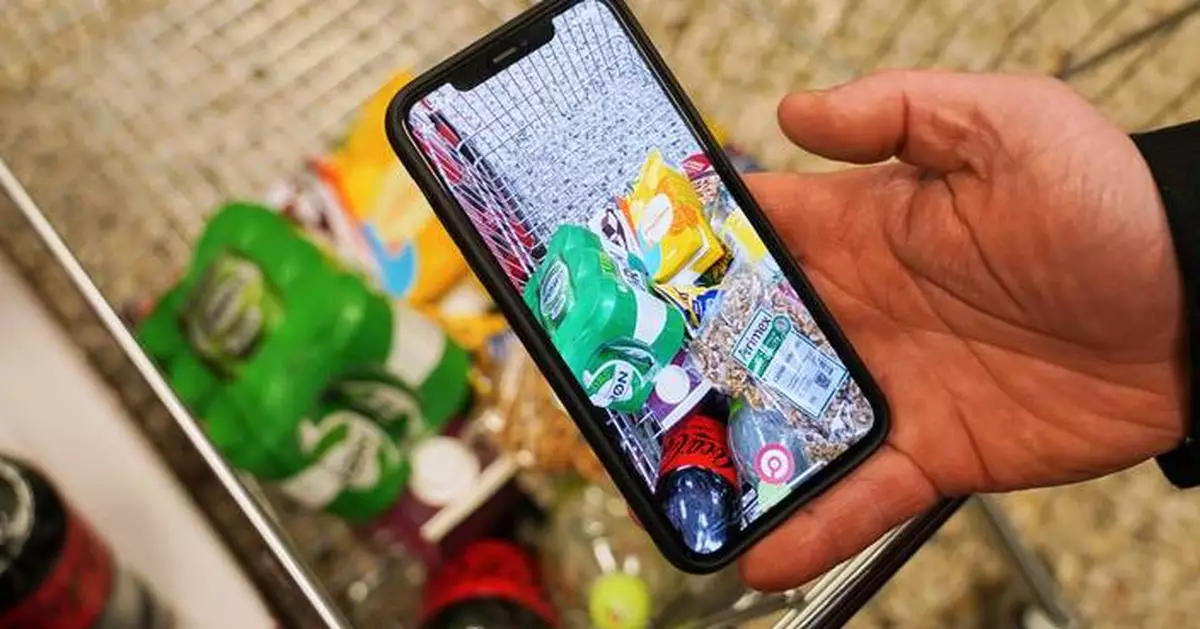
Ian Rosenfeldt, the creator of "Made O'Meter" mobile app, demonstrates how shoppers can use the application to identify and boycott American goods in a grocery store in Copenhagen, Wednesday, Jan. 28, 2026. (AP Photo/James Brooks)

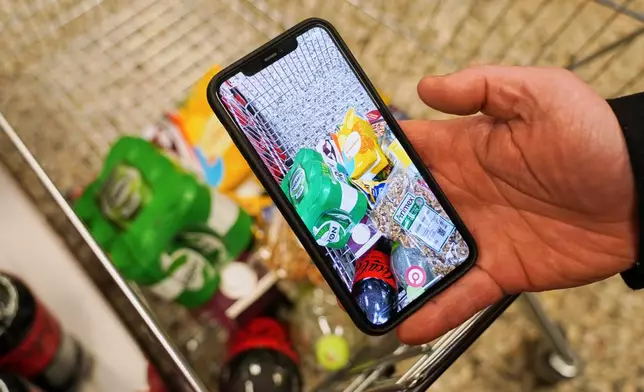
The mobile app "Made O'Meter", developed to help shoppers to identify and boycott American goods, is shown on a smartphone in a grocery store in Copenhagen, Wednesday, Jan. 28, 2026. (AP Photo/James Brooks)
Rosenfeldt, who lives in Copenhagen and works in digital marketing, decided to create the app a year ago after joining a Facebook group of like-minded Danes hoping to boycott U.S. goods.
“Many people were frustrated and thinking, ‘How do we actually do this in practical terms,’” the 53-year-old recalled. “If you use a bar code scanner, it’s difficult to see if a product is actually American or not, if it’s Danish or not. And if you don’t know that, you can’t really make a conscious choice.”
The latest version of “Made O’Meter” uses artificial intelligence to identify and analyze several products at a time, then recommend similar European-made alternatives. Users can set preferences, like “No USA-owned brands” or “Only EU-based brands.” The app claims over 95% accuracy.
“By using artificial intelligence, you can take an image of a product … and it can make a deep dive to go out and find the correct information about the product in many levels,” Rosenfeldt told The Associated Press during a demonstration at a Copenhagen grocery store. “This way, you have information that you can use to take decisions on what you think is right.”
After an initial surge of downloads when the app was launched, usage tailed off. Until last month, when Trump stepped up his rhetoric about the need for the U.S. to acquire Greenland, a strategically important and mineral-rich Arctic island that is a semiautonomous territory of Denmark.
Usage peaked Jan. 23, when there were almost 40,000 scans in one day, compared with 500 or so daily last summer. It has dropped back since but there were still around 5,000 a day this week, said Rosenfeldt, who noted “Made O’Meter” is used by over 20,000 people in Denmark but also by people in Germany, Spain, Italy, even Venezuela.
“It’s become much more personal,” said Rosenfeldt, who spoke of “losing an ally and a friend.”
Trump announced in January he would slap new tariffs on Denmark and seven other European countries that opposed his takeover calls, only to abruptly drop his threats after he said a “framework” for a deal over access to mineral-rich Greenland was reached with NATO Secretary-General Mark Rutte’s help. Few details of that agreement have emerged.
The U.S. began technical talks in late January to put together an Arctic security deal with Denmark and Greenland, which say sovereignty is not negotiable.
Rosenfeldt knows such boycotts won’t damage the U.S. economy, but hopes to send a message to supermarkets and encourage greater reliance on European producers.
“Maybe we can send a signal and people will listen and we can make a change,” he added.
Another Danish app, “NonUSA,” topped 100,000 downloads at the beginning of February. One of its creators, 21-year-old Jonas Pipper, said there were over 25,000 downloads Jan. 21, when 526 product scans were performed in a minute at one point. Of the users, some 46,000 are in Denmark and around 10,000 in Germany.
“We noticed some users saying they felt like a little bit of the pressure was lifted off them,” Pipper said. “They feel like they kind of gained the power back in this situation.”
It's questionable whether such apps will have much practical effect.
Christina Gravert, an associate professor of economics at the University of Copenhagen, said there are actually few U.S. products on Danish grocery store shelves, “around 1 to 3%”. Nuts, wines and candy, for example. But there is widespread use of American technology in Denmark, from Apple iPhones to Microsoft Office tools.
“If you really want to have an impact, that’s where you should start,” she said.
Even “Made O’Meter” and “NonUSA” are downloaded from Apple’s App Store and Google’s Play Store.
Gravert, who specializes in behavioral economics, said such boycott campaigns are usually short-lived and real change often requires an organized effort rather than individual consumers.
“It can be interesting for big supermarket brands to say, OK, we’re not going to carry these products anymore because consumers don’t want to buy them,” she said. “If you think about large companies, this might have some type of impact on the import (they) do.”
On a recent morning, shoppers leaving one Copenhagen grocery store were divided.
“We do boycott, but we don’t know all the American goods. So, it’s mostly the well-known trademarks,” said Morten Nielsen, 68, a retired navy officer. “It’s a personal feeling … we feel we do something, I know we are not doing very much."
“I love America, I love traveling in America,” said 63-year-old retiree Charlotte Fuglsang. “I don’t think we should protest that way.”
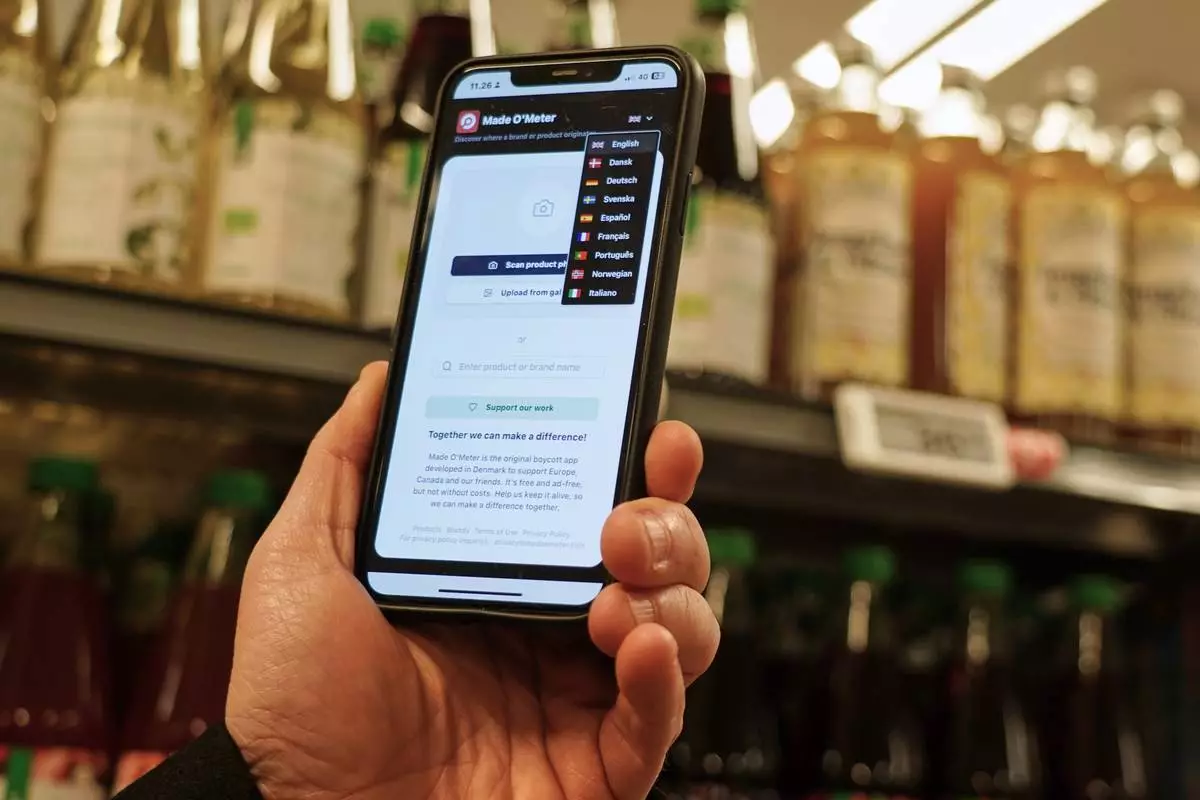
Ian Rosenfeldt, the creator of "Made O'Meter" mobile app, demonstrates how shoppers can use the application in different languages to identify and boycott American goods in a grocery store in Copenhagen, Wednesday, Jan. 28, 2026. (AP Photo/James Brooks)

Ian Rosenfeldt, the creator of "Made O'Meter" mobile app, demonstrates how shoppers can use the application to identify and boycott American goods in a grocery store in Copenhagen, Wednesday, Jan. 28, 2026. (AP Photo/James Brooks)

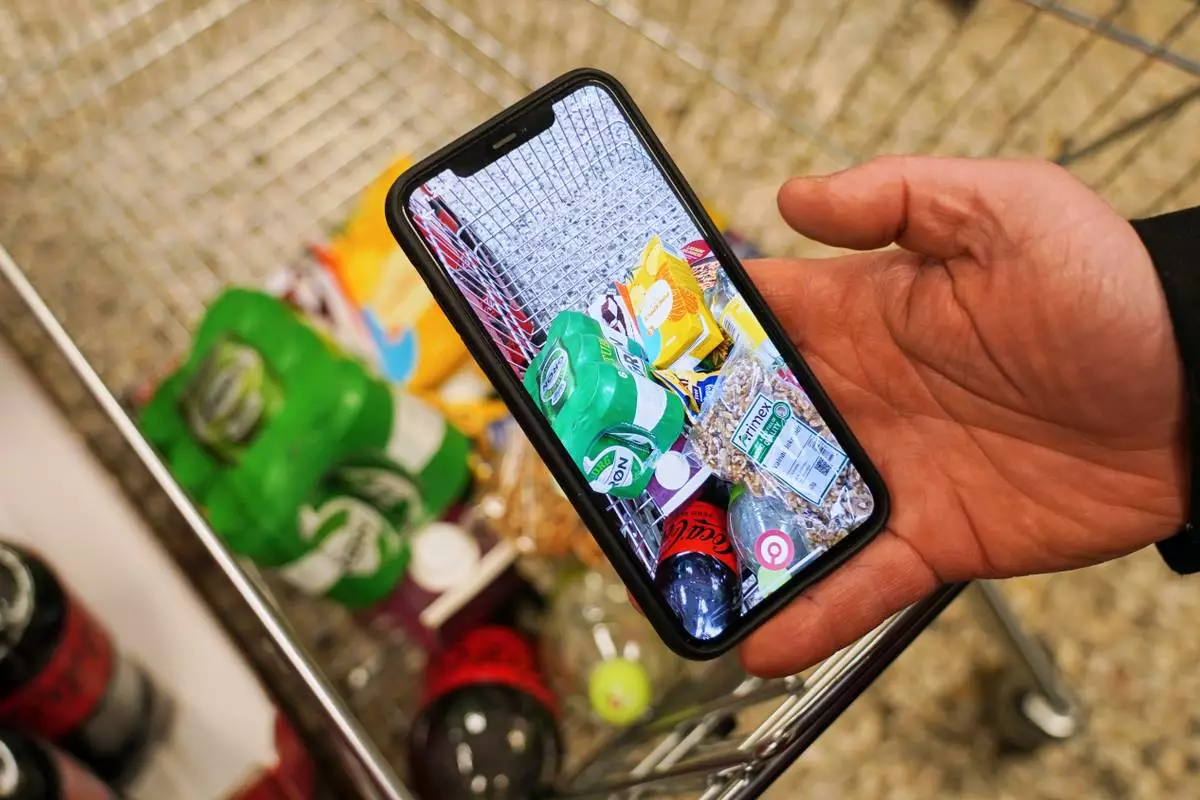
The mobile app "Made O'Meter", developed to help shoppers to identify and boycott American goods, is shown on a smartphone in a grocery store in Copenhagen, Wednesday, Jan. 28, 2026. (AP Photo/James Brooks)

CAIRO (AP) — U.S. President Donald Trump's appeal to China, France, Japan, South Korea, Britain and others to send warships to keep the Strait of Hormuz “open and safe” brought no commitments on Sunday as oil prices soar during the Iran war.
Iran's Foreign Minister Abbas Araghchi told CBS that Tehran has been “approached by a number of countries” seeking safe passage for their vessels, “and this is up to our military to decide.” He said a group of vessels from “different countries” had been allowed to pass, without providing details.
Iran has said the strait, through which one-fifth of global oil exports normally pass, is open to all except the United States and its allies.
Araghchi added that “we don’t see any reason why we should talk with Americans” about finding a way to end the war, noting that Israel and the U.S. started the fighting with coordinated attacks on Feb. 28 during indirect U.S.-Iran talks on Iran's nuclear program. He also said Tehran had “no plan to recover” the enriched uranium that is under rubble following U.S. and Israeli attacks last year.
U.S. Energy Secretary Chris Wright told NBC he has been “in dialogue” with some of the countries Trump mentioned, and said he expected China “will be a constructive partner” in reopening the strait.
But countries made no promises.
Britain said Prime Minister Keir Starmer on Sunday discussed with Trump the importance of reopening the strait "to end the disruption to global shipping,” and spoke with Canada’s prime minister about it separately.
A spokesperson for China’s embassy to the U.S., Liu Pengyu, said “all parties have the responsibility to ensure stable and unimpeded energy supply” and that China would “strengthen communication with relevant parties” for de-escalation.
South Korea’s Foreign Ministry said it “takes note” of Trump’s call and that it “will closely coordinate and carefully review” the situation with the U.S.
Expectations are high that Trump will ask Japan directly when Prime Minister Sanae Takaichi meets him on Thursday at the White House.
France previously said it is working with countries — President Emmanuel Macron mentioned partners in Europe, India and Asia — on a possible international mission to escort ships through the strait but has stressed it must be when “the circumstances permit,” when fighting has subsided.
Foreign Minister Johann Wadephul of Germany, which was not mentioned in Trump's call, told ARD television: “Will we soon be an active part of this conflict? No.”
Meanwhile, emergency oil stocks “will soon start flowing to global markets,” the International Energy Agency said Sunday, describing the collective action to lower prices “by far the largest ever.”
It updated last week’s announcement of 400 million barrels to nearly 412 million. Asian member countries plan to release stocks “immediately,” and reserves from Europe and the Americas will be released “from the end of March.”
Gulf Arab states including Saudi Arabia, Kuwait and Bahrain reported new missile or drone attacks a day after Iran called for the evacuation of three major ports in the United Arab Emirates — the first time it has threatened a neighboring country’s non-U.S. assets.
Tehran has accused the U.S. of launching Friday's strikes on Kharg Island, home to Iran’s primary oil terminal, from the UAE, without providing evidence. It has threatened to attack U.S.-linked “oil, economic and energy infrastructures” if its oil infrastructure is hit.
U.S. Central Command said it had no response to Iran’s claim, and Anwar Gargash, a diplomatic adviser to the UAE president, rejected it. Gulf countries that host U.S. bases have denied allowing their land or airspace to be used for military operations against Iran.
Iran has fired hundreds of missiles and drones at Arab Gulf neighbors during the war, causing significant damage and rattling economies even as most are intercepted. Tehran says it targets U.S. assets, even as Iranian strikes are reported at civilian sites such as airports and oil fields.
Iranian strikes have killed at least a dozen civilians in Gulf countries, most of them migrant workers.
In Iran, the International Committee for the Red Cross said more than 1,300 people have been killed. Iran’s Health Ministry said 223 women and 202 children are among the dead, according to Mizan, the judiciary’s official news agency.
Iran’s government on Sunday showed journalists buildings damaged by strikes in Tehran on Friday. A police station was hit and surrounding buildings were damaged. Some apartments’ outer walls had been stripped away.
“God had mercy on all of us,” said Elham Movagghari, a resident. Other Iranians are leaving the country.
In Israel, 12 people have been killed by Iranian missile fire and more have been injured, including three on Sunday. At least 13 U.S. military members have been killed, six in a plane crash in Iraq last week.
At least 820 people have been killed in Lebanon, according to its Health Ministry, since Iran-backed Hezbollah hit Israel and Israel responded with strikes and sent additional troops into southern Lebanon. In just 10 days, more than 800,000 people — nearly one out of every seven residents of Lebanon — have been displaced.
Israel’s military said early Monday that Iran launched missiles toward Israel.
Earlier, several strikes hit central Israel and the Tel Aviv area, where they caused damage at 23 sites and sparked a small fire. Magen David Adom, Israel’s rescue service, released video showing a large crater in a street and shrapnel damage to an apartment building.
Israel’s military says Iran is firing cluster bombs that can evade some air defenses and scatter submunitions across multiple locations.
Metz reported from Ramallah, West Bank, Frankel from Jerusalem and Anna from Lowville, New York. Associated Press journalists Sally Abou AlJoud and Fadi Tawil in Beirut, John Leicester in Paris, Christopher Weber in Los Angeles, and Fatima Hussein and Tia Goldenberg in Washington contributed to this report.
This version corrects to say Araghchi was speaking to CBS, not NBC as previously reported.
People walk past tents sheltering people displaced by Israeli airstrikes at a public space along the Beirut waterfront at sunset in Beirut, Lebanon, Sunday, March 15, 2026. (AP Photo/Hassan Ammar)
People gather outside an apartment building damaged by an Iranian missile strike in Bnei Brak, Israel, Sunday, March 15, 2026. (AP Photo/Oded Balilty)
People shout slogans during an anti U.S. and Israeli rally outside the U.S. consulate in Istanbul, Turkey, Sunday, March 15, 2026. The sign reads in Turkish: "Leave NATO, close the bases." (AP Photo/Emrah Gurel)
Heavy rain falls over tents sheltering people displaced by Israeli airstrikes in southern Lebanon and Dahiyeh, Beirut's southern suburbs, along the Beirut waterfront in Beirut, Lebanon, Sunday, March 15, 2026. (AP Photo/Hassan Ammar)
Israeli air defense system fires to intercept missiles during an Iranian attack over Tel Aviv, Israel, early Sunday, March 15, 2026. (AP Photo/Ohad Zwigenberg)
Volunteers clean debris from a residential building damaged when a nearby police station was hit Friday in a U.S.-Israeli strike in Tehran, Iran, Sunday, March 15, 2026. (AP Photo/Vahid Salemi)
A cargo ship sails in the Arabian Gulf towards Strait of Hormuz in United Arab Emirates, Sunday, March 15, 2026. (AP Photo/Altaf Qadri)
Firefighters extinguish fire at a site damaged during an Iranian missile strike in Tel Aviv, Israel, Sunday, March 15, 2026. (AP Photo/Ohad Zwigenberg)
Volunteers clean debris from a residential building damaged when a nearby police station was hit Friday in a U.S.-Israeli strike in Tehran, Iran, Sunday, March 15, 2026. (AP Photo/Vahid Salemi)
Home Front Command officer works at an apartment damaged after an Iranian strike in Bnei Brak, Israel, Sunday, March 15, 2026. (AP Photo/Oded Balilty)
Smoke rises from the rubble of buildings destroyed in an Israeli airstrike in Dahiyeh, Beirut's southern suburbs, Lebanon, Sunday, March 15, 2026. (AP Photo/Hassan Ammar)
A man photographs the rubble of buildings destroyed in an Israeli airstrike in Dahiyeh, Beirut's southern suburbs, Lebanon, Sunday, March 15, 2026. (AP Photo/Hassan Ammar)
Israeli air defense system fires to intercept missiles during an Iranian attack over Tel Aviv, Israel, early Sunday, March 15, 2026. (AP Photo/Ohad Zwigenberg)
Smoke rises from the U.S. embassy building in Baghdad, Iraq, Saturday, March 14, 2026. (AP Photo/Ali Jabar)
Mourners react during the funeral ceremony for Gen. Ali Shamkhani, secretary of Iran's Defense Council and a senior adviser to the Supreme Leader who was killed in a strike, at the courtyard of the Imamzadeh Saleh shrine in Tehran, Iran, Saturday, March 14, 2026. (AP Photo/Vahid Salemi)
Two men ride their motorbike past a billboard of the Iranian Supreme Leader Ayatollah Mojtaba Khamenei in downtown Tehran, Iran, Saturday, March 14, 2026. (AP Photo/Vahid Salemi)
Fire and plumes of smoke rise from an oil facility in Fujairah, United Arab Emirates, Saturday, March 14, 2026. (AP Photo/Altaf Qadri)
A man chants slogan while the body of Gen. Ali Shamkhani, secretary of Iran's Defense Council and a senior adviser to the Supreme Leader who was killed in a strike, is being buried at the courtyard of the Imamzadeh Saleh shrine in Tehran, Iran, Saturday, March 14, 2026. (AP Photo/Vahid Salemi)