A Pakistani human rights group that has accused the military of widespread abuses as it battles Islamist militants in Pakistan's rugged border region with neighboring Afghanistan has emerged as a force among the country's Pashtun minority, drawing tens of thousands to rallies to protest what it contends is a campaign of intimidation that includes extrajudicial killings and thousands of disappearances and detentions.
The group's charismatic leader, 25-year-old Manzoor Pashteen, has become the face of the country's oppressed Pashtun, charging that in the name of its "war on terror" the military has used indiscriminate force as it hunts for Taliban hideouts in the tribal regions where the Pashtun dominate, imposing collective punishments like bulldozing the homes of family members of suspected militants and punishing entire villages for extremist attacks.
Click to Gallery
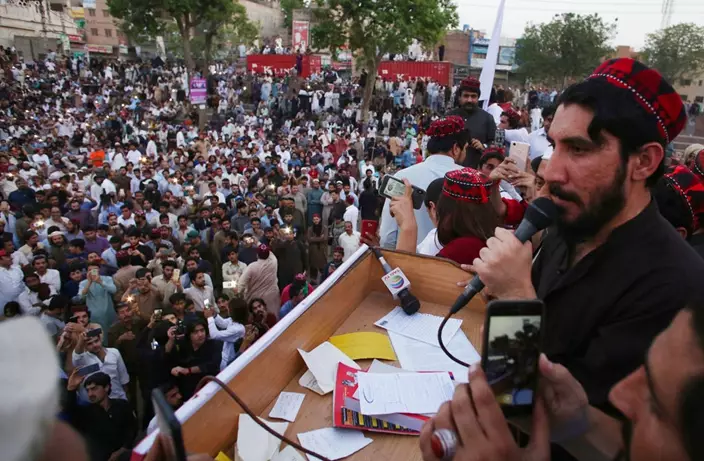
In this Sunday, April 22, 2018 photo, Manzoor Pashteen, a leader of Pashtun Protection Movement addresses his supporters during a rally in Lahore, Pakistan. (AP Photo/K.M. Chaudary)
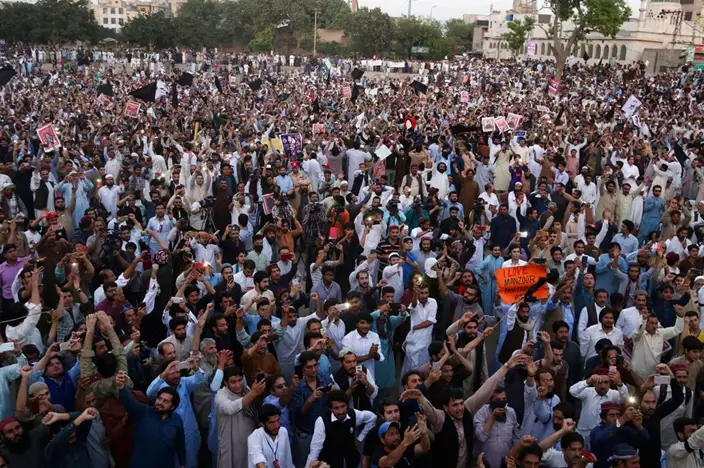
In this Sunday, April 22, 2018 photo, people attend the Pashtun Protection Movement rally in Lahore, Pakistan. A Pakistani rights group in the country's troubled border region has been protesting police brutality, censorship and disappearances, drawing a police campaign against its members and deepening tensions. (AP Photo/K.M. Chaudary)
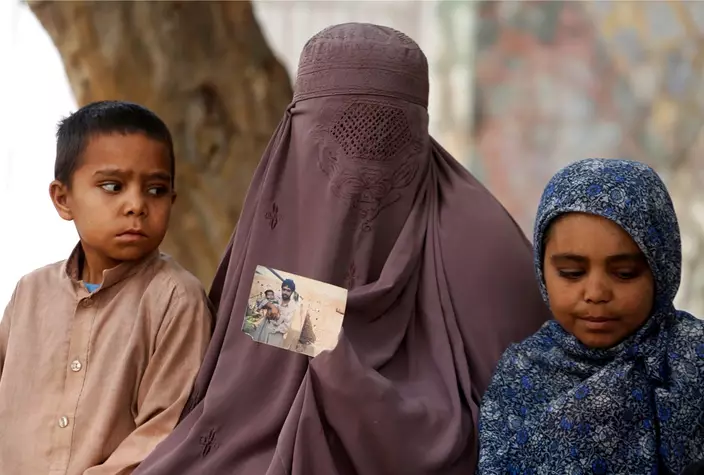
In this Thursday, April 19, 2018 photo, Bashro Bibi, a mother of five shows picture of her missing husband in Peshawar, Pakistan. A Pakistani rights group in the country's troubled border region has been protesting police brutality, censorship and disappearances, drawing a police campaign against its members and deepening tensions.(AP Photo/Muhammad Sajjad)
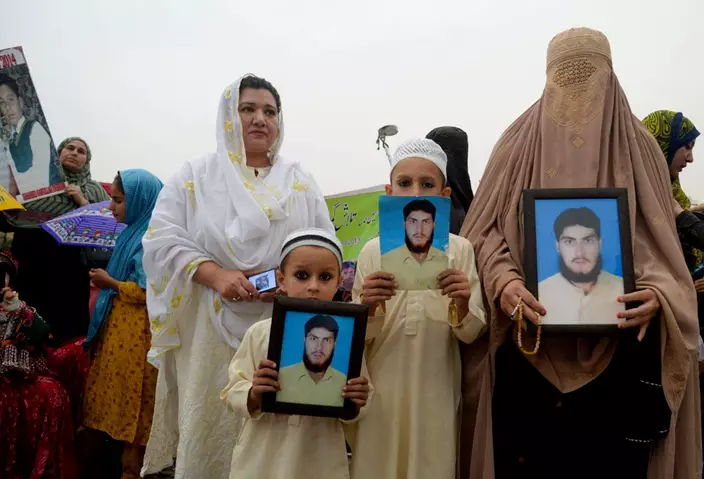
FILE - In this Sunday, April 8, 2018 file photo, a Pashtun family from a Pakistani tribal area display pictures of a missing family member during a Pashtun Protection Movement rally in Peshawar, Pakistan.(AP Photo/Muhammad Sajjad, File)
In this Sunday, April 22, 2018 photo, Manzoor Pashteen, a leader of Pashtun Protection Movement addresses his supporters during a rally in Lahore, Pakistan. (AP Photo/K.M. Chaudary)
The catalyst for the group's creation was the police killing in January of Naqueebullah Mehsud, a 27-year-old ethnic Pashtun and aspiring model who was shot dead in the southern port city of Karachi, where many displaced Pashtuns have relocated after being displaced by the military operations in the tribal regions. The authorities originally said Mehsud fired first during a raid by security forces on a militant hideout, but later acknowledged he was unarmed and had been targeted simply because he was Pashtun.
His death ignited protests by Pashtuns, who accused Pakistan's security forces of racial profiling, seeing all Pashtuns as Taliban simply because many insurgents in Afghanistan and Pakistan are recruited from among Pashtun tribesmen.
In this Sunday, April 22, 2018 photo, people attend the Pashtun Protection Movement rally in Lahore, Pakistan. A Pakistani rights group in the country's troubled border region has been protesting police brutality, censorship and disappearances, drawing a police campaign against its members and deepening tensions. (AP Photo/K.M. Chaudary)
Within weeks what began as a small group of about two dozen had morphed into a popular movement. Known as the Pashtun Protection Movement, it has drawn huge crowds to rallies where Pashteen leads the charge, accusing the military of detaining thousands of Pashtuns in internment camps for months or even years without charges and intimidating residents at the dozens of checkpoints scattered throughout the tribal regions.
Residents, he said, were scared silent, too afraid to criticize the army tactics.
"Punishment is all about sending a message to keep silent," Pashteen told The Associated Press in an interview in Peshawar, the capital of Pakistan's Khyber Pukhtunkhwa province and home to the majority of the country's ethnic Pashtuns. "When we began we were fed up with life, treated like we were not human. One thousand percent we were sure we would be killed."
In this Thursday, April 19, 2018 photo, Bashro Bibi, a mother of five shows picture of her missing husband in Peshawar, Pakistan. A Pakistani rights group in the country's troubled border region has been protesting police brutality, censorship and disappearances, drawing a police campaign against its members and deepening tensions.(AP Photo/Muhammad Sajjad)
Even his father pleaded with him to end his campaign against the military. "He told me that it would be trouble not just for me, but for my family," Pashteen said.
Yet, as his small group of followers took their grievances from the tribal regions to Peshawar and eventually to the capital, Islamabad, "people joined us," he said. "For many years our people have wanted to do something. They were looking for a leader."
Wearing his signature red embroidered cap and a dark, well-kept beard, Pashteen seems an unlikely leader.
Trained as a doctor, he is a pacifist, who refuses — despite prodding from family and friends — to carry a weapon in his car for protection in an area where guns proliferate and are considered a birthright. His protests are peaceful, he said, adding he has just two demands: The establishment of a peace and reconciliation commission to address the grievances of Pashtuns, including extrajudicial killings, and that the thousands of people in detention centers be brought to trial if they are accused of a crime or be released.
FILE - In this Sunday, April 8, 2018 file photo, a Pashtun family from a Pakistani tribal area display pictures of a missing family member during a Pashtun Protection Movement rally in Peshawar, Pakistan.(AP Photo/Muhammad Sajjad, File)
"The military has become a state within a state," Pashteen said.
Public criticism of the army, considered the most powerful institution in Pakistan, is risky and rarely tolerated. At the same time, the ascendency of the Pashtun Protection Movement poses a public relations nightmare for the army at a time when it is ramping up its effort to project success in the tribal areas, claiming to have defeated extremism and boasting that terrorist hideouts have been wiped out.
"The protesters aren't just politely critiquing the military. They're relentlessly assailing it and linking it to terror in ways rarely done before," said Michael Kugleman, deputy director of the Asia Center at the Washington-based Wilson Center. "The protesters, with their focus on indignities and injustices in the tribal areas, are undercutting a narrative the military is trying to project about peace and normalcy returning to the tribal belt after many years of war."
Infuriated by Pashteen's outspoken criticism, the army has accused him of being backed by "foreign powers," a term usually used to refer to neighboring Afghanistan or rival India. The army has also turned its intimidation tactics against his movement, pressuring news organizations throughout the country to ignore it and setting intelligence agents on university professors to try to force them to identify students attending protests. One political analyst was told his weekly column, in which he urged dialogue with Pashteen's movement, could not be published because the newspaper was "under pressure" to remove it.
"The military believes that (if) these protests get any air, they can turn from small fires into massive political conflagrations, so the best tactic is to deprive them of oxygen from the start," said Daniel Markey, director of the Global Policy Program at Johns Hopkins University's School of Advanced International Studies. "And, to be sure, they are operating in a challenging and contentious political climate."
Political chaos has marred much of the last year in Pakistan. Its prime minister was unseated on corruption charges, and handed a lifetime ban from participating in politics. Pashteen's attacks on the military come as Pakistanis prepare to go to the polls later this year and could undermine the army's traditional ability to influence the elections.
"The army tends — also something we've seen before — to want to control or manage political outcomes as much as possible," Markey said.
The journalists' advocacy group, Reporters without Borders, issued a statement last week complaining about the military's efforts to muzzle Pakistan's media and nearly 100 Pakistani journalists signed a petition condemning censorship.
"After a week with several cases of overt press censorship in Pakistan, Reporters Without Borders ... reiterates its solidarity with the country's journalists and deplores the way the military continues to impose its diktat on the media," the statement said. "The latest subject to be placed off limits is the Pashtun (Protection) Movement, which has been organizing protests in defense of Pakistan's Pashtun minority and denouncing human rights violations by the military targeting Pashtuns."
Mosharraf Zaidi, whose column was pulled by a local English language newspaper, said the supporters of Pashteen's movement are mostly young and educated. They have known only war and chaos, he said, and most know or are related to someone who has been killed or taken either by militants or the military.
Zaidi said he had hoped Pashteen's movement "would prompt an honest discussion about our (decades-old) relationship with violent extremism."