French President Emmanuel Macron on Thursday formally recognized the responsibility of the French state in the death of a dissident mathematician in Algeria in 1957, admitting for the first time the French military's "system" that included torture during Algeria's independence war.
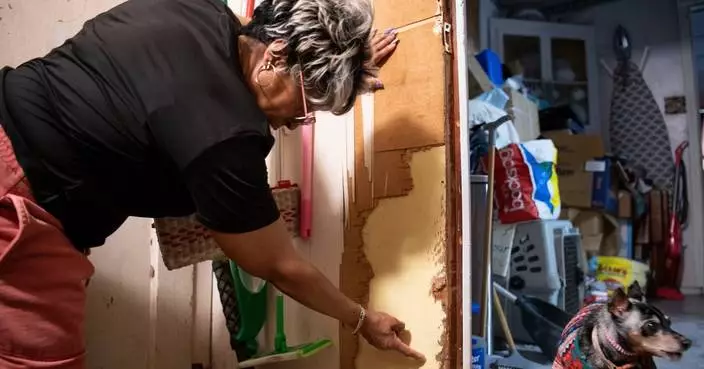
Macron visited on Thursday the 87-year-old widow of Maurice Audin, a French anti-colonial activist who disappeared after his arrest. He asked for her pardon, announced the opening of French archives on the war and expressed hope a new era would dawn for often-bitter French-Algerian relations.
Audin, a French communist mathematician, was arrested in 1957 by the French military during the battle of Algiers. His body has never been recovered, but historians widely believe he was tortured — which Macron acknowledged, a major break with France's official version of the war.
"The only thing I am doing is to acknowledge the truth," Macron told Josette Audin.
Maurice Audin has become the symbol of France's abuses during the brutal war in its former colony that ended with Algeria's independence in 1962. A square in Algiers bears his name and his widow's battle to uncover the truth made his case a cause celebre.
The scars of the seven-year war have yet to heal in Algeria or in France. Unlike other French colonies, Algeria, which France invaded in 1830, was part of the French nation, a colonial jewel.
Both the occupation and the brutality during the war have embittered ties between Algiers and Paris. French authorities did not refer to war at the time, calling the violence, disappearances and bloodshed an "operation of public order."
A declaration Macron gave to Josette Audin during his visit spelled out the method used by French soldiers to legally eliminate people like Audin, who clandestinely worked for the liberation of Algeria from the French.
Security forces were allowed to arrest, detain and interrogate all "suspects" through special powers accorded by parliament to the French Army that gave them carte-blanche to re-establish order.
"This system was the unfortunate ground for acts, sometimes terrible, including torture that the Audin affair has highlighted," the declaration says, adding that it made torture a "weapon considered legitimate."
Torture wasn't punished "because it was conceived as an arm against the FLN" — the National Liberation Front fighting for Algeria's independence — "but also against anyone seen as its allies, militants and partisans of independence."
Historians have long studied the disappearance of Audin and widely concluded he was tortured after his arrest at his home the evening of June 11, 1957.
Macron announced that France will open its archives, telling Audin's widow that "everyone should know the truth."
Macron's predecessor, Francois Hollande, had previously acknowledged that Audin didn't escape — the official version of events until then — but died in jail.
Sylvie Corbet in Paris contributed.
WASHINGTON (AP) — U.S. forces boarded another oil tanker in the Caribbean Sea on Friday, the U.S. military said, as the Trump administration targets sanctioned tankers traveling to and from Venezuela as part of a broader effort to take control of the South American country's oil.
The predawn raid was carried out by Marines and Navy sailors launched from the aircraft carrier USS Gerald R. Ford, part of the extensive force the U.S. has built up in the Caribbean in recent months, according to U.S. Southern Command, which declared “there is no safe haven for criminals” as it announced the seizure of the tanker called the Olina. The Coast Guard then took control of the vessel, officials said.
Southern Command and Homeland Security Secretary Kristi Noem both posted unclassified footage on social media Friday morning of a U.S. helicopter landing on the vessel and U.S. personnel conducting a search of the deck and tossing what appeared to be an explosive device in front of a door leading to inside the ship.
In her post, Noem said the ship was “another ‘ghost fleet’ tanker ship suspected of carrying embargoed oil” and it had departed Venezuela “attempting to evade U.S. forces."
The Olina is the fifth tanker that has been seized by U.S. forces as part of the effort by President Donald Trump’s administration to control the production, refining and global distribution of Venezuela’s oil products, and the third since the U.S. ouster of Venezuela President Nicolás Maduro in a surprise nighttime raid.
In a post on his social media network later in the day, Trump said the seizure was conducted “in coordination with the Interim Authorities of Venezuela” but offered no elaboration.
The White House did not immediately respond to requests for more details.
Venezuela’s government acknowledged in a statement that it was working with U.S. authorities to return the tanker, “which set sail without payment or authorization from the Venezuelan authorities,” to the South American nation.
“Thanks to this first successful joint operation, the ship is sailing back to Venezuelan waters for its protection and relevant actions,” according to the statement.
Samir Madani, co-founder of TankerTrackers.com, said his organization used satellite imagery and surface-level photos to document that at least 16 tankers left the Venezuelan coast in contravention of the quarantine U.S. forces have set up to block sanctioned ships from conducting trade. The Olina was among that flotilla.
U.S. government records show that the Olina was sanctioned for moving Russian oil under its prior name, Minerva M, and flagged in Panama.
While records show the Olina is now flying the flag of Timor-Leste, it is listed in the international shipping registry as having a false flag, meaning the registration it is claiming is not valid. In July, the owner and manager of the ship on its registration was changed to a company in Hong Kong.
According to ship tracking databases, the Olina last transmitted its location in November in the Caribbean, north of the Venezuelan coast. Since then, however, the ship has been running dark with its location beacon turned off.
While Noem and the military framed the seizure as part of an effort to enforce the law, other officials in the Trump administration have made clear they see it as a way to generate cash as they seek to rebuild Venezuela's battered oil industry and restore its economy.
In an early morning social media post, Trump said the U.S. and Venezuela “are working well together, especially as it pertains to rebuilding, in a much bigger, better, and more modern form, their oil and gas infrastructure.”
The administration said it expects to sell 30 million to 50 million barrels of sanctioned Venezuelan oil, with the proceeds to go to both the U.S. and Venezuelan people. But the president expects the arrangement to continue indefinitely. He met Friday with executives from oil companies to discuss his goal of investing $100 billion in Venezuela to repair and upgrade its oil production and distribution.
Vice President JD Vance told Fox News this week that the U.S. can “control” Venezuela’s “purse strings” by dictating where its oil can be sold.
Madani estimated that the Olina is loaded with 707,000 barrels of oil, which at the current market price of about $60 a barrel would be worth more than $42 million.
Associated Press writers Dánica Coto in San Juan, Puerto Rico, Josh Boak in Washington, and Regina Garcia Cano in Caracas, Venezuela, contributed to this report.
This story has been corrected to reflect that the United States has seized three tankers, not five, since Nicolás Maduro was ousted as Venezuela’s president.
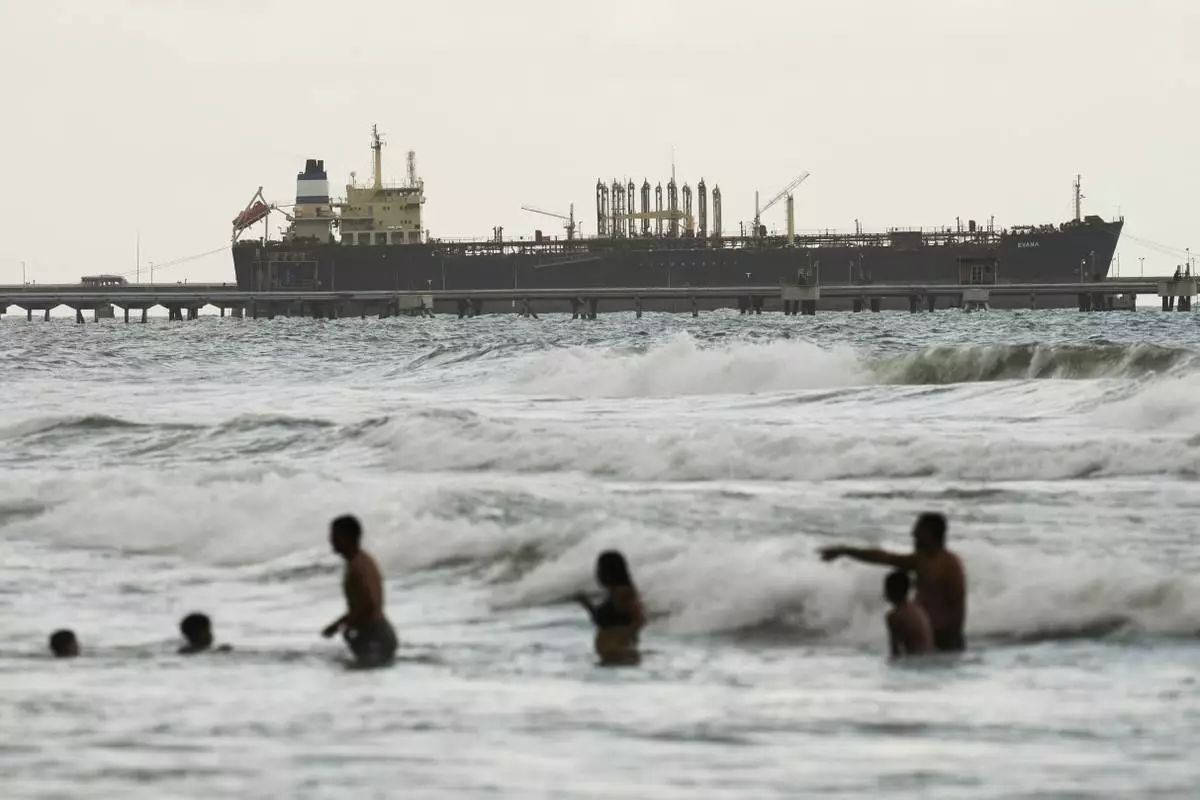
FILE - Evana, an oil tanker, is docked at El Palito Port in Puerto Cabello, Venezuela, Dec. 21, 2025. The U.S. military says U.S. forces have boarded another oil tanker in the Caribbean Sea. The Olina is the fifth tanker seized by U.S. forces. (AP Photo/Matias Delacroix, File)